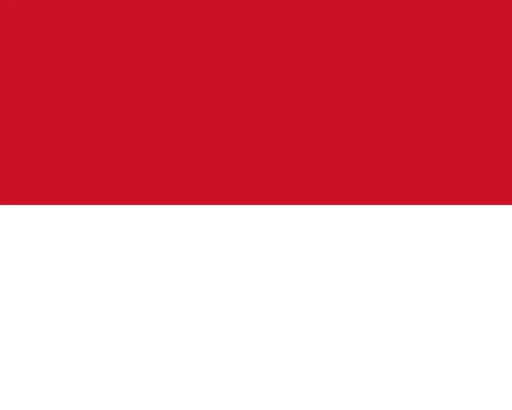
The Flag of Monaco
Principality of Monaco
The flag of Monaco is two horizontal bands of equal size, red on top and white below. The colors are the heraldic colors of the House of Grimaldi, which has ruled Monaco since the 13th century.
At first glance the flag of Monaco looks almost indistinguishable from Indonesia's: a horizontal bicolor of red over white. Yet Monaco's carries one of the oldest unbroken heraldic lineages in Europe, tied to the Grimaldi dynasty that has ruled the principality for over seven centuries. The two colors are not a design choice at all. They are a medieval family's shield, still flying.
Seven centuries of the same two colors
Most national flags are products of revolution, independence movements, or 20th-century nation-building. Monaco's is different. Its red and white trace back to the coat of arms of the House of Grimaldi, established in the 13th century, making it one of the oldest continuously used heraldic identities on the planet.
The founding story is irresistible. In 1297, François Grimaldi captured the Rock of Monaco by disguising himself as a Franciscan monk, smuggling a sword beneath his robes and opening the fortress gates to his soldiers. That act of audacious deception launched a dynasty. The red and white lozenges, diamond-shaped patterns on the Grimaldi arms, have been associated with the family ever since. Those same tinctures, gules (red) and argent (white or silver) in heraldic language, became inseparable from Monegasque identity itself.
The formal adoption of the current bicolor flag in its modern rectangular form came in 1881 under Prince Charles III. But calling that the flag's "origin" would be misleading. The colors had already represented the Grimaldis for nearly six hundred years by that point. What happened in 1881 was standardization, not invention.
This continuity is extraordinary when you consider the context. France redesigned its tricolor multiple times. Italy's flag didn't exist before the late 18th century. Germany's has changed with almost every regime. Monaco simply kept going. The Grimaldi coat of arms, with its fusilly pattern of red and white lozenges, translates directly into the flag's two-color scheme. In most countries, the national flag and the ruling family's heraldry are separate things. In Monaco, they're essentially the same, connecting sovereign identity to national identity in an unusually literal way.
Red over white
The design couldn't be simpler. The upper half is red, the lower half white. No stars, no crescents, no coat of arms, no inscription. Just two bands of color in a near-square format with an aspect ratio of 4:5, making it one of the few national flags that's almost as tall as it is wide.
That simplicity is intentional. The civil flag preserves the heraldic clarity of the Grimaldi tinctures without embellishment.
The colors correspond precisely to heraldic terminology: gules for the red, argent for the white. These aren't arbitrary choices or references to landscape and sky. They're pulled straight from a medieval shield. The 4:5 ratio is sometimes rendered as 2:3 in practice, particularly in informal international displays, which blurs one of the few visual differences between Monaco's flag and Indonesia's. More on that shortly.
Monaco does maintain a state flag variant, used on government buildings and official vessels, which incorporates the full Grimaldi coat of arms centered on the bicolor field. But the plain civil version, two colors and nothing else, is the one most people encounter. It flies over private homes, businesses, and at international events representing the principality.
The Monaco and Indonesia problem
Monaco's civil flag and Indonesia's national flag, the Sang Saka Merah Putih, are virtually identical. Both are horizontal bicolors of red over white, and the resemblance is coincidence rather than influence or copying.
Indonesia's red-and-white color scheme traces back to the Majapahit Empire of the 13th to 15th centuries, a maritime power in Southeast Asia that used a red-and-white banner. Monaco's colors come from the Grimaldi arms, rooted in Genoese heraldry from roughly the same period. Two entirely unrelated medieval traditions produced the same flag, half a world apart.
The confusion has caused real headaches. At the 2004 Olympic Games in Athens, both flags appeared in close proximity during ceremonies, prompting renewed discussion about whether something should be done. Nothing was. Monaco, understandably, has no interest in abandoning colors it's used since the 1200s. The only reliable way to tell them apart is the aspect ratio: Monaco's 4:5 format is slightly squarer than Indonesia's 2:3. In practice, though, that difference is nearly invisible.
They're not alone in this predicament. Chad and Romania share an almost identical tricolor. New Zealand and Australia have long battled over their similar ensigns. These accidental twins reveal something interesting about flag design: with a limited palette of colors and geometric arrangements, duplication is almost inevitable.
The coat of arms and the state flag
The state flag tells a richer story than the civil version ever could. At its center sits the Grimaldi coat of arms: a shield covered in the fusilly pattern of red and white lozenges, supported by two monks holding raised swords. Those monks are a wonderfully self-aware heraldic joke, a direct reference to François Grimaldi's 1297 conquest in disguise. Few national arms so openly celebrate an act of trickery.
Above the shield sits a princely crown, reflecting Monaco's status as one of the world's few remaining sovereign principalities. Below, a ribbon bears the motto "Deo Juvante," meaning "With God's Help." The whole composition is both ornate and surprisingly personal, less a national emblem than a family crest that happens to belong to a country.
The state flag variant appears on government buildings, the Prince's Palace, royal residences, and official state correspondence. It signals sovereign authority, distinguishing official use from the civilian bicolor. Citizens fly the plain red and white; the state flies its arms.
Over the centuries, the coat of arms has undergone minor stylistic adjustments. The monks' robes have been redrawn, the crown reshaped, the lozenge proportions tweaked. Formal standardization occurred primarily in the 19th and 20th centuries. But the core elements, shield, monks, swords, crown, have remained remarkably stable. The arms today would be recognizable to a Grimaldi from five hundred years ago.
Protocol and precedence
Monaco's flag flies over the Prince's Palace on the Rock of Monaco according to strict protocols tied to the sovereign's presence. When the Prince is in residence, the flag is raised; when he departs, it comes down. Visitors to Monaco can glance up at the palace and know immediately whether the head of state is home.
Since joining the United Nations in 1993, Monaco's flag has flown at UN headquarters in New York, making it one of the smallest nations represented among the rows of flags along First Avenue. At just two square kilometers, Monaco is the second-smallest UN member state after Vatican City (which holds only observer status), so its flag at the UN carries an outsized symbolic weight.
Half-mast protocols follow European royal conventions. The flag is lowered on the death of the reigning Prince or senior members of the Grimaldi family, and during periods of national mourning. Monaco doesn't maintain a traditional navy or significant military force, so maritime flag traditions are limited, though vessels registered in Monaco fly the civil ensign in port and at sea.
The flag's biggest moment in the global spotlight comes every May with the Formula 1 Monaco Grand Prix. The race is among the most televised sporting events in the world, which has probably made Monaco's red and white the most recognized microstate flag anywhere. At home, National Day on November 19th and the Feast of Saint Devote on January 27th are the main occasions for public display, when the streets are lined with the bicolor.
References
[1] Palais Princier de Monaco, official website of the Prince's Palace, for flag protocols and state heraldry: https://www.palais.mc
[2] Government of Monaco official portal, for constitutional and civic flag usage: https://www.gouv.mc
[3] Flag Institute (UK), vexillological analysis of Monaco's flag, aspect ratio, and comparisons: https://www.flaginstitute.org
[4] FOTW (Flags of the World), Monaco entry, including historical variants and state flag details: https://www.crwflags.com/fotw/flags/mc.html
[5] Smith, Whitney. Flags Through the Ages and Across the World. McGraw-Hill, 1975. Foundational vexillology reference with Monaco entry.
[6] International Federation of Vexillological Associations (FIAV), standards and documentation on Monaco's flag registration.
[7] United Nations Protocol and Liaison Service, UN flag display standards covering Monaco's membership.
Common questions
- What do the red and white colors on Monaco's flag represent?
- They come straight from the coat of arms of the House of Grimaldi, Monaco's ruling family since 1297. These aren't symbols of nature or political ideals, just the actual colors of a medieval family shield. It's one of the few national flags that's basically a direct copy of heraldry, which is pretty cool.
Featured in these articles
- When Red, White, and Blue Doesn't Mean America: How Indonesia, the Netherlands, and Croatia Share a Palette but Not a Story
- Tricolore Confusion: How Chad and Romania Ended Up With the Exact Same Flag, and Why Neither Will Change It
- Red, White, and Identical: The Indonesia-Monaco-Poland Problem and How Flags Handle Accidental Twins
- Red Over White: How Indonesia, Monaco, and Poland Ended Up Fighting Over the Same Flag
Download this flag
Free in 12 styles, from 32px icons up to 2000px, as SVG, PNG, WebP and JPG.