The Flag of Chad
Republic of Chad
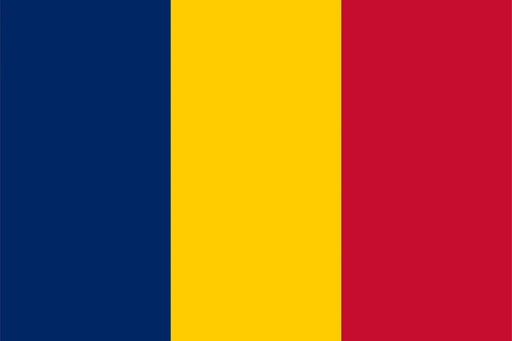
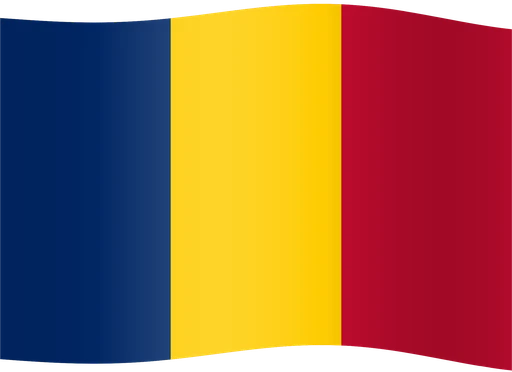
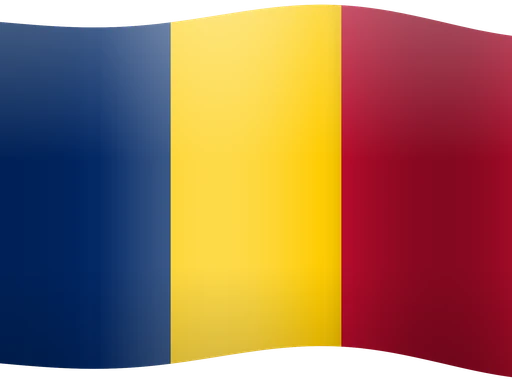
The flag of Chad consists of a vertical tricolor of blue, yellow, and red. The blue symbolizes the sky, hope, and water; the yellow represents the sun and the desert in the north of the country; and the red stands for progress, unity, and the sacrifice of the nation's martyrs. Notably, the flag closely resembles Romania's flag, differing only in the shade of blue used.
The flag of Chad is a vertical tricolor of blue, gold, and red, close enough to Romania's to be the most famous case of two near-identical national flags. It was adopted on November 6, 1959, just before Chad gained full independence from France in 1960, and it mixes the format of the French Tricolore with the pan-African palette. Romania protested formally at the United Nations in 2004. Chad has never altered its design, and the two countries still fly banners almost nobody can tell apart.
Chad, Romania, and an unresolved dispute
Place Chad's flag next to Romania's and you'll struggle to tell them apart. Both are vertical tricolors of blue, yellow, and red, arranged in the same order from hoist to fly. The only measurable difference is the shade of blue: Chad uses a slightly darker indigo (Pantone 281), while Romania opts for a cobalt blue (Pantone 280). In practice, especially on mass-produced flags flapping in the wind, even that distinction vanishes.
Romania's tricolor has deep roots. It dates to the revolutionary movements of 1848 and was re-adopted in December 1989 after the fall of Nicolae Ceaușescu's communist regime, which had placed a socialist coat of arms in the center stripe. Chad's version arrived in 1959, designed during the country's transition from French colonial rule to self-governance. The two flags emerged from completely unrelated historical circumstances, separated by thousands of miles and over a century of political context.
In 2004 Romanian President Ion Iliescu raised the issue at the United Nations and asked Chad to modify its flag. Chad's President Idriss Déby reportedly answered that his country saw no reason to change. Legally there was nothing Romania could do, since no international law governs flag duplication between sovereign states and no body adjudicates color disputes. The matter is still unresolved, and vexillologists cite it as the closest case of two unrelated countries sharing a design.
The flag's origins
Chad was part of French Equatorial Africa for decades, governed from Brazzaville alongside what are now the Central African Republic, Gabon, and the Republic of the Congo. The loi-cadre reforms of 1958 set the stage for self-governance across France's African territories, and with autonomy came the need for national symbols. Chad's Constituent Assembly took up the question of a flag during the drafting of the country's first constitution.
The design they settled on was a compromise. The vertical tricolor format followed France's own Tricolore, which signaled constitutional governance to the international community. The colors broke from it. Where France uses blue, white, and red, Chad put gold in the center stripe, from the pan-African palette that was spreading across the continent as country after country moved toward independence.
Gabriel Lisette, Chad's first prime minister and a leading figure in the Chadian Progressive Party (PPT), guided the selection process alongside other members of the assembly. On November 6, 1959, the flag was formally adopted. It was retained without modification when Chad achieved full independence on August 11, 1960.
Many African countries changed their flags after coups, revolutions, or political realignments. Chad has kept the same one for over six decades, through almost continuous civil conflict since independence.
Reading the colors
If you know Chad's geography you can read the flag as a map turned on its side.
Blue, on the hoist side, is the sky and hope, and also the waters of the south: Lake Chad, the shrinking inland sea that gives the country its name, and the rivers of the Chari-Logone basin that support agriculture in the most fertile region. The specified shade is a deep blue, closer to navy or indigo than a bright primary. That is the one technical difference from Romania's flag, and you would need a Pantone swatch book to confirm it.
Gold, in the center, is the sun and the desert. Northern Chad is dominated by the Sahara and the Sahel, which cover most of the country's landmass.
Red, on the fly side, is sacrifice, meaning the blood shed in the struggle for independence from France, along with national unity and progress.
The scheme is a hybrid. Blue and red come from the French Tricolore, gold from the pan-African tradition. In practice, manufactured flags often print Chad's blue lighter than the official specification, which makes the Romania problem worse.
Protocol and usage
The national flag is enshrined in Article 8 of Chad's constitution and flies at all government buildings, military installations, and diplomatic missions worldwide. Chad's presidential standard incorporates the tricolor with additional embroidered elements, including the national coat of arms.
That coat of arms, featuring a shield with wavy blue and red lines, a rising sun, a goat, and a lion, sometimes appears alongside the flag at official events but isn't incorporated into the flag's design itself. Military flags and ensigns follow the tricolor pattern with unit-specific modifications.
The most prominent displays of the flag occur on Independence Day, August 11, and Republic Day, November 28, when the tricolor appears on buildings, vehicles, and clothing across the country. At international sporting events and diplomatic venues, the Romania similarity has led to documented mix-ups. Flags have been swapped or misidentified at events including the Olympics, a recurring embarrassment that neither country has been able to fully prevent.
The flag through civil war
Since independence Chad has seen nearly continuous conflict. The Chadian Civil War ran from 1965 to 1979, Libya intervened militarily in the 1970s and 1980s, factional warfare continued through the 1990s, and instability has not gone away. The flag never changed.
Rebel factions and political movements have flown their own banners or modified versions of the tricolor, but the national flag has stayed put even when the state looked close to collapse. Libya changed its flag several times under Gaddafi and again after his fall, and the Central African Republic has seen proposed modifications to its own.
After President Idriss Déby was killed in April 2021, a day after winning a sixth term, the Transitional Military Council under his son Mahamat Idriss Déby kept the flag unchanged. Chadians abroad have made it a rallying point at protests and demonstrations in Paris, Brussels, and other cities with sizeable diaspora communities.
Duplicate flags elsewhere
The Chad-Romania question is a staple of vexillological study and pub trivia, and it turns up in nearly every discussion of flag similarities, from academic journals to Reddit threads. Other pairs come close. Monaco and Indonesia share a nearly identical red and white bicolor, and the Netherlands and Luxembourg fly horizontal tricolors that are easily confused. Neither pair is as close as Chad and Romania.
There may be no avoiding this. With nearly 200 sovereign states and a symbolic vocabulary of stripes, stars, crescents, and primary colors, there are only so many ways to arrange a few colors on a rectangle.
Proposals to differentiate Chad's flag, by adding the coat of arms or a star to the center stripe, surface occasionally but have never gained official traction. Chad chose its flag before Romania re-adopted its current version, so neither country has the stronger claim.
References
[1] Constitution of the Republic of Chad (revised 2018), Article 8. Official definition of national symbols and flag specifications.
[2] Smith, Whitney. Flags Through the Ages and Across the World. McGraw-Hill, 1975. Comprehensive vexillological reference covering national flag origins and design histories.
[3] Znamierowski, Alfred. The World Encyclopedia of Flags. Lorenz Books, 2013. Detailed entries on all national flags, including Pantone color specifications and historical context.
[4] Flag Institute (UK). Technical flag specifications and Pantone color references. https://www.flaginstitute.org
[5] Decalo, Samuel. Historical Dictionary of Chad. Scarecrow Press, 1997. Background on Chadian political history, national symbols, and the independence movement.
[6] CRW Flags (Flags of the World). Vexillological database with historical flag variants and expert commentary. https://www.crwflags.com
[7] Official Journal of the Republic of Chad (Journal Officiel), November 1959. Original records of flag adoption by the Constituent Assembly.
Common questions
- Why does Chad's flag resemble Romania's?
- Chad and Romania have similar flags because both feature vertical stripes of blue, yellow, and red. This similarity is purely coincidental, as each country chose its design independently. Chad's flag has a slightly darker shade of blue for distinction.
- What do the colors on Chad's flag mean?
- The colors on Chad's flag have specific meanings: blue represents the sky and water, yellow symbolizes the sun and desert, and red stands for sacrifice and unity. While commonly accepted, these interpretations aren't officially documented.
Featured in these articles
- Stripes That Tell the Wrong Story: How the Horizontal Band Became the Default, and What Countries Lost When They Copied It
- The Coat of Arms Trap: Why Belize, Moldova, and Paraguay Put Encyclopedias on Their Flags, and Whether It Works
- The Sun With a Face: How an Inca Deity Became the Shared Soul of Two South American Flags
- Tricolore Confusion: How Chad and Romania Ended Up With the Exact Same Flag, and Why Neither Will Change It
Download this flag
Free in 12 styles, from 32px icons up to 2000px, as SVG, PNG, WebP and JPG.