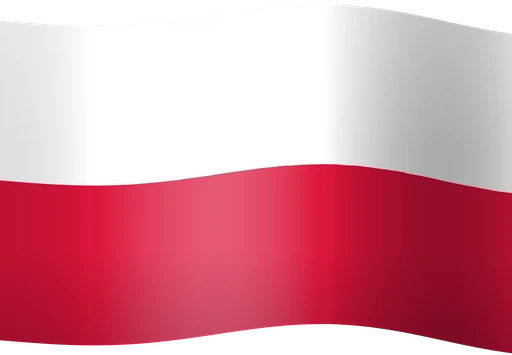
The Flag of Poland
Republic of Poland
The flag of Poland is two horizontal stripes of equal width, white on top and red below. The Polish constitution names these as the national colors. Two versions are in use: the plain bicolor, and one with the national coat of arms on the white stripe, flown abroad and at sea.
Poland's flag is a plain white-over-red bicolor, and both stripes were lifted from a coat of arms that predates the country's modern borders by six centuries.
White eagle, red field
The white eagle on a red shield has been Poland's emblem since the 13th century. The flag takes those two heraldic colors and lays them out as stripes, white above and red below. White is usually read as peace and purity, red as valor and the fight for freedom, though the colors sat on the shield long before anyone attached those meanings to them. Similar combinations turned up on banners of the Polish-Lithuanian Commonwealth.
The current flag was adopted in 1919, the year after Poland regained independence at the end of the First World War, following more than a century of partition between Austria, Prussia, and Russia. Nothing about the design has changed since. What changed was the mood around it. Under the communist government the white and red carried an edge of dissent; after 1989 it could be flown without one. Because there is no emblem on the national flag, there was never anything for a new government to add or scrape off, which is one reason it came through the century intact.
Where you see it
The flag flies on government buildings and comes out in quantity for Constitution Day on May 3 and Independence Day on November 11. Protocol governs how and where it is hung. Polish supporters carry it at international sporting events, and it turns up throughout Polish literature and art, particularly in work about the partitions and the struggle for independence.
The version with the coat of arms on the white stripe is the one used abroad and at sea. The naval ensign carries the eagle.
Not Indonesia, not Monaco
Indonesia and Monaco both use red and white with red on top, the exact reverse of Poland. The proportions differ as well. Two horizontal stripes in two colors leaves very little room for variation, so the overlap says less than it looks like it does.
Related terminology
Vexillologists call a two-color design like this a bicolor, and a flag flown by naval forces an ensign. In Polish the flag is "Flaga Polski," and the white and red are the "barwy narodowe," the national colors.
References
[1] Polish Ministry of Culture and National Heritage
[2] Flags of the World Association (FOTW)[3] Gov.pl - Polish Government
Common questions
- Why are there only two colors on the Polish flag?
- Two colors are all the flag needs, because both come straight off the coat of arms: a white eagle on a red shield. White is read as peace and purity, red as struggle and valor.
- How does the Polish flag differ from those of Indonesia and Monaco?
- All three use red and white, but Poland puts white on top and red below, the reverse of Indonesia and Monaco. The proportions differ too.
- What do the white and red colors on the Polish flag signify?
- White is taken to mean peace and purity, red courage and the fight for freedom. Both are drawn from Poland's historical coat of arms, a white eagle on a red shield.
Featured in these articles
- The White That Isn't Empty: How Libya, Japan, and Switzerland Turned Minimalism Into a Statement
- When Red, White, and Blue Doesn't Mean America: How Indonesia, the Netherlands, and Croatia Share a Palette but Not a Story
- The Coat of Arms Trap: Why Belize, Moldova, and Paraguay Put Encyclopedias on Their Flags, and Whether It Works
- Red, White, and Identical: The Indonesia-Monaco-Poland Problem and How Flags Handle Accidental Twins
Download this flag
Free in 12 styles, from 32px icons up to 2000px, as SVG, PNG, WebP and JPG.