Fiji Promised a New Flag by 2015. A Cyclone and a Rugby Final Kept the Old One.
Julio Song · · 8 min read
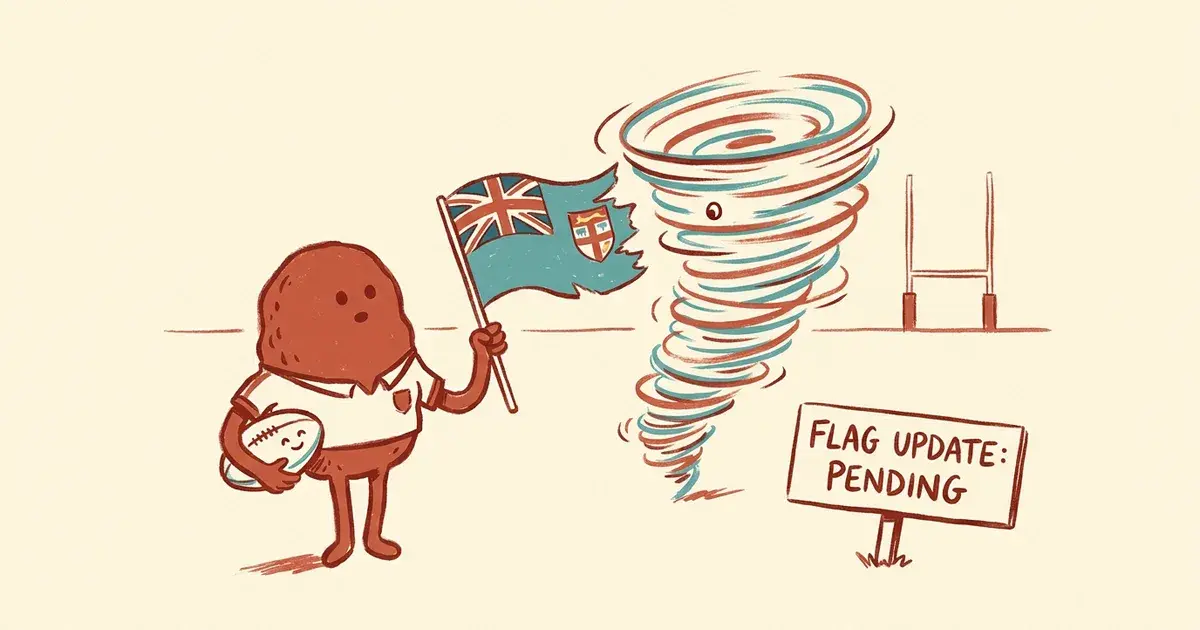
On 11 August 2016, in Rio de Janeiro, Fiji's rugby sevens team beat Great Britain 43-7 in the Olympic final. It was the country's first Olympic medal of any colour. Back home, people poured into the streets. The flag they waved had a Union Jack in the corner and a British lion on its shield.
Eighteen months earlier, Fiji's prime minister had promised to get rid of that flag. A week after the final, he told the country it would stay.
This is the story of a flag change that had a competition, a committee, a foreign expert, 23 finalists and a moving deadline, and still never happened. If you want to know why most flag changes fail, Fiji is a better case study than the famous ones.
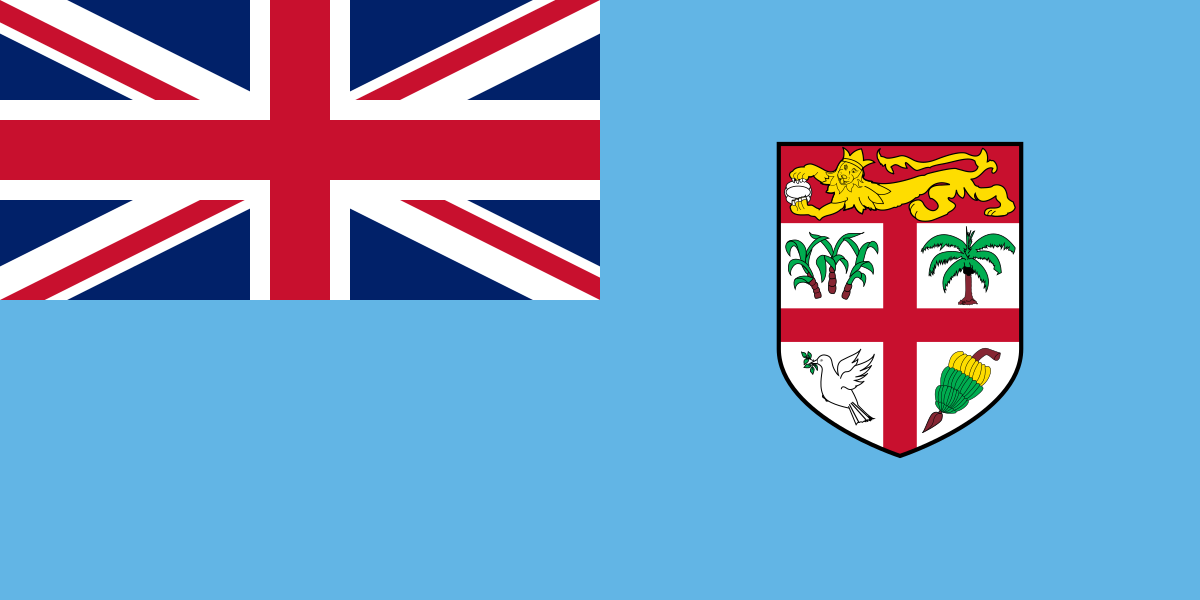 FijiView flag →
The flag Fiji got in 1970
Fiji's flag was introduced at independence in 1970. It came out of a national competition. One of the winning designers, a teacher named Tessa Mackenzie, told the Fiji Times in 2018 how she and the artist Robi Wilcock put it together.
She kept the Union Flag for its history. She chose a blue field for the sea, since Fiji sits in the Pacific. Her late husband suggested taking the shield from the coat of arms. That shield carries a lion holding a cocoa pod above a red cross, with sugar cane, a coconut palm, a dove and a bunch of bananas in the quarters.
To Mackenzie, the lion meant power rather than Britain. A flag, she said, is "your symbol and it's your identity."
That last line matters for what came next. Mackenzie saw the shield as a picture of Fiji. Not everyone did.
"What does this have to do with us?"
On 3 February 2015, Prime Minister Frank Bainimarama used the opening of a legal aid office in Nasinu to announce a new national flag. Bainimarama had taken power in a 2006 coup. Fiji held its first election since then in September 2014, and he won it. He framed the flag as the next step for the new democracy.
He didn't hide what he wanted gone. "The Union Flag belongs to the British, not to us," he said, as reported by the Irish Times. "The shield on our flag has the British lion and the cross of St George, a British patron saint. What does this have to do with us?"
He was careful about tone. The existing flag, he said, "is widely loved and admired" and "has served us well since it was introduced at Independence in 1970." The target was tight: a new flag in time for the 45th anniversary of independence, 10 October 2015. The design competition was open to everyone, schoolchildren included.
At the time, Fiji was one of five independent countries still flying the Union Flag design, alongside the United Kingdom, Australia, New Zealand and Tuvalu. New Zealand was preparing its own vote on the same question.
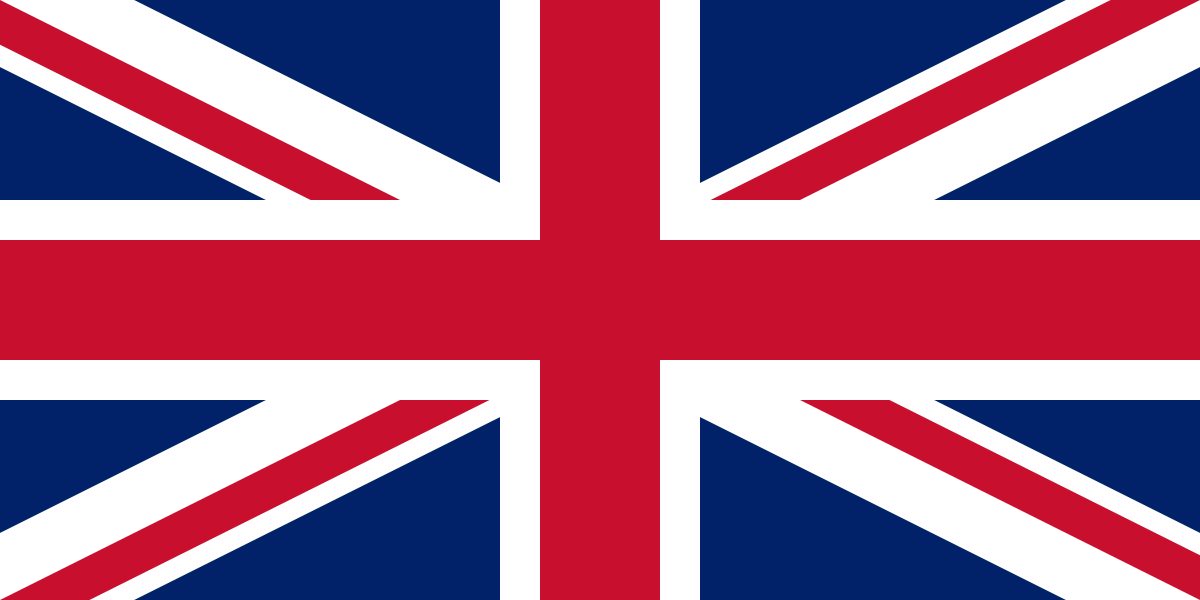 United KingdomView flag →
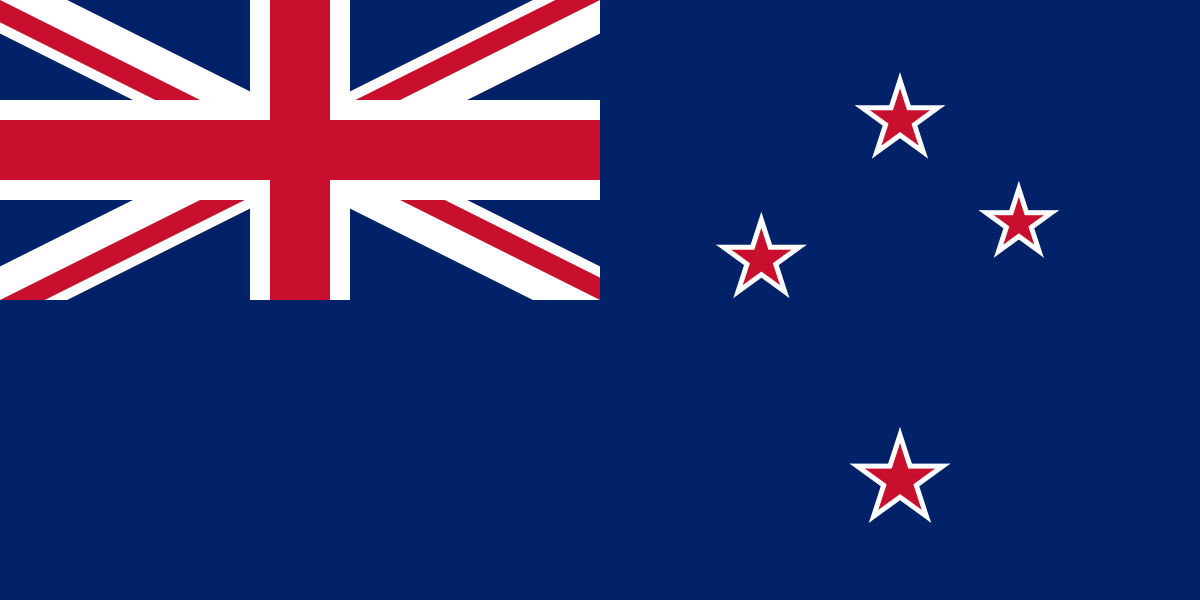 New ZealandView flag →
Inside the committee room
Fiji's process is unusually well documented, because one committee member wrote it up.
In May 2015 the government named a 13-member National Flag Committee, chaired by Iliesa Delana, Assistant Minister for Youth and Sports and a Paralympic gold medallist. Its thirteenth member was an American vexillologist, Ted Kaye. The government had read an interview he gave to Vice and decided it wanted a "flag expert and vexillologist" on the panel.
Kaye flew to Suva at the end of May on about a week's notice and later wrote up the three-day session. The numbers he gives are worth a look:
- More than 2,000 distinct designs came in.
- Opponents of the change also sent in about 7,000 images of the current flag.
- The committee cut the field to 167 on day one, then to 47, then to 20.
- Every one of the 20 used a shade the committee called "Fiji Blue."
Pause on that second number. Thousands of people took the time to enter a design competition with the flag they already had. That was a protest vote, cast in the only ballot box on offer.
The committee's work was meant to pass to the public next. Instead, on 9 June, acting Prime Minister and Attorney-General Aiyaz Sayed-Khaiyum announced 23 shortlisted designs, posted online for comment and open to a text-message vote.
Twenty-three was not the committee's number. According to RNZ's reporting, the committee had first picked five finalists, and the Attorney-General told it to select more. The 23 were not the original public entries either, and many looked alike. A request to Parliament to put the question to a referendum was rejected. Bainimarama called the search a national "crusade" and said none of the 23 was fixed.
A Fiji Times opinion column a few weeks later went further. It said the 23 "composite" designs had appeared suddenly, that some committee members were seeing them for the first time, and that nobody had submitted them. It noted the prime minister's reported admission that the public reaction "has not been entirely positive," and it asked for a referendum alongside the 2018 election.
So by late June 2015, the process had three problems at once. The public hadn't asked for a new flag. The shortlist didn't come from the public. And the public wouldn't get the final say.
The deadline that kept moving
The 10 October target slipped first. In June 2015 Bainimarama announced a six-month delay. In December the government pushed the decision back again, to the end of February 2016, and laid out a fresh plan:
- The prime minister's office would pick five designs in March.
- Citizens would get three months to choose one.
- The government would announce the winner on 1 July.
- The new flag would go up on Constitution Day, 7 September.
The government said it was still looking for more submissions, even after the 23. That detail tells you a lot. Ten months in, the people running the process didn't like their own shortlist.
None of the four steps happened.
A cyclone, then a gold medal
On 20 February 2016, Cyclone Winston hit Fiji. The World Health Organization describes it as the strongest cyclone on record in the Southern Hemisphere. It killed 44 people and damaged at least 88 of the country's 214 health facilities.
A flag vote planned for March was suddenly a strange thing to spend money on. Then came Rio.
Fiji's win over Great Britain carried an obvious irony. The team beat the old colonial power, and its fans celebrated under a flag carrying that power's emblem. Al Jazeera reported days of street parties and an extra public holiday. "We are all proud to be Fijians right now," Bainimarama said.
A week after the final, the government made it official. The flag "should not be changed for the foreseeable future," Bainimarama said, according to ABC News. He gave two reasons:
- "The cost of any flag change is better spent at the present time assisting Fijians back on their feet." He called it "a question of resetting national priorities" after Winston.
- The sevens win had brought people together under the existing flag. He urged Fijians to fly it when the team came home.
He did not change his mind about the symbols. He said he was still personally convinced "we need to replace some of the flag's colonial symbols."
The opposition welcomed the U-turn. Opposition Leader Ro Teimumu Kepa told RNZ the flag was dear to people and there was no reason to change it. Former opposition leader Mick Beddoes credited young protesters with leading the push against the change and called the government's earlier delays "kicking the can down the road."
What Fiji's failed flag tells you
Fiji's government had a fair point. The Union Jack in the canton is a British emblem, and the cross on the shield belongs to a British patron saint. Bainimarama wasn't wrong that those symbols came from somewhere else.
He lost anyway, and the record shows why. The public wasn't asking. Around 7,000 people answered a design contest by sending back the old flag, and that signal arrived before the committee had even met.
The shortlist had no owners. When the committee's five became 23 composites nobody had drawn, the designs lost the one thing a new flag needs, which is people who feel it is theirs. Bainimarama had also ruled out a referendum, so every delay read as doubt rather than consultation.
Then events picked a side. A disaster made the cost look indulgent. A gold medal, won by beating Britain, turned the old flag into a winner's flag.
Compare that with Mackenzie's view of the shield. She saw sugar cane, coconuts, bananas and a dove, and read the lion as strength. Bainimarama saw St George and the Crown. Both were looking at the same 1970 design. The flag held because enough Fijians saw it the way she did.
So the flag Fiji flies today is the one it raised in 1970, with the Union Jack still in the canton. The phrase Bainimarama chose was "the foreseeable future," not "forever." For now, a cyclone and a rugby final settled an argument that a committee, a competition and 23 finalists left open.
Julio Song
Writer
Julio is a staff writer at FlagDB. He studied Mathematics at the University of Madrid and has a passion for vexillology.
More from Julio Song →