Ask five people from five different countries what green means on a flag and you will get five different answers, each delivered with total confidence. A Saudi diplomat will tell you it represents Islam. A Ghanaian historian will say it is the land, the soil, the promise of agricultural self-sufficiency. An Irish republican will point to Gaelic nationalism and a pre-colonial Celtic past. A Libyan who lived through the Gaddafi era might grimace and say it was one man's ego printed on cloth. A Pakistani will connect it to faith and the Muslim majority.
They are all right, and that is the problem.
Red is supposed to mean revolution. Blue means the ocean. White means peace, or surrender. Those readings feel like settled facts, the sort of thing you find on an infographic and never question. Green never settled. It is the only major flag color whose meaning has been repeatedly and irreconcilably reinvented by different peoples at different moments, and the contradictions are not subtle. In one tradition it points to paradise. In another it points at the dirt.
Political symbols are not inherited so much as manufactured, and Libya's all-green flag of 1977 to 2011 makes the point more bluntly than any other example: a solid rectangle of a single color, no emblem, no stripe, no star.
The myth of universal color symbolism
There is a popular idea floating around vexillology circles, tourism boards, and government fact sheets: that flag colors carry fixed, cross-cultural meanings. Red equals blood, sacrifice, revolution. White equals peace. Blue equals water, sky, freedom. You have seen these explanations in embassy brochures, Wikipedia sidebars, and school presentations. They sound authoritative.
They are also largely retrofitted. Governments frequently chose colors for pragmatic, dynastic, or aesthetic reasons and assigned symbolic meanings afterward. The official explanation of a flag's colors is often written decades or even centuries after the flag was first flown.
Semioticians call this semiotic drift: symbols carry no inherent meaning, they get assigned meaning by communities, and those assignments shift and contradict each other over time. Most flag colors hide the drift because one dominant cultural context drowns out the competition. Red has its communist-revolutionary association so deeply embedded in global consciousness that its other meanings, danger and love and the blood of martyrs, feel like footnotes.
Green never achieved that kind of dominance. No single tradition owned it, so its contradictions stayed on the surface where anyone could see them.
Green and the Prophet: sacred color in Islamic vexillology
The association between green and Islam goes back centuries. The Hadith describe the Prophet Muhammad wearing a green cloak and turban. The Quran's description of Jannah, paradise, includes green garments and lush gardens, notably in Surah Al-Insan (76:21). Green became the color of the Prophet's descendants, of spiritual authority, of the reward awaiting the faithful.
Saudi Arabia's flag is the most direct expression of that tradition: a green field bearing the Shahada, the Islamic declaration of faith, and a sword. The design has been fundamentally unchanged since the early 20th century and was formally standardized in 1973.
The association rippled outward. Pakistan adopted a dark green band in 1947 for its Muslim majority population. The Ottoman Empire's naval standards carried green. The Palestinian flag includes green as one of its four Pan-Arab colors, each linked to a different dynasty of Islamic history.
The tension worth sitting with is that green is not Islamic because Islam prescribed it for flags. No verse of the Quran mandates a green national banner. The connection is a centuries-old cultural association that 20th-century nation-states selectively formalized when they wanted religious legitimacy woven into cloth.
So what happens when a color that means the divine and the eternal in Riyadh gets transplanted into the entirely secular project of African independence?
Green and the soil: Pan-African nationalism and the Ethiopian template
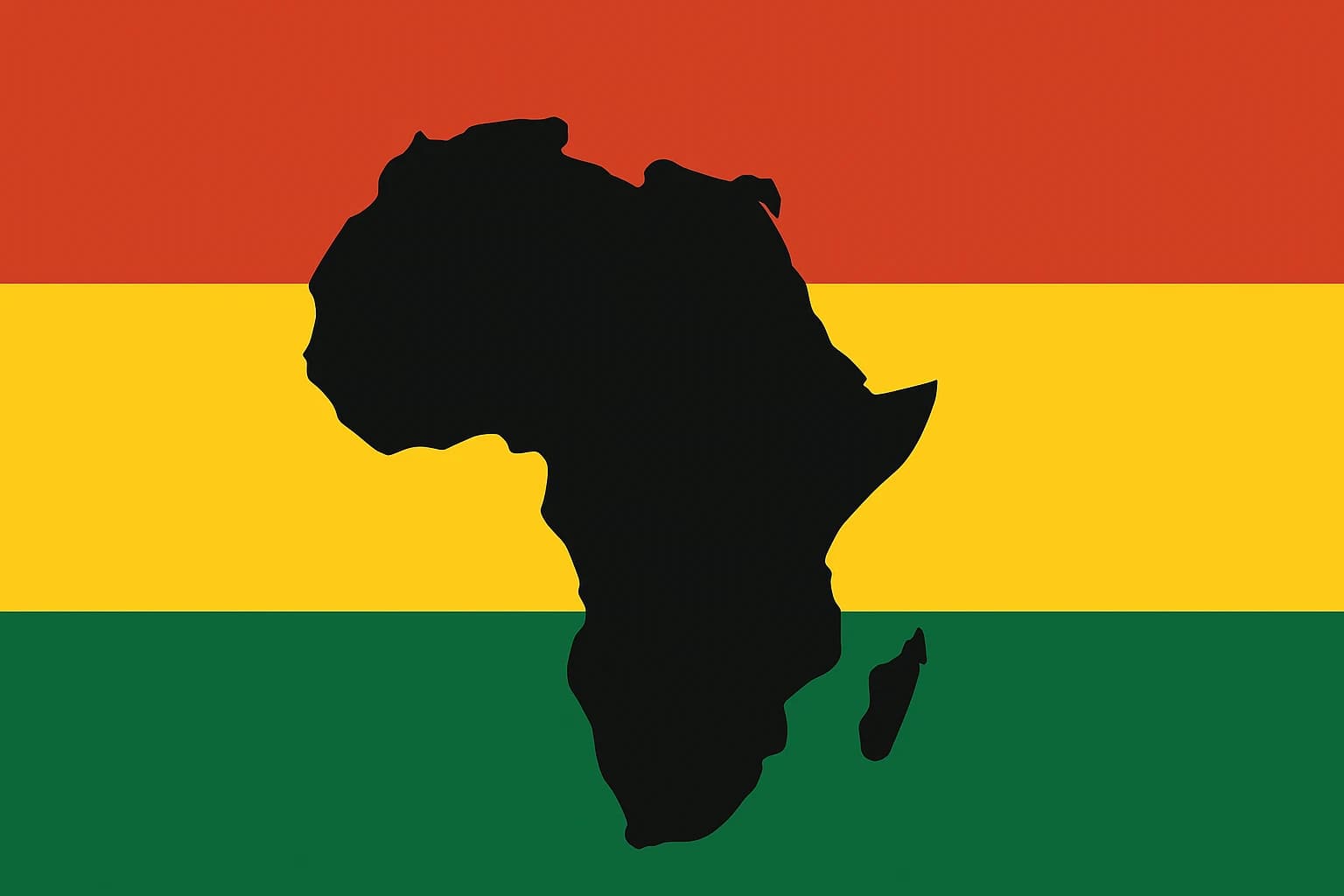
Ethiopia's flag is the origin point. Its tricolor of green, gold, and red, used in various forms since the late 19th century, became the template for the Pan-African palette. No continental body ever codified the combination. It spread organically through the symbolism of independence movements.
For Ethiopia, green had a deliberately earthly meaning: agricultural fertility, the physical territory of a nation that had resisted European colonization, the promise of self-sufficiency. No religious dimension, no heavenly gardens. Green pointed down, at the soil.
When Ghana adopted its flag in 1957 under Kwame Nkrumah's direction, green again denoted forests and natural wealth, but it carried extra freight. Choosing the Ethiopian palette was itself a political act, a declaration of solidarity with the only African nation that had never been colonized, aside from a brief Italian occupation. The color meant land, and it also meant defiance.
The same green traveled into Guinea's flag in 1958, Mali's in 1961, Senegal's in 1960, and dozens of others: post-colonial states borrowing the color's meaning from Ethiopia even as that meaning shifted with each new context.
A color that in Saudi Arabia points upward, to God and paradise, in this tradition points downward, to earth and agriculture and physical roots. Same hue, opposite metaphysical direction.
The green manifesto: Gaddafi's Libya
On November 19, 1977, Libya officially adopted its all-green flag. A solid rectangle of a single color. No emblem, no stripes, no crescent, no star. It was the only plain monochrome national flag in the world, and one of the most radical flag designs in history.
The ideological source was Gaddafi's Green Book, published between 1975 and 1979, which laid out his Third Universal Theory as an alternative to both capitalism and Soviet communism. Green was the literal color of that ideology. It appeared on the book's cover, in state iconography, on government buildings, and now on the flag.
What made this unprecedented was the mechanism. For the first time in modern vexillology, a flag color was being used not to invoke a religion, a landscape, or a historical tradition, but to brand a living ruler's personal political philosophy in real time. The flag was advertising one man's book.
International reaction ranged from bemusement to derision. The flag was widely mocked, sports commentators struggled with it, graphic designers found it close to absurd. It also demonstrated something genuinely interesting: a state with enough coercive power and institutional will can declare what a color means and enforce that meaning for decades.
The epilogue is short. After Gaddafi's fall in 2011, Libya immediately reverted to its pre-1969 flag with red, black, white, and green elements, complete with the crescent and star.
That reversion was a deliberate unwriting. The meaning Gaddafi had imposed on green evaporated the moment the institutions enforcing it collapsed. It had never been intrinsic. It had been coerced.
Green at the margins: Celtic nationalism and pre-Christian identity
Shift the map entirely. In northwestern European nationalist and cultural movements, green carries a meaning with nothing to do with Islam, Africa, or political ideology. Here it is the color of pre-Christian agrarian identity, of landscape before statehood.
The Irish tricolor is the clearest case. Its green band has an unambiguously Gaelic nationalist meaning, traceable to the 1798 United Irishmen rebellion and formalized during the 1916 to 1922 independence period. But the green does not invoke religion or ecology in any direct sense. It invokes a pre-colonial, pre-Christian Celtic past, a mythologized Ireland that existed before English rule.
Welsh nationalism uses green similarly. The green and white field behind the red dragon anchors the design in an ancient territorial identity, a landscape claimed long before the Acts of Union.
Green is archaeological in this tradition. It reaches back past written history to a mythologized landscape, which makes it an anti-modern color, a rejection of the nation-state's usual habit of anchoring itself in recent events. It does not say look at what we are building. It says look at what was here before you arrived.
Why green couldn't pick a side
Set those four traditions side by side and ask what they share. Almost nothing, except green's visual association with living nature: plants, growth, the physical world. Each tradition then attaches a completely different valuation to that association.
The semiotician Ernesto Laclau had a useful term for this, the empty signifier: a symbol so formally simple that it gets filled with whatever content is needed by whoever controls the context of its display. Green fits the description better than any other major flag color.
Part of the reason is visual neutrality. Green is not as viscerally charged as red and does not carry the institutional cleanness of white. It sits in the middle of the emotional spectrum, available for appropriation. Red, for all its variations across communist revolution, danger, bloodshed, and love, retains a consistent register of intensity and urgency that limits how far its meaning can drift. Green has no such anchor. It is mild, ambient, everywhere in nature and nowhere in particular.
If green means Islamic paradise in Riyadh and Gaddafist political theory in Tripoli and agricultural independence in Accra, then the meaning of a flag color is not embedded in the color. It is embedded in the institutions, histories, and structures around it.
The most honest color on the flag
Green's inconsistency looks like a flaw. It is closer to a feature.
Because green never achieved the global dominance of red's revolutionary connotations or blue's maritime associations, it never successfully masked the constructed nature of its own meaning. Every flag color is equally constructed. The universal meanings of red and blue are historical accidents that became self-reinforcing through repetition and political power. Green reveals the mechanism because it was never dominant enough to hide it.
For flag designers, that makes green the most intellectually honest choice on the palette. A designer using green has to decide consciously what it means for this people, in this moment. There is no inherited shorthand to fall back on.
The flags that feel most natural to us are usually the ones whose manufactured meanings have been in place long enough to feel inevitable. We do not question why red means revolution, because the French and Soviet and Chinese flags hammered that association into global consciousness over two centuries. The construction happened and we forgot it was a construction.
Gaddafi's all-green flag failed not because he misunderstood color symbolism but because he understood it too well. He saw that meaning is imposed rather than discovered, and he imposed it with maximum force and zero subtlety. The construction was too naked, too visible, too tied to a single mortal person to survive him.
So go back to those five people from five countries. Their disagreement is not a problem to be solved, it is the answer. Green's wandering across Saudi Arabia, Ethiopia, Ghana, Libya, and the Celtic fringe is not a sign that the color is semantically broken. It is proof that flag colors have no fixed grammar. They are a negotiation, and the outcome depends on who is at the table and what they need the color to do. Green happened to lose so many of those arguments in public that we get to watch how the arguing works.