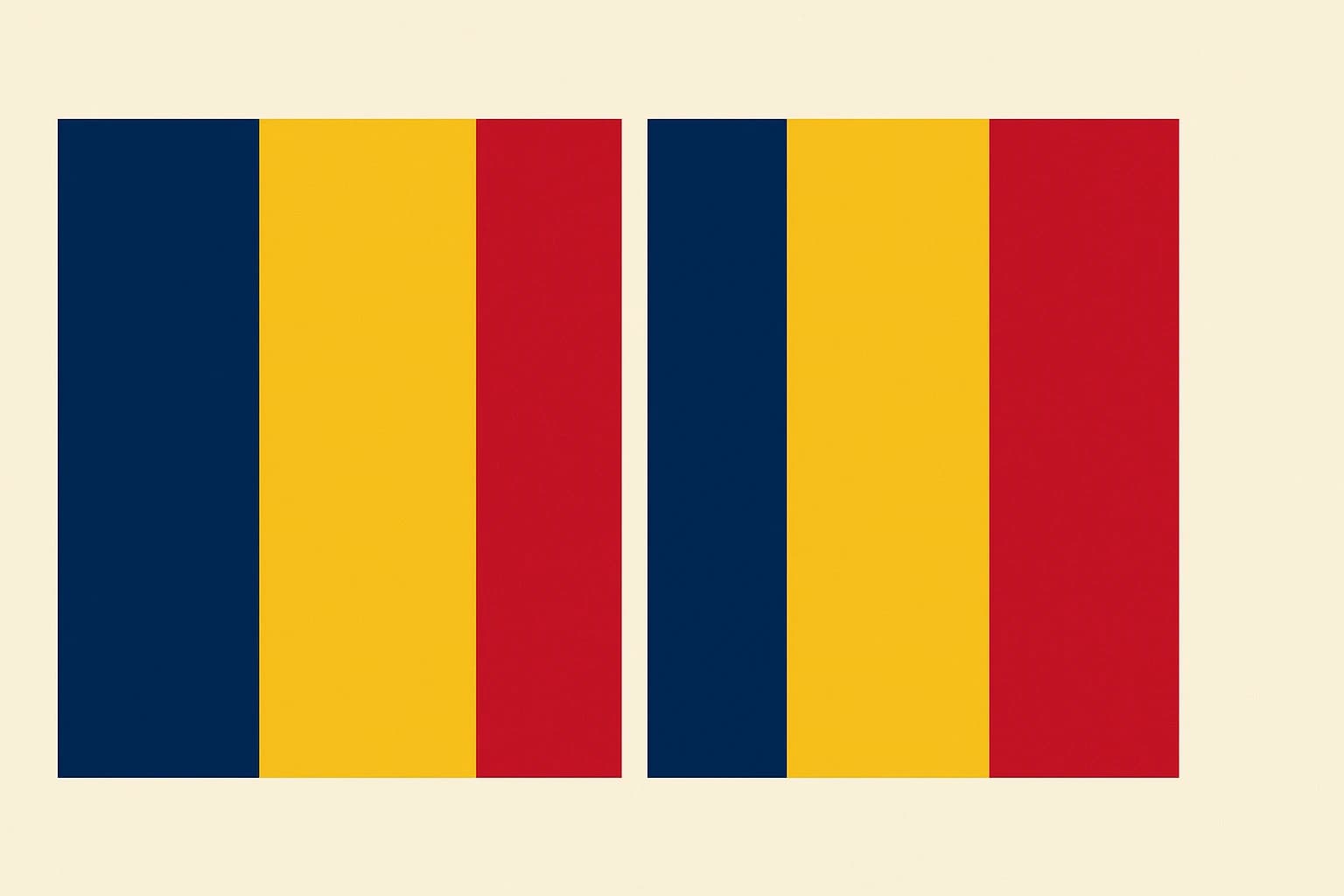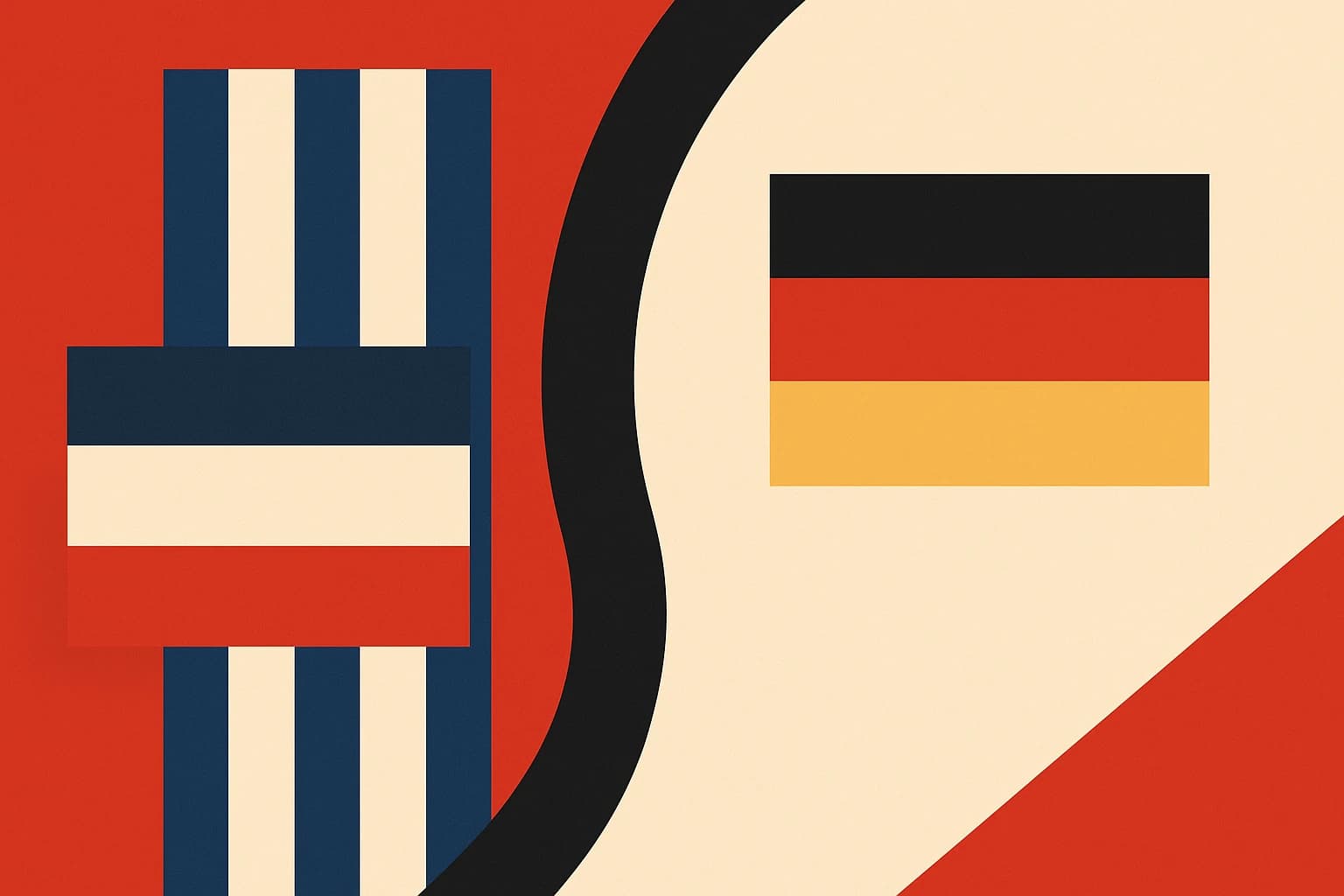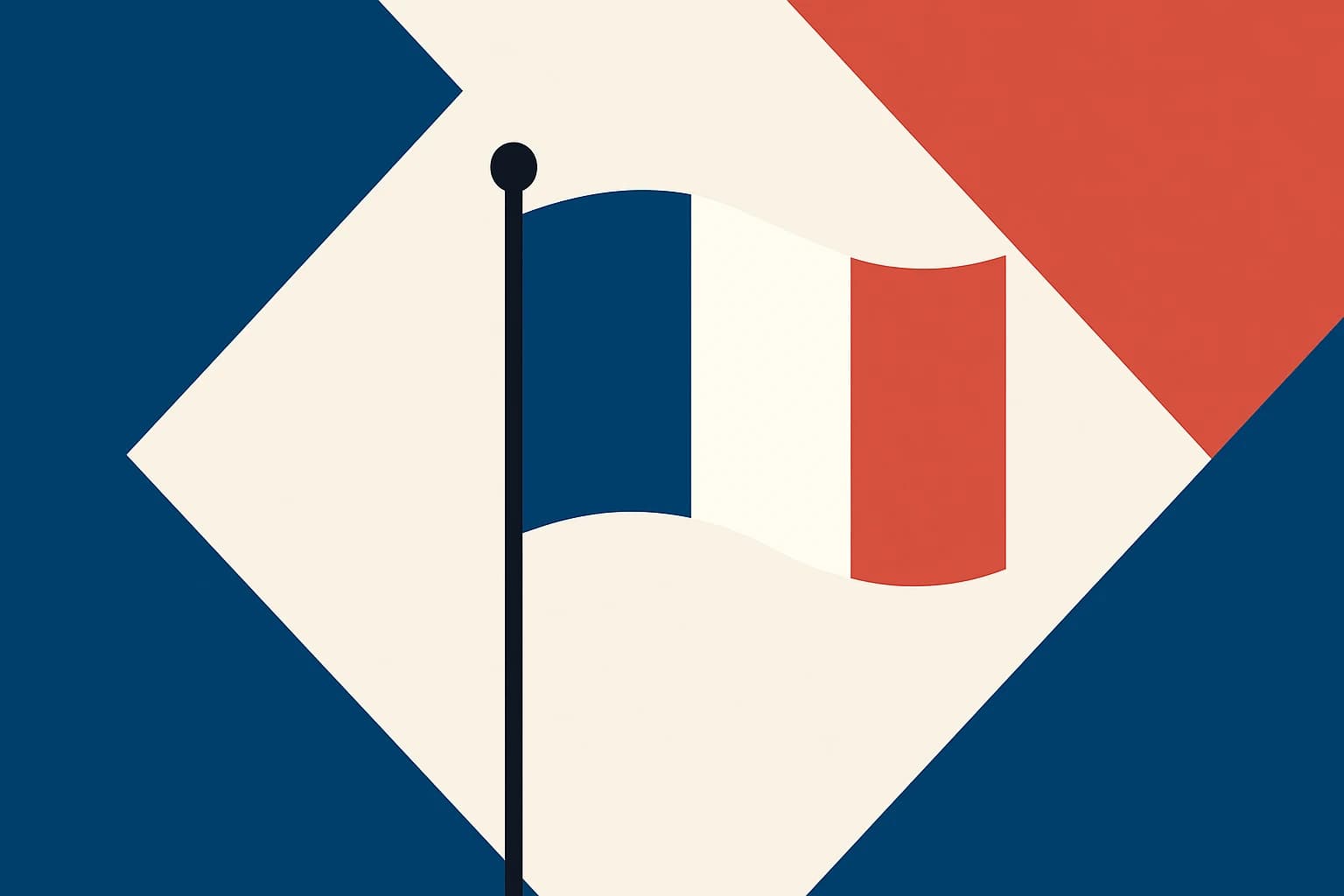
More than 30 sovereign nations fly a tricolor today. Vertical or horizontal, three bands of solid color, no emblem required. It is the single most replicated flag structure on Earth, and it all traces back to one legislative act on a winter night in revolutionary Paris.
On February 15, 1794, the French National Convention formally codified blue, white, and red into a vertical triband. The legislators in that room were solving a practical problem: France needed a single, official national flag. They had no idea they were writing the visual grammar of modern statehood, a template that would spread to six continents over the next 230-plus years.
French imperial soft power explains part of the spread, and revolutionary contagion explains more of it. The larger reason is stranger. The design is structurally empty, which meant any new nation could pour its own meaning into it, and that emptiness was what arriving nation-states needed. The tricolor won on usefulness rather than on looks.
The accident of genius: how the tricolor was born (and what it meant)
The tricolor's origins are murkier than most people assume. The standard story involves the Marquis de Lafayette in July 1789, brokering a visual compromise. Blue and red were the colors of Paris, associated with the city militia. White was the color of the Bourbon monarchy. Slap them together on a cockade, and you get a forced marriage of revolution and crown, pinned to a hat.
The vertical orientation was a deliberate break from European heraldic tradition. For centuries, flags across the continent had favored complex coats of arms, crosses, diagonal charges, lions rampant, eagles displayed. The tricolor was ostentatiously simple, to the point of being aggressively anti-aristocratic. Anyone could read it without specialized knowledge, and no herald was needed to decode it.
And what did the three colors mean? Liberty, equality, fraternity, the story goes. But that symbolism was retrofitted. The colors were chosen for civic and political reasons, not ideological ones. Blue and red because Paris. White because the king. The grand philosophical meanings came later, layered onto a design that had already been chosen for completely different reasons.
This mattered enormously, though nobody saw it at the time. The flag's simplicity was a political statement. A peasant or soldier could describe it, draw it, sew it from memory. Three equal vertical bands of solid color. No special dyes, no embroidery, no goldwork. A democratic flag for a democratic age.
And that formula, three equal bands, would prove to be the tricolor's most exportable feature. Its blankness was its strength.
The first copy: Italy and the color swap that launched a template
The first nation to borrow the format did so while French bayonets were still warm.
Napoleon's Italian campaigns of 1796 and 1797 brought more than armies south across the Alps. They brought French political aesthetics. In January 1797, the Cispadane Republic adopted the first Italian tricolor: red, white, and green. The structural debt to France was obvious. Three equal vertical bands. Same proportions. Same clean geometry.
The logic of the color swap was straightforward. Green replaced blue, drawn from the green uniforms of the Milanese civic guard and possibly from Enlightenment associations of green with hope and the natural world. The grammar was lifted wholesale. Only the vocabulary changed.
What happened next is the part that matters for the global story. The tricolor became the flag of the Risorgimento. Giuseppe Garibaldi carried it. The revolutionaries of 1848 rallied under it. It was a banner of national liberation before Italy even existed as a unified state.
This set a profound precedent. You could borrow France's format, swap the colors to local symbols, and produce a flag that felt both internationally legible (it looks like a "real" national flag) and locally meaningful. A template for nation-branding, decades before anyone used that term.
Italy's tricolor proved the format was not French property. It was open-source political technology, available to any movement that needed to signal modernity, legitimacy, and revolutionary intent at the same time.
Revolutionary contagion: the tricolor spreads across 19th-century Europe
The template spread fast. And it spread along specific routes: the routes that revolutionaries traveled.
In 1831, Belgium adopted a black, yellow, and red vertical tricolor after its revolution against Dutch rule.
In 1848, Ireland's green, white, and orange tricolor appeared, directly inspired by the French model. Thomas Francis Meagher, the Young Ireland leader, reportedly brought the idea home from Paris itself, a physical act of transmission. He had seen the French flag, absorbed its power, and carried the format across the Irish Sea.
Romania's blue, yellow, and red tricolor also emerged from the revolutionary ferment of 1848.
The pattern is striking. Virtually every European tricolor adoption clusters around the revolutionary moments of 1830 and 1848, the "Springtime of Nations." New nationalist movements needed flags fast. They reached for the most recognizable template of legitimate statehood available.
Paris functioned as a hub. European revolutionaries physically traveled to France, absorbed its political culture, and carried the format home. The tricolor's spread was a story of direct human transmission, people talking to people, not some abstract cultural osmosis.
Not every tricolor was a copy, though.
The Netherlands' red, white, and blue horizontal tricolor predates the French version entirely. It evolved from the Dutch Revolt's orange, white, and blue banner in the 16th century. And Luxembourg's red, white, and light blue is nearly identical to the Dutch. These are cases of convergent evolution: similar political pressures (anti-aristocratic sentiment, the need for civic identity) producing similar design solutions independently.
This contrast sharpens the central point. The tricolor did not just spread widely, it spread because it was intuitive: stripped heraldry, three colors, clean bands. This is what modernity looked like to the 19th century.
Guinea and the pan-African tricolor: when the template crossed the Sahara
October 2, 1958. Conakry, Guinea. Sékou Touré's government declares independence from France, making Guinea the first sub-Saharan African nation to break away from French colonial rule. The moment was dramatic. Guinea had voted "Non" in Charles de Gaulle's 1958 referendum on a proposed French Community. Every other French African territory voted "Oui." Guinea stood alone.
And its new flag? A vertical tricolor. Red, gold, and green.
The double layer of influence here is worth pausing over. Guinea borrowed France's structural format, the vertical tricolor. But it filled that structure with colors drawn from pan-African symbolism, first systematized by Marcus Garvey's Universal Negro Improvement Association in the 1920s. Red for the blood of struggle. Gold for the wealth of the African continent. Green for the land.
This was a deliberate act of cultural recoding. The colonizer's flag grammar, repurposed to announce decolonization.
Guinea's flag then became a template itself. Mali adopted a near-identical design in 1961.
Senegal's flag, adopted in 1960, uses the same pan-African colors with a green star added to the center band.
Guinea-Bissau followed with its own variation, creating a regional flag family across West Africa.
Sékou Touré knew what he was doing. His rejection of French rule was the most pointed in all of Francophone Africa. The flag choice, borrowing French form while repudiating French content, reads as deliberate political provocation.
The irony runs through the whole story of the tricolor. A format born of the French Revolution's universalist ideals became a tool for anti-French, anti-colonial liberation movements. The template had been so thoroughly de-nationalized that it could be turned against its own origin. The French Revolution's gift to the world was a design so adaptable that the world used it to reject French authority.
The grammar of legitimacy: why new nations reach for the tricolor
Newly formed states face an immediate crisis. They must signal to their own citizens and to the international community that they are real, modern, sovereign nations. A tricolor does this instantly. The format has been associated with legitimate statehood since 1794. Choosing one is like choosing to write your constitution in formal legal language. It signals belonging to a tradition.
Compare the tricolor to other flag families. The Nordic cross remains confined to Scandinavia and its cultural orbit.
Union Jack derivatives are tied to British colonial history.
Islamic crescent flags carry a specific religious identity. None of these formats traveled the way the tricolor did, because none of them were ideologically portable enough.
The post-Soviet wave confirmed this. When the USSR dissolved in 1991, several newly independent states reached for tricolors. Russia reactivated its pre-Soviet white, blue, and red tricolor.
Slovenia, Slovakia, and Croatia all adopted tricolor-based designs, repeating the 1848 pattern in a completely new political context.
There's a term for this: vexillological signaling. A country's flag choice communicates its political lineage and aspirations to an international audience. Choosing a tricolor in 1960 or 1991 was a way of saying that the country belonged to the tradition of the nation-state rather than to the empire or the tribe.
There is a practical dimension too, easy to overlook. Tricolors are extraordinarily cheap to manufacture: three bands of solid color, no complex printing and no embroidery, easy to launder and easy to replicate at scale. For new states operating on limited budgets, this mattered. The format's democratic, accessible character extended to the factory floor.
The emptiness is the point
The philosophical core of the story is that the tricolor succeeded globally because it carries no inherent meaning.
Think about the Union Jack. It encodes specific political unions: the crosses of St. George, St. Andrew, and St. Patrick, layered on top of each other. You cannot replicate that design without looking like you are copying Britain specifically. The same goes for Japan's rising sun or any flag carrying a culturally specific symbol.
But three colored bands? They mean nothing until a nation decides what they mean.
France's blue means liberty. Italy's green means hope. Guinea's red means revolutionary struggle. Ireland's orange represents the Protestant community. The same slot in the same structure holds completely different cultural content. Each flag is structurally identical and semantically unique.
Modern vexillologists have started to note a problem. The North American Vexillological Association's design principles, while praising simplicity, implicitly acknowledge that the tricolor has become so common it risks diluting its own distinctiveness. When everyone uses the same format, nobody stands out. The tricolor is, in some ways, a victim of its own success.
But that critique misses the deeper point. The tricolor is the world's most successful national symbol partly because it is the least nationally specific. It is a universal placeholder. The act of nation-building fills it with local meaning. It is simultaneously the same flag and a different flag everywhere it flies.
A template for 230 years and counting
Go back to that night in February 1794. The legislators codifying three colored bands into law were solving a narrow problem for one republic in the middle of a revolution, and they were not thinking about Guinea or Italy or Ireland or the collapse of the Soviet Union.
What they produced anyway is the format new states have reached for ever since, whenever they needed to look like nation-states in a hurry. It has lasted this long because it makes no argument of its own and will hold whichever argument gets poured into it.