The Flag of Slovenia
Republic of Slovenia
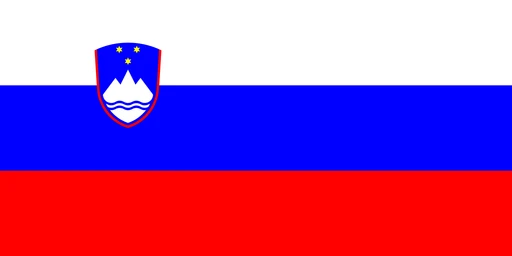
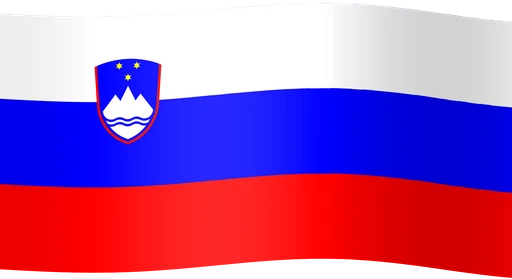
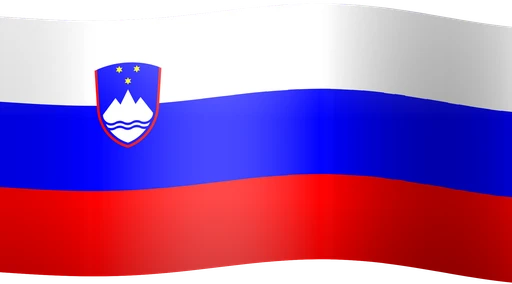
The flag of Slovenia has three horizontal bands of white (top), blue, and red, with the national coat of arms at the hoist side. The coat of arms shows Mount Triglav, Slovenia's highest peak, in white against a blue background. Above the mountain are three six-pointed stars arranged in an inverted triangle, taken from the arms of the Counts of Celje. The wavy lines at the bottom stand for the sea and the rivers of Slovenia.
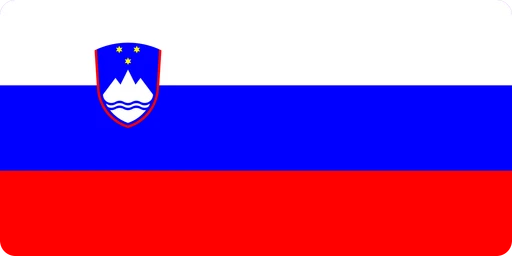
The flag of Slovenia is a white, blue, and red tricolor with the national coat of arms set near the hoist.
A tricolor from 1848, an emblem from 1991
Slovenia adopted the flag on June 27, 1991, two days after declaring independence from the Socialist Federal Republic of Yugoslavia.
The colors go back much further. The historical flag of the Duchy of Carniola was blue, white, and red, and Slovene nationalists took up that combination during the 1848 Spring of Nations. It is also the Pan-Slavic palette, which is why the Russian flag looks so much like it.
Little has changed since 1991, and what has changed concerns the emblem rather than the field: refining how Mount Triglav is drawn, and keeping the coat of arms consistent across the formats it appears in.
Triglav, the sea, and the Counts of Celje
The bands run white, blue, red from top to bottom. White is read as peace and sincerity, blue as truth and loyalty, red as courage and sacrifice.
The coat of arms sits in the upper hoist corner. Inside it is a stylized Mount Triglav, Slovenia's highest peak, in white on blue. Wavy lines below the mountain stand for the country's rivers and the Adriatic. Above it are three six-pointed gold stars in a triangle, taken from the arms of the Counts of Celje, a historically important noble house.
Flying it
The flag goes up on national holidays, at state funerals, and at official government events. Government instructions cover the details, including height ratio and positioning. There are variants for the military and a separate presidential standard, each adapting the basic design to its own use.
Telling it apart
Russia, Slovakia, and Croatia all use white, blue, and red, and at a distance, where the emblem blurs, the flags are easy to confuse. The coat of arms is the only reliable way to identify Slovenia's.
Because the flag arrived with independence, Slovenes tend to treat it as shorthand for 1991 itself. It appears at sports fixtures and international events, and in art, music, and writing about the country's break from Yugoslavia.
References
Government of Slovenia Official Website slovenia.si
International Federation of Vexillological Associations ifvexillology.org
Common questions
- What does the coat of arms on the Slovenian flag mean?
- The coat of arms shows Mount Triglav, Slovenia's highest peak. The wavy lines beneath it stand for the country's rivers and the Adriatic Sea, and the three stars above it come from the arms of the Counts of Celje, a historically important noble house.
- Why are white, blue, and red used on the Slovenian flag?
- These colors come from the historical Duchy of Carniola and stand for peace, truth, and courage. They are also the Pan-Slavic colors, shared with other Slavic nations.
- Why does the Slovenian flag look like other Slavic flags?
- Slovenia uses the Pan-Slavic colors of white, blue, and red, which several Slavic nations have in common. The coat of arms is what tells the flags apart.
Featured in these articles
Download this flag
Free in 12 styles, from 32px icons up to 2000px, as SVG, PNG, WebP and JPG.