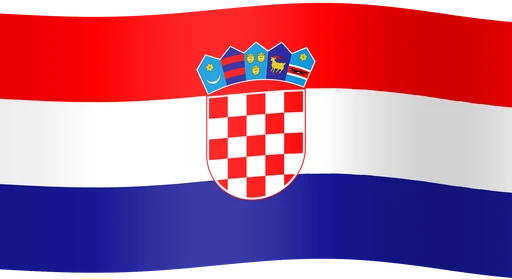
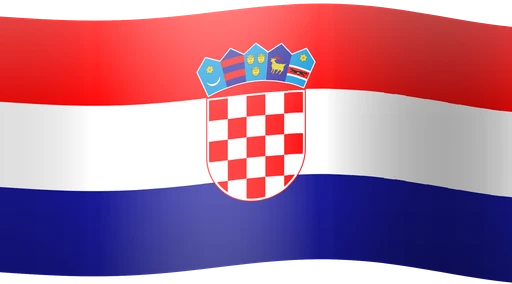
The Flag of Croatia
Republic of Croatia
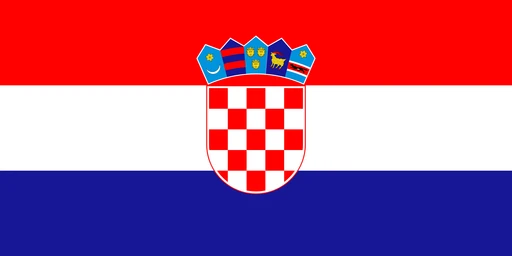
The flag of Croatia consists of three horizontal stripes in red, white, and blue, which are the Pan-Slavic colors representing freedom and revolutionary ideals. At the center of the flag is the coat of arms of Croatia, consisting of a shield with a red and white checkerboard pattern, above which are five smaller shields that represent the historical regions of Croatia. This distinctive checkerboard, known as the šahovnica, has been a symbol of Croatian kings since at least the 10th century.
Croatia's flag carries a feature found on no other national flag: a full coat of arms crowned by a miniature gallery of five historical shields. The red-white-blue tricolor puts it in the Pan-Slavic tradition, but the checkerboard shield at its center, the šahovnica, is far older than the modern state and goes back to medieval kingdoms. Croatia adopted the flag on December 21, 1990, as it moved toward independence from Yugoslavia.
The šahovnica: a chessboard older than the nation
The red-and-white checkerboard is the heart of the Croatian coat of arms and one of the oldest national symbols in continuous use anywhere in Europe. Its origins trace to at least the 10th century and the medieval Kingdom of Croatia. There's a popular legend that a Croatian king won his freedom in a chess match against a Venetian doge, and while the story makes for great telling, the historical basis is thin at best. The symbol more likely grew out of heraldic traditions among the Croat tribal nobility, evolving into a marker of identity long before modern nationalism existed.
The checkerboard has appeared in many configurations over the centuries. The current design uses a 5×5 grid of 25 fields, with a red square in the upper-left corner. That detail, red first, was a deliberate choice made in 1990. The reason is uncomfortable but important: during World War II, the Independent State of Croatia (NDH), a Nazi puppet state run by the Ustasha regime, used a šahovnica that began with a white square. By choosing the red-first variant, the framers of the modern flag put clear distance between the new republic and its darkest chapter.
The red-first versus white-first debate remains culturally sensitive. Vexillologists and historians are quick to point out that both versions predate the 20th century and appear in medieval manuscripts and carvings. But the political associations of the 1940s cast a long shadow, and in practice, the distinction matters enormously in Croatian public life.
Five crowns: a skyline of regional history
At the top of the coat of arms sit five smaller shields in an arc above the main checkerboard, forming a kind of heraldic crown. No other national flag attempts anything this layered.
Each shield represents a historical region. From left to right: the oldest known arms of Croatia proper (a blue shield bearing a gold six-pointed star above a silver crescent); the Republic of Dubrovnik (two red horizontal bars on blue); Dalmatia (three golden crowned leopard heads on blue); Istria (a golden goat on blue); and Slavonia (a gold star above a red bar flanked by blue, with a running marten beneath).
Taken together, the five shields argue for continuity: that modern Croatia is the heir to several distinct historical polities, each folded into the national story.
One detail spills off the flag and into daily life. The marten (kuna) on the Slavonian shield gave its name to the Croatian currency, the kuna, which circulated until January 2023, when Croatia adopted the euro. For decades Croatians carried their heraldry in their wallets.
Red, white, and blue, but which red, white, and blue?
The tricolor of red, white, and blue reflects Pan-Slavic colors adopted during the Illyrian movement of the 1830s and 1840s, a cultural and political campaign to unite South Slavic peoples. The Croatian tricolor was first flown during the revolutionary upheaval of 1848, when Ban Josip Jelačić led Croatian forces in support of the Austrian emperor against Hungarian revolutionaries. That makes the flag, from its very first public appearance, simultaneously a symbol of national awakening and imperial loyalty. History is rarely tidy.
Under Yugoslavia, the tricolor survived but was modified. The socialist-era flag placed a red star at its center, deliberately replacing the checkerboard coat of arms. The star said: this is a Yugoslav republic first, a Croatian one second.
Today, the specific shades of red and blue are defined by Croatian law in the Zakon o grbu, zastavi i himni, published in the Official Gazette (Narodne novine), with precise Pantone and CMYK values to ensure consistency across every flagpole and government document.
From kingdom to republic: the flag through regime changes
The checkerboard and the tricolor have both been in use, in some form, since the medieval period. But their combination and meaning have shifted dramatically with each political regime, like a sentence rewritten by every new author.
Under the Austro-Hungarian Empire, the Croatian tricolor was officially recognized as the symbol of the autonomous Kingdom of Croatia-Slavonia within the Hungarian half of the dual monarchy. It had legal standing, but limited sovereignty behind it.
The darkest chapter came between 1941 and 1945. The Independent State of Croatia, the NDH, used the šahovnica beginning with a white square on a flag that became associated with genocide and collaboration. That specific configuration was permanently tainted in public memory.
When Croatia declared independence in 1991, the new flag was a conscious act of rehabilitation: reclaiming the checkerboard as a civic symbol while picking the red-first variant to break from the NDH. The Croatian Parliament, the Sabor, adopted it on December 21, 1990, several months before the independence referendum of May 19, 1991, and the declaration of independence on June 25, 1991. The flag came first, and sovereignty followed.
Protocol, variants, and the flag in daily life
Croatian law governs the display, dimensions (a 1:2 ratio), and protocol of the national flag, including rules about when it must be flown at half-staff and penalties for desecration. The civil ensign, used by merchant ships, is the plain tricolor without the coat of arms. The naval ensign includes the full arms. This civil-versus-naval distinction is common across European vexillology, but most people never notice it unless they're watching ships in the Adriatic.
The presidential standard takes a different approach entirely: the coat of arms on a dark blue background, distinct from the national flag and reserved for the head of state.
The pattern is most visible in sport. The Croatian national football team has taken the checkerboard as a secondary identity, and its red-and-white checked jerseys mirror the šahovnica. During the 2018 World Cup, when Croatia reached the final, the pattern became globally recognizable overnight.
Controversy does surface abroad. People unfamiliar with Croatian history sometimes mistake the checkerboard for an Ustasha symbol, and Croatians and scholars push back by pointing to its medieval roots and centuries of use before the 1940s.
Neighbors and cousins: similar flags and mutual influences
Place the flags of Croatia, Serbia, and Slovenia side by side, and you'll see three nearly identical red-white-blue tricolors. The coats of arms do most of the distinguishing work. Serbia's features a white double-headed eagle; Slovenia's shows Mount Triglav. Without the arms, you'd be hard-pressed to tell them apart at a distance.
The Netherlands' flag, one of the oldest tricolors in the world, is sometimes cited as a visual twin. But there's no direct design lineage between the two. The resemblance is coincidental, a case of convergent evolution in flag design.
The checkerboard motif itself has parallels in other European heraldry, appearing in the arms of various Polish and German noble families. Yet no other nation uses it as a primary national emblem. It belongs to Croatia alone.
One last curiosity: Croatia's flag is sometimes compared to Paraguay's for sharing the unusual trait of displaying a detailed coat of arms. Paraguay famously has different emblems on each side. Croatia's flag technically shows the arms on both sides, making it simpler to produce but no less striking to encounter.
References
[1] Official Gazette of the Republic of Croatia (Narodne novine): Zakon o grbu, zastavi i himni Republike Hrvatske (Law on the Coat of Arms, Flag, and Anthem), consolidated text. https://narodne-novine.nn.hr
[2] Heimer, Željko. "Flags of Croatia." Flags of the World (FOTW). https://www.crwflags.com/fotw/flags/hr.html
[3] Smith, Whitney. Flags Through the Ages and Across the World. McGraw-Hill, 1975.
[4] Goldstein, Ivo. Croatia: A History. McGill-Queen's University Press, 1999.
[5] Jelić, Ivan. Grb i zastava Republike Hrvatske (Coat of Arms and Flag of the Republic of Croatia). Zagreb, 1994.
[6] Croatian Parliament (Sabor) official website: constitutional documents and flag specifications. https://www.sabor.hr
[7] Fédération internationale des associations vexillologiques (FIAV), International Congress of Vexillology proceedings.
Common questions
- What does the checkerboard pattern on the Croatian flag signify?
- The checkerboard, or šahovnica, has been part of Croatian heraldry since the medieval Kingdom of Croatia, and it is shorthand for Croatian identity.
- What do the five smaller shields above the checkerboard mean?
- They represent Croatia's historical regions: Croatia, Dubrovnik, Dalmatia, Istria, and Slavonia. Each carries that region's own arms.
- Why does the Croatian flag use red, white, and blue?
- The red, white, and blue colors symbolize Slavic heritage. Red signifies the struggle for independence, white symbolizes peace, and blue represents freedom.
- What does the checkerboard pattern on the Croatian flag mean?
- The red-and-white checkerboard is called the šahovnica, and it's one of the oldest national symbols in Europe. It goes back to at least the 10th century and the medieval Kingdom of Croatia. Croat nobility and rulers used it in various forms for centuries. The current version has a 5×5 grid of 25 fields, starting with a red square in the upper-left corner. It's basically shorthand for Croatian identity itself.
- Is the Croatian checkerboard associated with the Ustasha?
- No. The šahovnica dates back to at least the 10th century, hundreds of years before the Ustasha regime existed. It's one of Europe's oldest continuously used national symbols. The modern flag deliberately starts with a red square in the upper-left corner to distinguish it from the white-first version the WWII-era regime used. Historians consistently trace it back to its medieval origins as a legitimate national emblem.
- Why does Croatia's flag look so much like the flags of Serbia, Slovenia, and the Netherlands?
- Croatia, Serbia, and Slovenia all use red-white-blue tricolors that came out of the Pan-Slavic color tradition from the 1830s-40s Illyrian movement. Their coats of arms do the heavy lifting when it comes to telling them apart. The resemblance to the Dutch flag is just a coincidence, there's no actual design connection. Sometimes different countries just land on similar flag designs independently.
Featured in these articles
Download this flag
Free in 12 styles, from 32px icons up to 2000px, as SVG, PNG, WebP and JPG.