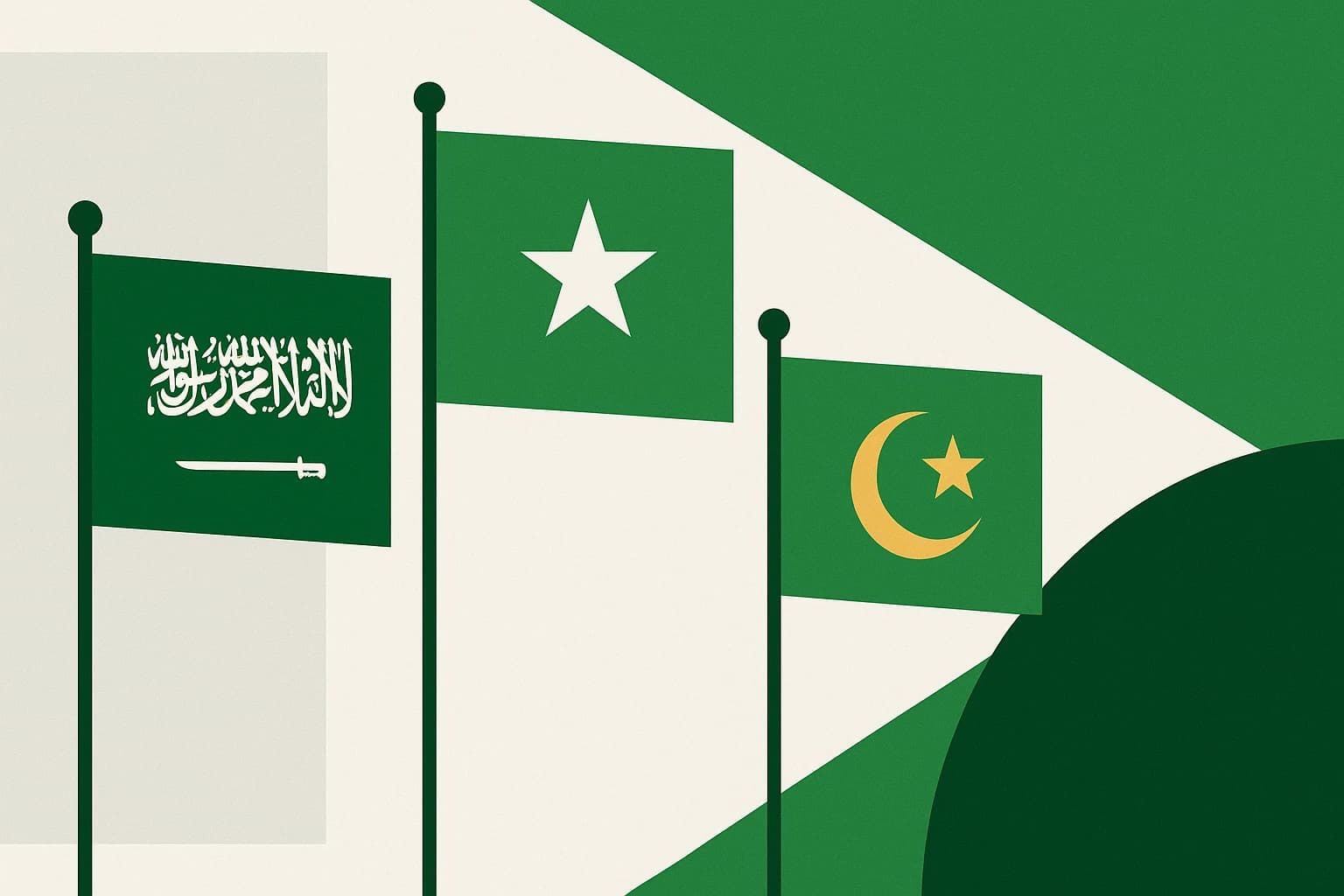
At the 2022 FIFA World Cup in Qatar, stadium staff faced a problem nobody had written a manual for. A Saudi Arabian fan's flag slips off the railing and lands on the concrete. A souvenir vendor wants to print it on disposable cups. A child waves a small paper version, then crumples it and tosses it in a bin. Each of these moments, trivial for any other nation's flag, becomes a theological incident when the flag in question carries the Shahada: "There is no god but God, and Muhammad is his messenger."
The Shahada is not a motto. It is the holiest declaration in Islam, the first of the Five Pillars, the sentence whispered into a newborn's ear and recited at the moment of death. Saudi Arabia stitched it onto a green field in white Thuluth calligraphy, paired it with a sword, and made it the centerpiece of their national banner. The result is the most theologically loaded piece of cloth in international relations.
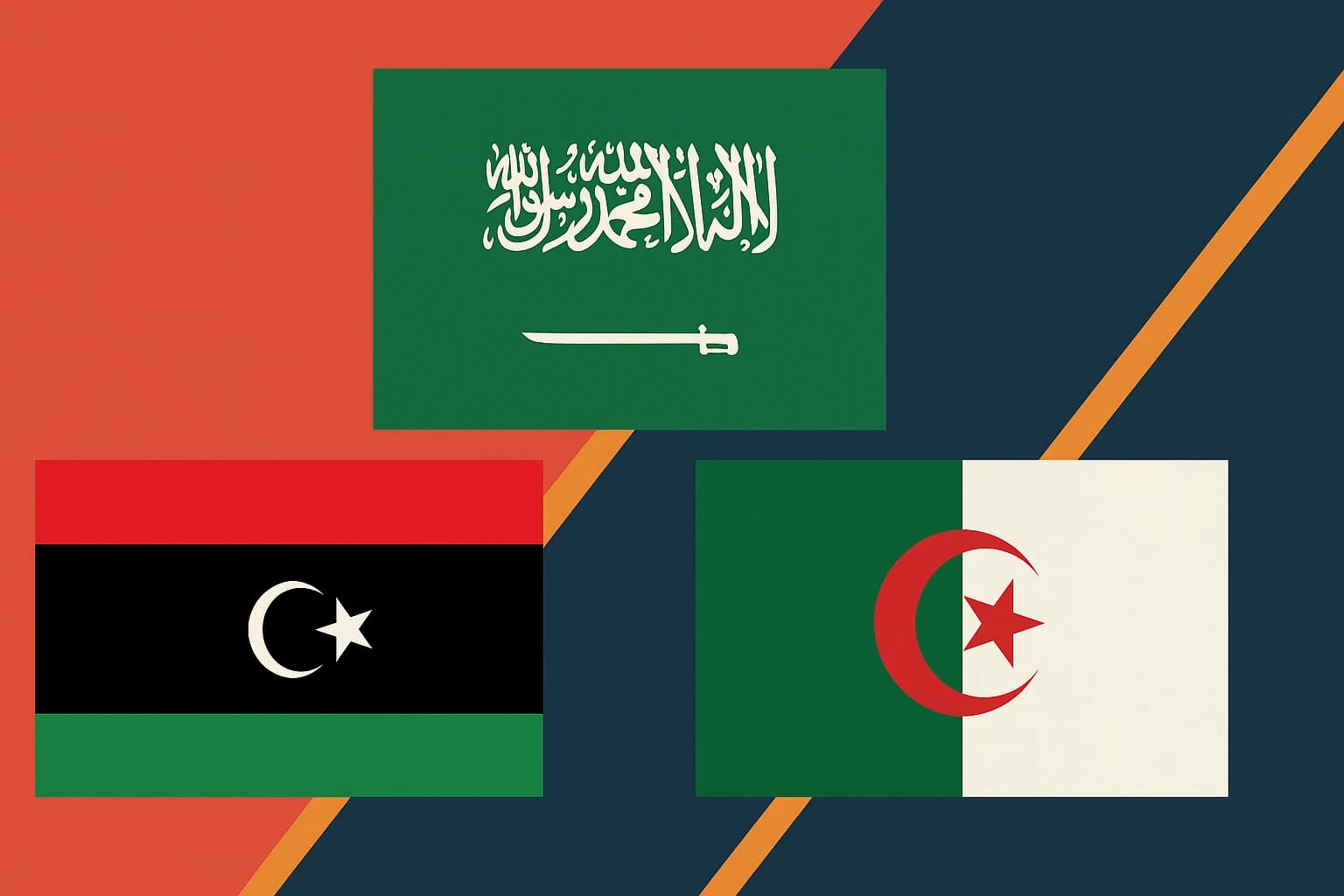
A flag is supposed to be a flexible, functional symbol of state. Flags get burned in protest, flown at half-mast in mourning, mass-produced for parades, and printed on cheap merchandise. The Shahada's sacred status makes all of these acts either forbidden or deeply controversial. The decision by Saudi Arabia, and to varying degrees Libya and Algeria, to inscribe or embed holy associations onto their flags was not an aesthetic whim. It was a binding, nearly irreversible act of theocratic self-identification with real geopolitical consequences. And most Muslim-majority nations deliberately chose not to do it, which says a good deal about how costly the choice was.
A flag is never a passive object
Flags operate differently from constitutions, anthems, or mottos. You don't need to read a flag. You don't need to translate it. A flag communicates instantly, across language barriers, at a distance. It's the most globally legible symbol a nation possesses.
That's why written script on flags is so rare. Of the 195 UN-recognized nations, only a small handful include any text or calligraphy. Brazil puts "Ordem e Progresso" on its banner. Iran uses a stylized "Allahu Akbar" repeated along its red and green borders. Afghanistan, under the Taliban, carries the Shahada.
But there's a categorical difference between a national motto rendered in text and a sacred religious declaration. Brazil's positivist slogan is a philosophical statement. It carries weight, sure, but nobody considers it blasphemous to print it on a beach towel. The Shahada occupies an entirely different plane. It is, for 1.8 billion Muslims, the literal word of God.
There's also the problem of what vexillologists call "flag permanence." Unlike a law or constitutional clause, changing a flag triggers an identity crisis. Laws get amended quietly. A flag change makes headlines, sparks protests, and forces every embassy, military unit, and government building on Earth to update their materials. When the text on the flag is sacred, the political cost of removal becomes essentially infinite.
Which raises the obvious question. If putting holy words on a flag creates this many complications, why did anyone do it, and why do they keep it?
Saudi Arabia: when the word of God becomes state property
The Saudi flag's design traces back to the 18th-century alliance between Muhammad ibn Saud and Muhammad ibn Abd al-Wahhab. That partnership fused political authority with religious legitimacy from the very first moment. The Shahada wasn't added to an existing state symbol. The state was built around the Shahada. The green field, the white calligraphy, the crossed swords beneath it: this is a flag that proclaims the Saudi state derives its authority from God, not from a social contract or popular sovereignty.
This isn't subtle, and it wasn't meant to be.
The practical consequences are constant. Saudi Arabia does not lower its flag to half-mast. Ever. Not for heads of state funerals, not for international days of mourning, not for anything. The reasoning is straightforward in Islamic terms: lowering the Shahada would imply that God's word can be diminished. At UN headquarters in New York, where all member state flags fly together, this creates recurring protocol headaches. When other flags drop to half-mast after a tragedy, the Saudi flag stays at full height. Diplomatic staff have developed workarounds, including flying a separate mourning banner alongside the national flag, but the visual dissonance persists.
Then there's the merchandise problem. FIFA, the IOC, and other international sports bodies have had to negotiate special protocols for Saudi Arabia. Printing the Shahada on paper flags, temporary bunting, or disposable items that will end up in a garbage bin is considered deeply disrespectful by Islamic scholars. During the 2022 World Cup, vendors quietly pulled certain Saudi-branded merchandise. Stadium shops stocked items carefully. The same challenges arose at the Olympics.
With Saudi Arabia's expanding global sports presence (LIV Golf, the 2034 FIFA World Cup awarded in December 2024), this issue is intensifying. Every new international event hosted or sponsored by the Kingdom brings the flag protocol question back to the surface. In 2026, as Saudi Arabia accelerates its sports investment strategy, the frequency of these diplomatic micro-negotiations is only going up.
Libya's revolving door: a flag as political battlefield
Libya offers the sharpest contrast to Saudi Arabia's flag stability. Where the Saudi banner has been essentially unchanged for over a century, Libya's flag history reads like a chronicle of political rupture.
The Kingdom of Libya, established in 1951, flew a black, red, and green tricolor with a white crescent and star. When Gaddafi seized power in 1969, the flag changed. And changed again. In 1977, Gaddafi introduced what remains one of the strangest national flags in modern history: a plain green rectangle. No emblem, no text, no symbol. A single, unadorned color.
This was deliberate. The plain green flag was a statement of Gaddafi's "Green Book" ideology, stripping away traditional Islamic calligraphy and symbolism in favor of his own brand of secular revolutionary politics. The flag was an argument about what a flag should say: in Gaddafi's vision, the answer was nothing except loyalty to his revolution.
When the 2011 revolution toppled Gaddafi, one of the National Transitional Council's first acts was restoring the 1951 tricolor. The flag change wasn't symbolic cleanup. It was a political argument, a rejection of Gaddafi's entire project, conducted through cloth and color.
The current Libyan flag carries a crescent and star. While this isn't written scripture, it is explicitly Islamic imagery, representing a conscious middle path. Libya signals Islamic identity through symbol rather than text, avoiding the theocratic literalism of Saudi Arabia's approach while still anchoring the nation in its Muslim heritage. Libya's flag history proves the central point from the opposite direction: the addition and removal of religious imagery tracks almost perfectly with shifts in political power. What goes on a flag is always a declaration of who is in charge.
Algeria: the Shahada-adjacent choice
Algeria's flag occupies a specific and instructive middle ground. It features a green and white field with a red crescent and star. Islamic imagery, yes. But no Arabic text, no Quranic verse, no Shahada.
This was a deliberate choice made during the 1954-1962 independence war. The FLN (Front de Libération Nationale) designed a flag that expressed pan-Arab and Islamic solidarity while stopping short of theocratic commitment. The founders wanted to signal cultural and religious identity without binding the state to a specific theological claim.
Algeria's post-independence history retroactively validates that caution. During the brutal civil war of the 1990s, the secular military government fought Islamist insurgents in a conflict that killed an estimated 200,000 people. The state and political Islam became adversaries. If the Algerian flag had carried the Shahada, the secular government would have been flying the very text their opponents used to justify armed struggle against them. The absence of sacred script gave the state flexibility that it badly needed.
Some Algerian Islamist movements have historically pushed for Arabic text or Quranic verses on state symbols. The resistance to that pressure tells its own story about how contested national identity remains. Algeria chose symbols over scripture, and that choice has proven prescient.
The road not taken: Morocco, Malaysia, Kuwait, and Pakistan
The most revealing evidence in this story isn't which countries put text on their flags. It's which deeply Islamic countries looked at the option and said no.
Morocco is a constitutional monarchy explicitly defined by Islam. The King holds the title Commander of the Faithful. And yet the Moroccan flag is a red field with a green pentagram, resolutely non-textual.
Malaysia's Jalur Gemilang ("Stripes of Glory") uses a crescent and 14-pointed star on a blue canton alongside red and white stripes. Malaysia is a Muslim-majority nation, but its population includes significant Chinese, Indian, and indigenous communities, roughly 35% non-Muslim. Putting the Shahada on the flag would have been an explicit act of exclusion. The designers understood this.
Kuwait and the UAE, despite strong Islamic governance and Wahhabist influence in the broader Gulf, designed flags that are secular in appearance. Kuwait's red, white, green, and black trapezoid design and the UAE's simple horizontal tricolor suggest that even states closely aligned with Saudi Arabia's religious establishment understood the practical complications the Kingdom had locked itself into.
And then there's Pakistan, the "Islamic Republic" that kept text off its flag. Pakistan was founded in 1947 explicitly as a Muslim homeland. Its flag uses a white crescent and star on green, with a white stripe along the hoist side representing religious minorities. Muhammad Ali Jinnah reportedly defended this inclusive design. Pakistan has since endured decades of tension between secular governance and Islamist politics, but the flag itself has never become a liability in diplomatic protocols. No special FIFA rules. No half-mast crises.
The absence speaks as loudly as the presence.
Living consequences: half-mast, merchandise, and burning
The practical problems created by sacred text on a national flag are not theoretical. They are documented, recurring, and growing.
At UN headquarters, Saudi Arabia's refusal to lower its flag during international mourning periods has generated quiet diplomatic friction for decades. When all other flags descend, the Saudi flag remains. The message, intentional or not, reads as indifference.
The merchandise issue recurs at every major sporting event. FIFA developed specific protocols for the 2022 World Cup. Paper Saudi flags were restricted at venues. Similar considerations apply to Afghanistan's Taliban-era flag, which also carries the Shahada.
Flag burning raises a more disturbing dimension. When protesters in Western capitals burn a Saudi flag, they are, from an Islamic jurisprudence standpoint, burning the name of God. Saudi authorities have used this framing to characterize political protest as blasphemy, conflating opposition to the Saudi state with an offense against Islam itself. No secular flag design allows that rhetorical move.
There's the inversion problem too. When the Saudi flag is displayed upside-down, whether by accident or in protest, the Shahada is inverted. This constitutes a profound desecration. Incidents at international sporting competitions have triggered diplomatic fallout, apologies, and investigations, all over the orientation of a flag that most event staff don't realize has a mandatory "right side up."
You cannot un-ring this bell
Despite all these complications, no nation that has put sacred text on its flag has seriously moved to remove it. The reason is simple: the political cost of removal is greater than the cost of keeping it.
For Saudi Arabia, removing the Shahada would be interpreted as the House of Saud renouncing its founding Wahhabi covenant. It would be read as an act of apostasy from the state's own origin story. Compared to that existential threat, dealing with FIFA merchandise guidelines is a minor inconvenience.
Compare this to successful flag changes elsewhere. South Africa replaced its apartheid-era flag in 1994.
Australia and New Zealand have debated removing the Union Jack. These changes were possible, or at least thinkable, because the old symbols carried negative associations. Sacred text carries only positive religious associations for the faithful. The political logic runs entirely in the opposite direction. No leader wants to be the one who "took God off the flag."
Afghanistan is the live experiment. The Taliban's flag carries the Shahada, so any future non-Taliban government inherits the same bind from the other side. Keep the flag and it reads as endorsement of the people who raised it. Change it and the charge of apostasy is waiting.
Saudi Arabia's global footprint keeps expanding, and with it the number of occasions where a green flag with white calligraphy has to be handled differently from every other flag in the room. That is the argument the design was making in the first place: the state is not the highest sovereign, and the flag says so in words rather than in symbols. Every time it goes up, and every time it conspicuously does not come down, the argument gets made again.