The Flag of The United Arab Emirates
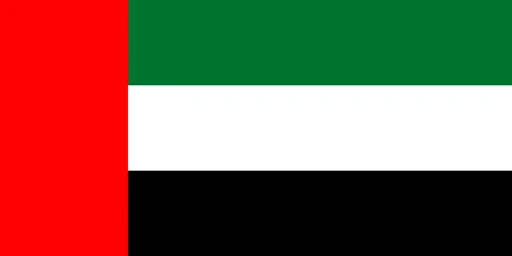
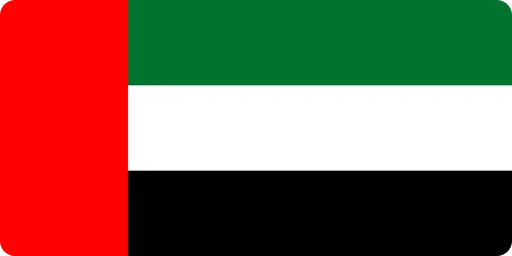
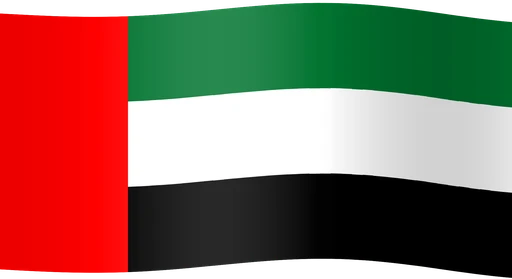
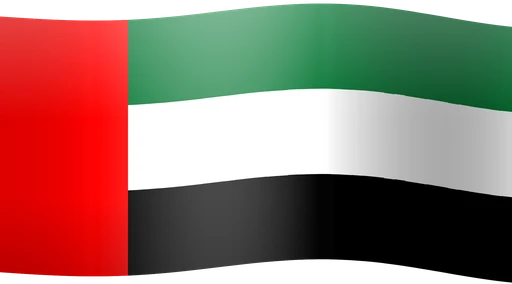
The flag of the United Arab Emirates (UAE) consists of a vertical red stripe at the hoist, next to three horizontal stripes of green, white, and black. These are the traditional Pan-Arab colors, and each carries its own meaning: green for fertility, white for neutrality and peace, black for oil wealth, and red for unity and for the blood of those who fought for the country.
When the United Arab Emirates declared independence from British protection on 2 December 1971, it did so under a flag that drew on a shared Arab heritage stretching back centuries. The UAE flag's four colors, red, green, white, and black, are the Pan-Arab colors, but the way they are arranged gave the new federation an identity of its own straight away. It was designed by Abdullah Mohammed Al Maainah, who was 19 when he won the national competition, and it has not changed in more than five decades. Until 1971 each of the seven emirates had flown its own banner.
A 19-year-old wins the competition
In 1971, as the federation was being assembled from seven formerly separate Trucial States, the new country needed a flag. A national competition was announced and over 1,000 entries came in. The winner was Abdullah Mohammed Al Maainah, a 19-year-old whose design beat submissions from artists and designers many years his senior. He took his idea from a poem by the 14th-century Iraqi poet Safiul Din Al Hili, which linked the four Pan-Arab colors to Arab virtues: white for deeds, green for fields, black for battles, and red for swords. Al Maainah turned that into clean geometry, putting a vertical red band at the hoist alongside three horizontal stripes of green, white, and black.
The flag was adopted on the same day the UAE came into existence, 2 December 1971. Al Maainah went on to a career in diplomacy and government and rose to senior positions, but the flag he drew as a teenager is the thing he is known for.
The design has also proved unusually durable. Many post-colonial nations revised their flags within a few years of independence, adjusting colors, adding emblems, or starting over. The UAE never did, and Al Maainah's original composition flies exactly as he drew it.
What the four colors mean
The four colors on the UAE flag didn't originate in the Emirates. They trace back to the Arab Revolt of 1916 against the Ottoman Empire, and before that to centuries of Islamic and dynastic symbolism. What the UAE flag adds is a local meaning for each color on top of the older Pan-Arab ones.
The vertical red band at the hoist is the first thing you see. Red has a long association with the Hashemite dynasty and, before that, the Kharijite movement in early Islamic history. For the UAE it means unity, courage, and strength. There is a more local resonance too. The Trucial States had flown red flags for generations as part of their treaty arrangements with Britain, so red was the color of the Gulf coast's political identity for over a century before the federation existed.
Green occupies the top horizontal stripe, carrying its near-universal Islamic association alongside meanings of hope, optimism, and fertile land. White sits in the middle, representing peace, honesty, and the country's charitable aspirations. Black fills the bottom stripe, often interpreted as the strength and resolve of the Emirati people, though some readings connect it to the oil wealth that transformed the federation from a collection of modest coastal sheikhdoms into one of the world's wealthiest states.
The flag's proportions are fixed at 1:2, height to width.
The flags of the Trucial States
Before 1971, each of the seven Trucial States flew its own flag, and most of them looked strikingly similar. Abu Dhabi's was plain red. Dubai's was red with a vertical white stripe at the hoist. Sharjah's added a white band as well, with minor variations distinguishing it from Dubai's. The pattern repeated across the other emirates with small tweaks that were, frankly, easy to miss.
This similarity caused real problems, especially at sea. Identifying which emirate a vessel hailed from was sometimes a matter of guesswork. One practical motivation for adopting a single national flag was simply to end the confusion.
The politics mattered more than the maritime convenience, though. When seven separate polities agreed to fly one flag, they were saying publicly that they had chosen a shared identity over their individual ones, and in 1971 that was not a foregone conclusion. Several emirates still keep their own flags for local ceremonial use, but the national flag takes precedence in all federal contexts.
Protocol and Flag Day
The UAE takes its flag seriously, both in law and in practice. Federal Law No. 2 of 1971, along with subsequent amendments, governs how the flag is used, prohibiting desecration and regulating display on government buildings, military installations, and diplomatic missions. It's flown at half-mast during official mourning periods, such as after the death of a head of state.
In 2013, Sheikh Khalifa bin Zayed Al Nahyan established UAE Flag Day by decree, celebrated every year on 3 November, the anniversary of Sheikh Zayed's accession to the presidency of the federation. The occasion has grown into a major national event, with coordinated flag-raising ceremonies held simultaneously across all seven emirates. Schools, government offices, and private companies participate, and landmarks across the country are draped in the national colors.
Some of the largest flags ever flown have appeared in the UAE. The flagpole on the Abu Dhabi Corniche once held a world record, and oversized flags are a regular feature at prominent sites. National Day on 2 December and Commemoration Day on 30 November (formerly known as Martyrs' Day) are the other peak moments for public flag displays, when the green, white, black, and red seem to appear on every building, car, and lapel in the country.
Other flags in the same palette
The UAE isn't the only country flying these four colors. Jordan, Kuwait, Palestine, Sudan, and several others draw from the same Pan-Arab palette, rooted in the same historical and poetic sources. Line them up and the family resemblance is obvious.
The closest visual cousin is Jordan's flag, which uses red, black, white, and green but arranges them with a chevron at the hoist and a seven-pointed star. Kuwait's flag uses the same four colors in a horizontal layout with a black trapezoid at the hoist, and it's the one most commonly confused with the UAE's. Palestine's horizontal tricolor of black, white, and green with a red triangle at the hoist is another near relative. At a glance, especially on a small screen or at a distance, mix-ups happen.
Once you know what to look for, though, the UAE's design is distinct: a vertical red band at the hoist paired with three horizontal stripes is a combination no other country uses. The shared palette is deliberate. It says that national borders don't erase a common cultural and linguistic heritage, and each country takes the same four colors and does something of its own with them.
References
[1] UAE Government Portal (u.ae), "National Symbols of the UAE," official information on the flag, Flag Day, and federal law. https://u.ae/en/about-the-uae/the-uae-flag
[2] Federal Law No. 2 of 1971 Concerning the Flag of the United Arab Emirates and the National Emblem.
[3] Whitney Smith, Flags Through the Ages and Across the World (New York: McGraw-Hill, 1975), comprehensive vexillological reference covering Pan-Arab flag symbolism.
[4] Flags of the World (FOTW), "United Arab Emirates," maintained by an international community of vexillology scholars. https://www.crwflags.com/fotw/flags/ae.html
[5] Al Maainah, Abdullah Mohammed, interviews published by WAM (Emirates News Agency) and The National, recounting the 1971 flag design competition.
[6] J.E. Peterson, The Arab Gulf States: Steps Toward Political Participation (New York: Praeger, 1988), historical context on the Trucial States and the formation of the federation.
[7] North American Vexillological Association (NAVA), resources on Pan-Arab color symbolism and flag design conventions.
Common questions
- What do the colors on the UAE flag represent?
- The flag uses the four Pan-Arab colors, and each one has its own meaning. The vertical red band on the hoist side represents unity, courage, and strength. Green on top is for hope, optimism, and fertility. White in the middle means peace and honesty. Black on the bottom signals strength and resolve, and it's sometimes connected to the country's oil wealth.
Featured in these articles
- One Poem, Two Flags: How the Arab World's Colors Split Into Rival Family Trees
- The Serrated Secret: Why Bahrain and Qatar Share the Same Zigzag, and What Britain Had to Do With It
- Guilty by Association: How Libya, Saudi Arabia, and Algeria Put Sacred Text on Their Flags, and Why Almost No One Else Dared
- The Serrated Edge: Why Bahrain and Qatar Chose Zigzag Lines While Every Other Nation Drew Straight Ones
Download this flag
Free in 12 styles, from 32px icons up to 2000px, as SVG, PNG, WebP and JPG.