The Flag That Had to Please Everyone: How the European Union's Circle of Stars Became the Most Negotiated Image in History
Julio Song · · 9 min read
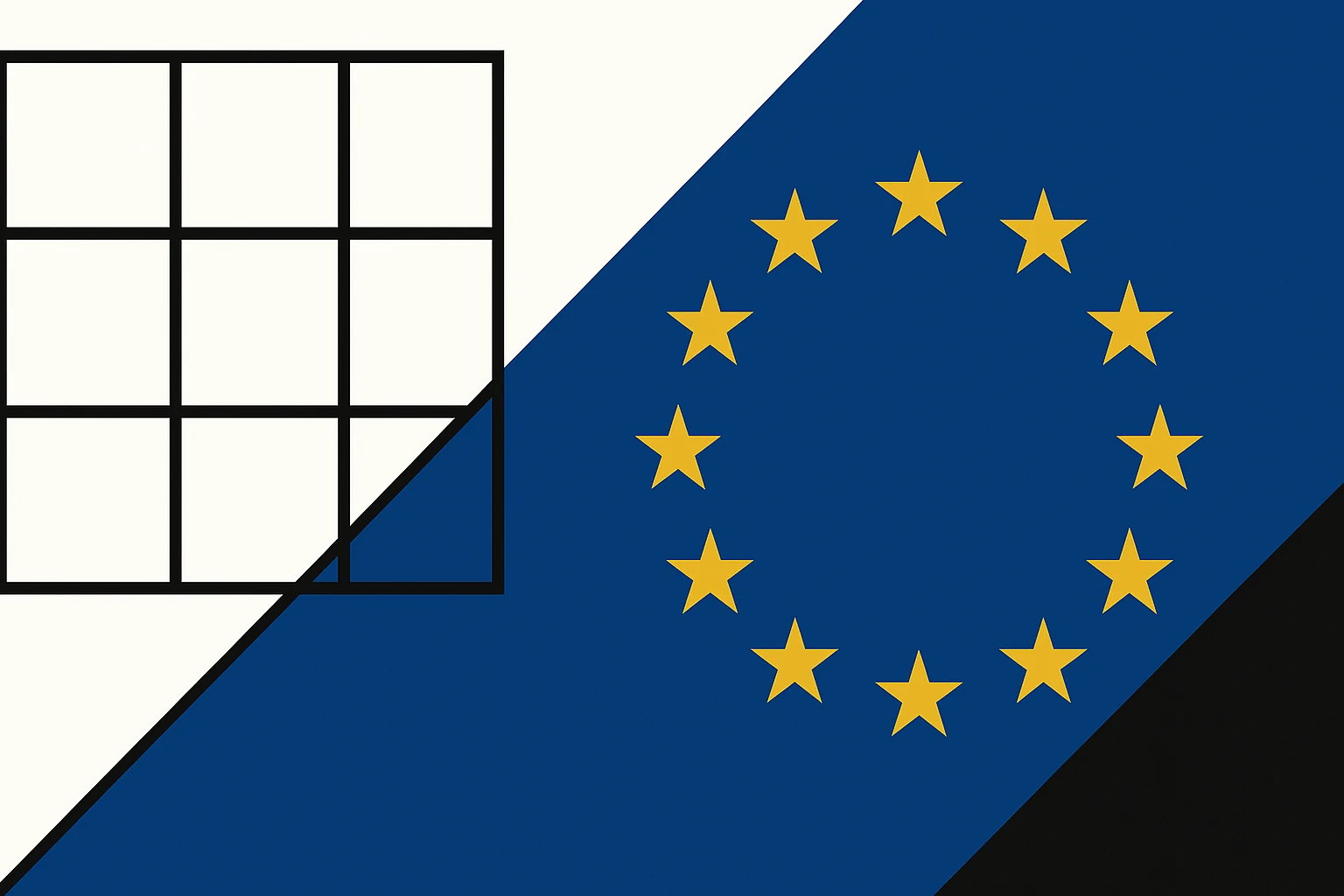
You've seen it a thousand times. The circle of twelve gold stars on a blue field, hanging outside embassies, courthouses and passport offices from Lisbon to Helsinki. It looks calm and inevitable, like something that has always existed.
It isn't. The EU flag was not designed by the EU. It took over three decades of political combat to reach a flagpole, and it nearly died because one Protestant delegate thought it looked too Catholic.
The gap between the flag's serene appearance and the frantic, paranoid, theologically charged process that produced it is wide. No committee can design a symbol meant to transcend politics without politics getting in the way. The story of how that circle of stars survived anyway is one of the odder design histories of the 20th century.
Before the EU: the Council of Europe's forgotten flag war (1950-1955)
The flag was designed by the Council of Europe, a separate, older and broader institution than the EU. Not by the European Economic Community. Not by any of its successors.
The year was 1950. Postwar Europe was a continent desperate to project unity it did not yet feel, and the Council of Europe, founded in 1949 in Strasbourg, needed a visual identity to legitimize itself, quickly.
What followed was design chaos. Early proposals flooded in. One featured a large green "E" on a white background. Another scattered fifteen stars across the field in no discernible pattern. The European Movement submitted a yellow "E" on white. All rejected. Too literal, too national, too ugly.
The committee faced an impossible brief: design a flag that evokes unity, authority and European-ness without referencing any single nation's color, religion, history or alphabet. Any symbol strong enough to mean something would inevitably mean the wrong thing to someone.
For five years, proposals stalled. Then, in 1955, a Consultative Assembly committee received a hard deadline, and that pressure forced the compromise that became one of the most recognized symbols on Earth.
The twelve-star question
Twelve stars does not represent the number of founding members. It does not represent the number of member states at any given time. It represents no political headcount whatsoever.
The number twelve was chosen for its symbolic resonance as a number of completeness and perfection. Twelve months in a year. Twelve hours on a clock face. Twelve apostles. Twelve signs of the zodiac. A number that, crucially, could never become "wrong" as membership changed.
The specific arrangement is often credited to Arsène Heitz, a designer working for the Council of Europe's postal service. His own later statements about Marian symbolism, the woman crowned with twelve stars in Revelation 12:1, added retrospective theological weight to what was officially a secular design choice.
The "twelve equals members" myth propagated anyway. When the European Economic Community had six members in 1958 and the flag showed twelve stars, journalists and diplomats invented explanations. They were doubling the members. They were representing future aspirants. People will find meaning in a symbol whether you put it there or not.
Fixing the number at twelve had a quiet advantage. By anchoring the count to symbolism rather than membership, the designers, perhaps accidentally, future-proofed the flag against every enlargement. From the original six members to the twenty-seven member states of the EU in 2026, the number has never needed updating.
The Marian crisis
In 1953, an early version of the circular star design was gaining consensus. Then a delegate raised an alarm. The circle of twelve gold stars on blue, he argued, was unmistakably the iconographic symbol of the Virgin Mary as depicted in the Miraculous Medal and countless Catholic artworks: Mary, crowned by twelve stars on a blue field.
The stakes were enormous. The Council of Europe included Protestant-majority nations (the UK, Scandinavia, the Netherlands) alongside Catholic-majority ones like France, Italy and Belgium. A flag that read as a Catholic devotional image to half its audience was politically radioactive in 1950s Europe, where memories of confessional conflict were less than a century old.
Proponents fought back. The blue was not specifically Marian blue, they argued. The stars were five-pointed and secular, not arranged in the specific patterns of Catholic iconography. The symbolism of circles and stars predated Christianity entirely. These were reasonable arguments. They were also, strictly speaking, beside the point, because symbols mean what people see in them, not what designers intend.
The resolution carries a delicious irony. Arsène Heitz later claimed in interviews that he had absolutely intended the Marian reference, having been inspired by a statue of the Virgin in the Cathedral of Strasbourg. The flag survived the theological objection by being officially secular, while its designer privately considered it a devotional object. That ambiguity was the only reason it survived.
The long wait: why the EU resisted its own flag for thirty years
When the European Economic Community was founded in 1957 through the Treaty of Rome, it deliberately chose not to adopt the Council of Europe's flag. The concern was straightforward: conflating two different institutions with different memberships and mandates would create confusion.
So the EEC went flagless. Through the 1960s and 1970s, the Community operated without an official flag, using a variety of ad hoc logos and the national flags of member states. It was institutional awkwardness, and it mirrored the political reluctance to push for deeper symbolic union.
During the 1970s, MEPs and federalist advocates repeatedly proposed adopting the Council of Europe flag. The two institutions shared values, they argued, and the flag had already achieved recognizability. Opponents, particularly nationalists and Gaullists, countered that a shared flag implied a superstate and should be resisted at all costs.
The deadlock broke between 1983 and 1985. The Solemn Declaration on European Union in 1983, then the Milan European Council in 1985, saw Heads of Government formally resolve to adopt the flag. Implementation came in 1986, thirty-one years after the flag's original design. By then the flag was already so associated with the "European idea" in the public imagination that refusing it would have looked stranger than accepting it. The EU didn't so much choose the flag as acknowledge that the flag had already chosen the EU.
What the flag does and doesn't unify
The EU flag functions as what semioticians call an "empty signifier," a symbol strong precisely because it does not have a fixed, specific meaning. Europhiles, eurosceptics, technocrats and federalists all project their own content onto it.
It reappears at every moment of European crisis. The Maastricht debates of 1992. The Constitutional Treaty rejection in 2005. The Brexit referendum of 2016, where both Remain and Leave campaigns used European imagery for opposite purposes. The Russian invasion of Ukraine in 2022 prompted a wave of EU-flag solidarity across the continent that the flag's designers in 1955 could never have anticipated.
But the flag has a curious vulnerability. Because it was designed to offend no one, it lacks the emotional pull of flags that carry genuine historical weight precisely because they were never designed by committee.
Compare the American Stars and Stripes, born from revolution, or the Union Jack, layered through centuries of political union. Those flags provoke strong feelings. The EU flag provokes acknowledgment.
Other European symbols struggled more. The proposed European anthem, Beethoven's "Ode to Joy," was adopted alongside the flag in 1985 and faced similar battles. The EU motto, "United in Diversity," formalized in 2000, remains almost entirely unknown to European citizens in 2026. The flag succeeded where these other symbols stumbled.
The blandness is arguably the point. In a union of twenty-seven sovereign nations with twenty-four official languages, a flag that sparks no strong reaction in any of them is the only kind of flag that could have survived.
Design by committee
The EU flag's journey is a case study in what happens when symbol-making is a democratic, multi-stakeholder process rather than an act of individual creative vision. Most national flags were designed by individuals or small groups under unified political authority. International committees work differently.
The United Nations flag went through similarly tortured negotiations.
The flag of the African Union, adopted in 2010, faced analogous tensions between pan-African symbolism and the sensitivities of fifty-five member states.
What let the EU flag survive its committee was abstraction over representation (stars instead of landmarks), a palette of two colors, and a mathematical rather than narrative composition: a circle, not a scene.
The professional vexillological consensus is telling. The North American Vexillological Association's five principles of good flag design, simplicity, meaningful symbolism, two or three basic colors, no lettering or seals, and distinctiveness, are all satisfied by the EU flag. Not by intention, but as a byproduct of stripping out everything anyone could object to.
Which suggests the EU flag is the most successfully designed flag in modern history precisely because no single designer ever got to impose a vision on it. Every compromise that nearly killed it made it slightly more universal.
Still flying, still contested
That serenity cost five years of failed proposals, a near-death experience over Catholic iconography, thirty-one years of institutional resistance, and a designer who privately believed he was making a devotional object while publicly insisting he was not. The flag that looks like it was always inevitable was, at every step, almost not.
Symbols that survive political gauntlets do not do so by rising above politics. They survive by becoming capacious enough to contain contradictions. The twelve stars on blue work not because they mean one clear thing, but because they mean something slightly different to everyone who looks at them, and nothing offensive enough to anyone for them to tear it down.
The arguments over sovereignty, enlargement and identity running in 2026 are exactly the kind the flag is capacious enough to contain, which is why it has outlasted them.
Julio Song
Writer
Julio is a staff writer at FlagDB. He studied Mathematics at the University of Madrid and has a passion for vexillology.
More from Julio Song →