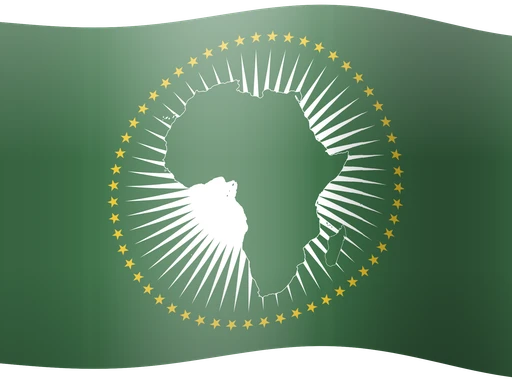
The Flag of The African Union
The African Union
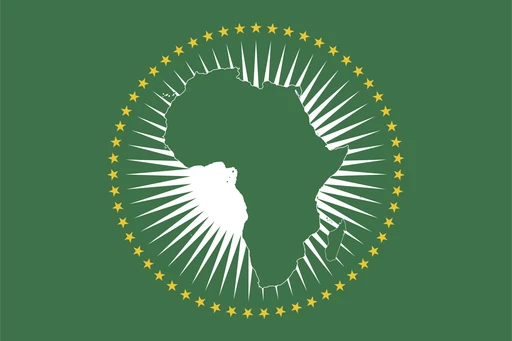
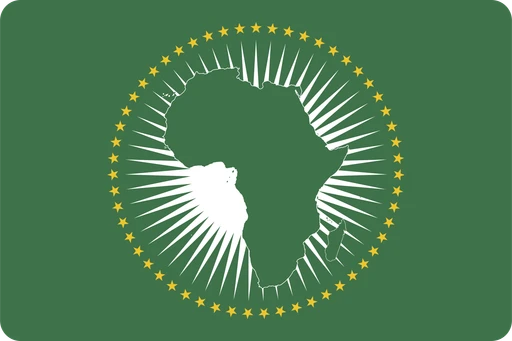
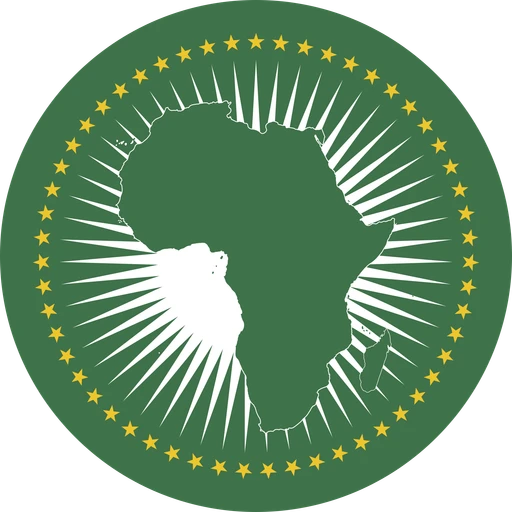
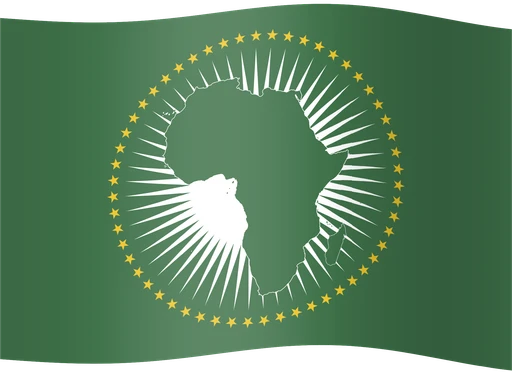
The flag of the African Union (AU) is a green field with the AU emblem at the center. The emblem is a gold circle enclosing a gold map of Africa, the island of Madagascar included, ringed by a green circle carrying the words 'African Union' in English and 'Union Africaine' in French. Gold stands for Africa's wealth and its future, green for African hopes and aspirations.
The flag of the African Union, a golden map of the continent set against a deep green field, encircled by a ring of gold stars, has been redesigned more often than almost any other emblem of an international organization. Its current design, adopted in 2010, replaced a version that had itself only existed for eight years, which in turn replaced the emblem of the Organisation of African Unity, the AU's predecessor born in the era of decolonization. Each attempt has been a search for an image that can credibly speak for 55 member states at once.
Three flags in twenty years
When the Organisation of African Unity was founded in 1963 in Addis Ababa, its emblem carried the optimism and urgency of decolonization: a gold map of Africa on a green field, framed by a gold wreath and a border of interlocking chain links. The chain symbolized solidarity among newly independent nations. That emblem lasted nearly four decades, outliving the organization's ability to prevent coups, civil wars, and famines, but never losing its association with the first generation of African liberation leaders.
In 2002, the OAU formally dissolved and reconstituted itself as the African Union, modeled partly on the European Union, with ambitions for deeper economic integration and a more muscular stance on governance. A new flag arrived with the new name: a green field interrupted by a broad white horizontal stripe bearing the AU emblem and 53 gold stars, one for each member state. It looked busy. Critics said the white stripe was too reminiscent of colonial-era imagery, and the overall composition felt cluttered, more corporate letterhead than continental banner.
The fix came in 2010, at the AU Summit in Kampala, Uganda. Delegates adopted a cleaner, bolder design: a dark green field with no white stripe, a golden silhouette of Africa at the center, a radiant sun rising behind the continent's outline, and 55 stars arranged in a circle. The number of stars has shifted over the years. The original 2002 flag carried 53; South Sudan's independence in 2011 brought the count to 54; Morocco's readmission in 2017, after a 33-year absence, pushed it to 55. Each change raises a practical question that flag manufacturers know all too well: when do you update the template?
Green, gold, and the weight of pan-African color
The AU's colors were chosen as much for what they avoid as for what they mean. The green field stands for natural wealth, hope and agricultural heritage. It also keeps its distance: the designers consciously steered away from the red-black-green of Marcus Garvey's pan-African movement and the red-gold-green of the Ethiopian tricolor, both of which carry partisan or regional connotations that could alienate portions of the membership. The specific shade, sometimes called "AU green," was selected to be darker and more distinct than the green on any single member state's flag.
Gold carries several meanings at once: mineral wealth, the sands of the Sahara, and prosperity to come. Rendering the entire continent in gold, rather than outlining it or filling it with topographic detail, turns the map into something almost heraldic, a device that transcends the colonial borders still visible on any political atlas.
The circle of 55 gold stars deliberately echoes the European Union's ring of twelve, a nod to the AU's institutional inspiration. But the star carries its own African pedigree: count the national flags featuring a star and you'll find Ghana, Ethiopia, Senegal, Morocco, Mozambique, Somalia, and over a dozen others. Behind the map, the radiant burst of the rising sun signals the concept of an "African Renaissance," a phrase championed by South Africa's Thabo Mbeki in the late 1990s, promising cultural, economic and political renewal.
A continent on the flag
Few international organizations put a literal map at the center of their flag. The United Nations does it, in stylized form, but the AU's golden silhouette is more geographically precise and more politically loaded.
Madagascar and the other island states are on the map, and their inclusion is deliberate. The AU's definition of "Africa" isn't limited to the continental landmass; it takes in Comoros, Mauritius, Seychelles, Cape Verde, and São Tomé and Príncipe. Leaving them off would be a political statement rather than a cartographic oversight.
Then there's Western Sahara. The map depicts the full territory, reflecting the AU's recognition of the Sahrawi Arab Democratic Republic as a member state. This single cartographic choice has caused real diplomatic friction. Morocco left the OAU in 1984 over precisely this issue and only rejoined the AU in 2017, making it the last country readmitted. The map also quietly reinforces the AU's commitment to the principle of uti possidetis juris, the idea that inherited colonial borders, however arbitrary, should remain inviolable. It's a map that simultaneously projects unity and freezes the territorial status quo.
Protocol and display
At AU headquarters in Addis Ababa, the flag flies alongside the national flags of all 55 member states, arranged in English alphabetical order. Protocol is specific: the AU flag should be flown alongside, never above, member state flags. Sovereignty comes first.
Beyond Addis Ababa, the flag appears at every AU summit, on the uniforms and vehicles of AU peacekeepers (most visibly in the AMISOM/ATMIS mission in Somalia), and at diplomatic missions worldwide. It's increasingly common at international sporting events, too. During the African Cup of Nations and the Olympics, fans wave it as an informal continental banner, a use that has no official sanction but plenty of emotional resonance.
Variants exist for different contexts. The AU emblem, without the green field, appears on official documents, letterheads, and digital platforms, where a simplified version renders better at small sizes. Africa Day, celebrated on May 25, the anniversary of the OAU's founding, is the primary occasion for ceremonial display across the continent and in diaspora communities from London to São Paulo.
Echoes and influences
Place the AU flag next to the European Union's and the family resemblance is obvious: a circle of stars on a solid field. The continental map is what separates them. Where the EU settled on abstraction, the AU put the land itself on the flag.
The relationship between the AU flag and the two dominant pan-African color traditions is one of respectful distance. The Ethiopian green-yellow-red tricolor inspired dozens of African national flags after Ghana adopted those colors at independence in 1957. Garvey's red-black-green, introduced through the Universal Negro Improvement Association flag of 1920, influenced a separate lineage. The AU sidesteps both by omitting red and black entirely, opting for a palette that belongs to no single tradition.
Sub-regional organizations have developed their own visual vocabularies in parallel. The flags of ECOWAS, SADC, and the East African Community all feature star circles, continental outlines, or green-and-gold palettes that echo, and in some cases predate, the AU's choices. And long before any of these institutions existed, delegates at early pan-African congresses debated what a unified African flag should look like. Those conversations, stretching back over a century, are still unresolved, and the current flag is only the latest answer to them.
References
[1] African Union Official Website, "Symbols of the Union." https://au.int/en/symbols
[2] Assembly/AU/Dec.308(XV), Decision on the Flag of the African Union, 15th Ordinary Session, Kampala, Uganda, July 2010.
[3] Constitutive Act of the African Union (2000), particularly articles on institutional symbols.
[4] Znamierowski, Alfred. The World Encyclopedia of Flags. Lorenz Books, 2013.
[5] Murithi, Timothy. The African Union: Pan-Africanism, Peacebuilding and Development. Ashgate, 2005.
[6] Eriksen, Thomas Hylland, and Richard Jenkins. Flag, Nation and Symbolism in Europe and America. Routledge, 2007.
[7] Smith, Whitney. Flags Through the Ages and Across the World. McGraw-Hill, 1975.
[8] Nkrumah, Kwame. Africa Must Unite. Frederick A. Praeger, 1963.
[9] Flags of the World (FOTW), African Union page. https://www.crwflags.com/fotw/flags/int-au.html
Common questions
- What does the African Union flag's emblem show?
- A gold circle enclosing a gold map of Africa, with Madagascar included, ringed by a green circle carrying the words 'African Union' in English and 'Union Africaine' in French. Gold stands for Africa's wealth and its future, green for African hopes and aspirations.
- When was the African Union flag adopted?
- The African Union was established on 9 July 2002 as successor to the Organisation of African Unity, and adopted a flag then. The current version dates from 2010, when the AU folded its new logo into the design as part of a push to make the Union more visible internationally.
- What was the flag of the Organisation of African Unity?
- The OAU, which the African Union replaced in 2002, used a green field with a gold map of Africa on a white disc, ringed by interlocking chains representing solidarity. The AU's design keeps the map and the gold-on-green scheme while dropping the chain motif.
- Why does the African Union flag include Madagascar?
- The map is drawn to include the island alongside the continental landmass, making the point that AU membership is continental in the broad sense. All 55 member states are represented by the map as a whole rather than by individual stars or stripes.
Featured in these articles
- The Flag That Had to Please Everyone: How the European Union's Circle of Stars Became the Most Negotiated Image in History
- The Sahrawi Riddle: How Western Sahara Flies a Flag for a Country That Doesn't Fully Exist
- Vexillology 101: How to Read a Flag
- Flags of International Organizations: UN, EU, and Beyond
Download this flag
Free in 12 styles, from 32px icons up to 2000px, as SVG, PNG, WebP and JPG.