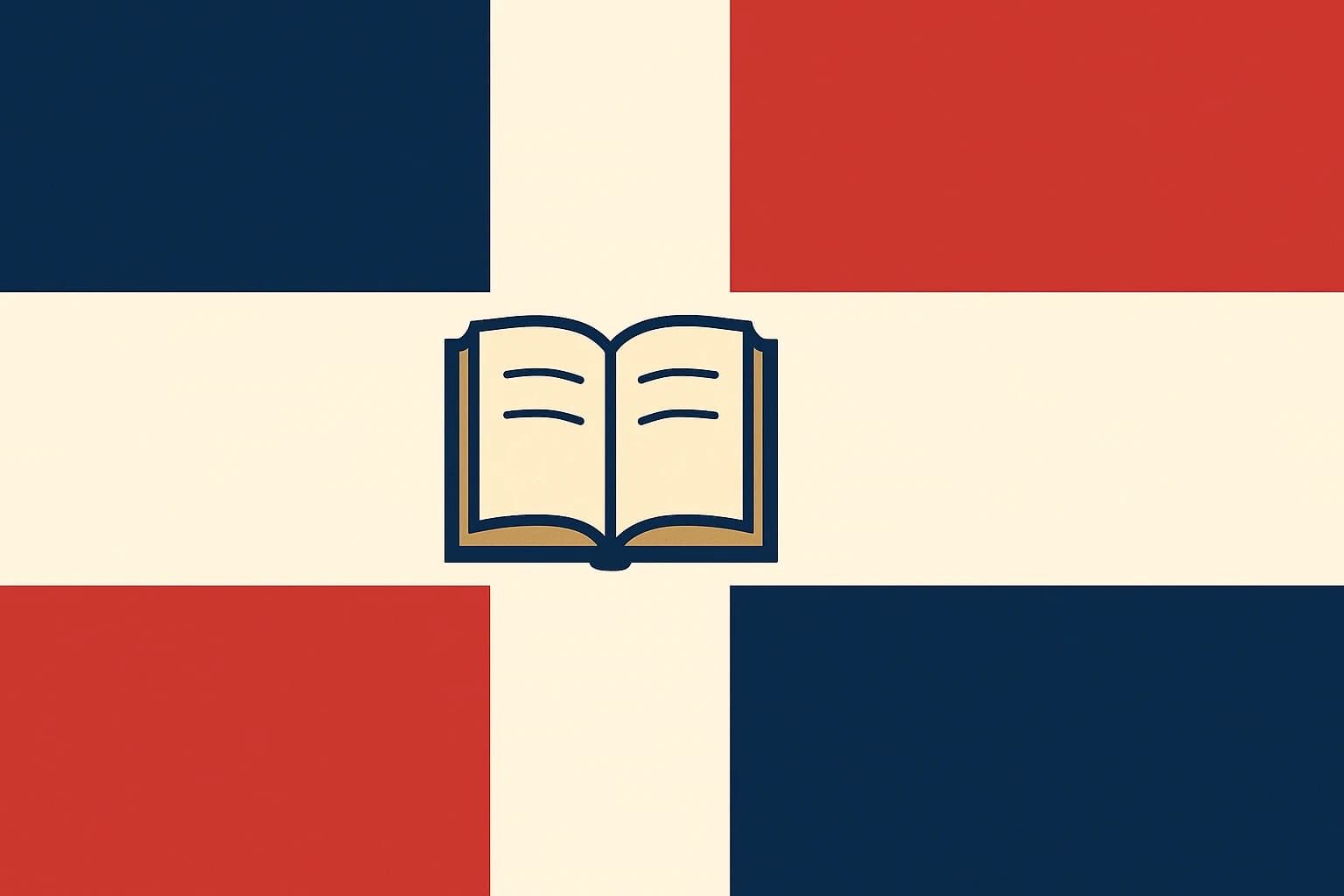
Of the 193 sovereign nations recognized by the United Nations, exactly one puts an open book of scripture on its flag. Not a cross, not a crescent, not an abstract geometric nod to the divine. An actual Bible, open to a specific verse, legible if you get close enough. The Dominican Republic's coat of arms, centered on its red, white, and blue banner, shows the Gospel of John 8:32: "Y la verdad os hará libres" ("And the truth shall make you free").
For a nation born in rebellion the choice looks almost too neat, and the route it took to get there involves a secret society modeled on revolutionary cells, an urgent need to look unlike neighboring Haiti, and a Catholic Church that functioned as both spiritual authority and political instrument.
A flag born in conspiracy
In 1838 a young intellectual named Juan Pablo Duarte founded La Trinitaria, a clandestine independence movement structured like the European revolutionary cells of the period. Members organized in groups of three, which is where the name comes from. Each cell worked independently, and no member knew more than two others. The aim was to free the eastern two-thirds of Hispaniola from Haitian rule, which had governed the whole island since 1822, first under Jean-Pierre Boyer and later Charles Rivière-Hérard.
That is what makes Dominican independence unusual in the Western Hemisphere. On February 27, 1844, the Dominican Republic declared independence not from a European colonial power but from Haiti, and the flag was designed to look unmistakably not Haitian.
The original design, attributed to Duarte and his fellow Trinitarios, put a white cross across blue and red quadrants, a deliberate inversion of the Haitian flag's color scheme. The cross announced Christian identity in contrast to Haiti's Vodou-influenced culture, or at least to the Dominican perception of it. Every choice was an act of differentiation.
The coat of arms, Bible included, appeared in the flag's earliest versions and was formalized through successive constitutions. Details shifted over the decades: the arrangement of the flags, the style of the laurel branches, the rendering of the shield. The scripture at the center never moved.
Reading the coat of arms
The Bible sits open and propped upright at the center. Six national flags flank it, three on each side. A gold cross rises above the book. Laurel branches frame the left of the shield for victory, palm branches the right for liberty. A blue ribbon above reads "Dios, Patria, Libertad": God, Fatherland, Liberty.
The order of that motto is doing work. God, then country, then freedom, encoding a vision of sovereignty underwritten by divine authority. Nobody puts God first in a national motto by accident.
John 8:32 was chosen as a theological and political statement at once. In its biblical context Jesus is speaking about spiritual liberation through divine truth; the Trinitarios repurposed it as a claim about political liberation, and it worked as both theology and battle cry.
The book is also open, which matters. A closed Bible suggests sacred mystery, knowledge held by an authority. An open one suggests scripture meant to be read by everybody, which fits the 19th-century liberal Catholic sensibility that treated faith and Enlightenment reason as compatible.
Nothing else in world vexillology matches it. Not a vague religious gesture, not an abstract shape, but a specific identifiable passage of holy text rendered legibly on a state emblem.
Faith as a border
The independence movement was shaped at nearly every level by opposition to Haiti, and religion became one of the sharpest available lines.
Haitian rule had confiscated Church properties and expelled or marginalized Catholic clergy. In Dominican nationalist rhetoric, Haiti was associated with Protestantism and Vodou, two traditions that made convenient foils for Catholic identity. Whether the associations were accurate or fair is a separate question. What mattered was the equation: Dominican meant Catholic, and Catholic meant not Haitian.
Duarte, Ramón Matías Mella, and Francisco del Rosario Sánchez positioned Catholicism as a public, civic institution rather than a private faith, and the Bible on the flag was the most visible expression of that.
The differentiation had racial dimensions too. Dominican nationalist ideology often emphasized the country's Spanish, Catholic, European heritage against Haiti's African and Creole identity, and the Bible functioned as a cultural boundary marker whether or not anyone intended it that way. The claims were politically useful even where they were historically messy.
The Concordat of 1954 between the Dominican Republic and the Vatican, signed under the Trujillo dictatorship, made Roman Catholicism the state religion and cemented the Church's official role. The Bible on the flag was never contested domestically, in part because the regime that formalized its status controlled everything else as well.
The Dominican constitution still references God in its preamble, and the coat of arms is unchanged. Nineteenth-century religious symbolism has survived every upheaval from Trujillo's tyranny through democratic transition without a single revision.
How other flags encode religion without spelling it out
Set against how other nations handle religion, the Dominican approach gets stranger.
Crosses are the most common religious element. The Nordic cross on the flags of Denmark, Norway, Sweden, Finland, and Iceland began as a Christian crusading emblem, and Denmark's Dannebrog, with its legend dating to 1219, is often called the oldest continuously used national flag in the world. The cross has been absorbed so completely into cultural identity that most Scandinavians no longer read it as religious at all.
The Union Jack layers three crosses, St. George, St. Andrew, and St. Patrick, each tied to a patron saint, and functions today as a secular national symbol.
Tonga went the other way. Its red cross on a white canton is an explicit Christian statement, enshrined in the constitution as unalterable.
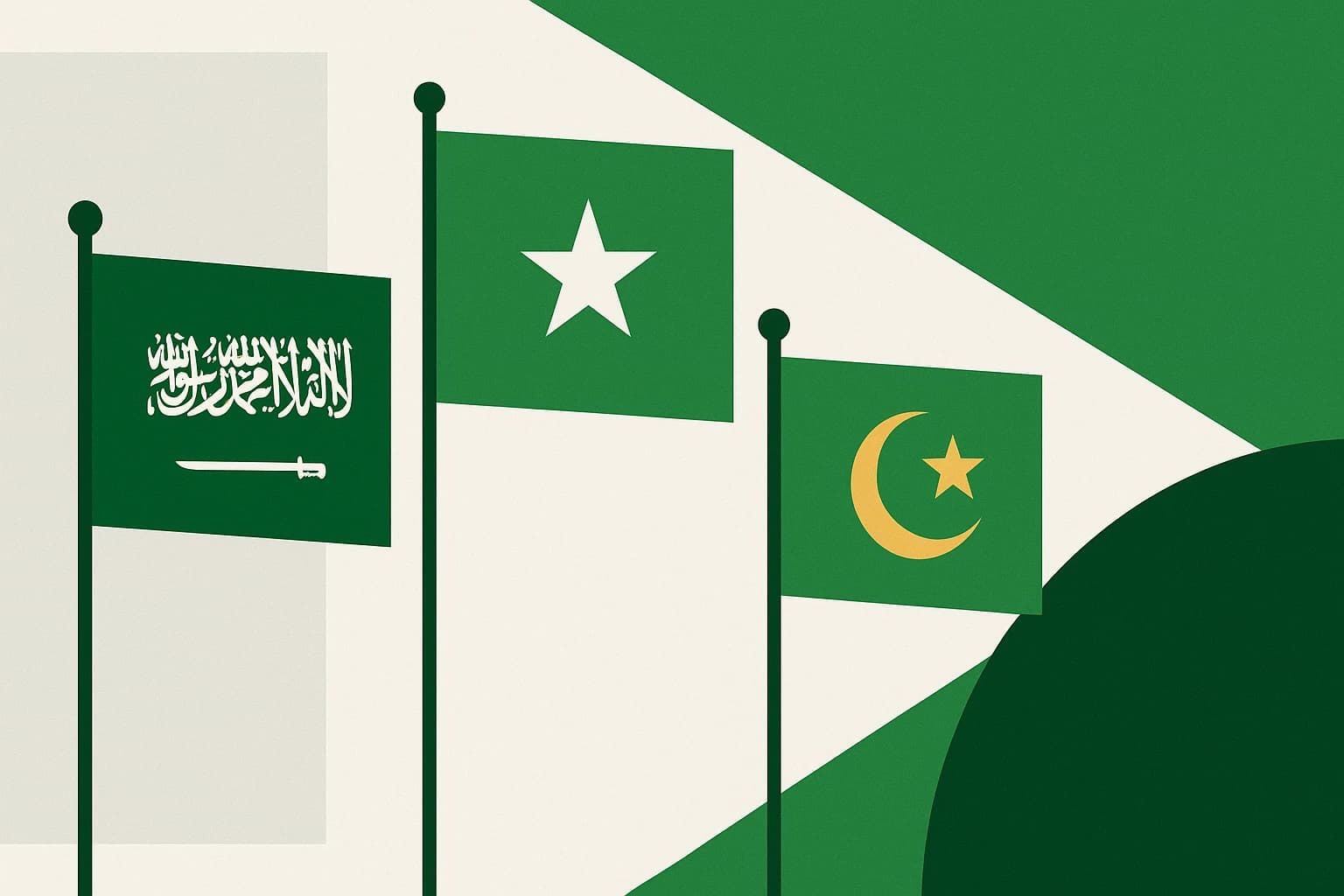
Islamic symbolism appears on the flags of Turkey, with a star and crescent from Ottoman tradition, Pakistan, where the crescent and star sit alongside a white stripe for minorities, and Mauritania, with a crescent and star on the green of Islam. All recognizable, all abstract. No Quranic verse is quoted.
India's Ashoka Chakra, the 24-spoke wheel at the center of the flag, comes from Buddhist iconography, the Dharma wheel on Ashoka's pillars, but the secular Indian republic adopted it as a symbol of law and righteousness rather than of Buddhist faith. Religious in origin, secular in application.
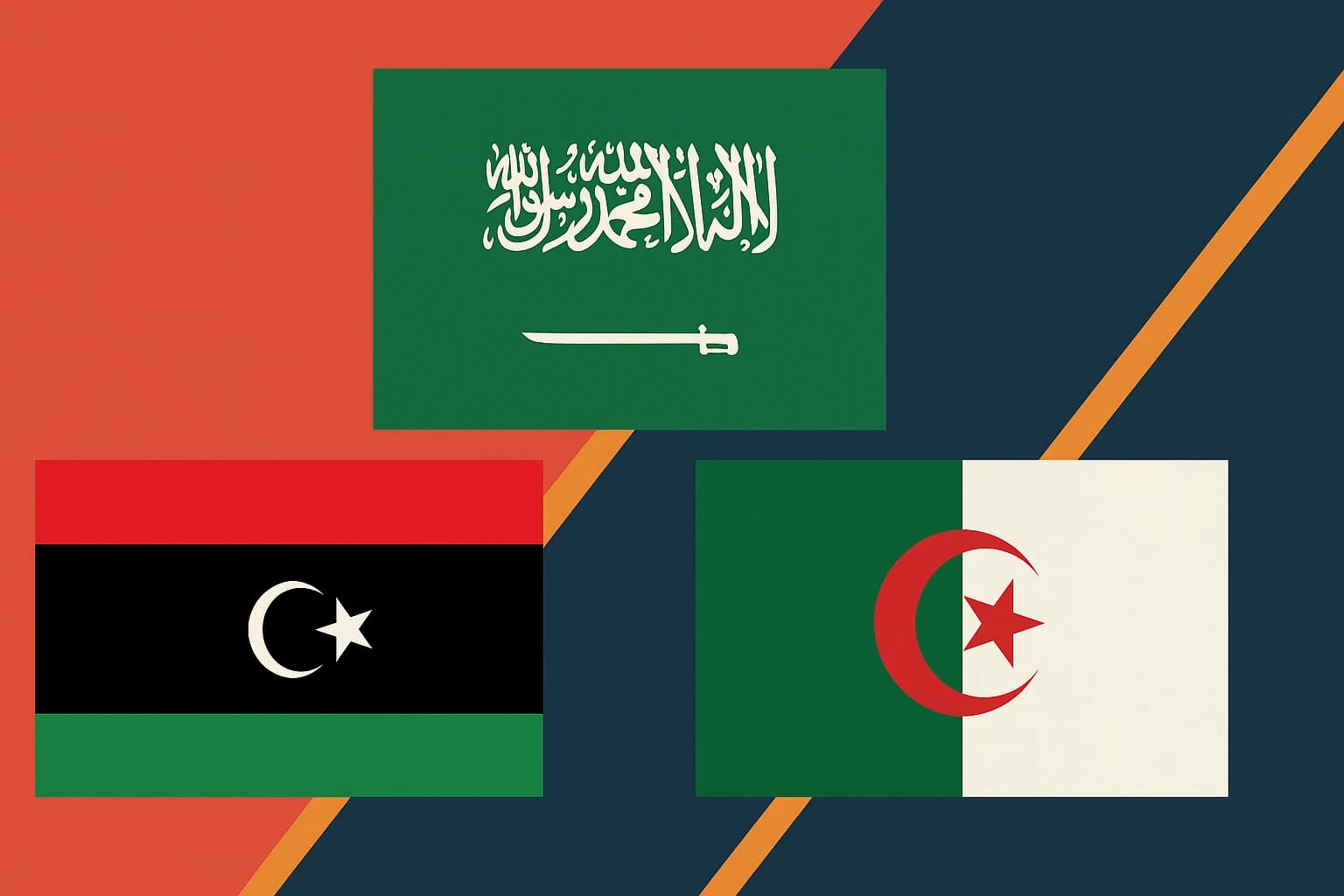
Israel's Star of David and Saudi Arabia's shahada, the Islamic declaration of faith rendered in calligraphy above a sword, come closest to Dominican explicitness. Even the shahada, though, is a creed rather than a citation with chapter and verse.
Why maximalism?
Most countries that put religion on a flag do it through abstraction: a shape or a color that gestures at faith without quoting it. So why did the Dominican Republic go further than anyone?
Geography is part of the answer. Flags born from anti-colonial struggles against distant European powers, in India, Pakistan, and much of Africa, could rely on geography and culture to establish distinctiveness. The Dominican Republic shared an island with Haiti, along with a colonial history and a degree of cultural overlap. Religious specificity was one of the few unmistakable markers available, and when the neighbor in question is across a land border on the same island, subtlety does not accomplish much.
The other part is the trajectory of Latin American secularization. Nineteenth-century nation-building across the region leaned on Catholic imagery, from the Virgin of Guadalupe in Mexican independence iconography to the sun on Argentina's early flags, and most countries later secularized their symbols. The Dominican Republic did not, partly because its Bible was tied not to Catholicism in general but to one verse about liberation, which is a hard thing to campaign against.
That elasticity has protected it. The verse has been claimed by regimes across the entire Dominican political spectrum, by liberal democrats and by Trujillo's authoritarian state alike, and its usefulness as a slogan has kept it in place as an emblem.
Contrast that with nations that have stripped religious symbols from their flags. Afghanistan's has been redesigned repeatedly, each version reflecting whichever regime held power.
Libya's post-Gaddafi changes followed the same pattern.
In both cases the religious symbolism belonged to a particular faction, and when the faction fell the flag went with it. The Dominican Bible is attached to the founding myth rather than to any faction, so nobody has ever had both the motive and the authority to take it down.
The flag in Dominican life
The flag is everywhere: government buildings, schools, baseball stadiums, and the large diaspora communities in New York, Boston, and Miami. Independence Day on February 27 and Restoration Day on August 16 bring parades, music, and flags on every surface.
For the diaspora the religious element carries extra weight. In heavily Catholic communities in Washington Heights or Lawrence, Massachusetts, the Bible on the flag reinforces a dual identity as Dominican and as faithful. Hung in a barbershop or a bodega, it says where you come from and what you believe in one object.
There is essentially no domestic movement to secularize the coat of arms. Unlike arguments over crosses in European public spaces or "In God We Trust" on U.S. currency, the Dominican Bible generates almost no controversy, because it is woven too far into the national identity to read as a statement anyone could take a position on.
The design is protected by law as well. The constitution specifies the coat of arms in detail, and altering it would require a constitutional amendment, so the Bible's placement is not the sort of tradition that could quietly lapse through bureaucratic neglect.