The Flag of India
Republic of India
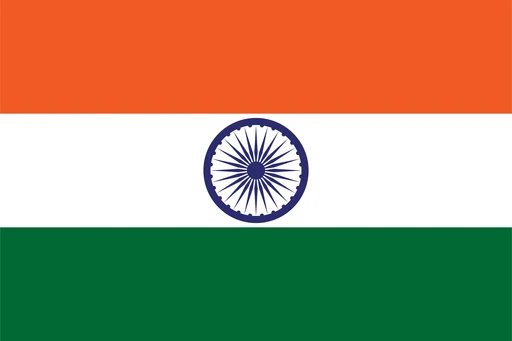
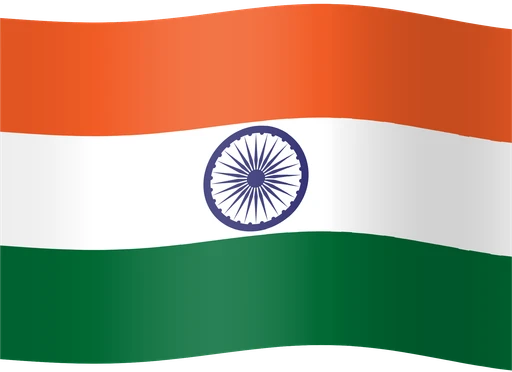
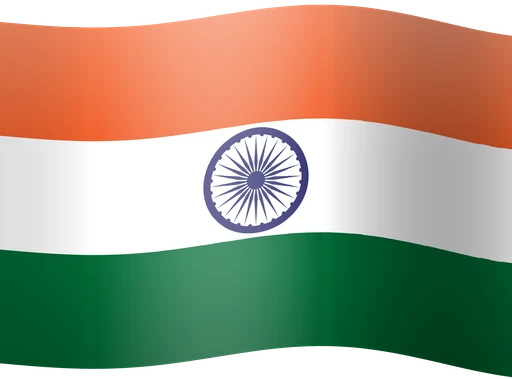
The flag of India, also known as the Tiranga, is a horizontal tricolour of three equal bands: deep saffron at the top, white in the middle, and dark green at the bottom. At the centre of the white band is a navy blue wheel with 24 spokes, the Ashoka Chakra. Saffron is usually read as courage and sacrifice, white as peace and truth, green as faith and chivalry, and the wheel as the law of dharma.
India's Tricolour, the Tiraṅgā (तिरंगा), is three horizontal stripes of deep saffron, white, and India green, with a navy blue wheel at its centre lifted from a 3rd-century BCE Buddhist emperor's pillar. It was adopted 24 days before independence in 1947, and it holds together two very different projects: Gandhian self-reliance and Nehruvian pluralism. The rules governing who may fly it, what fabric it must be made from, and how it must be destroyed have been fought over all the way to the Supreme Court.
The Ashoka Chakra
At the heart of the white band sits the Ashoka Chakra, a 24-spoked wheel rendered in navy blue. It almost wasn't there. Until July 1947, the flag of the Indian independence movement featured Gandhi's charkha, the spinning wheel that symbolized self-reliance and the swadeshi movement's rejection of British-manufactured goods. But when the Constituent Assembly's Flag Committee met to finalize the design of a sovereign nation's flag, they made a deliberate and somewhat controversial swap: out went the charkha, in came the dharmachakra from the Lion Capital of Ashoka at Sarnath.
That capital, carved around 250 BCE, is the same sculpture that gave India its national emblem and its national motto, "Satyameva Jayate" (Truth Alone Triumphs). Emperor Ashoka had adopted the wheel of dharma after renouncing violence in the wake of the Kalinga War. Placing it on the flag tied modern India to a philosophy of righteous, non-violent governance stretching back over two thousand years.
The 24 spokes are commonly interpreted as the 24 hours of the day, a reminder that the nation must keep moving. The reading is neat, though historically the spokes simply match those on the original Sarnath capital. The navy blue was chosen pragmatically, because it is visible against the white stripe, but it also evokes the sky and the ocean.
Gandhi, by most accounts, was disappointed. The charkha was his emblem of an agrarian, self-sufficient India. Its removal in favour of an ancient imperial symbol reflected the tension between his vision and Nehru's push toward a modern, industrializing, pluralist state. That tension was embedded in the flag from its first day and has never fully resolved.
From Congress flag to national symbol
The Tiranga didn't appear fully formed. Its lineage stretches back to 1921, when Pingali Venkayya, an agriculturalist and freedom fighter from Andhra Pradesh, presented Gandhi with a two-colour design: red for Hindus, green for Muslims. Gandhi suggested a white strip to represent other communities and insisted on adding the charkha, turning the flag into a statement about economic self-determination as much as political identity.
By 1931, the Indian National Congress had formally adopted a version with saffron, white, and green stripes and the charkha at centre. This became the de facto flag of the independence movement, carried through protests, marches, and imprisonments for the next sixteen years.
The final transformation happened quickly. The Constituent Assembly's Flag Committee, chaired by Rajendra Prasad, who would become India's first president, finalized the design on 22 July 1947. The proportions were codified at a strict 2:3 width-to-length ratio, and the Chakra's exact diameter and placement within the white band were specified to the same level of precision.
On the night of 14-15 August 1947, Jawaharlal Nehru hoisted the new Tricolour at the Red Fort in New Delhi. That midnight ceremony, broadcast by All India Radio, marked the moment the flag stopped being a party symbol and became a national one.
Saffron, white, and green
India's government has never enshrined a single official interpretation of the flag's colours in law. The Flag Code acknowledges multiple readings, leaving the symbolism deliberately open.
The most common interpretation links saffron (kesari) to courage and sacrifice, white to peace and truth, and India green to faith, fertility, and prosperity. There's a parallel, more secular reading that ties the colours to geography: saffron for the soil and dawn, white for the Himalayan snows, green for forests and fields. Both coexist, and that ambiguity is the point. A country of over a billion people, dozens of languages, and half a dozen major religions needs a flag capacious enough to hold competing meanings.
The specific shades are anything but vague, though. "India saffron" and "India green" are defined in precise colorimetric terms under Bureau of Indian Standards specification IS 1. Few nations standardize their flag colours this rigorously.
The evolution of what the colours mean matters too. Venkayya's original red and green were explicitly communal, Hindu and Muslim. The shift toward abstract, inclusive symbolism mirrored the secular constitution India adopted in 1950. Saffron is always at the top, the position of honour, and flying the flag upside down is a punishable offence under the Prevention of Insults to National Honour Act, 1971.
The khadi rule and the Jindal case
For over half a century after independence, Indian law required the national flag to be made exclusively from khadi, the hand-spun, hand-woven cloth Gandhi championed. Production was controlled by the Khadi and Village Industries Commission, and for decades a single facility, the Karnataka Khadi Gramodyoga Samyuktha Sangha in Dharwad, Karnataka, held a near-monopoly on manufacturing the nation's flag.
Until 2002, ordinary Indian citizens couldn't legally fly the Tricolour at their own homes. The flag was reserved for government buildings and official occasions. An industrialist named Naveen Jindal changed that. After police stopped him for flying the flag at his factory, Jindal launched a legal challenge that wound through the courts for a decade. In 2004, the Supreme Court ruled in Union of India v. Naveen Jindal that flying the national flag is a fundamental right protected under Article 19(1)(a), the constitutional guarantee of freedom of expression.
The Flag Code was revised in 2002 to let citizens fly the Tricolour year-round, provided they do so with dignity. Then, in 2022, the government amended the Code again to permit machine-made polyester flags. Khadi advocates were dismayed, arguing the change undercut Gandhi's legacy and the livelihoods of hand-weavers. The catalyst was the "Har Ghar Tiranga" (Tricolour at Every Home) campaign, launched to mark India's 75th Independence Day, which distributed hundreds of millions of flags. Meeting that demand with hand-spun cloth was impossible. The tension between symbolic purity and mass participation plays out in the flag's material, not just its design.
Protocol and precedence
The Flag Code of India, 2002 (amended 2022), governs the Tricolour's display in detail. Size ratios, who may use which dimensions, how a damaged flag must be destroyed: all of it is codified.
A soiled or torn flag can't simply be thrown away. It must be destroyed privately, with dignity, preferably by burning or burial. When draped over a coffin at a state funeral, the saffron band must be at the head and the green at the feet. Half-mast display requires explicit orders from the President of India, and the rules governing state mourning follow a strict hierarchy.
The flag must never touch the ground, never be worn as clothing below the waist, never serve as a tablecloth or wrapping. Violations carry penalties under the Prevention of Insults to National Honour Act. Only constitutionally designated officials, the President, Vice President, Prime Minister, Chief Ministers, and a few others, may display the flag on their vehicles, mounted on the right front fender. For everyone else, vehicle display remains off-limits.
When flown alongside foreign flags, India's Tricolour follows United Nations flag protocol for precedence.
India's place among tricolours
India's horizontal triband format places it within a tradition tracing back to the French Tricolore of 1794, a design grammar that spread through anti-colonial movements worldwide. The Irish Tricolour shares two of India's three colours (saffron or orange, white, green) and the same horizontal format. Both flags were born from independence movements in the first half of the 20th century, though their designers worked independently.
The Pan-African and Pan-Arab colour traditions show a similar dynamic: flag design as a vehicle for collective political identity across borders. India's Tricolour played a comparable unifying role for the subcontinent's independence movement.
Pingali Venkayya, the man who started it all with a sketch in 1921, remains surprisingly obscure outside India. He died in poverty in 1963. A commemorative postage stamp wasn't issued in his honour until 2009.
The Tiranga has remained unchanged since 1947, which is unusual among post-colonial flags; many newly independent nations revised theirs with each change of government. It is also one of very few national flags to lift a specific historical artifact directly into its design, drawing a line from Ashoka's remorse over the Kalinga War to the republic founded more than two thousand years later.
References
[1] Flag Code of India, 2002 (as amended 2022), Ministry of Home Affairs, Government of India (https://www.mha.gov.in)
[2] Prevention of Insults to National Honour Act, 1971, India Code, Legislative Department (https://www.indiacode.nic.in)
[3] Bureau of Indian Standards, IS 1: "Sizes, Shapes, and Colours of the National Flag of India"
[4] Constituent Assembly of India Debates, Vol. IV, 22 July 1947, Parliament of India Digital Library (https://parliamentofindia.nic.in)
[5] Union of India v. Naveen Jindal & Anr., Supreme Court of India, Civil Appeal No. 325 of 1996 (judgment 2004)
[6] Smith, Whitney, Flag Lore of All Nations (2001), Millbrook Press
[7] Flags of the World (FOTW), India entry (https://www.fotw.info)
[8] Nehru, Jawaharlal, Speech on the adoption of the national flag, Constituent Assembly, 22 July 1947
[9] National Museum, New Delhi, holdings related to the Lion Capital of Ashoka and the Ashoka Chakra
Common questions
- What do the colors on the Indian flag stand for?
- Saffron signifies courage and sacrifice, white represents truth and peace, and green stands for growth and prosperity.
- What is the significance of the Ashoka Chakra on the Indian flag?
- The Ashoka Chakra has 24 spokes and stands for law and dharma. It comes from the Lion Capital of Ashoka and is read as a symbol of movement and the cycle of time.
- When was the Indian flag adopted?
- The Indian flag was officially adopted on July 22, 1947, just weeks before India gained independence on August 15, 1947.
- Why was the charkha replaced with the Ashoka Chakra?
- The charkha was replaced to point the flag at a modern democratic republic rather than at the village self-reliance the spinning wheel stood for.
- What do the colors on the Indian flag represent?
- Saffron stands for courage and sacrifice. White represents peace and truth. Green symbolizes faith, fertility, and prosperity. India has never fixed one interpretation in law, though. Some people read the colors as geography instead, with saffron as soil, white as Himalayan snow, and green as forests. The ambiguity is deliberate, and it lets the flag mean something personal to over a billion people.
- Why did India replace the spinning wheel with the Ashoka Chakra on the flag?
- Gandhi's spinning wheel (charkha) was on the Indian National Congress flag, but when the Constituent Assembly finalized the official flag in 1947, they swapped it out for the Ashoka Chakra instead. The change reflected Nehru's vision of a modern, pluralist state over Gandhi's agrarian ideals. Gandhi wasn't thrilled about it, honestly. The Chakra connected the new nation to ancient Indian philosophy and the principle of non-violence.
Featured in these articles
- The Flag of Ceylon: How a Lion Banner Captured in 1815 Was Rebuilt From a Sketch to Become Sri Lanka's Flag
- Four Suns on Four Flags, and Not One of Them Means the Same Thing
- The Serrated Edge: Why Bahrain and Qatar Chose Zigzag Lines While Every Other Nation Drew Straight Ones
- Tricolore Confusion: How Chad and Romania Ended Up With the Exact Same Flag, and Why Neither Will Change It
Download this flag
Free in 12 styles, from 32px icons up to 2000px, as SVG, PNG, WebP and JPG.