The Flag of Antarctica
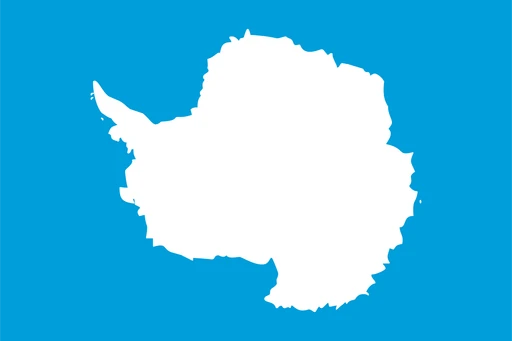
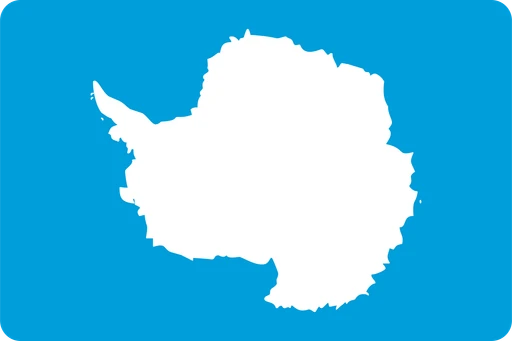
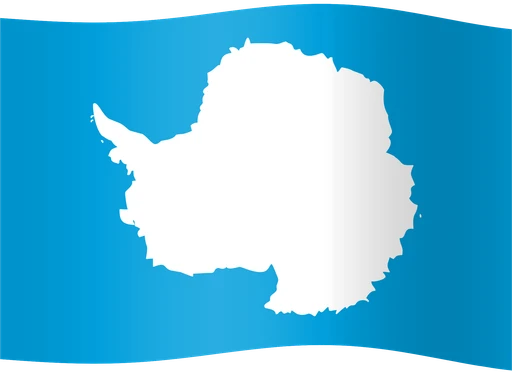
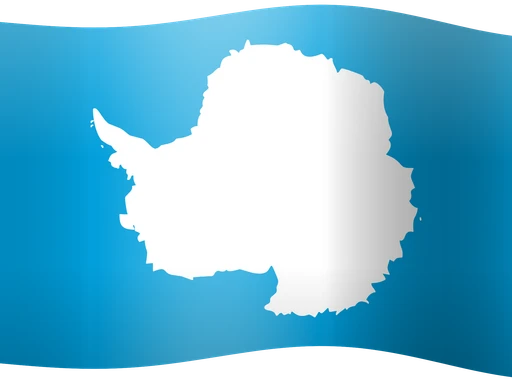
The most widely seen flag of Antarctica is a white outline of the continent centered on a United Nations blue field. The blue and white are meant to signal neutrality, because no country owns the land. The map has no borders, no claims and no national symbols. Graham Bartram, a British vexillologist, drew it in 1996 for a CD-ROM atlas. No government or treaty body has adopted it, so it is a symbol of the continent rather than an official flag.
Picture a white outline of a continent floating on a blue field. That is the flag most people see when they look for Antarctica's flag. It is on your phone as an emoji. It is also unofficial, because Antarctica has no government to adopt one.
The design is a symbol, not a banner of authority. It tells you something about a place where seven countries have claims, several more do not recognize any, and the rest of the world has agreed to set the argument aside.
A continent nobody governs
The Antarctic Treaty was signed in Washington on 1 December 1959 by twelve countries whose scientists had worked in Antarctica during the International Geophysical Year of 1957 and 1958. It entered into force in 1961. Article I requires that Antarctica be used for peaceful purposes only. Article IV freezes the claims already made. No new claim and no enlargement of an old one is allowed while the treaty stands.
The Antarctic Treaty Secretariat now lists 58 parties. Seven countries hold overlapping claims. Some states recognize none. The United States and Russia keep what they call a basis of claim.
A flag normally needs a state, a law or a people behind it. Antarctica has none of those. The continent is run as a shared space, so no body has the standing to choose a flag for it. That is why every Antarctic flag you see is a proposal.
The atlas flag
Graham Bartram is a British vexillologist. In 1996 he drew a flag for the 3D Atlas, a multimedia atlas published by The MultiMedia Corporation and distributed by Electronic Arts. The Flags of the World archive dates his image to 22 July 1996.
The atlas needed a flag for every place, and Antarctica had none. Bartram wrote that it took hard work to come up with a flag with no political bias. He wanted to stay out of the disputes between the United Kingdom, Chile and Argentina, so he skipped national colors and symbols.
His answer borrowed from the United Nations flag. It shows a plain white outline of the continent on a UN blue field. There are no borders, no stations and no claim lines. Bartram says the atlas sold more than 1.5 million copies, which he believes makes this the most widely promoted flag of the continent.
What the colors say
Bartram's own account stresses neutrality. A 2024 report describes the original as a symbol of scientific collaboration, peace and nature conservation.
The master SVG on FlagDB uses two colors, a UN-style blue (#009edb) and white. Its proportions are 2:3.
From CD-ROM to emoji
The flag did not stay on discs. Since 2015 the design has served as the emoji for Antarctica on most platforms. A symbol that began in an atlas now sits in text messages.
Not everyone likes this. A flag that is rarely flown on the continent stands in for it everywhere online. Evan Townsend, the designer of a rival flag, argues that neither the atlas design nor the treaty emblem is officially recognized or widely flown in Antarctica itself.
The 2024 redesign
In February 2024 Bartram unveiled a new version as part of the Antarctica Flag Redesigned campaign by the nonprofit Agenda Antarctica. The solid white map gave way to colored dots that look like pieces of plastic.
The change draws on a 2022 study that found microplastics in all 13 fresh snow samples it collected in Antarctica. The designers used measurements from melted snow to set the type, color, shape and size of the dots. Bartram said, "It's not a clean white colour anymore."
The redesign shows how an unofficial flag has more freedom than an official one. Nobody has to vote on it. It is a message about a problem, and it appeared without a ceremony.
Other flags for the ice
Bartram's flag is one of several.
- 1929: The British, Australian and New Zealand Antarctic Research Expedition, led by Sir Douglas Mawson, sailed on RRS Discovery with an improvised white cotton flag meant to stand for Antarctica. The National Maritime Museum in Greenwich holds it. It measures 889 by 1498.6 millimeters.
- 1978: Vexillologist Whitney Smith presented a design in international orange with a white emblem at the hoist, including an A for Antarctica.
- 2000: Dave Hamilton drew a flag of pale blue, dark blue and yellow for pack ice, night sky and the aurora. It appeared on mock Antarctican dollar notes.
- 2007 to 2008: Olivier Leroi designed four vertical stripes based on the plumage of an emperor penguin.
- 2018: Evan Townsend, an American journalist and seasonal worker in Antarctica, created True South, with navy and white stripes, a white peak and a compass arrow pointing to geographic south. A few national Antarctic programs and expedition teams have flown it.
None of them is official. They compete for attention, not for legal standing.
The treaty emblem
People often mistake the Antarctic Treaty emblem for the continent's flag. It is neither. At its meeting in Warsaw on 20 September 2002, the Treaty's consultative parties adopted it as the formal emblem of the Antarctic Treaty. Decision 2 (2002) lets the Treaty Secretariat and the host of a consultative meeting use it. It also allows the emblem on flags and signs.
That use is a treaty tool. It stands for the agreement, not the land.
Where you will see it
You will see the white-on-blue flag in emoji keyboards, atlases and classroom posters, and on websites that need a flag for every region. If you want to put Antarctica on a flag list, Bartram's design is the standard choice, with the caveat that it carries no legal weight.
References
[1] "Flag of Antarctica," Wikipedia. https://en.wikipedia.org/wiki/Flag_of_Antarctica
[2] "Antarctica," Flags of the World. https://crwflags.com/fotw/flags/aq!.html
[3] "Decision 2 (2002): Antarctic Treaty emblem," Antarctic Treaty Secretariat. https://ats.aq/devAS/Meetings/Measure/289
[4] "The Antarctic Treaty," Antarctic Treaty Secretariat. https://www.ats.aq/e/antarctictreaty.html
[5] "White Flag of Antarctica," Royal Museums Greenwich. https://www.rmg.co.uk/collections/objects/rmgc-object-895
[6] "New microplastic flag for Antarctica," Mail & Guardian, 16 February 2024. https://mg.co.za/the-green-guardian/2024-02-16-new-microplastic-flag-for-antarctica
[7] "Antarctica True South flag design by Evan Townsend," Dezeen, 29 April 2021. https://www.dezeen.com/2021/04/29/antarctica-true-south-flag-design-evan-townsend/
Common questions
- Does Antarctica have an official flag?
- No. Antarctica is not a country and no government rules it, so nobody has the authority to adopt a flag. The Antarctic Treaty has an official emblem, adopted in 2002, but it represents the treaty and not the continent. Several unofficial designs exist. The white map on blue is the one most people mean.
- Who designed the flag of Antarctica?
- Graham Bartram, a British vexillologist, designed the white-on-blue version in 1996. He made it for the 3D Atlas, a CD-ROM from The MultiMedia Corporation. Other people have proposed their own designs, including Whitney Smith in 1978 and Evan Townsend in 2018, but those are different flags.
- Why is the Antarctica flag blue and white?
- Bartram took his cue from the United Nations flag, which also shows a white map on blue. He wanted a flag with no political bias, so he avoided the colors and symbols of the countries that claim Antarctic land, including the United Kingdom, Chile and Argentina.
- Is the Antarctica emoji flag the real flag?
- The emoji flag is Bartram's 1996 design, in use as the Antarctica emoji on most platforms since 2015. That makes it the version most people see. It is not an official flag, and it is rarely flown on the continent itself.
- What is the True South flag?
- True South is a separate proposal by Evan Townsend, who made the first version in the winter of 2018. It has navy and white stripes, a white peak and a compass arrow pointing south. It uses a 3:5 ratio. Some research stations and expedition teams fly it. Like Bartram's flag, it has no official status.
Download this flag
Free in 12 styles, from 32px icons up to 2000px, as SVG, PNG, WebP and JPG.