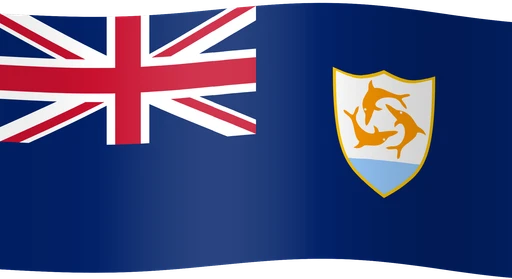
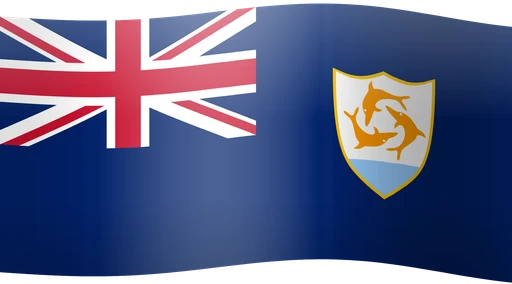
The Flag of Anguilla
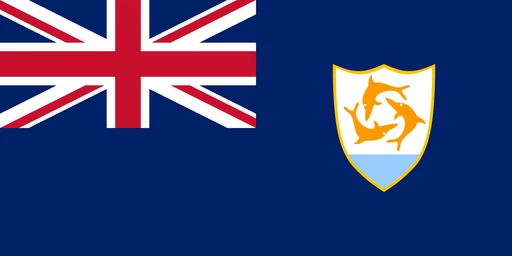
Anguilla's flag is a Blue Ensign: the Union Jack in the canton and the territory's coat of arms in the fly. The arms show three orange dolphins in a circle on a white ground, standing for endurance, unity, and strength. The blue field is the Caribbean Sea.
Anguilla's flag comes out of a rare kind of political struggle: a tiny Caribbean island fighting for the right to stay under British rule. The current flag, a Blue Ensign with the territory's coat of arms and its three orange dolphins in the fly, has been official since 1990. Getting there took a revolution, a short-lived republic, and a set of homemade banners sewn by the people using them. At 35 square miles, Anguilla is one of the smallest territories anywhere with a flag history this eventful.
The revolution to stay British
In 1967 Britain bundled Anguilla together with St. Kitts and Nevis into a single associated state. On paper it was tidy colonial housekeeping. On the ground it went badly. Anguillans resented being governed from St. Kitts under Premier Robert Bradshaw, whose administration they saw as neglectful at best and hostile at worst. The island had almost no roads, no electricity, and no running water, and Anguillans blamed St. Kitts for keeping it that way.
So they revolted. In June 1967 islanders expelled the St. Kitts police force and held a referendum on secession. The result was 1,813 votes to break from St. Kitts and five against.
Independence was never really the goal. Anguilla declared itself a republic briefly in 1969 under Ronald Webster, but what Anguillans wanted was a return to direct British governance, a colonial arrangement they remembered as far more benign than rule from St. Kitts. It is one of history's few anti-independence revolutions.
Britain's response was strange in its own way. In March 1969 London launched Operation Sheepskin, landing Royal Marines and Metropolitan Police officers on Anguilla's beaches, where they were met with bemusement rather than gunfire. Some accounts describe islanders offering the troops drinks. The international press had a field day at Britain's expense.
Sorting out the constitutional mess took more than a decade. Anguilla was formally separated from St. Kitts-Nevis in 1980 under the Anguilla Act and became a full British Dependent Territory, now styled British Overseas Territory, in 1982.
The homemade banners, 1967 to 1990
Through those years Anguilla cycled through several unofficial flags, and their rough quality says something about the movement. This was not a revolution with a propaganda ministry. It was a few thousand people on a small island improvising.
The first flag raised after the revolution had a white field with two mermaids and a shell between them, drawing on local folklore and the islanders' picture of themselves as tough and sea-shaped. It was handmade and rudimentary, stitched from whatever was available, and it never really caught on. The three dolphins replaced it within months.
The most recognizable flag of the era carried three dolphins in a circle on a white field with a turquoise lower stripe. That design eventually became the formal coat of arms, but at the time it was another grassroots creation. None of these flags went through heraldic channels or any official approval. They emerged the way flags do during political upheaval: quickly, imperfectly, and with real feeling behind them.
Three dolphins in a circle
The current flag was first hoisted on May 30, 1990. The arms it carries were granted by royal warrant on November 27, 1990, handled through the College of Arms in London, and the same warrant retroactively authorized the defaced ensign that had already been flying for six months. It follows the standard British Overseas Territory format: a dark blue ensign with the Union Jack in the canton and the territory's arms in the fly half.
The arms themselves are plain. Three orange dolphins swim in a circle on a white shield. The circular arrangement suggests continuity and mutual support, since no single dolphin leads and the loop has no beginning or end. The dolphins stand for endurance, unity, and strength, and they nod to the island's inseparable bond with the sea. Even the name "Anguilla" comes from the French or Spanish word for eel, a reference to the island's long, thin shape seen from above.
The orange is unusual in flag design, and here it is said to represent the wisdom and strength of the Anguillan people. It reads sharply against the white shield, which stands for peace and tranquility, and the deep blue of the ensign around it is the Caribbean Sea that shapes fishing, tourism, and the view from most front porches on the island.
Two flags, one island
The Blue Ensign is the official government flag. It flies at government buildings, appears at international events, and does the formal diplomatic work. Walk around Anguilla itself and you will mostly see something else.
The "local flag" is a white field with a lower turquoise stripe carrying the three orange dolphins, without the Blue Ensign framework. It shows up at cultural festivals, on fishing boats, and at sporting events where Anguilla competes independently.
This dual-flag practice is common across British Overseas Territories, where the ensign handles protocol and a simpler local design carries everyday identity. In Anguilla the split runs deeper than convenience, because the local flag descends directly from those revolutionary-era banners, stitched by people fighting to control their own future. Flag protocol otherwise follows British conventions, with the Union Jack and the Governor's flag appearing in the appropriate ceremonial contexts.
Among the other territory ensigns
Anguilla's Blue Ensign puts it in a family with Bermuda, the Cayman Islands, Turks and Caicos, the British Virgin Islands, and Montserrat, all using the same dark blue base with their own arms in the fly. Where the others carry lions, ships, flamingos, or turtles, Anguilla offers three dolphins and nothing else.
The dolphin motif connects the island to a wider maritime heraldic tradition. Dolphins appear on the arms and flags of several Caribbean and Pacific island nations, reflecting the shared reality of communities defined by the ocean. Anguilla's version, with its circular arrangement and that orange, stays instantly recognizable.
In vexillology circles Anguilla's flag story gets cited as a case study in how political identity and flag design develop together in small island communities. The move from hand-sewn revolutionary banners to a formally granted heraldic ensign follows the territory's own path from improvisation to stable self-governance inside the British constitutional framework.
References
[1] Anguilla Act 1980 and Anguilla Constitution Order 1982, UK legislation. Available at legislation.gov.uk
[2] Government of Anguilla, official national symbols and history pages. Available at gov.ai
[3] Westlake, Donald E. Under an English Heaven (1972). Journalistic account of the Anguillan Revolution and British invasion.
[4] Smith, Whitney. Flags Through the Ages and Across the World (1975). Comprehensive vexillological reference.
[5] Flags of the World (FOTW) online database, entries on Anguilla's historical and current flags. Available at fotw.info
[6] Petty, Colville L. Anguilla: Where There's a Will, There's a Way (1984). Local historical account of the revolution and its aftermath.
[7] The College of Arms, London. Records of the royal warrant granting Anguilla's coat of arms (1990).
Common questions
- What do the three dolphins on Anguilla's flag mean?
- The three orange dolphins arranged in a circle stand for endurance, unity, and strength, all tied to Anguilla's history of political struggle. No single dolphin leads the others, which speaks to continuity and mutual support. They also reflect the island's connection to the sea. It is a simple design that carries a lot of weight for Anguillans.
- Why does Anguilla have two different flags?
- There is an official Blue Ensign with the Union Jack for government and diplomatic use, and a simpler local flag, white with a turquoise stripe and three orange dolphins, for everyday life, sports, and cultural events. The local version traces back to hand-sewn revolutionary banners from the 1960s, and it is the one most Anguillans have any feeling about.
- Why did Anguilla fight to stay a British colony instead of seeking independence?
- Anguillans in 1967 did not revolt against Britain. They revolted against being governed by St. Kitts, whose administration they felt had neglected them for years. They voted almost unanimously to break away from St. Kitts-Nevis and return to direct British rule, which they saw as the fairer arrangement. It is one of history's rare anti-independence revolutions.
- What was Operation Sheepskin?
- In March 1969, Britain sent Royal Marines and police to 'invade' Anguilla during its brief stint as a self-declared republic. The troops met no resistance. Islanders reportedly offered them drinks. The press mocked Britain for launching a military operation against a tiny island that wanted to be British.
Featured in these articles
- Nutmeg, Mahogany, and Defiance: How Caribbean Nations Turned Plantation Crops into Flags of Liberation
- Bermuda's Sinking Ship and Anguilla's Dolphins: Flags Nobody Reads
- Afghanistan's Flag Kept Being Rewritten. Andorra's Settled a Negotiation.
- The Flag of Unity: Analyzing Symbols in Flags from Afghanistan to Anguilla
Download this flag
Free in 12 styles, from 32px icons up to 2000px, as SVG, PNG, WebP and JPG.