The Flag of Antigua and Barbuda
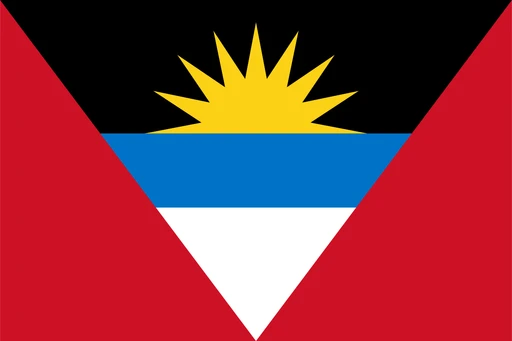
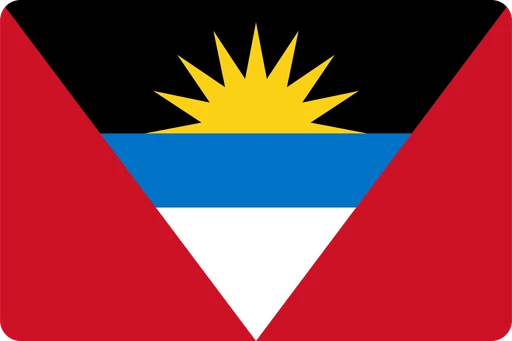
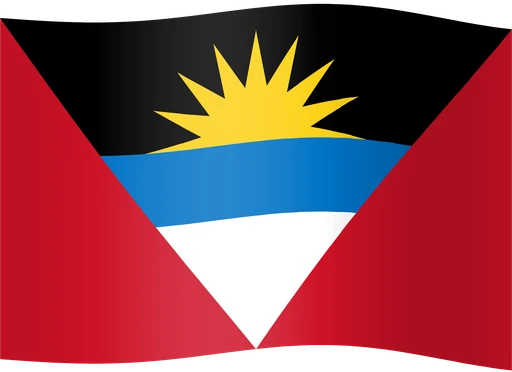
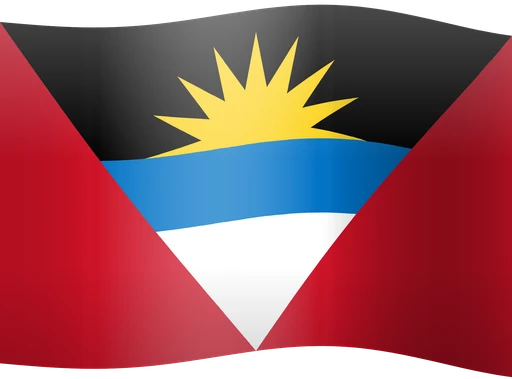
The flag of Antigua and Barbuda has a red field with an inverted triangle of black, blue, and white stripes, topped by a half sun whose rays spread across the upper edge. The sun is the dawn of a new era, the black is the African heritage of the islands' people, the blue is hope, and the white is the sandy beaches.
The flag of Antigua and Barbuda came out of a nationwide public competition and was won by a high school art teacher. Adopted on February 27, 1967, when the islands became an Associated State of the United Kingdom with internal self-governance, it survived the transition to full independence in 1981 unchanged. The inverted triangle of black, blue, and white, topped by a half-rising sun against a red field, holds the islands' history of slavery and their hopes for what came after in a single image.
The 1967 design competition
When Antigua and Barbuda prepared to become an Associated State in 1967, the government opened the question of national identity to the public. A competition was launched to design a flag, and more than 600 entries came in from across the islands.
The winner was Reginald Samuel, an art teacher at the Princess Margaret School in Antigua and already known in local artistic circles. His design did not look like anything else flying in the Caribbean. Most British Caribbean territories still used colonial ensigns, blue or red fields with a coat of arms in the corner. Samuel proposed a blood-red field, an inverted triangle slicing downward through the center, and a golden half-sun rising out of darkness.
The flag was first raised on February 27, 1967, the day Antigua and Barbuda formally became an Associated State. Fourteen years later, when full independence came on November 1, 1981, nobody argued for replacing it.
Samuel became a celebrated figure in the national story. Independence movements across the Caribbean were driven mostly by politicians and diplomats, and his flag was chosen from hundreds of alternatives by the people it was meant to represent.
Sun, sea, and soil
Read the flag from the bottom up and it works as a landscape.
The white band at the base of the inverted triangle is sand, specifically the white-sand beaches Antigua is known for. The country claims 365 of them, one for every day of the year. Whether the number holds up exactly, anyone who has seen the coastline understands the impulse behind the boast.
Above the white is a band of blue, the Caribbean Sea. It is the source of most of what sustains the islands, from fishing and trade routes to the tourism economy that dominates modern Antiguan life, and it carries a sense of horizon beyond the reef.
Then comes black, the widest section of the triangle and the flag's most direct element. It represents the African heritage of the great majority of Antigua and Barbuda's population and the soil of the islands themselves. It is also an acknowledgment of the slave trade. Antigua was one of the great sugar colonies of the British Empire, and the ancestors of most modern Antiguans were brought there in chains to work the plantations.
A golden half-sun breaks the horizon at the top of the black band. It is a sunrise, the beginning of self-determination, and its placement directly above the band that recalls slavery makes the metaphor plain.
The red field flanking the triangle carries the energy and vitality of the people. Some readings also connect it to the blood and endurance of enslaved ancestors. And the V-shape the red field forms around the triangle is widely read as victory, which feels earned given the centuries of colonial rule that preceded it.
Compared with its Caribbean neighbors
Set the flags of the Caribbean side by side and Antigua and Barbuda's is the outlier. Most countries in the region that gained independence between the 1960s and 1980s chose horizontal or vertical stripes, stars, or traditional heraldic elements. Trinidad and Tobago went with a bold diagonal stripe. Jamaica chose a saltire cross. Barbados placed a trident on vertical bands. Dominica put a parrot on a tricolor.
The inverted triangle has no real precedent among national flags, which gives the design a modernist, poster-like quality closer to graphic design than to heraldry. The palette of red, black, gold, blue, and white echoes Pan-African and Caribbean identity movements, tying the flag to regional currents while keeping it distinctly Antiguan.
The boldness helps in practice too. At international sporting events, particularly cricket and athletics, the flag is easy to pick out at a distance or in a crowd of other nations' colors.
Protocol and variants
The flag is governed by the laws of Antigua and Barbuda and flies at all government buildings, ports, and official functions. There is no separate Flag Day, but the flag is central to Independence Day celebrations on November 1.
Following British maritime tradition, the civil ensign for merchant ships and the naval ensign incorporate the national flag into canton or field positions on traditional ensign layouts, a reminder of the colonial inheritance that shaped the islands' institutions even as the flag itself broke from colonial aesthetics.
The diaspora, concentrated in New York, Toronto, and London, displays the flag at Carnival celebrations and independence commemorations. It is a common sight in Brooklyn during the summer and in Notting Hill each August.
The country has a coat of arms too, with a pineapple, hibiscus flowers, sugar cane, and a sailing ship among other symbols. It appears on the presidential standard and official documents, but not on the flag, which keeps Samuel's geometry intact.
The flag in national life
During Antigua's Carnival, held in late July and early August, the flag is painted on faces, draped over shoulders, printed on shorts and bikinis, and splashed across murals and floats.
When Hurricane Irma devastated Barbuda in September 2017, leaving the island effectively uninhabitable and forcing a complete evacuation, the flag became a rallying point. It appeared at relief efforts, fundraisers, and solidarity marches, standing for the promise that Barbuda would not be forgotten and that the two-island nation would hold together.
Reginald Samuel's story still circulates as a point of national pride, because it frames independence as something the people made rather than something negotiated in a government office.
The rising sun motif has drifted into the wider visual culture of the islands, turning up in tourism branding, sports team logos, and public murals from St. John's to English Harbour. Among vexillologists the flag ranks consistently among the best-designed in the world, praised for its clarity and the graphic punch of that inverted triangle against the red.
References
[1] Government of Antigua and Barbuda, "Official National Symbols," ab.gov.ag
[2] Smith, Whitney. Flags Through the Ages and Across the World. McGraw-Hill, 1975.
[3] Znamierowski, Alfred. The World Encyclopedia of Flags. Lorenz Books, 2001.
[4] The Flag Institute, "Antigua and Barbuda," flaginstitute.org
[5] Crampton, William. The Complete Guide to Flags. Kingfisher Publications, 1989.
[6] Caribbean Community (CARICOM), Member State Profiles: Antigua and Barbuda, caricom.org
[7] North American Vexillological Association (NAVA), survey data on flag design quality, nava.org
[8] Antigua and Barbuda Independence Act, 1981, UK Parliament records.
Common questions
- What do the colors on the Antigua and Barbuda flag mean?
- Red is the energy of the people, black is African heritage and the island soil, blue is the Caribbean Sea, and white is the sandy beaches. The golden half-sun rising from the black band is the dawn of a new era. The V-shape formed by the red field is widely read as a symbol of victory over colonialism.
- Who designed the flag of Antigua and Barbuda?
- A high school art teacher named Reginald Samuel. He was teaching at Princess Margaret School in Antigua when he entered a nationwide competition in 1967, the year the islands gained self-governance. More than 600 people submitted designs and his won.
- Why does the Antigua and Barbuda flag have a rising sun?
- The golden half-sun is a sunrise, marking the dawn of a new era and the start of self-determination. It rises out of the black band, which stands for African heritage and the history of slavery. The placement is intentional: light coming out of darkness.
- Why does the Antigua and Barbuda flag have an inverted triangle shape?
- It is the most distinctive thing about the flag, and Reginald Samuel's design had no real precedent among national flags. The inverted triangle stacks a compressed landscape from bottom to top, sand and sea and soil, with a rising sun above it. The V-shape created by the surrounding red field doubles as a symbol of victory over centuries of colonial rule.
Featured in these articles
Download this flag
Free in 12 styles, from 32px icons up to 2000px, as SVG, PNG, WebP and JPG.