In 1975 the Khmer Rouge marched into Phnom Penh, emptied the city at gunpoint, abolished money, closed every school, and set about erasing nearly every trace of the Cambodia that came before. Temples were defaced. Monks were executed. The Buddhist calendar was replaced with "Year Zero." And when Pol Pot's regime designed the flag of Democratic Kampuchea, there at the center sat a golden silhouette of Angkor Wat.
The most radical revolution in modern Southeast Asian history, one that set out to annihilate the past entirely, could not bring itself to remove a 12th-century Hindu temple from the national flag.
No other single building on Earth has survived on a national flag through five violently different political regimes across nearly a century. Cambodia's flag has been redesigned at least six times since the 1860s. The colors have changed: blue, red, yellow, black, back to blue. The surrounding symbols have been swapped out for wreaths, rice stalks, cogwheels, stars, and royal crests. Angkor Wat has never left the center.
The temple on the flag works less as a religious or historical ornament than as a claim to Khmer civilizational legitimacy, and it is a claim no regime, however revolutionary, could afford to give up.
A building on a flag is rarer than you think
Scan the flags of the world's 193 UN member states and you find an ocean of stripes, crescents, stars, crosses, and coats of arms. What you almost never find is a specific, identifiable, real-world building.
Cambodia is the most prominent example by a distance. Afghanistan has at various points included a mosque in its emblem.
San Marino has its three towers. Portugal's coat of arms is sometimes cited for the Tower of Belém, but the object you are actually looking at is an armillary sphere. The list runs out fast.
Most flags rely on abstract geometry or heraldic devices because those symbols are flexible. A star can mean anything; a stripe carries whatever meaning you assign to it. Putting an actual building on a flag anchors national identity to a single physical place, one that can be visited, damaged, or claimed by someone else.
So why did every Cambodian government, across wildly incompatible ideologies, decide this one building was indispensable?
Some background helps. Angkor Wat was built by King Suryavarman II in the early 12th century, originally a Hindu temple dedicated to Vishnu, and later converted to Theravada Buddhism. By area it remains the largest religious structure in the world. It is not a ruin in the conventional sense but a functioning sacred site, a UNESCO World Heritage Site since 1992, where people still pray.
The French protectorate and the invention of the flag (1863 to 1953)
Before French colonization Cambodia had no modern national flag in the European sense. Royal banners existed, but the rectangular flag standing for a nation-state was a Western import. When King Norodom I accepted French protection in 1863, the protectorate gradually introduced Western-style state symbols, including a flag with Angkor Wat on a red field.
The French had strategic reasons for putting that temple front and center. It supported a convenient narrative: Cambodia's greatest achievements lay in the distant past, and French protection was necessary to safeguard a declining civilization. Angkor Wat became, paradoxically, both a source of Khmer pride and a justification for colonial rule.
That dynamic had roots in Henri Mouhot's famous "rediscovery" of Angkor Wat in 1860. The scare quotes are earned, because the temple was never lost to locals. Cambodians knew exactly where it was, and monks maintained parts of it. But Mouhot's breathless accounts created a European sensation, and the French École française d'Extrême-Orient began systematic restoration in the early 1900s.
By the early 20th century the flag with Angkor Wat on a red and blue field was established, and the building had become the central image through which both colonizers and colonized understood what Cambodia meant. The colonial administration had welded a single building to the idea of a nation, probably without grasping what that would later be worth.
Kingdom, republic, revolution: three flags in thirteen years (1953 to 1975)
When King Norodom Sihanouk achieved independence in 1953, he kept Angkor Wat and redesigned everything around it. The temple now sat in white on a blue and red triband with no colonial apparatus attached. Under the French, Angkor Wat on the flag had said: they once built great things. Under Sihanouk it said: we built this, and now we govern ourselves again.
In 1970 General Lon Nol's coup established the Khmer Republic and abolished the monarchy. The new flag replaced the royal blue with a canton of three white stars representing the republic's ideals, and Angkor Wat remained, rendered in a slightly different style. Lon Nol's government needed the temple to claim continuity with the Khmer people even while rejecting the king.
In barely two decades the same building served a god-king, a Cold War military strongman, and soon a communist revolution. Each regime kept the temple and stripped away its predecessor's framing symbols, which suggests Angkor Wat was understood to belong not to any government but to the civilization. You could change the government. You could not change the temple.
The period also saw Angkor Wat become a literal battleground, as Khmer Rouge and government forces fought near the temple complex. Its physical survival mirrored its symbolic survival on the flag.
Year Zero with a temple: the Khmer Rouge flag (1975 to 1979)
The Khmer Rouge under Pol Pot set out to build an entirely agrarian, classless society. They emptied cities, destroyed records, banned religion, and murdered an estimated 1.5 to 2 million people. Their ideology explicitly rejected the past, and they called their takeover Year Zero, as if history itself could be reset to a blank state.
The flag of Democratic Kampuchea, a red field with a yellow three-towered Angkor Wat silhouette, kept the temple front and center. The design was stripped to its most minimal form: no ornate detail, no decoration, just a stark geometric outline. Three towers instead of five.
The Khmer Rouge recast Angkor Wat not as a religious monument but as proof that Khmer peasant labor could achieve monumental greatness without foreign influence, a kind of proto-communist achievement. Pol Pot himself referenced it in speeches, arguing that if ancient Khmers could build such a structure, the new revolution could build something even greater. The temple became evidence that the Khmer people were inherently extraordinary and needed no outside world.
A regime that destroyed countless temples and murdered monks still put a temple on its flag. Angkor Wat had moved past its religious and historical origins into something closer to a civilizational totem, an identity marker deep enough that even Year Zero could not reach it.
There is a design detail worth noting. The three-towered silhouette reduced the temple to its most recognizable outline, close to the simplified iconography of modern logo design. The minimalism was ideological, stripping away "feudal" ornamentation, but it also demonstrated how iconic the shape had become. You could reduce Angkor Wat to three triangles and everyone still knew what they were looking at.
Occupation, restoration, and the flag that came back (1979 to 1993)
After Vietnam's 1979 invasion toppled the Khmer Rouge, the People's Republic of Kampuchea established a new flag: a red field with a five-towered Angkor Wat in yellow. The shift from three towers to five was a deliberate political statement, the PRK claiming to restore the "full" Angkor Wat that the Khmer Rouge had symbolically diminished. Even the number of towers became a battleground.
The PRK was a Vietnamese-backed socialist state and its flag included communist iconography, but Angkor Wat stayed at the center, reinterpreted as a symbol of the Cambodian people's resilience and cultural survival after genocide.
Through the 1980s, rival factions including royalists, republicans, and Khmer Rouge remnants all continued to use Angkor Wat on their own proposed flags. The temple was the one point of agreement among groups that otherwise wanted each other dead. Three armed factions fighting a civil war, and all three put the same building on their banner.
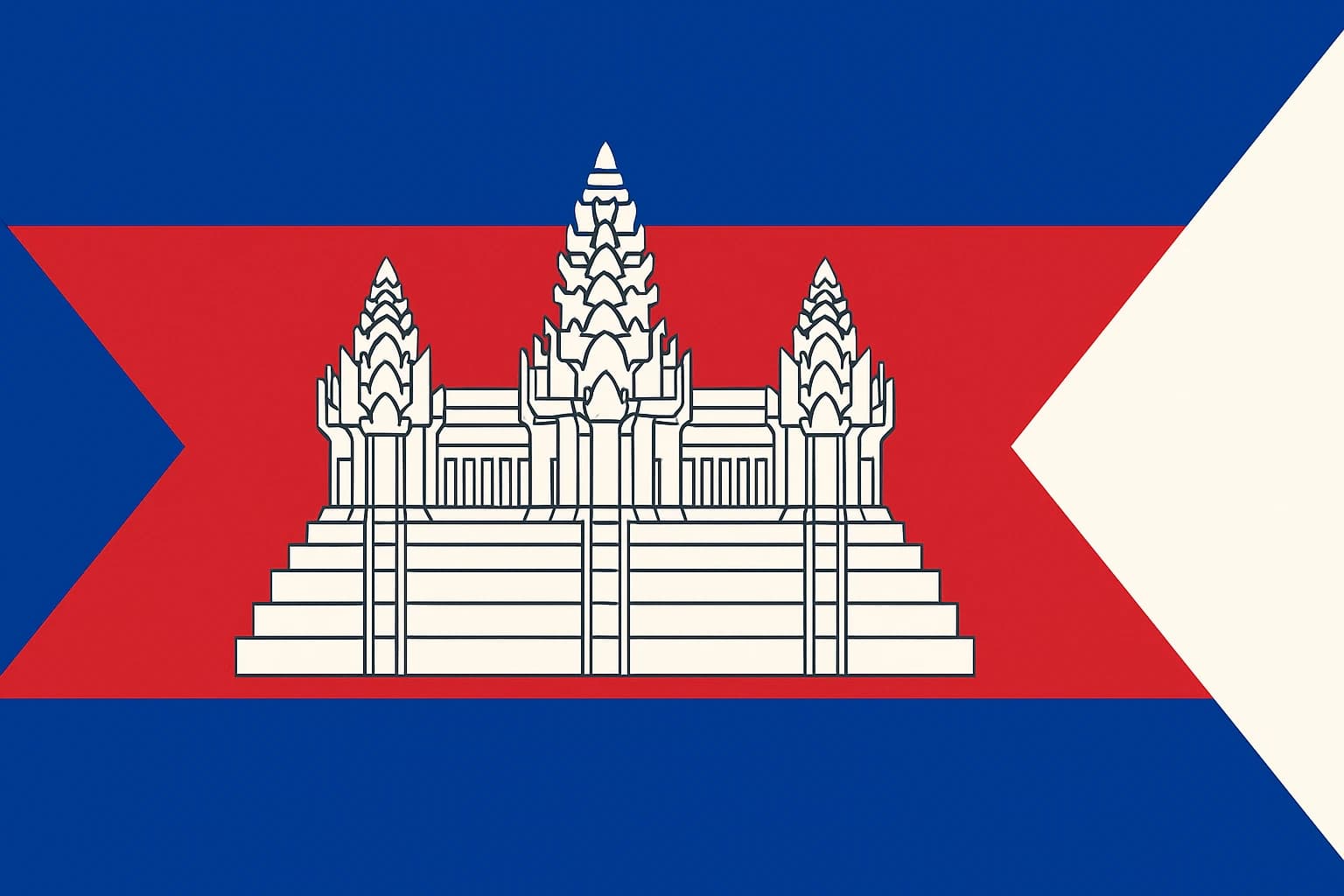
The 1991 Paris Peace Accords and the UNTAC transitional period from 1992 to 1993 led to elections and the restoration of the constitutional monarchy under King Sihanouk. The flag adopted in 1993, still flying as of 2026, returned to the pre-1970 design: white Angkor Wat on a red band between two blue bands.
How Angkor Wat functions as a civilizational claim
Angkor Wat on the flag is not primarily a religious symbol. It has served Hindu kings, Buddhist monks, secular republicans, atheist communists, and restored monarchs. Nor is it primarily historical, since it has been used by regimes that wanted to destroy history. It is a legitimacy claim: we are the heirs of the people who built this.
That is why no regime could remove it. Taking Angkor Wat off the flag would concede that your government was not the rightful heir to Khmer civilization. In a region where Cambodia's neighbors, Thailand and Vietnam, have historically contested Cambodian territory and cultural heritage, that concession would be politically fatal.
The stakes are not abstract. Thai-Cambodian tensions over the Preah Vihear temple led to military clashes as recently as 2011, and architectural heritage claims in Southeast Asia carry real geopolitical weight. Angkor Wat on the flag is, among other things, a territorial assertion: this building is ours, this civilization is ours, this land is ours.
Compare Cambodia's choice with other nations. Turkey does not put the Hagia Sophia on its flag. Greece does not feature the Parthenon. Egypt does not center its flag on the pyramids.
Cambodia is genuinely exceptional in how completely one building has become synonymous with one nation's identity, and the flag makes that inseparability official.
The current design has now gone unchanged since 1993, the longest period of flag stability in modern Cambodian history. A French colonial administration, an independent monarchy, a Cold War republic, a genocidal revolution, a Vietnamese-backed socialist state, and a restored constitutional monarchy all kept the same building at the center of their flags. Removing it was never a real option, because that would mean admitting Cambodia was something less than what Angkor Wat proves it once was.