The Flag of Cambodia
Kingdom of Cambodia
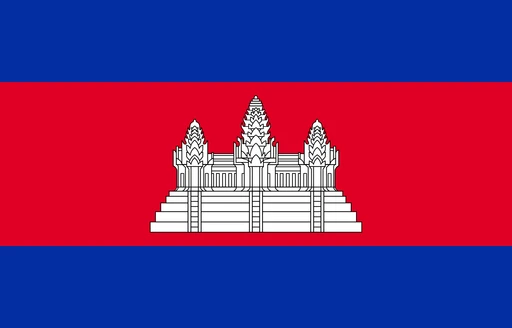
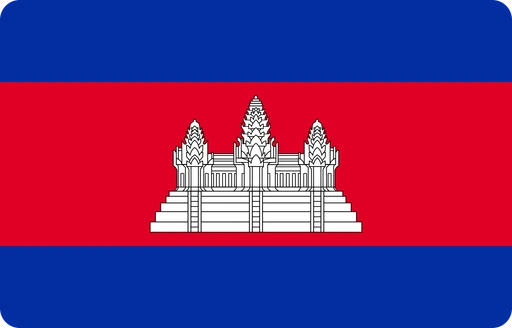
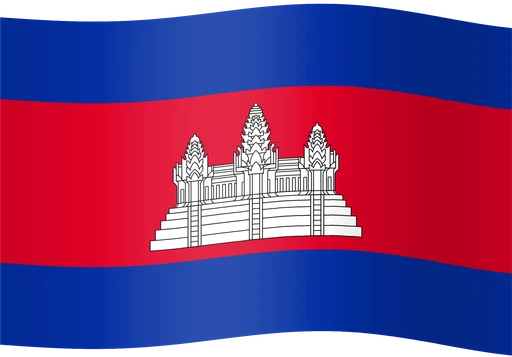
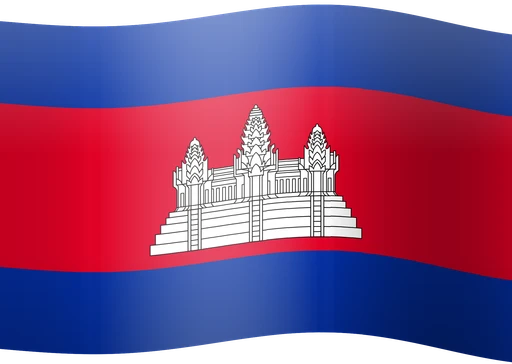
The flag of Cambodia has three horizontal bands: blue on top, red at double width in the middle, and blue at the bottom, with a white depiction of Angkor Wat centered on the red. The blue bands stand for royalty, the red for the nation, and Angkor Wat for integrity, justice, and heritage.
Cambodia's flag is one of very few in the world with a building at its center: a white depiction of Angkor Wat, the 12th-century temple complex. The current form dates from 1993, after the restoration of the constitutional monarchy, and the blue and red triband layout goes back, with interruptions, to about 1850. That continuity hides a great deal of turbulence. Cambodia has changed its flag more often than almost any other country, and every regime from the French protectorate to the Khmer Rouge redrew the banner while keeping the temple on it.
A temple that outlasted every regime
Cambodia has used roughly ten different flags since the mid-19th century. That's more than nearly any other modern nation. And yet, through all of it, Angkor Wat has appeared on almost every single one.
The French Protectorate flag, introduced in 1863, was the first to formally place the temple on a national banner, though earlier royal standards under the Khmer kings referenced it indirectly. From that point on, the temple became inescapable. Under the monarchy, it represented divine kingship and the grandeur of the Khmer Empire. When Lon Nol's Khmer Republic seized power in 1970, the temple signaled revolutionary legitimacy. The Khmer Rouge, architects of one of the 20th century's worst genocides, printed a stark yellow Angkor Wat on their red flag to evoke an agrarian utopia rooted in Cambodia's ancient past. After Vietnam toppled the Khmer Rouge in 1979, the new People's Republic of Kampuchea kept the temple on its flag too, this time rendered with five towers in yellow to deliberately distinguish it from the three-towered Khmer Rouge version.
Only the State of Cambodia flag (1989-1991) and the brief UNTAC transitional period (1991-1993) departed much from this, and even the 1989 design kept a simplified Angkor Wat silhouette. Regimes that set out to erase one another's legacies entirely still kept the same temple on the flag.
Reading the triband
The current flag is a horizontal triband: a deep blue stripe on top, a wide red band in the center, and another deep blue stripe on the bottom. Centered on the red field sits a white depiction of Angkor Wat. The proportions are 2:3, with the red band occupying exactly half the flag's height and each blue band taking up one quarter.
Look closely at the temple and you'll notice it shows three towers, the central prasat flanked by two smaller ones, rising from a stepped base. It's rendered as a white outline, clean and stylized. This is deliberately simpler than the more detailed or filled-in versions that appeared on earlier Cambodian flags, and the simplicity is what makes it work so well at a distance.
The three colors map directly onto Cambodia's national motto: Nation, Religion, King (ជាតិ សាសនា ព្រះមហាក្សត្រ). Red stands for the Cambodian people and their courage. Blue represents the monarchy, a connection rooted in centuries of royal tradition stretching back to the Varman kings. White symbolizes Theravada Buddhism, the state religion practiced by more than 95% of the population.
The triband layout closely follows the flag first adopted under King Ang Duong around 1850, and that is no accident. When Cambodia restored its monarchy in 1993, the designers reached back past decades of war and revolution to a pre-colonial, pre-republican identity.
A timeline of change
c. 1850: King Ang Duong adopts what may be the first formal Cambodian national flag, a red banner featuring Angkor Wat. Details are scarce, but it established the template everything else would follow.
1863: France establishes its protectorate over Cambodia and formalizes the flag with the blue-red-blue triband layout. Angkor Wat appears in red outline on the central band.
1948: The Kingdom of Cambodia gains internal autonomy and adopts the version most similar to today's design, with a white Angkor Wat on the red central stripe. This is the flag that would be revived 45 years later.
1970: Lon Nol's military coup creates the Khmer Republic. The new regime replaces the flag entirely with a blue canton bearing three white stars on a red field. It's one of the very few Cambodian flags to drop Angkor Wat altogether, though variant state emblems later reintroduced the temple.
1975-1979: The Khmer Rouge seizes power. Their flag for Democratic Kampuchea features a stark yellow three-towered Angkor Wat silhouette centered on an all-red field. The regime co-opted the temple to project an image of agrarian purity while systematically destroying Cambodia's people and institutions.
1979-1989: Vietnam topples the Khmer Rouge and installs the People's Republic of Kampuchea. The new flag is red with a yellow five-towered Angkor Wat, a pointed visual rebuke to the Khmer Rouge's three-towered version.
1989-1992: The renamed State of Cambodia modifies the design once more. Then, from 1992 to 1993, the United Nations Transitional Authority (UNTAC) flies its own flag during the peacekeeping administration.
1993: Following UN-supervised elections and the restoration of the constitutional monarchy under King Norodom Sihanouk, Cambodia readopts the 1948 flag design. It remains in use today.
Buildings on national flags
Cambodia is one of only three sovereign nations whose flag carries a recognizable building. The others are Afghanistan, which has shown a mosque in several of its many flag versions, and, by some readings, Portugal, whose coat of arms includes the Tower of Belém.
The reason so few countries try it is practical. Buildings are hard to render small. They turn cluttered or unrecognizable on a flag flapping fifty feet up a pole. The white silhouette of Angkor Wat avoids that, being simple enough to read at a distance and specific enough to identify. Vexillologists often cite it as the most effective use of architectural imagery on any flag.
The flag has also fed the temple's global profile. Angkor Wat is a UNESCO World Heritage Site and Cambodia's biggest tourism draw, with millions of visitors a year.
Protocol and use
Cambodia's Constitution, specifically Article 153, lays out the flag's design, and its display is further governed by royal decree and national law. Unauthorized alteration or desecration of the flag is a criminal offense.
The Royal Standard is a separate flag entirely: the royal coat of arms set on a golden yellow field, flown at royal residences and during state ceremonies alongside the national banner. When former King Norodom Sihanouk passed away in October 2012, the national flag flew at half-mast across the country in one of the most widely observed periods of mourning in modern Cambodian history.
Abroad, Cambodian expatriate communities display the flag during Khmer New Year (Chaul Chnam Thmey) in April and the Water Festival (Bon Om Touk) in November, from the United States to France to Australia. At home it anchors Independence Day on November 9, which marks the day in 1953 when Cambodia gained full independence from France. Each year on that date the triband flies from government buildings, schools, temples, and houses.
References
[1] Constitution of the Kingdom of Cambodia (1993), Article 153. Official specification of the national flag's design and legal protections.
[2] Whitney Smith, Flags Through the Ages and Across the World (McGraw-Hill, 1975). Comprehensive vexillological reference covering historical Cambodian flag variants.
[3] David Chandler, A History of Cambodia, 4th ed. (Westview Press, 2008). Authoritative political history providing context for each regime change and its associated symbols.
[4] UNESCO World Heritage Centre, "Angkor" entry. https://whc.unesco.org/en/list/668. Documentation of Angkor Wat's cultural significance and international recognition.
[5] Flags of the World (FOTW), Cambodia page. https://www.fotw.info/flags/kh.html. Peer-reviewed vexillological database with detailed notes on each Cambodian flag variant.
[6] Royal Government of Cambodia, Official Gazette. Legal provisions governing national flag use and protocol.
[7] Proceedings of the International Congress of Vexillology, various years. Scholarly discussions of Cambodian flag history and design analysis.
Common questions
- Why does Cambodia have a building on its flag?
- That building is Angkor Wat, the famous 12th-century temple complex and Cambodia's biggest source of cultural pride. It's one of the only national flags in the world with a recognizable building on it. The white silhouette represents the greatness of the Khmer Empire, and it's appeared on nearly every Cambodian flag since around 1850, surviving monarchy, colonialism, revolution, and genocide.
- What do the colors on the Cambodian flag mean?
- They reflect Cambodia's national motto: Nation, Religion, King. Red represents the Cambodian people and their courage. Blue symbolizes the monarchy, rooted in centuries of royal tradition. And the white of the Angkor Wat silhouette represents Theravada Buddhism, the state religion practiced by over 95% of the population.
- Why has Cambodia changed its flag so many times?
- Cambodia's had roughly ten different flags since the mid-1800s, mostly because its political history has been incredibly turbulent. Every new regime, from French colonial rule to the Khmer Rouge to UN administration, brought a new flag. The remarkable thing? Nearly all of them kept Angkor Wat front and center.
- Did the Khmer Rouge use Angkor Wat on their flag?
- They did. Their flag had a yellow three-towered Angkor Wat on an all-red background. They used the temple to project an image of agrarian purity tied to Cambodia's ancient past. When Vietnam overthrew the Khmer Rouge in 1979, the new government deliberately switched to a five-towered version to set itself apart from the Khmer Rouge's three-towered design.
- When was Cambodia's current flag adopted?
- It was adopted in 1993 after UN-supervised elections restored the constitutional monarchy under King Norodom Sihanouk. The design is basically a revival of the 1948 flag, intentionally reaching back past decades of war and revolution to reconnect with Cambodia's pre-conflict identity.
Featured in these articles
- The Flag That Wasn't Allowed to Change: How Belarus Brought Back Stalin's Design, and Why It Started a Revolution
- The Dragon That Refused to Die: Bhutan's Living Mythology and the Flag It Never Modernized
- The Lotus, the Angkor, and the Nation: Why Cambodia Put a Building on Its Flag and Never Took It Off
Download this flag
Free in 12 styles, from 32px icons up to 2000px, as SVG, PNG, WebP and JPG.