The Flag of Egypt
Arab Republic of Egypt
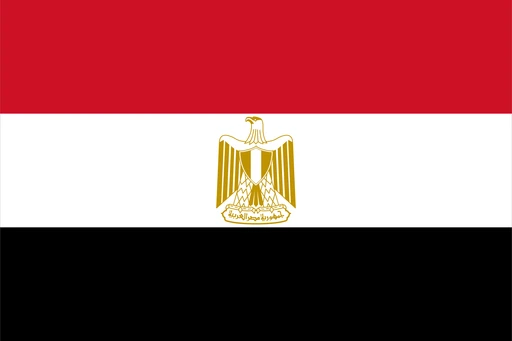
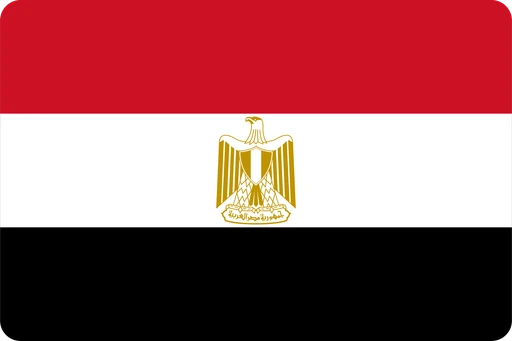
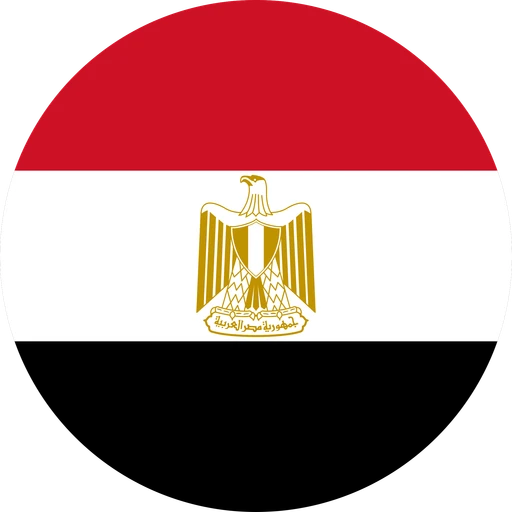
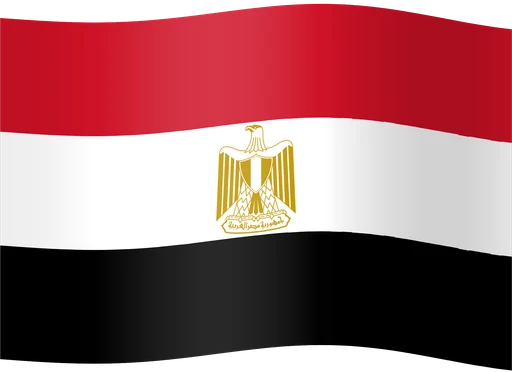
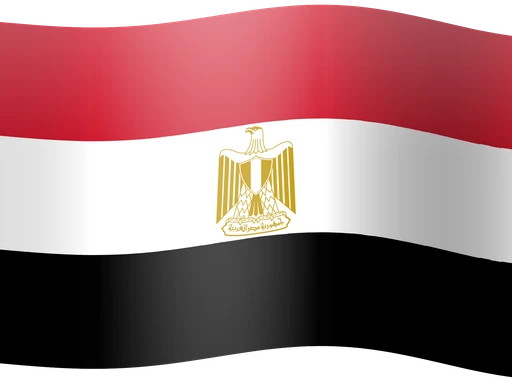
The flag of Egypt has three horizontal stripes, red on the top, white in the middle and black on the bottom, with the national emblem, the Eagle of Saladin, centered in the white stripe. The current design was adopted on October 4, 1984. Red stands for bravery and sacrifice, white for purity, and black for the period of occupation that ended with the 1952 revolution.
Egypt's national flag is three horizontal bands of red, white, and black with the golden Eagle of Saladin at its center. Since the fall of the monarchy in 1952, Egypt has changed its flag more often than almost any other modern nation, and each redesign tracks a shift in alliances or the collapse of a union. The current design, adopted on October 4, 1984, was the point at which the country stopped redrawing the flag for the sake of a partnership abroad.
Six flags in sixty years
Egypt's modern flag story begins in 1922, when nominal independence from Britain brought a green field bearing a white crescent and three white stars. That flag flew for three decades under King Fuad I and then King Farouk, its green evoking both Islam and the Khedival dynasty. It looked nothing like today's flag.
The Free Officers' revolution of July 23, 1952, led initially by Muhammad Naguib and soon dominated by Gamal Abdel Nasser, toppled the king and scrapped the country's entire visual identity along with him. By 1953, the Liberation Rally flag replaced the royal green: a horizontal tricolor of red, white, and black, with the Eagle of Saladin perched on the white band. The monarchy's crescent and stars were gone overnight.
Then came the unions. In 1958, Egypt and Syria merged into the United Arab Republic, and the eagle gave way to two green stars on the white stripe, one for each member state. Syria pulled out in 1961, but Egypt stubbornly kept the two-star flag for another eleven years, as if waiting for the union to reconvene. It never did.
A new experiment arrived in 1972: the Federation of Arab Republics, linking Egypt with Libya and Syria. This time the flag swapped in the golden Hawk of Quraysh, a different bird entirely, meant to signal broader Arab lineage. That federation proved just as fragile. By 1977, relations between Egypt and Libya had soured to the point of a brief border war.
On October 4, 1984, under President Hosni Mubarak, Egypt restored the Eagle of Saladin and settled on the flag that flies today. The decision was deliberate. After decades of chasing pan-Arab unions that collapsed one after another, Egypt chose a symbol tied specifically to its own soil, its own history. Every one of these six flag changes maps directly onto a geopolitical event: revolution, union, dissolution, federation, and finally, national consolidation. Few flags carry that much biography.
The Eagle of Saladin
The bird at the center of Egypt's flag isn't generic. It's specifically the Eagle of Saladin, traced to a stylized eagle carved into the western wall of the Citadel of Cairo. That fortress was built in the 12th century by Salah ad-Din al-Ayyubi, the Ayyubid sultan better known in the West as Saladin, the commander who recaptured Jerusalem from the Crusaders in 1187.
When the Free Officers chose this eagle in 1952, they were making an unmistakable point. Saladin represented resistance to foreign occupation, a theme that resonated powerfully in a country only recently free of British military presence. The eagle faces the viewer's left (heraldic dexter), its wings spread, clutching a scroll inscribed with the country's official name in Arabic: Jumhūriyyat Miṣr al-ʿArabiyyah, the Arab Republic of Egypt. It's rendered in gold.
One important distinction often gets muddled. The Eagle of Saladin and the Hawk of Quraysh are two different birds with different political meanings. Egypt, Iraq, and Palestine use (or have used) the Eagle of Saladin. Syria still uses the Hawk of Quraysh, which Egypt itself briefly adopted during the Federation of Arab Republics period (1972 to 1984). The hawk references the Quraysh tribe of the Prophet Muhammad, a broader pan-Arab symbol; the eagle ties specifically to Egyptian and Ayyubid heritage.
Beyond the flag, the Eagle of Saladin functions as Egypt's coat of arms. You'll find it stamped on passports, mounted above courtroom doors, and stitched onto military uniforms. It's one of the few national emblems in the world whose origin can be traced to an actual, still-standing piece of medieval architecture.
Red, white, and black
The red-white-black tricolor is sometimes called the "Arab Liberation Colors," a lineage that stretches back further than you might expect. The 14th-century poet Safi al-Din al-Hilli wrote verses celebrating four colors associated with the great Arab dynasties: black for the Abbasids, white for the Umayyads, green for the Fatimids, and red for the Hashemites. Centuries later, these colors resurfaced in the Arab Revolt flag of 1916, and from there flowed into the flags of half a dozen modern states.
In Egypt's specific telling, the three stripes carry revolutionary meaning. Red recalls the struggle before 1952, the blood of those who resisted British colonial rule and fought against the monarchy. White marks the revolution itself, a point of genuine national pride: the monarchy fell without civil war, without mass bloodshed. Black represents the end of oppression, the dark period of foreign domination now consigned to history.
These same three colors, often joined by green, appear across the flags of Iraq, Syria, Yemen, Sudan, and Palestine. That's no coincidence. The pan-Arab nationalist movement of the mid-20th century, with Nasser as its most charismatic voice, deliberately promoted shared symbols to signal solidarity. What distinguishes Egypt's version is the specific arrangement (red on top, black on bottom) and, of course, the golden eagle. Yemen uses identical stripes but no emblem at all, which makes the two flags surprisingly easy to confuse at a distance.
Protocol and display
Egyptian law takes the flag seriously. Desecration is a criminal offense under the Egyptian penal code, and strict rules govern how the flag is handled, folded, and displayed. Government buildings, military installations, and Egyptian embassies fly it year-round, with particular prominence on Revolution Day (July 23) and Armed Forces Day (October 6).
When hung vertically, the red band should appear on the observer's left. The presidential standard features the Eagle of Saladin on its own distinct background, separate from the national tricolor. Variant flags exist for the navy and civil maritime fleet, each with different proportions or added elements.
The flag's official proportions are 2:3, though you wouldn't always know it from practice. Oversized flags are a fixture of Egyptian public squares. The enormous flag at Cairo's Tahrir Square became one of the most photographed objects on earth during the 2011 revolution, visible in nearly every aerial shot broadcast worldwide. That single flag, already planted in the square before the protests, became an accidental icon.
The flag in Tahrir Square
During the January 25, 2011, uprising, Egypt's flag became the one thing everyone agreed on. Islamists, secularists, liberals, socialists, young and old: they all carried it into Tahrir Square. In a movement defined by its internal diversity, the flag was the single unifying object. Face-painting the red, white, and black stripes became a signature gesture of the protests, images that circled the globe on social media and 24-hour news channels.
That was the difference between 2011 and 1952. In the original revolution, the old royal flag was torn down and physically replaced. In 2011, protesters were defending the existing flag as their own, and nobody called for a redesign, because the flag already belonged to them rather than to Mubarak's government.
Egyptian football ultras had laid the groundwork for this. Groups like Ultras Ahlawy and Ultras White Knights had spent years turning the flag into a symbol of popular defiance in stadiums, long before anyone imagined occupying Tahrir Square. When the revolution came, the culture of flag-waving was already second nature.
After 2013, when President Morsi was removed from power, both his supporters and his opponents wrapped themselves in the same flag. Neither side made a rival one. Two movements fighting over the same banner is a decent measure of how far the flag has travelled from any particular regime.
References
[1] Whitney Smith, Flags Through the Ages and Across the World (1975). Comprehensive vexillological reference covering Egypt's flag history.
[2] Constitution of the Arab Republic of Egypt (2014), Article 223. Legal definition and description of the national flag. Available via Egypt's State Information Service: https://www.sis.gov.eg
[3] FOTW (Flags of the World), Egypt page. Detailed vexillological analysis and historical variants. https://www.crwflags.com/fotw/flags/eg.html
[4] Zeinab Abul-Magd, Imagined Empires: A History of Revolt in Egypt (2013). Discussion of Safi al-Din al-Hilli's poetry and the origins of the Arab Liberation Colors.
[5] BBC News and Al Jazeera English archival coverage of the 2011 Egyptian revolution, documenting flag use in Tahrir Square.
[6] Egyptian Government Official Portal. Official description of national symbols. https://www.egypt.gov.eg
Common questions
- What do the colors on Egypt's flag mean?
- Red stands for struggle and sacrifice, white for peace and purity, and black for the end of oppression. All three have been on the flag since the 1952 revolution.
- Who's the eagle on Egypt's flag?
- It's the Eagle of Saladin, an emblem of Arab nationalism named after the 12th-century sultan who took Jerusalem back from the Crusaders.
- Why was Egypt's flag changed after 1952?
- After the 1952 revolution, Egypt's flag changed to reflect the end of the monarchy and support Arab unity, featuring red, white, and black stripes.
- What is the eagle on the Egyptian flag?
- It's the Eagle of Saladin, based on a carved eagle found at the Citadel of Cairo, built by the 12th-century sultan Salah ad-Din (Saladin), who took Jerusalem back from the Crusaders. The Free Officers picked it after the 1952 revolution to represent resistance to foreign rule. It's rendered in gold and doubles as Egypt's coat of arms, showing up on passports and government buildings.
- What do the colors on the Egyptian flag represent?
- Red is for the struggle against colonial rule and the monarchy before the 1952 revolution. White represents the revolution itself, which toppled the king without civil war. Black marks the end of oppression and foreign domination. Together, they're sometimes called the "Arab Liberation Colors," and they trace back to colors linked with historic Arab dynasties.
- Why does Egypt's flag look so similar to Yemen's?
- They both use the same red, white, and black horizontal stripes, rooted in pan-Arab nationalist symbolism. The difference is that Egypt's flag has the golden Eagle of Saladin on the white stripe, while Yemen's is plain, no emblem at all. From a distance, they're surprisingly easy to mix up.
- Why has Egypt changed its flag so many times?
- Egypt's had roughly six flags since 1922, and each one came with a major political shake-up: independence from Britain (1922), the Free Officers' revolution (1952-53), the union with Syria as the UAR (1958), the Federation of Arab Republics with Libya and Syria (1972), and finally the current design in 1984. Every redesign reflected new alliances or failed unions.
- What's the difference between the Eagle of Saladin and the Hawk of Quraysh?
- They're two different birds with different meanings. The Eagle of Saladin, used by Egypt, Iraq, and Palestine, references the Ayyubid sultan and Egyptian heritage. The Hawk of Quraysh, used by Syria, references the Prophet Muhammad's tribe and points to a broader pan-Arab identity. Egypt actually used the Hawk from 1972 to 1984 during the Federation of Arab Republics before switching back.
Featured in these articles
- Stripes That Tell the Wrong Story: How the Horizontal Band Became the Default, and What Countries Lost When They Copied It
- The Cedar That Outlasted Every Regime: How Lebanon Built a Nation Around a Symbol No One Could Own
- The Lotus, the Angkor, and the Nation: Why Cambodia Put a Building on Its Flag and Never Took It Off
- Around the World in 50 Flags: A Vexillological Journey
Download this flag
Free in 12 styles, from 32px icons up to 2000px, as SVG, PNG, WebP and JPG.