The Flag of Thailand
Kingdom of Thailand
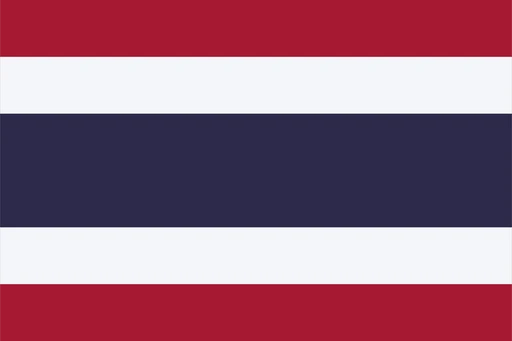
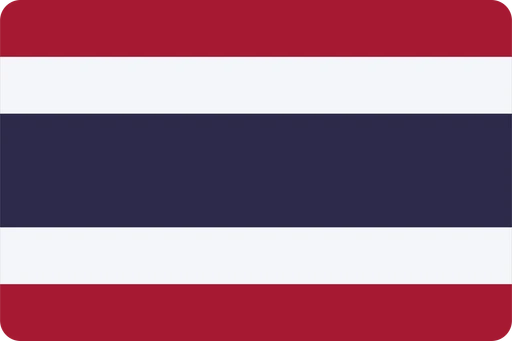
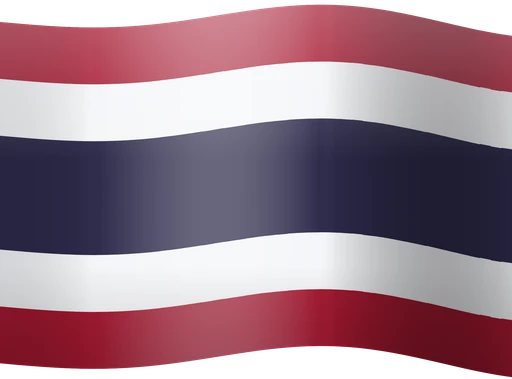
The flag of Thailand, the 'Traisanga' or 'Traisanga Chai', has five horizontal stripes in red, white and blue. A wide blue stripe runs through the center, flanked by narrower white stripes and then red ones at the top and bottom. Red stands for the land and its people, white for religion and blue for the monarchy. The flag is in a 2:3 ratio.
The flag of Thailand, the "Thong Trairong" or tricolor flag, is five horizontal stripes of red, white and blue.
What came before 1917
King Rama VI adopted the current flag on September 28, 1917, ending a long run of red-based designs. In the Ayutthaya period Siam flew a plain red flag with nothing on it at all. The white elephant appeared under Rama II as a mark of royal power and prosperity, and by the 19th century, under Rama IV, a red flag with a white elephant had become standard. A naval ensign of the period used a plain red field with a white circle containing a red elephant.
As Thailand modernized and dealt more closely with Western states, the flag changed with the politics, and the nationalism of the early 20th century pushed for something new. The First World War gave Rama VI the occasion for the tricolor, a single emblem meant to hold the country's core commitments in one design.
Five stripes, one of them double width
From top to bottom: red, white, blue, white, red. The blue stripe at the center is twice the width of the others, which gives the flag its balance and makes it legible at a distance.
Red is the land and the people. White is Buddhism, the country's dominant religion. Blue is the monarchy and loyalty to the king. There are no emblems or devices anywhere on the flag, so the colors do all the work.
Protocol and public life
Government and military institutions fly the flag, and it has a fixed place in national ceremonies, with detailed etiquette for how it is handled. It appears on public buildings and at official events during national celebrations, and rules cover flying it at half-mast during mourning. It has been present at every major national turning point since 1917, and it appears throughout Thai literature and media.
A design of its moment
The tricolor scheme is a product of the early twentieth century, when Western conventions were spreading through flag design worldwide, and Thailand's flag resembles a great many others at a glance. Its proportions and its particular assignment of meaning to each color are what make it Thai.
References
[1] Thailand Government Public Relations Department: prd.go.th
[2] "A History of Thailand" by Chris Baker and Pasuk Phongpaichit
Common questions
- Why does Thailand have its current flag design?
- King Rama VI adopted the current flag on September 28, 1917, at a point when the country was modernizing quickly and wanted a single emblem to stand for it.
Featured in these articles
Download this flag
Free in 12 styles, from 32px icons up to 2000px, as SVG, PNG, WebP and JPG.