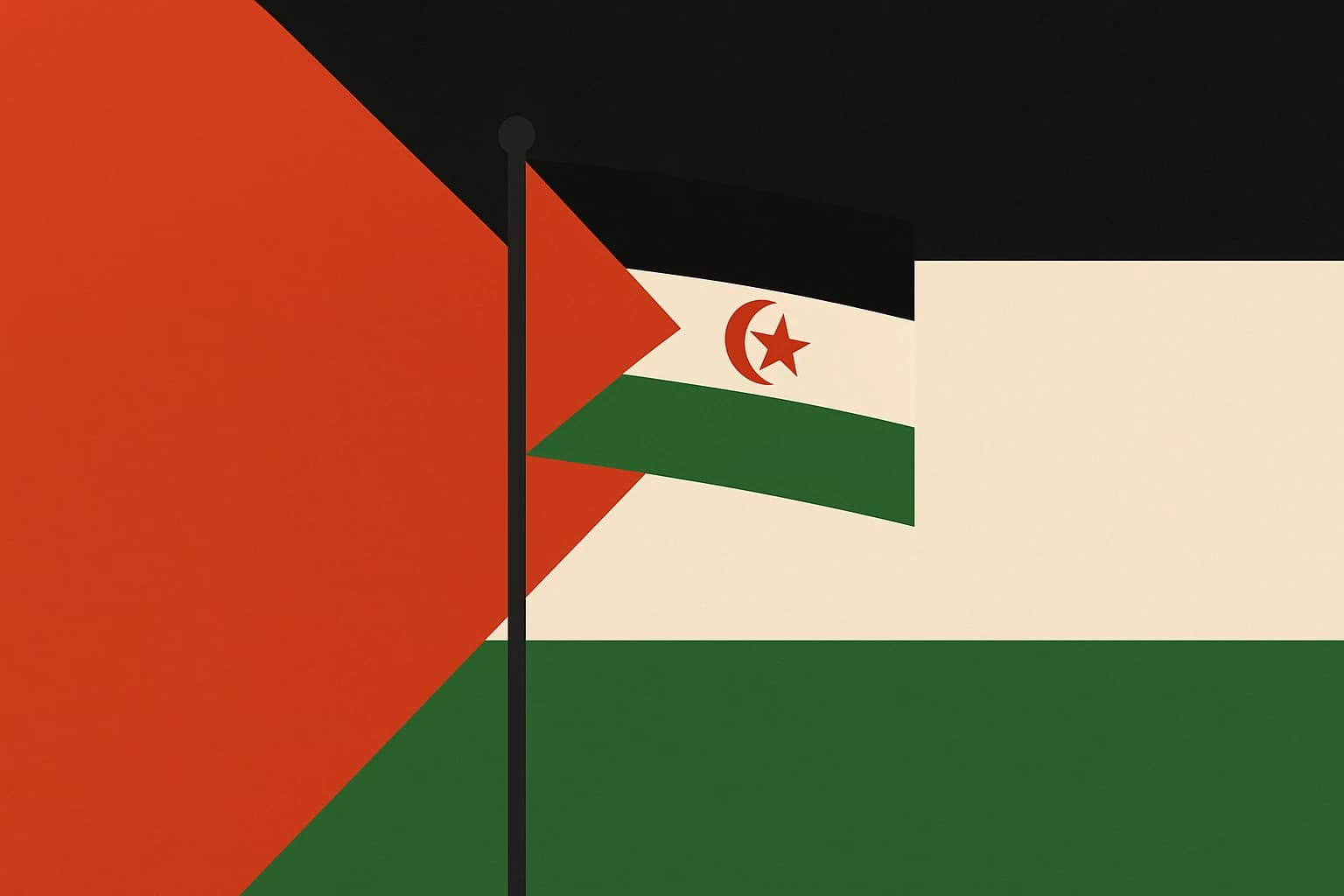
In February 2024, the flag of the Sahrawi Arab Democratic Republic, a horizontal tricolor of black, white, and green with a red triangle at the hoist bearing a crescent and star, was raised at the African Union headquarters in Addis Ababa alongside those of 54 other member states.
It flies at refugee camps in Tindouf, Algeria, where over 170,000 Sahrawis have lived in exile for nearly half a century. It appears on diplomatic letterhead in more than 40 countries that formally recognize the SADR as a sovereign nation. And yet, if you open Google Maps or consult most Western atlases, the territory this flag claims to represent, Western Sahara, is drawn as part of Morocco, sometimes with a faint dashed line the only concession to its contested status.
Which leaves a genuine question: what does it mean to design, adopt and fly a national flag when the nation itself is the thing under dispute? The SADR flag was built to make an argument, and it is worth taking apart to see how the argument works.
A flag born in guerrilla war (1973-1976)
The Polisario Front, or Frente Popular de Liberación de Saguía el-Hamra y Río de Oro, was founded on May 10, 1973. Its original enemy was Spain. The territory then known as Spanish Sahara had been a colonial possession since the late 19th century, and the Polisario emerged as an armed resistance movement fighting for self-determination. The flag's story begins not with independence but with anti-colonial struggle.
When Spain withdrew in 1975 under the Madrid Accords, things got worse, not better. Morocco and Mauritania partitioned the territory between them, and the Polisario Front, backed by Algeria, found itself fighting a new war on two fronts. On February 27, 1976, the movement declared the Sahrawi Arab Democratic Republic. The flag was adopted that same day as one of the new state's founding acts.
The sequence is the interesting part. The flag came before a functioning government, settled borders or a census, because the flag was the argument.
Algeria's backing was not incidental. The Polisario leadership grasped something that gets underestimated: a flag designed for a movement signals rebellion, while a flag designed for a country signals statehood. The Polisario Front already had its own organizational flag, similar in colour scheme but different in layout. Creating a separate national flag for the SADR, one belonging to the state rather than the party, was a deliberate move. This was a state project rather than an insurgency branding exercise, announced to the world in fabric.
The flag did two jobs from day one. It was a military standard for guerrilla fighters operating across long stretches of desert, and it was a diplomatic instrument for international forums, embassies and negotiations. The battlefield and the conference table needed the same banner.
Reading the colours
The SADR flag uses the four Pan-Arab colors: black, white, green, and red. These colors trace their origins to the Arab Revolt of 1916-1918 against Ottoman rule and were later codified through the flags of newly independent Arab states across the 20th century.
The design gets strategic in its layout. The colour scheme and arrangement closely mirror the Palestinian flag: a horizontal black, white and green tricolour with a red triangle at the hoist.
The resemblance is not accidental. It links the Sahrawi cause to the most widely recognized anti-colonial movement in the Arab world, so that a diplomat or journalist seeing the SADR flag for the first time gets an immediate association with occupation and resistance before anyone has explained anything.
The crescent and star in red on the triangle serve a dual function. They signal Islamic identity, connecting to the flags of Algeria, Tunisia, Turkey, and others. The red itself evokes the blood of martyrs, a common motif in revolutionary flag design stretching back to the French tricolore and beyond.
Other Pan-Arab flags use the same palette in different arrangements to tell different national stories. The UAE stacks its colors vertically. Jordan mirrors the Palestinian layout but adds a white star. Sudan and Kuwait rearrange the same building blocks into their own configurations.
The SADR's arrangement, nearly identical to Palestine's, is a calculated act of visual solidarity and borrowed legitimacy. By placing itself inside the Pan-Arab visual tradition, the flag claims membership in a family of nations before a word of diplomatic text is written.
Flags without countries
Western Sahara is far from alone in this phenomenon. A survey of flags flown by unrecognized or partially recognized states reveals a global pattern. Somaliland declared independence in 1991, is recognized by zero UN members, yet operates its own government, currency, and flag. Transnistria, Abkhazia, South Ossetia, and the Turkish Republic of Northern Cyprus all maintain full national flag programs. None of them appear on most world maps as independent states.
Taiwan presents the most dramatic version of this paradox. Its flag flies at Olympic ceremonies (under protest and a different name), at de facto embassies worldwide, and over a nation of 23 million people. Yet it is formally recognized by fewer than 15 UN member states.
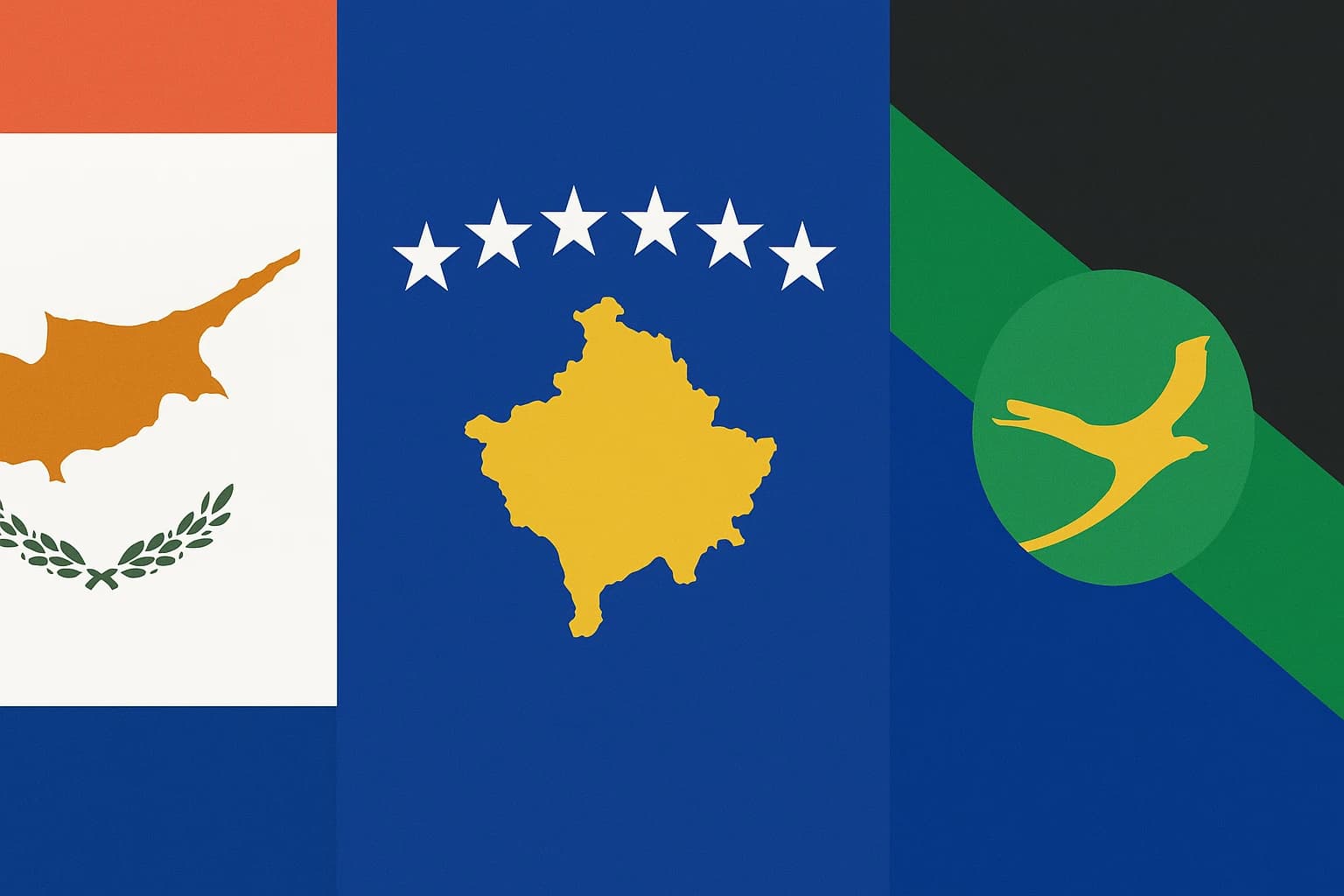
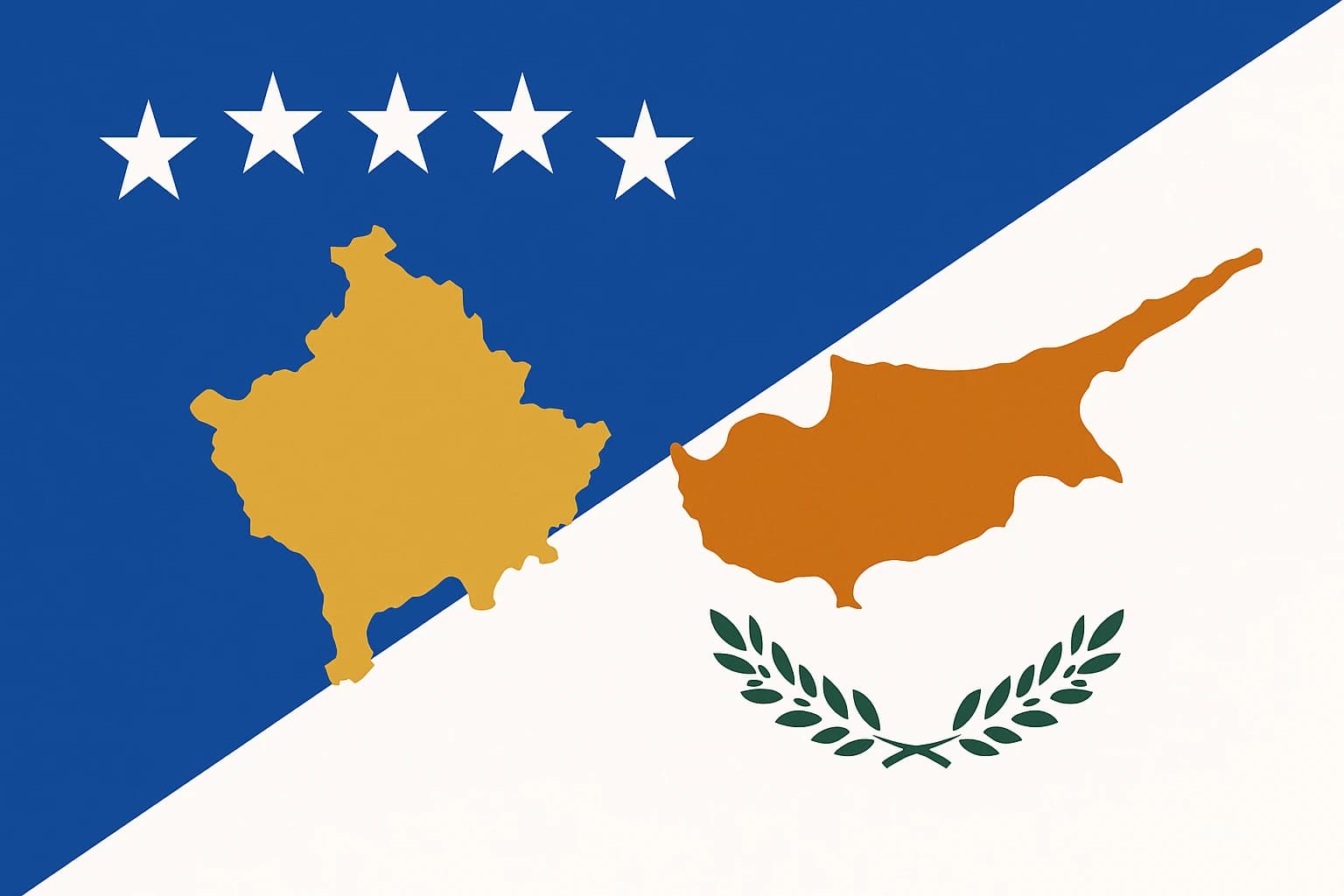
Kosovo, recognized by over 100 countries but not admitted to the UN, designed its flag in 2008 specifically to avoid the Albanian eagle and the Serbian cross. That's a case where flag design was shaped entirely by the politics of non-recognition. The designers chose a blue field with a gold map outline and six stars, a "neutral" design meant to signal a new, inclusive identity rather than ethnic allegiance.
The difference from a recognized state is fundamental. For a recognized state a flag represents sovereignty that already exists. For an unrecognized one it attempts to create the perception of sovereignty, which makes it performative rather than descriptive. The SADR flag is trying to will a country into being.
That is why flag display at international organizations becomes a flashpoint. When the African Union, then still the OAU, accepted the SADR flag in 1984, Morocco withdrew from the body and stayed away for 33 years, returning only in 2017.
Thirty-three years. Over a flag.
Life under the banner in Tindouf and the occupied territory
In the Tindouf refugee camps in southwestern Algeria, five main camps named after Western Saharan cities (Laayoune, Smara, Dakhla, Aousserd and Boujdour), the SADR flag is everywhere. It hangs on schools, hospitals, government buildings and homes. For generations born in exile it is the most tangible connection they have to a homeland most of them have never seen.
Cross the sand berm, the 2,700-kilometre Moroccan-built wall that divides the territory, and the same flag becomes something else entirely.
Inside Moroccan-controlled Western Sahara, displaying the SADR flag is illegal. It has led to arrests, beatings, and imprisonment. Human rights organizations including Amnesty International and Human Rights Watch have documented cases where Sahrawis were detained solely for possessing or displaying the flag. In Laayoune, the city that gives one of the Tindouf camps its name, raising this flag is an act of civil disobedience with real consequences.
The same piece of fabric is bureaucratic wallpaper on one side of the wall and a radical political act on the other. In Tindouf, children grow up surrounded by it. In Laayoune, adults risk prison for it.
Morocco has run its own flag campaign in response. Large Moroccan flags dominate public spaces across Western Sahara, loyalty ceremonies are built around the Moroccan banner, and Sahrawi symbols have been systematically replaced. Both sides are treating flags as claims rather than decoration, which tells you they agree about what is at stake even when they agree about nothing else.
How the SADR flag operates on the world stage
As of 2024, the SADR is recognized by approximately 46 UN member states. The number moves as countries extend and withdraw recognition, often under Moroccan diplomatic pressure or in response to shifting alliances. Each recognition usually involves a flag-raising ceremony, which costs a government nothing and is noticed by everyone.
The 2020 normalization agreement between Morocco and Israel, part of the Abraham Accords, changed the landscape. The United States recognized Moroccan sovereignty over Western Sahara in exchange for Moroccan recognition of Israel, which established that recognition of the Sahrawi flag was something that could be traded away.
At the United Nations, Western Sahara remains on the list of Non-Self-Governing Territories. The SADR flag does not fly at UN headquarters. But it does appear at the UN's Fourth Committee (Decolonization) sessions, carried by Sahrawi representatives. This liminal flag presence, inside the building but not on the flagpole, mirrors the territory's liminal political status with precision.
The ongoing UN-brokered negotiations, led by Personal Envoy Staffan de Mistura (appointed 2021), have produced no progress on a referendum originally promised in the 1991 ceasefire agreement. The flag, in this context, has outlasted the peace process it was supposed to accompany. It was designed for a transitional moment that has now lasted nearly 50 years.
What the Sahrawi flag says about flags and power
Most writing on flags treats them as symbols of political realities that already exist. The Sahrawi case shows them working the other way, as tools for constructing a reality that does not exist yet.
The Pan-Arab design was a communication decision, placing the SADR inside a recognized visual grammar of Arab statehood. The designers chose colours and symbols for how they would be read abroad rather than for what they meant at home.
There is a wider pattern here. Some of the most politically potent flags belong to states that do not fully exist. The Confederate battle flag carries outsized weight in the United States because the project it represented was defeated militarily but never resolved culturally. The flag of the Republic of China flies over 23 million people in a prosperous democracy that most of the world pretends is not there. The Kurdish sun disk appears across four countries where Kurds seek varying degrees of autonomy. In each case the flag matters more than its official status because the question it poses is still open.
So does a flag represent a nation or help create one? For Western Sahara it is plainly both. The SADR flag has now been flying for nearly half a century, longer than several of the recognized states whose flags hang beside it at the African Union, and it still represents a territory that most maps show as part of Morocco. That gap is not a failure of the flag. It is what the flag was made for.
National flags are usually the last ornament of sovereignty, raised once the state-building is finished. This one was the opening argument, and it is still waiting for an answer.