The Flag of Tunisia
Tunisian Republic
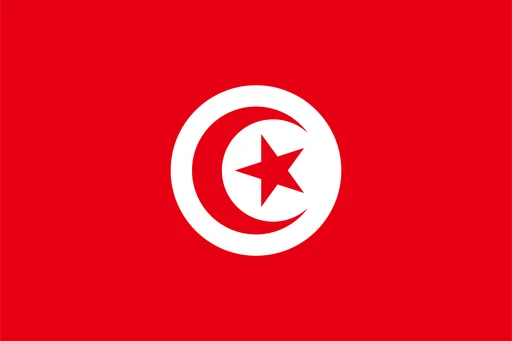
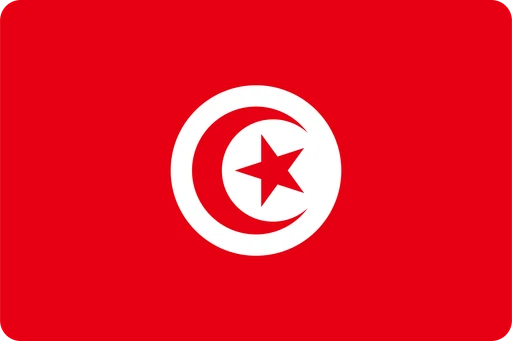
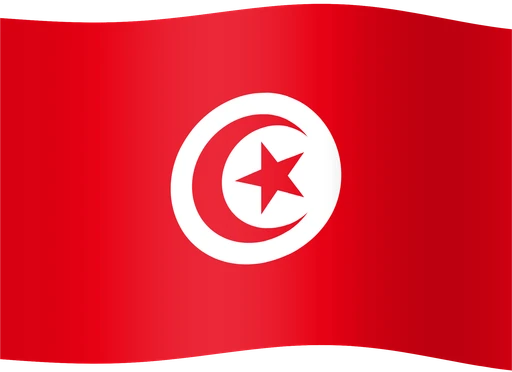
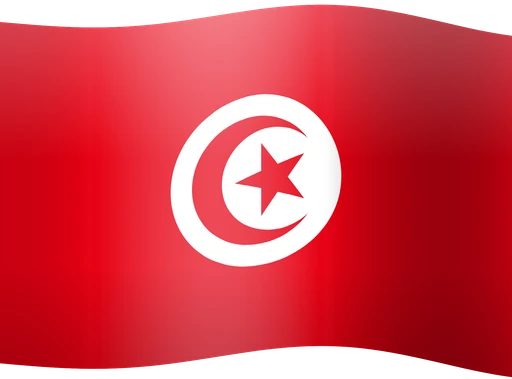
The national flag of Tunisia is a red field with a white circle in the middle. Inside the circle sits a red crescent around a red five-pointed star. The crescent and star are Islamic symbols, set in the red and white long used by Tunisia.
Tunisia's flag is a red field with a white disc at its center, holding a red crescent and star. It dates from 1827, which makes it older than the modern Tunisian state by well over a century.
An Ottoman-era flag that outlasted the empire
Hussein II Bey adopted the flag on October 20, 1827, during the Husainid dynasty and well before Tunisia became a French protectorate. When independence came on March 20, 1956, the flag was kept rather than replaced, and only its proportions and dimensions were standardized afterwards.
Its lineage runs back to the Ottoman Empire, which held much of North Africa into the 19th century. The crescent and star were Ottoman symbols before they were Tunisian ones, and they carried the region's Islamic identity through the politics of that period.
The disc, the crescent, and the star
The red field is read as the blood of the martyrs who fought for independence, and the white disc as peace. The crescent and star inside it are Islamic symbols with roots reaching back through the Ottoman and Byzantine periods, where they signified protection and divine guidance.
Where it flies
The flag is displayed on government buildings, at military installations, and at national events. Protocol calls for it on Independence Day on March 20 and Republic Day on July 25, hoisted with the appropriate ceremony. A presidential standard exists for official use, built on the same symbols.
Turkey and the wider region
Turkey's flag also pairs a red field with a white crescent and star, though the arrangement and the history behind it differ. The resemblance comes from the shared Ottoman inheritance rather than from one copying the other, and the crescent and star run through Islamic heraldry across the region.
Inside Tunisia and among Tunisians abroad, the flag turns up at national celebrations and sporting fixtures, and in art, music, and writing it tends to stand for freedom and resistance.
References
[1] Tunisia's Presidency Official Website - National Symbols: (http://www.carthage.tn/index.php?lang=en)
[2] Vexillological Association of France - Flags of the World: (https://flagspot.net/flags/tn.html)
Common questions
- What do the crescent and star symbolize on the Tunisian flag?
- They are Islamic symbols, tied historically to the Ottoman Empire and read as protection and guidance.
- Why is the Tunisian flag's background red?
- The red is usually read as the blood of the martyrs who died for Tunisian independence.
Featured in these articles
- Green Flags and the Prophet's Color: How Islam Shaped the Palettes of Saudi Arabia, Mauritania, and Beyond
- The Crescent Faces Left, the Crescent Faces Right: Why Orientation Matters More Than You Think
- The Sahrawi Riddle: How Western Sahara Flies a Flag for a Country That Doesn't Fully Exist
- The Crescent Twins: How Tunisia and Azerbaijan Inherited the Same Ottoman Symbol but Made It Mean Completely Different Things
Download this flag
Free in 12 styles, from 32px icons up to 2000px, as SVG, PNG, WebP and JPG.