Most national flags come down to stripes, and once a designer has settled on stripes there is one decision left that everyone notices: which way they run. Horizontal or vertical. It looks like a purely visual choice, and it mostly is, but a surprising amount of meaning has attached itself to the answer over the years.
What flag design has to do
Vexillology, the study of flags, covers their history, symbolism, and use. Most of what it has to say about good design comes back to a few practical constraints. A flag has to be simple enough to recognize and to reproduce. Its colors and elements should connect to something real in the country's history or values. The palette usually stops at two or three colors, because more than that turns to mud at any distance.
That is not an aesthetic preference so much as a working requirement. A flag has to carry its message at a glance, on a battlefield or at an international summit, and that hard limit on how much it can say shapes everything else about it.
Horizontal bands and the calm reading
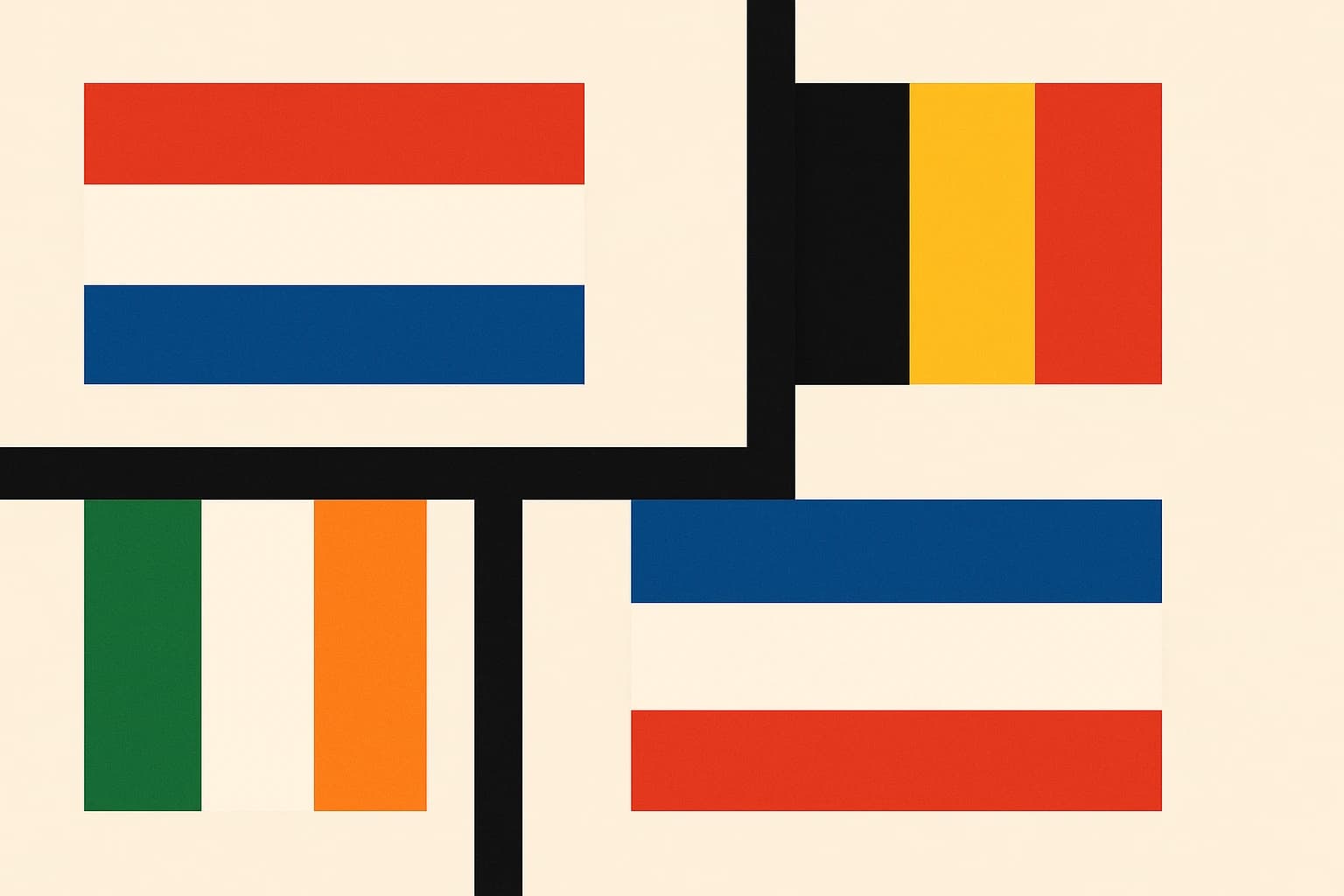
Horizontal stripes tend to be read as calm: peace, stability, a country settled rather than striving. Argentina and Australia are the examples usually given.
In a lot of cultures the horizontal band also reads as community. Everyone on the same level, nobody stacked above anyone else. Whether the people who actually designed these flags were thinking in those terms is a separate question, and the honest answer is usually no.
Vertical bands and the upright reading
Vertical stripes get the opposite association: strength, ambition, leadership. Belgium and Italy are the standard examples.
The logic is about as thin as it sounds. An upright line suggests something reaching, and that is roughly the whole of it. It is consistent enough to be worth knowing, but it is a habit of reading rather than a code.
Where the neat split falls apart
The horizontal and vertical categories are a rule of thumb, not a system, and they stop being useful fast. A layout does not lock in a meaning. The same arrangement of bands can be read very differently depending on who is flying it and when, and plenty of flags carry more than one reading at once.
National identity is complicated, and a flag with three bands on it is not. That mismatch is the interesting part.
Three flags worth reading closely
United States
The stars and stripes carry the country's founding claims about freedom and democracy. The reading has been attached to the design for so long that it is now hard to separate the two.
France
The French tricolor came out of the revolution, and its stripes still stand for the demand behind it: liberty, equality, fraternity.
Japan
Japan's flag has no stripes at all, which makes it a useful contrast. Harmony and continuity read just as clearly from a single circle as they do from a set of bands, and the design gets there with less.
Flags keep changing
Flags change as the societies flying them change. Newer designs pick up newer concerns, global cooperation and environmental responsibility among them. Flags attached to social movements now do a lot of the symbolic work that national flags once had mostly to themselves.
The pride flag carries an identity and a cause without a state behind it, which is a relatively new thing for a flag to do. It also uses horizontal stripes, for whatever that is worth.