Saudi Arabia's flag is one you cannot fly upside down. Flip it and you invert the Shahada, the Islamic declaration of faith, which would be blasphemy. Most national flags have informal rules about respectful display. Saudi Arabia put this one into law. The flag is less a banner than a portable sacred text.
And beneath that text sits a curved sword.
The instinct is to read the sword as a threat: military strength, conquest, a willingness to fight. That instinct is wrong. The sword on Saudi Arabia's flag, like the crossed khanjar on Oman's and the ceremonial regalia on Brunei's, is a symbol of legitimacy rather than war. It argues that the ruler's authority is divinely sanctioned and historically ordained. Swords on flags almost never say "we will fight you." They say "we have the right to rule."
A theological statement in green and white
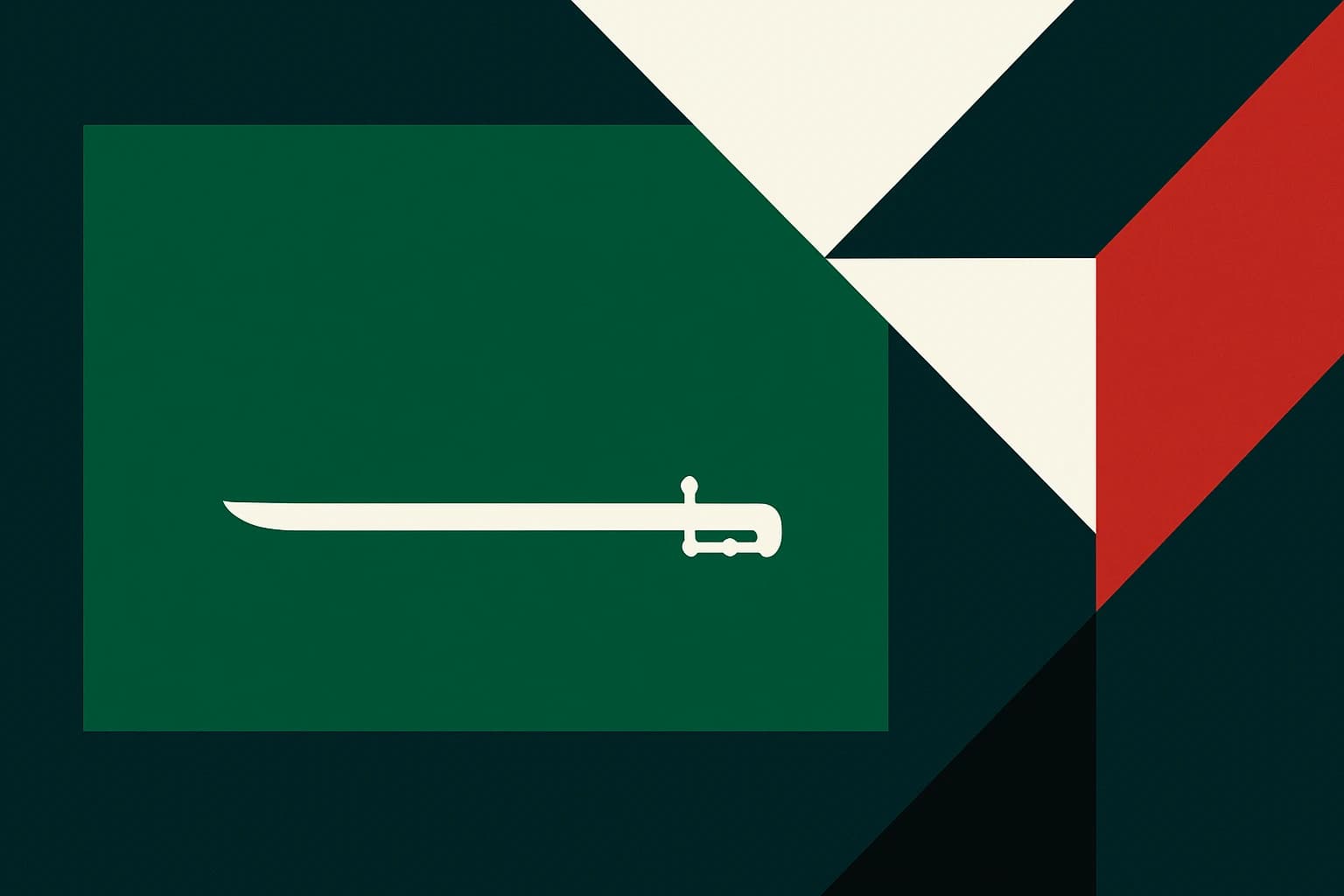
The Saudi flag is simple. A green field. White Arabic calligraphy spelling out the Shahada: "There is no god but God, and Muhammad is His Messenger." Beneath the inscription, a white horizontal sword. No coat of arms, no stars, no stripes.
The visual hierarchy is not negotiable. The Shahada sits above the sword, so religious authority literally crowns martial power. That arrangement encodes a specific relationship in which the sacred word governs and the sword serves.
Saudi law prohibits flying the flag at half-mast, and you will not find it printed on T-shirts or disposable merchandise the way the Stars and Stripes turns up on paper cups. The Shahada demands a level of respect that rules out casual use. Saudi Arabia is one of only two countries whose flag carries a religious text as its primary element; the other is Iran.
The design's roots go back to the 18th century and a reformist preacher named Muhammad ibn Abd al-Wahhab. His alliance with the tribal leader Muhammad ibn Saud, made in the central Arabian town of Diriyah in 1744, merged religious scholarship with tribal military power. The flag still encodes that merger, and flying it is a daily re-inscription of a founding bargain.
The 1744 alliance that made the sword sacred
The Diriyah Pact was straightforward. Ibn Abd al-Wahhab, a religious scholar with a puritanical reform agenda, needed armed protection. Muhammad ibn Saud, a local tribal chief, needed religious legitimacy to distinguish his authority from dozens of competing Arabian chieftains. Ibn Abd al-Wahhab supplied the theology and ibn Saud supplied the sword, which is not a metaphor: the sword was the instrument of the bargain.
That matters for the flag. The Saudi state was founded on the premise that political-military authority and religious authority are partners rather than rivals. The flag does not depict a tension between faith and force. It depicts a marriage.
Three distinct Saudi states rose and fell before the current Kingdom settled. The First Saudi State (1727 to 1818) was destroyed by an Ottoman-Egyptian invasion. The Second Saudi State (1824 to 1891) collapsed under internal rivalries and the competing Rashidi dynasty. The modern Kingdom, founded by Abdulaziz ibn Saud in 1932, absorbed the Hejaz, Najd and other regions into a unified state. Across all three, the sword and Shahada stayed constant while borders and capitals moved.
The current design was standardized in 1973, the year of the oil embargo and of Saudi Arabia's sudden emergence as a global economic force. The theological statement on the flag became a geopolitical one at the same moment: wealth and influence grounded in divine mandate.
What kind of sword is it?
Not all swords are the same. The one on the Saudi flag is an Arab saber, a saif: curved, single-edged, and specifically Arabian Peninsula in origin. It is not a European broadsword, and it is not a scimitar in the romanticized Orientalist sense. It carries associations with Bedouin warrior traditions and tribal justice.
Its orientation matters too. The sword points left, toward the hoist, which means it points toward the inscription rather than outward at the viewer. That is a posture of guardianship. The sword faces the text it protects.
Compare that with the double-edged straight sword common in European heraldry, which usually signals military might or Roman-derived justice. The European heraldic sword stands upright and declares power. The Saudi saif lies horizontal and serves the words above it.
One further detail. In Islamic tradition the legendary sword Zulfiqar, associated with Ali ibn Abi Talib, the Prophet's cousin and son-in-law, carries enormous symbolic weight, particularly in Shia iconography. The Saudi flag avoids that reference. Its sword is a Sunni-neutral symbol of temporal authority rather than a sectarian marker, which is a quiet but calculated distinction.
Oman's khanjar
If the Saudi flag puts one sword to work, Oman's clusters an arsenal into its upper hoist corner. The national emblem has a khanjar, the traditional curved Omani dagger, overlaid on two crossed swords and set above a belt.
Oman is also one of the most diplomatically neutral nations in the Gulf.
The khanjar is not a weapon of war. It is a ceremonial object worn by Omani men at weddings, state functions and national holidays, marking social status and tribal identity. It is closer to jewelry than armament, and leaving it off formal dress would be a breach of etiquette rather than a disarmament.
The crossed swords reference the Al Busaid dynasty, which has ruled Oman since 1744, the same year as the Diriyah Pact. The dynasty built a maritime trading empire stretching from the Arabian coast to East Africa and the Swahili Coast, and the swords stand for that role: maintaining order and projecting sovereignty across oceans.
Sultan Qaboos, who ruled from 1970 until his death in January 2020, used the flag's iconography as part of a national identity project that emphasized heritage and sovereignty over military posture. His successor, Sultan Haitham bin Tariq, has continued it.
The results are worth noting. Oman, with its flag full of blades, has been one of the Middle East's most committed back-channel diplomatic intermediaries. It helped facilitate the US-Iran nuclear negotiations and hosted Israeli-Palestinian backchannel communications. The weapons signal an authority to act, not an intent to attack.
Brunei's parasol
Brunei offers a Southeast Asian version of the same logic.
The design has yellow and black diagonal bands overlaid with a red emblem containing a parasol (the payung ubor-ubor), two upraised hands, a crescent and wings. No swords, no daggers, and the same symbolic function.
The royal parasol is one of the oldest markers of rightful sovereignty in Malay sultanate tradition. To stand beneath the sultan's parasol is to acknowledge his authority. It appears on the flag because the Sultan of Brunei is both head of state and head of the Islamic faith in the country.
This connects to a Malay concept called daulat, a kind of sacred royal charisma or divine protection surrounding a legitimate ruler. Daulat is not earned through elections or military victories. It is inherited, divinely granted, and represented through regalia, which is what the flag is doing.
The inscription on Brunei's emblem, in Arabic script, reads "Always render service with God's guidance." Sacred text alongside symbols of authority again, an ocean away from the Arabian desert and working the same way.
The broader pattern
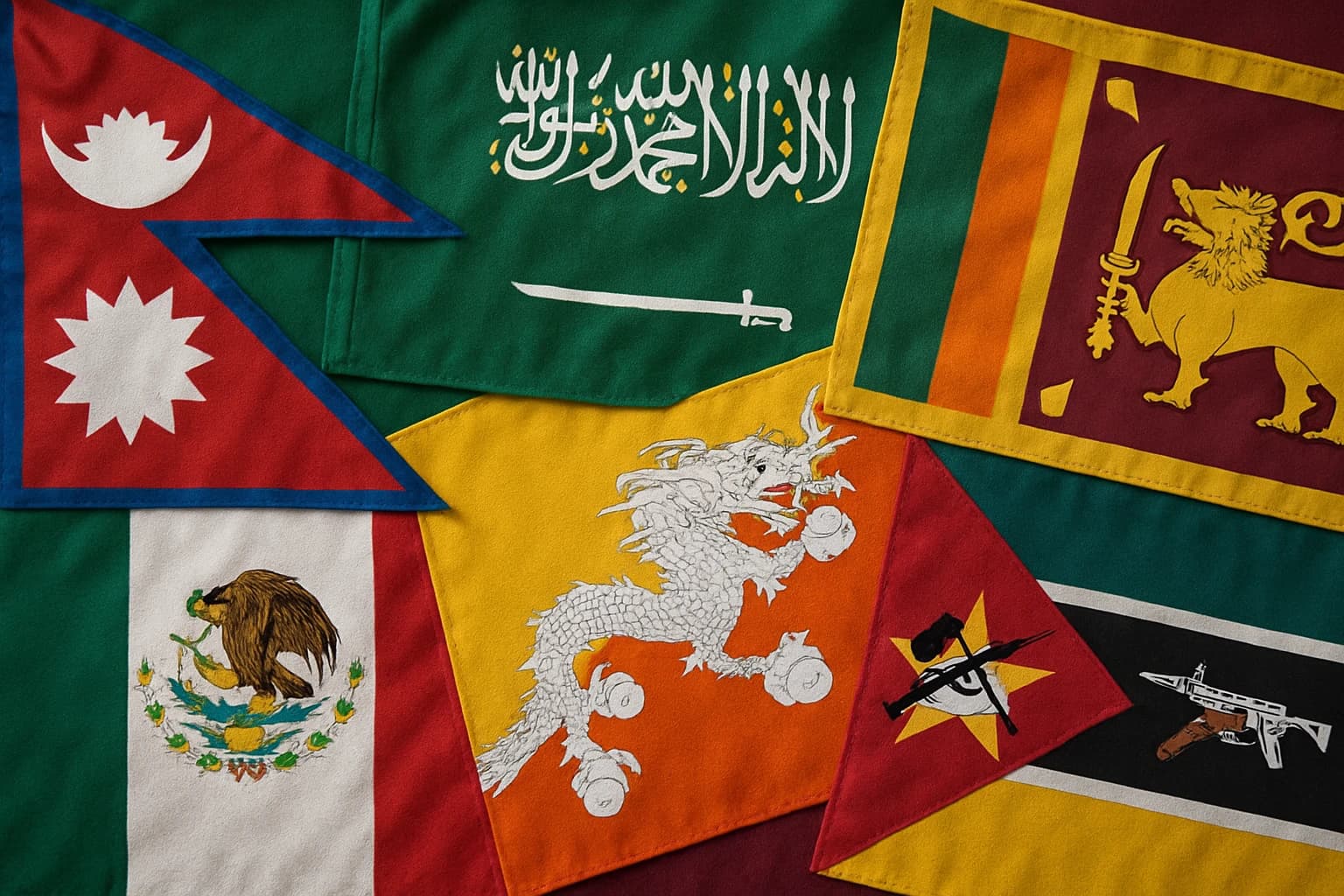
Eswatini's flag has a Nguni shield and spears, symbols of the Swazi monarchy's role as protector of the nation rather than an advertisement for aggression.
Sri Lanka's lion clutches a sword representing the sovereignty of the Sinhalese kingdom, a claim to historical continuity.
Angola's machete references the peasant and agricultural worker, grounding revolutionary legitimacy in labor.
In European heraldic tradition, where much of modern flag vocabulary originates, swords signified justice (the sword carried by St. Michael), authority (the sword of state in British heraldry), or divine protection. They almost never depicted literal warfare. The heraldic sword marked the right to judge and govern, not the capacity to kill.
Mozambique is the contrast that sharpens the rule. Its flag features an AK-47, the only modern assault rifle on any national flag. Adopted in 1983 at the height of a civil war, it is genuinely a symbol of armed revolutionary struggle. It claims no ancient legitimacy and invokes no divine sanction. It is modern, specific, and unadorned by religious or dynastic context.
The pattern is close to inverted, then: the more sacred or ancient the weapon on a flag, the less it has to do with violence. The Saudi saif is ceremonial and theological. The Mozambican AK-47 is neither, and it is the more genuinely menacing symbol because of it.
That is what the rule against inverting the Saudi flag really tells you. A flag that cannot be flipped is not primarily a military banner. It is a sacred text with a guardian, and the sword beneath the Shahada is not the point of the flag. The Shahada is. The sword is there to say that the text is protected, and that the right to defend it comes from the words written above it.