The Flag of Brunei
Nation of Brunei, Abode of Peace
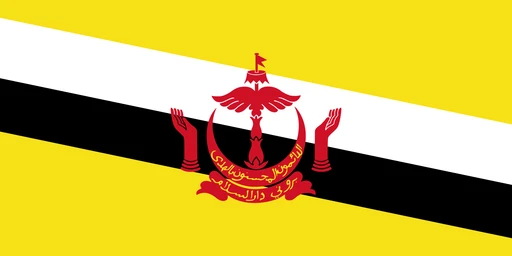
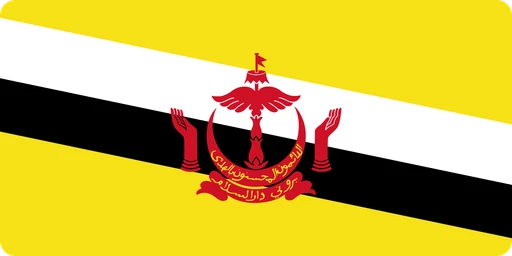
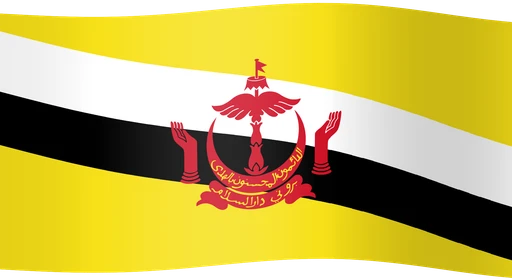
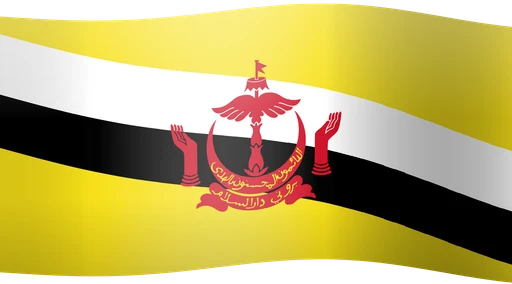
The flag of Brunei has a yellow field crossed by two diagonal bands, white and black, that run from the top hoist side toward the fly. The national crest sits in red at the center. Yellow is the color of the Sultan of Brunei, the white band stands for purity, and the black band for Brunei's chief ministers. The crest gathers a flag, a royal umbrella, wings, hands and a crescent for Islam, along with the motto 'Always render service with God's guidance'.
Brunei's flag is one of the few in the world to put a full coat of arms at its center, and one of fewer still whose design predates independence. It was adopted in 1959, when Brunei was a British protectorate: a yellow field with two diagonal stripes and the national crest laid over them, a dense heraldic composition that spells out the country's aspirations in Arabic script. The design came through the negotiations over joining the Malaysian federation and through full sovereignty in 1984 without being altered.
The yellow field
The whole background is yellow. Not a pale decorative gold, but a saturated shade that fills the 1:2 field and dominates everything else on the cloth. The color belongs to the Sultan.
Brunei's monarchy is one of the oldest continuously ruling dynasties anywhere, with a line traced back to the fourteenth century. Yellow has been the color of Malay royalty across Southeast Asia for centuries, on royal standards and court regalia from the Malay Peninsula to Borneo. The Sultan is not simply head of state, and the yellow field makes that claim before you notice anything else on the flag.
Among ASEAN flags the unbroken yellow stands out. Other countries in the region use stripes, stars, or multicolored fields, and Brunei's reads first as a royal proclamation. Set it beside the historical banners of the Malacca Sultanate or the Johor royal house and the family resemblance is obvious.
What the diagonal stripes record
Two diagonal stripes cut across the yellow from the upper hoist corner to the lower fly. The white one sits on top, slightly wider than the black one beneath it.
They were not part of the original royal flag. They were added in 1906, after the Treaty of 1905-1906 with Britain established the British Resident system and made Brunei a protected state. White and black stand for the country's two chief ministers, the Pengiran Bendahara and the Pengiran Pemancha, who co-signed that treaty alongside the Sultan.
Flags rarely record a specific diplomatic event this literally. Most settle for unity or progress in the abstract. These stripes name the moment Brunei's relationship with Britain changed and the men who were in the room for it.
When the national crest was added in 1959, the stripes stayed rather than being redesigned around it.
The crest at the center
In 1959 Sultan Omar Ali Saifuddien III oversaw the adoption of Brunei's first written constitution. The national emblem came with it, placed at the center of the flag over the diagonal stripes. It is a dense composition in red and gold, and every piece of it carries meaning.
At the top is a royal canopy, the payung ubor-ubor, a centuries-old symbol of Malay royalty and of the Sultan's protective authority. It is the kind of object carried above a ruler in ceremonial processions, and everything below it falls under that shelter.
Flanking the canopy are two stylized wings, the sayap, with four feathers each. The eight feathers stand for justice, tranquility, prosperity, and peace. Below them a pair of upraised hands faces outward for the government's duty to look after the welfare of its people.
The crescent at the heart of the crest is the symbol of Islam, Brunei's state religion. Inscribed on it in Jawi script are the words "Always render service with God's guidance" (الدائمون المحسنون بالهدى). Beneath that a ribbon carries the full formal name of the state, Brunei Darussalam, "Brunei, Abode of Peace."
The result is crowded, which is the opposite of what a minimalist Scandinavian cross or a plain tricolor does. Brunei put the whole statement on the cloth.
The flag that did not change at independence
Brunei's flag was adopted on September 29, 1959, twenty-five years before the country gained independence, and that gap turned out to matter.
The design was not touched during the early 1960s negotiations over joining the Federation of Malaysia. Brunei declined to join in 1963. The 1962 Brunei Revolt, an armed uprising against the Sultan and the proposed merger, came and went without any change to the flag either.
On January 1, 1984, Brunei became fully independent from Britain. Most postcolonial nations mark that moment with a new flag. Brunei kept flying the same one that had flown over a British protectorate, which said plainly enough that the 1959 constitution, not the 1984 handover, was treated as the founding moment.
Protocol and daily use
The flag flies at every government building and is central to National Day on February 23. The rules for display are strict: it must never touch the ground, fly upside down, or be used as decoration in any demeaning way.
The Sultan has his own royal standard, used to indicate his presence, separate from the national flag though both are dominated by yellow. Brunei's four districts have their own flags, but you rarely see them outside official buildings.
The national flag also appears on currency, official documents, and at every Bruneian embassy and consulate. At a distance the yellow field can be momentarily confused with other Southeast Asian flags, but the crest and the diagonal stripes settle it.
Brunei among its neighbors
The yellow field connects Brunei to Malaysia, where the Agong's royal yellow carries similar weight, and to the wider tradition of Malay sultanate banners, a visual language older than the modern borders.
Putting a full coat of arms on a national flag is uncommon. Belize, Ecuador, and El Salvador do it too, though few crests carry as much detail in as little space. The crescent and the Arabic script connect Brunei to the wider Muslim world, and the combination with Malay royal iconography is its own.
Many postcolonial flags adopted Pan-African, Pan-Arab, or other solidarity color schemes. Brunei's draws only on local Malay and Islamic tradition, with no borrowed palette and no nod to a broader movement.
References
[1] Government of Brunei Darussalam, Prime Minister's Office. Official description of national symbols. www.pmo.gov.bn
[2] Whitney Smith, Flags Through the Ages and Across the World (McGraw-Hill, 1975). Comprehensive vexillological reference covering Brunei's flag history and design.
[3] Constitution of Brunei 1959, Part I. Legal basis for the adoption of the national flag and crest.
[4] B.A. Hussainmiya, Sultan Omar Ali Saifuddien III and Britain: The Making of Brunei Darussalam (Oxford University Press, 1995). Historical context of the 1959 constitution and its significance.
[5] Flag Institute (UK). Brunei flag factsheet and historical notes. www.flaginstitute.org
[6] Graham Bartram, Complete Flags of the World (DK Publishing, multiple editions). Design specifications and symbolism.
[7] FOTW (Flags of the World). Brunei page, maintained by the world's largest online vexillological database. www.crwflags.com/fotw/flags/bn.html
Common questions
- What do the colors on the Brunei flag mean?
- The yellow field is all about the Sultan and Malay royalty, a tradition that goes back centuries across Southeast Asia. The white and black diagonal stripes represent Brunei's two chief ministers (the Pengiran Bendahara and Pengiran Pemancha), who co-signed the 1905-1906 treaty with Britain. So the colors tie together royal authority and a specific moment in Brunei's diplomatic history.
Featured in these articles
- The Diagonal That Refuses to Be Ignored: What Trinidad, Tanzania, and Namibia's Bold Stripes Are Really Saying
- The Diagonal That Changed Everything: How Saint Kitts and Nevis Turned a Simple Black Stripe Into a Masterclass in Flag Geometry
- The Sword on the Flag: How Arabia's Most Loaded Symbol Became a Statement of Holy Authority
- Flags of Countries That No Longer Exist, and Ones Nobody Looks At
Download this flag
Free in 12 styles, from 32px icons up to 2000px, as SVG, PNG, WebP and JPG.