The Flag of Eswatini
Kingdom of Eswatini
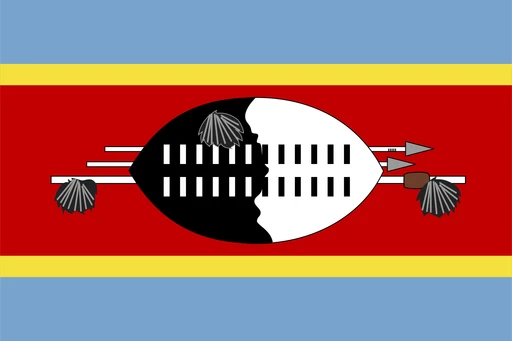
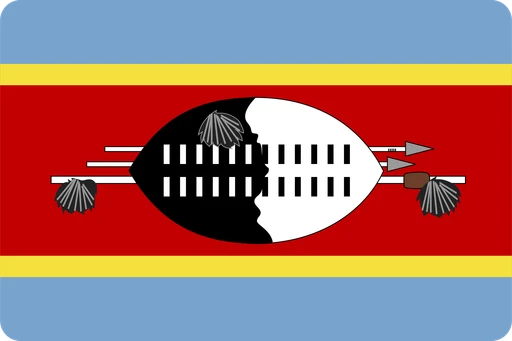
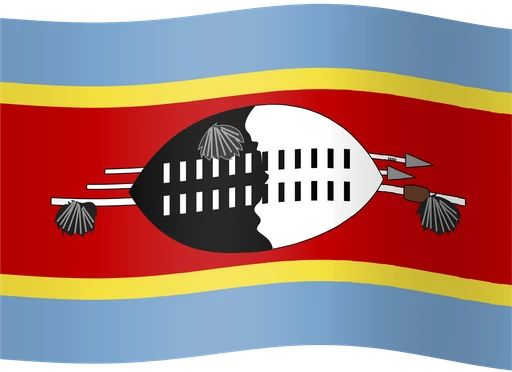
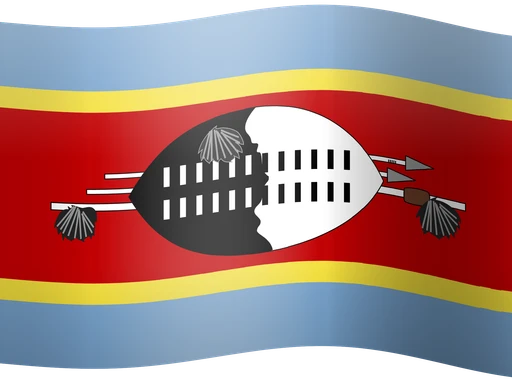
The flag of Eswatini (formerly known as Swaziland) consists of horizontal stripes in blue, yellow, and red, with a large black and white Nguni shield covering two spears and a staff decorated with feather tassels, all centered on the flag. The blue stripes symbolize peace and stability, the yellow represents the resources of Eswatini, and the red stands for past struggles. The shield and spears are symbols of protection from the country's enemies.
Few national flags demand as much attention as Eswatini's. Where most countries go for clean geometry and simple silhouettes, Eswatini puts a full-sized, realistically drawn Nguni warrior shield at its center, flanked by spears and decorated with feathered tassels. The design refuses to simplify, and it expects you to know what you are looking at. Adopted in 1968, the year of independence, it borrows from a World War II regimental banner and says the same thing about monarchy and warrior tradition that it did then.
A shield at the center of the flag
Five horizontal bands make up the background: blue at top and bottom, then thin yellow stripes acting as borders, and a wide, dominant red band occupying the center. The proportions follow a 2:3 ratio, but the visual weight falls squarely on that red middle section, which takes up roughly half the flag's height.
Laid horizontally across the red band is the flag's unmistakable centerpiece: a black-and-white cowhide Nguni shield called an umbhubhusi. Behind it sit two assegai, the long-shafted fighting spears of Swazi warriors, their blades pointing upward and outward. Between them stands a staff adorned with injobo, decorative tassels made from the feathers of the widowbird (black) and the lourie bird (red). Together, these elements form a precise tableau of Swazi royal and military regalia.
The shield's black-and-white coloring isn't accidental. At independence, the contrast was chosen to represent the peaceful coexistence of black and white peoples within Eswatini, a pointed political statement during an era when racial harmony in southern Africa was anything but guaranteed. That is a lot of diplomacy to ask of a piece of cowhide.
What makes this flag genuinely unusual in global vexillology is its insistence on realism. Most national emblems reduce cultural symbols to flat, abstract shapes. Eswatini's shield shows texture and dimension, and you can practically feel the hide. The spears are identifiable assegai rather than generic weapons, and the tassels are injobo with a specific ceremonial function.
From a wartime regimental banner to a national flag
On September 6, 1968, Swaziland (as it was then known) gained independence from Britain, and the flag flew over a sovereign state for the first time. It became the official national flag a month later, on October 6, 1968. The design was already in use by then. It was first hoisted on April 25, 1967, the day King Sobhuza II took the oath under the new protected-state constitution, and the College of Arms in London registered it that October. Its origins reach back further still.
During World War II, King Sobhuza II presented a regimental flag to the Swazi Pioneer Corps, Swazi soldiers who served alongside Allied forces. That military banner featured the same shield-and-spear motif that would later define the national flag. When independence arrived, Sobhuza II drew directly on this wartime design, adapting it for the new nation. The result is a flag with a double history: it marks the birth of an independent state while simultaneously honoring Swazi soldiers who fought far from home under colonial command.
Sobhuza II was personally involved in the design, which is why it reads as a royal statement rather than a committee product. The king centered the flag on the monarchy's own warrior symbols instead of anything inherited from the colonial period. There is no Union Jack canton and no borrowed European heraldry, just a shield, spears, and feathers that belong entirely to Swazi tradition.
That deliberate grounding in indigenous identity helps explain why the flag survived the country's 2018 renaming. When King Mswati III officially changed the nation's name from Swaziland to Eswatini, the flag remained untouched. There was no need to update it. Nothing about its design had ever referenced the colonial name or colonial imagery in the first place. It was already, and had always been, an expression of Swazi self-conception on Swazi terms.
What the colors say
Each of the three main colors carries a specific, declared meaning. Blue represents peace and stability, a common enough association, but one that carried real urgency in the late 1960s as southern Africa convulsed with liberation struggles and Cold War proxy conflicts. Red speaks to past battles, the blood and sacrifice of Swazi military history. Yellow, or gold, points to the country's natural resources: its mineral deposits and the agricultural wealth of a small but fertile kingdom.
Read from top to bottom, the colors make an argument: peace was won through struggle, and that stability is what allows the country to prosper.
Neighboring flags tell different stories. South Africa's post-apartheid design uses six colors to signal convergence. Mozambique's flag carries a Kalashnikov. Eswatini's palette is its own, and its meanings are distinctly Swazi rather than pan-African or ideological.
A subtle touch worth noticing: the injobo tassels on the central staff are made from widowbird feathers (black) and lourie feathers (red), mirroring the flag's own color scheme. The palette runs through the central emblem as well as the background stripes, which suggests the design was worked out carefully rather than assembled.
Shields, spears, and the emabutfo
Nguni shields appear across southern African cultures, from the Zulu to the Xhosa to the Ndebele. But on Eswatini's flag, the shield references something specifically Swazi: the emabutfo, the age-based military regiments that have organized Swazi men for centuries. These aren't relics. The emabutfo still exist, and regiment members participate actively in royal ceremonies, most notably the annual Incwala (kingship ceremony) and the Umhlanga (Reed Dance). When you see the shield on the flag, you're looking at a living institution, not a museum piece.
The staff with its injobo tassels carries even more specific meaning. It's an isigodlo symbol, an object associated exclusively with the Swazi king and used only with royal permission. Placing it on the national flag fuses the identity of the nation with the identity of the monarchy. What the flag represents is the king's Eswatini.
Globally, it's rare for a national flag to depict actual weapons with this degree of realism. Most countries that reference military strength do so through heraldic abstraction: crossed swords rendered as simple shapes, stylized eagles. Eswatini shows you the real thing. Mozambique offers the most famous parallel, with its AK-47, but the comparison reveals a key difference. Mozambique's rifle is a symbol of revolutionary liberation, a modern weapon for a modern ideology. Eswatini's spears and shield belong to a warrior culture that predates colonialism entirely, and the point they make is continuity rather than rupture.
Royal flag, national flag
In most countries, the national flag and the head of state's personal symbols are distinct. Eswatini blurs that line. Because the flag's central emblem is drawn directly from royal regalia, flying the national flag is, in a sense, always flying a royal banner. The Swazi Royal House does use additional symbols and standards, but no other national flag in the region carries quite this much monarchical weight.
The flag flies at government buildings, royal residences, and international venues. During major ceremonies like Incwala and Umhlanga, it appears alongside regimental banners and royal standards in a visual environment saturated with the same shield-and-spear iconography. On Independence Day (September 6) and the King's Birthday, flag displays take on particular ceremonial significance.
Internationally, Eswatini's flag is instantly recognizable at the United Nations, the African Union, and SADC gatherings. In a row of flags dominated by tricolors and simple geometric patterns, the detailed shield leaps out. It's one of those flags that works as a conversation starter, which, for a small landlocked kingdom of just over a million people, is no small advantage. Reproduction of the flag is expected to follow official specifications, and given its strong royal associations, the emblem is treated with a degree of respect that goes beyond ordinary patriotic protocol.
References
[1] Government of the Kingdom of Eswatini official portal (www.gov.sz). Official flag descriptions and national symbols.
[2] Flags of the World (FOTW). Eswatini entry (www.crwflags.com/fotw/flags/sz.html). Vexillological analysis and historical variants.
[3] Smith, Whitney. Flags Through the Ages and Across the World. McGraw-Hill, 1975. Foundational vexillology reference covering Swazi flag origins.
[4] Matsebula, J.S.M. A History of Swaziland. Longman, 1988. Key historical source on the Swazi monarchy and national symbols.
[5] Booth, Alan R. Swaziland: Tradition and Change in a Southern African Kingdom. Westview Press, 1983. Context on independence-era identity and flag adoption.
[6] Kuper, Hilda. An African Aristocracy: Rank Among the Swazi. Oxford University Press, 1947. Authoritative ethnographic source on Swazi royal regalia and warrior culture.
[7] The Flag Institute (UK) (www.flaginstitute.org). Peer-reviewed vexillological records on Commonwealth nation flags at independence.
[8] African Union Handbook. Flag usage in multilateral African institutional contexts.
Common questions
- What do the colors on Eswatini's flag mean?
- Blue stands for peace and stability, red highlights the struggles for independence, and yellow represents the richness of Eswatini's natural resources.
- Why are there a shield and spears on Eswatini's flag?
- The Nguni shield and spears stand for protection. The shield's black and white halves were chosen at independence to represent black and white people living together in the country.
- Did Eswatini's flag change when the country renamed itself from Swaziland?
- Nope, it stayed the same. When King Mswati III officially changed the country's name to Eswatini in 2018, the flag didn't need updating. That's because it was always based on Swazi royal and cultural symbols, not colonial imagery, so there was nothing to change.
Featured in these articles
Download this flag
Free in 12 styles, from 32px icons up to 2000px, as SVG, PNG, WebP and JPG.