Of the roughly 195 sovereign flags on Earth, fewer than a dozen feature a true diagonal band. The overwhelming majority speak the same visual language: horizontal stripes, vertical stripes, crosses, crescents, and the occasional emblem parked in the middle. The diagonal is the rarest geometric move in national flag design, and the flag that makes the best case for it belongs to a twin-island nation of roughly 47,000 people in the eastern Caribbean.
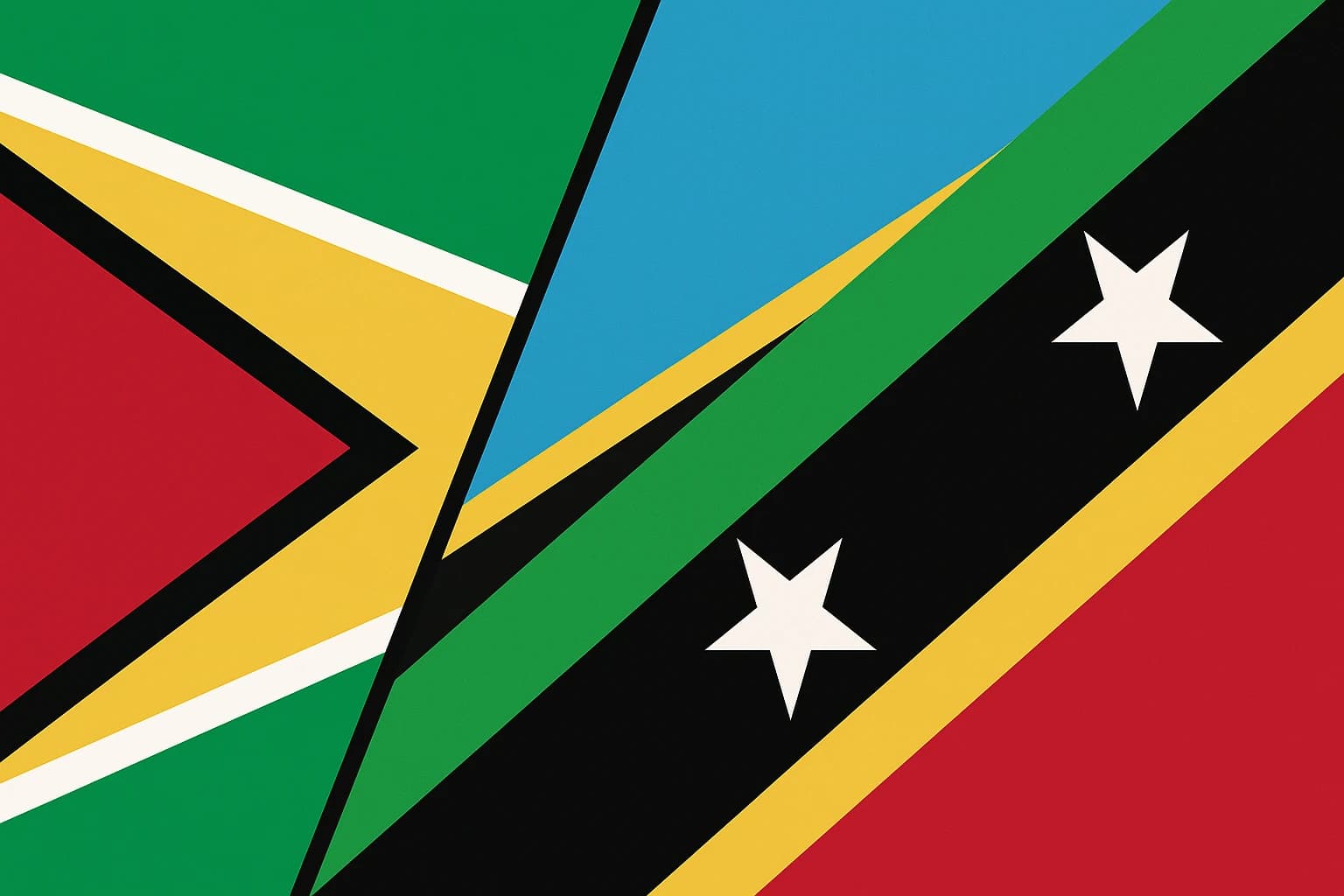
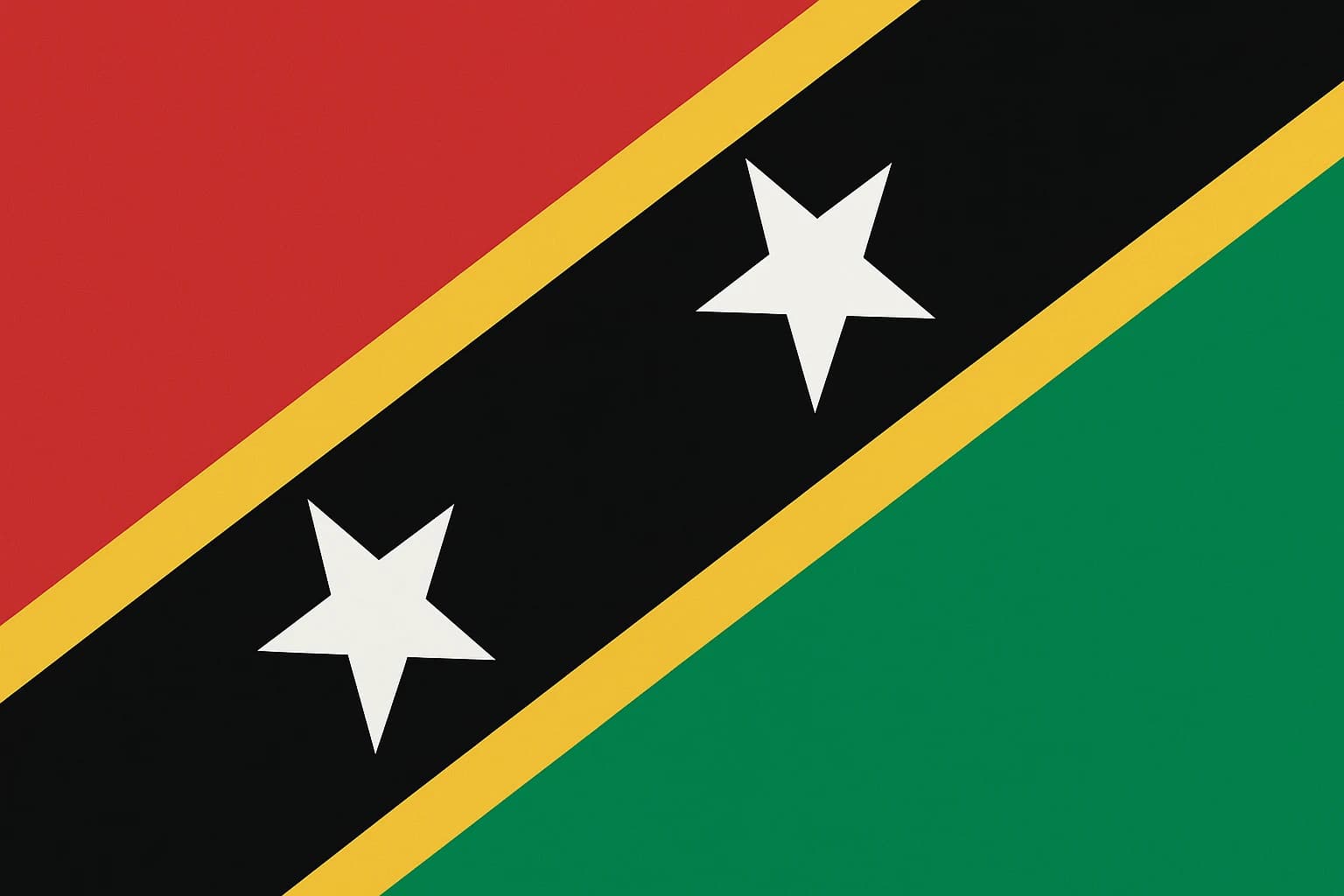
Saint Kitts and Nevis became independent on 19 September 1983. A local designer named Edrice Lewis answered the occasion with a flag that broke the conventions: a bold black stripe edged in gold, running from the lower-left corner to the upper-right, separating a green field from a red one, with two white stars sitting inside the dark band. It was not rebellion for its own sake. It was the only shape that solved the problem.
The tyranny of the tricolor
To understand why almost every flag looks the way it does, start in 1794. The French Tricolor, three vertical bands of blue, white and red, became visual shorthand for republican revolution, and as empires collapsed across the 19th and 20th centuries the new nations reached for the same template.
Germany, Italy, Ireland, Belgium, Romania, Ivory Coast, Mali, Chad, Nigeria and dozens more built their flags on the same grammar: two or three bands, horizontal or vertical. Some of that was ideological, since the tricolor signaled modernity and self-determination. Much of it was practical. Horizontal and vertical seams are easy to sew, they reproduce well at any scale, and they stay legible from a distance when fabric hangs from a pole. Those engineering constraints hardened into convention over two centuries.
The North American Vexillological Association's 2006 guide, "Good Flag, Bad Flag," wrote down what designers had long practiced: keep it simple, use meaningful symbolism, limit colors, avoid lettering, be distinctive. Sound principles, all of them, and all quietly favoring orthogonal geometry. A horizontal tricolor satisfies every rule on the list.
The diagonal club is small. Among UN member states the genuine diagonal-band flags are Tanzania, Trinidad and Tobago, the Republic of the Congo and Namibia. Brunei's parallelogram bands and the Seychelles' radiating wedges are different animals, and North Macedonia has rays rather than bands.
The problem that demanded a diagonal
The Caribbean in the early 1980s was working through the tail end of decolonization. Jamaica and Trinidad and Tobago went independent in 1962, Barbados in 1966, Grenada in 1974, Dominica in 1978, Saint Lucia and Saint Vincent in 1979. By September 1983 Saint Kitts and Nevis was the last, and the smallest sovereign nation in the Western Hemisphere.
"Smallest" undersells the difficulty. This was a federation of two islands with distinct identities. Nevis, the smaller one, had a long history of wanting to go its own way, a tension that surfaced again in a 1998 secession referendum where Nevisians voted to leave but fell short of the required two-thirds majority. The flag had to represent both islands as equals. It also had to carry the African heritage of the population (black), the fertile land (green), the struggle for independence (red), and the sunshine along with the sugar and salt industries (yellow), all without a coat of arms or a cluttered emblem.
Try to solve that with horizontals and you run into trouble immediately. Green on top and red on the bottom makes green dominant. Flip it and you have the same problem reversed. Put them side by side and you get a flag that resembles half a dozen others, with the hoist side, nearest the pole, traditionally the position of honor.
Edrice Lewis was not a vexillology consultant flown in from London or New York. He was a local designer working inside the culture and politics of the islands, and his solution came out of that: a single diagonal band of black bordered in gold, cutting from lower-left to upper-right. Green fills the upper-left triangle, red the lower-right. Neither sits above the other and neither takes the dominant position.
The stars follow the same logic. Two white five-pointed stars, one per island, sit inside the black band rather than on either colored field. They belong to neither and to both.
Reading the geometry
A horizontal line reads as stable, like a horizon. A vertical reads as strong but static. A diagonal implies movement, and it carries the eye across the flag instead of letting it settle.
The black band with its yellow borders does not sit passively between green and red; it runs the composition. Even when the flag hangs limp or is partly obscured, the diagonal stripe stays readable.
Direction matters too. The stripe ascends, running from lower-left to upper-right, which in Western visual culture reads as upward motion and progress. For an independence flag that is a quietly potent choice.
The yellow border around the black band is called fimbriation, and it solves a real problem. Black against dark green or deep red would muddle at a distance. The yellow separates them cleanly, following a rule inherited from heraldry: you do not place a color directly against another color without a metal, gold or silver, between them. It also makes the black stripe glow, which is the difference between a competent design and a good-looking one.
The star placement is the single most important decision in the flag. A star on the green would belong to green; a star on the red would belong to red. Putting both in the shared black space makes the federation's equality principle visible before anyone has to explain it.
The company it keeps
Saint Kitts and Nevis did not invent the diagonal national flag.
Tanzania's flag dates to 1964, when Tanganyika and Zanzibar merged. A black diagonal band edged in yellow runs from lower-left to upper-right, dividing green in the upper-left from blue in the lower-right. The structural similarity is striking, and it is not a coincidence of spirit: Tanzania's diagonal also had to bridge two political entities without putting one above the other.
Trinidad and Tobago, independent since 1962, takes the reverse approach. Its black diagonal band, edged in white, runs from upper-left to lower-right. A descending line reads more like a slash or a cut, and the flag has a boldness distinct from Tanzania's ascending energy. Direction changes the emotional register even when the structural logic is identical.
Brunei's flag, formalized in 1959, uses diagonal elements differently. Two parallelogram bands in white and black cross the yellow field like a sash. The bands do not run corner to corner, so they function more like livery than architecture.
Tanzania and Saint Kitts and Nevis are the closest pair. Both have a black diagonal band with yellow fimbriation running in the same direction, bridging two colored fields, and both were designed for federations that needed equal visual billing. They arrived at nearly identical solutions independently, 19 years and thousands of miles apart. When the brief is "unite two entities without hierarchy," the diagonal stripe is close to the geometrically optimal answer.
Why most countries avoid it
Start with the sewing table. A diagonal seam is harder to cut and stitch than a straight horizontal or vertical one, especially at small scales or with limited resources. For a newly independent nation setting up flag production with modest manufacturing infrastructure, the horizontal tricolor is the path of least resistance.
There is also a recognition problem. At extreme distance or in poor visibility the angle of a diagonal band can be ambiguous. Is it ascending or descending? Is it a flag, or a pennant seen at an angle? Maritime signal flags and military unit insignia tend to avoid complex diagonals for exactly this reason, because identification at 500 meters through sea spray wants verticals and horizontals.
The flip side is that the diagonal breaks expectation. The eye has to work slightly harder, which means the design sticks. For a naval ensign surprise is a liability. For a new nation asserting itself, it is an asset. The rarity is now part of Saint Kitts and Nevis's identity: in a room full of tricolors, the flag is unmistakable, and a country of 47,000 people designed its way to instant recognizability.
Forty-three years later
The flag Edrice Lewis designed in 1983 has not changed. It survived the 1998 Nevis secession referendum, shifts in government, economic crises, and the slow churn of Caribbean geopolitics. The two-star, two-island symbolism still holds.
Since roughly 2015, online vexillology communities have given flag design an audience it never had before. Reddit's r/vexillology, YouTube channels dedicated to ranking and analyzing flags, and Roman Mars's widely watched 2015 TED Talk about city flag design created a mass appetite for this kind of conversation, and the Saint Kitts and Nevis flag turns up regularly in "best flags" lists and design breakdowns.
Edrice Lewis's name turns up far less often. The designers of Canada's flag (George Stanley, 1965) and South Africa's flag (Frederick Brownell, 1994) are recognized in design histories. Lewis is not, which reflects broader patterns in whose creative contributions get remembered.
As flag redesign conversations continue into 2026, with New Zealand's identity discussions, Australian republican movement proposals, and various Pacific island nations considering new symbols, the Saint Kitts and Nevis flag is a useful reference. Two islands, equal standing, no coat of arms, four colors with specific meanings. The diagonal, rare and difficult and demanding, was the only shape that could hold two islands as equals without subordinating either.