Imagine your entire country scattered across 900,000 square miles of open ocean, an area larger than Western Europe, with a total landmass of less than ten square miles. There are no borders to draw and no coastline worth sketching. What goes on the flag?
You look up.
For centuries before European contact, Pacific Islanders crossed thousands of miles of featureless ocean using star paths, wave patterns, and memorized constellations. When many of these nations gained independence in the twentieth century, they put that tradition straight onto their flags. The stars on the flags of Nauru, Tuvalu and Samoa are not decorative. They are maps, and in some cases they are claims about where a country sits in the universe.
Why stars matter more when you have no borders
Continental nations define themselves by borders, rivers and mountain ranges. Nepal's flag evokes the Himalayas; Argentina has the Sun of May. These are terrestrial reference points, things you can walk to and touch.
Pacific island nations don't have that option. Tuvalu's 26 square kilometers of land sits inside an Exclusive Economic Zone of roughly 900,000 square kilometers, which makes the country about 99.997% water. Nauru is one of the smallest republics on Earth at 21 square kilometers. The Marshall Islands spreads across 750,000 square miles of ocean and contains 70 square miles of land.
When a country is almost entirely ocean, the ground underfoot is the exception rather than the rule.
Polynesian and Micronesian navigational traditions, collectively called wayfinding, offer the alternative. Traditional navigators used star compasses, mental catalogs of the rising and setting positions of over 200 stars, to cross thousands of miles of open water without instruments. No sextant, no GPS. The stars were the infrastructure of these civilizations in the way that Roman roads or Chinese canals were infrastructure elsewhere.
When decolonization moved through the Pacific between the 1960s and 1980s, the new nations needed symbols that were culturally authentic and geographically meaningful. Stars did both. They connected to ancestral navigation and they could carry real spatial information about islands and position. The night sky was also the one thing visible from every atoll.
Nauru's lone star sits below the equator
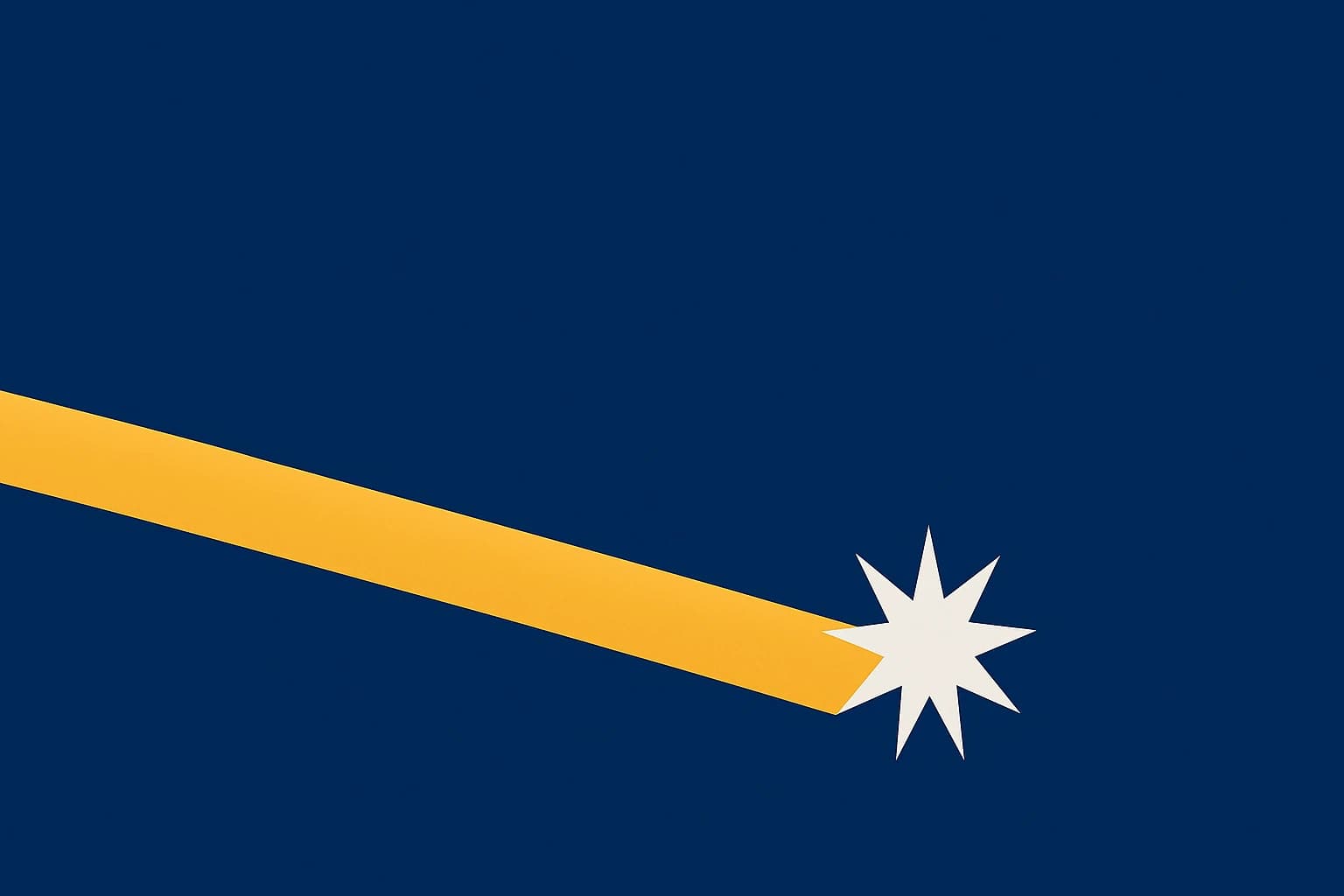
Nauru's flag, adopted on 31 January 1968 at independence from an Australian-administered UN trusteeship, is very simple. A blue field, a gold horizontal stripe, and a single white 12-pointed star just below the stripe.
The gold stripe is the equator. The star sits below it, where Nauru sits, at 0°32' south latitude. The flag is a geographic coordinate rendered as design, a miniature map of the island's position on Earth.
The 12 points stand for the island's 12 original tribes, but the placement is the unusual part. Most nations with a single star on the flag, Somalia and Vietnam and Turkey among them, use it for unity, ideology or religion. Nauru's star is a location pin.
The context makes it sharper. Phosphate mining nearly destroyed Nauru during the twentieth century. Colonial and post-colonial extraction stripped roughly 80% of the island's surface, leaving jagged coral pinnacles across the interior. A flag whose central element is fixed, singular and precise reads differently when the landscape it points to has been hollowed out.
Tuvalu's nine stars form a constellation that exists nowhere in the sky
Tuvalu's flag, adopted in its current form on 11 April 1997 after a brief experiment with a non-Union Jack design between 1995 and 1997, has nine yellow stars on a light blue field. Each star is one of the country's nine inhabited islands and atolls.
The stars are not arranged in a grid or a circle. They sit roughly where the islands sit on a map, with Nanumea in the northwest and Niulakita in the southeast. The flag is a cartographic projection. You are looking at a map.
That makes Tuvalu's flag one of very few national flags that works as a chart. Someone who knew the flag could read the relative positions of the islands off it. The constellation appears on no star chart because a nation invented it.
The name "Tuvalu" means "eight standing together." Only eight islands were originally counted as inhabited; Niulakita, the ninth, was added later. The flag records a decision about what counts as "us."
Then there is the arithmetic of climate change. Tuvalu's maximum elevation is 4.6 meters above sea level, and climate projections suggest some of its islands could face permanent inundation or become uninhabitable within decades. The nine stars could eventually mark islands that are no longer above water.
Samoa and the Southern Cross
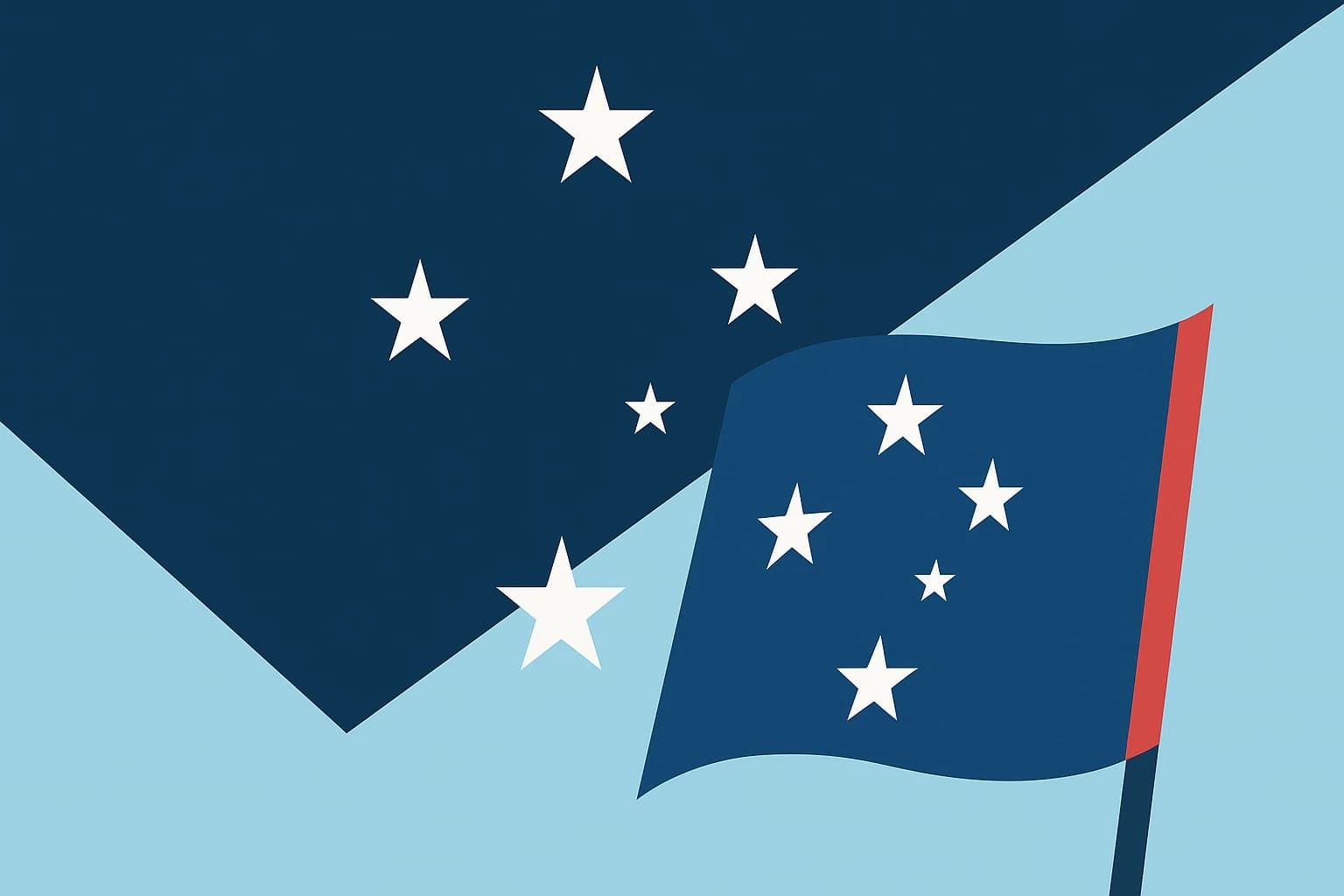
Samoa's flag, adopted on 24 February 1949 with four stars and a fifth added on 4 July 1949, more than a decade before independence in 1962, carries the Southern Cross: five white stars on a red field with a blue canton.
Australia and New Zealand use the same constellation, but for a different reason.
For Australia (1901) and New Zealand (1902), Crux marks hemispheric identity. It says "we are in the south." Both are settler-colonial nations using stars to claim belonging to a hemisphere they colonized.
For Samoa, the relationship with Crux is older and more practical. Polynesian navigators used the Southern Cross as a directional marker for centuries. Its long axis points roughly toward the South Celestial Pole, which makes it essential for holding a southward bearing on open ocean. Samoan navigators did not admire the constellation, they used it.
Samoa's flag encodes an action: navigation. Australia's encodes a position: southern. One records how people got there, the other records where there is.
The distinction has political edges. New Zealand's 2015-2016 flag referendum treated the Southern Cross largely as a generic southern symbol. Samoa's claim on Crux is rooted in what the stars were actually for.
Stars across the rest of the Pacific
The pattern extends well beyond those three.
The Marshall Islands' flag (1979) has a star with 24 points, four of them elongated rays representing the major centers of Majuro, Jaluit, Wotje and Ebeye. The star sits above two diagonal stripes for the Ratak (sunrise) and Ralik (sunset) island chains, so the whole design works as a compass rose.
Papua New Guinea's flag (1971) pairs the Southern Cross with a bird of paradise. A 15-year-old student named Susan Karike designed it.
The Federated States of Micronesia's flag (1978) uses four white stars on blue for its four constituent states: Yap, Chuuk, Pohnpei and Kosrae. It is Tuvalu's island-mapping approach at a smaller scale.
Non-independent territories carry the tradition too. The Cook Islands' flag has 15 stars in a circle, one per island.
Tokelau's flag shows a stylized canoe under a constellation of stars representing its three atolls.
Across thousands of miles of ocean, separated by enormous distances, these nations and territories arrived at the same solution independently. Where land is scarce and ocean is everything, identity gets written in the sky.
What happens when the geography goes
Tuvalu, Nauru, Kiribati and the Marshall Islands are among the countries most immediately threatened by sea-level rise. IPCC reports from 2023, with updates through 2025 and into 2026, project that several low-lying atolls could face permanent inundation or become uninhabitable within decades.
In 2023 Tuvalu began exploring "digital nationhood," a way of preserving its sovereignty, culture and territorial claims in digital form should the physical territory disappear. Its flag, with its island-map constellation, becomes a record of a geography that may not survive the century.
International law has no framework for a nation that exists on a flag but not on land. The stars on these flags could end up as the primary surviving evidence of specific geographic arrangements.
There is a cruel symmetry in that. The nations that embedded their geography most deeply into their flags are the nations most likely to lose it. Tuvalu's nine stars were placed to say "here we are." They may end up saying "here we were."
That gives Pacific star flags a weight no continental flag carries. France's tricolor will never need to serve as proof that France existed.
Tuvalu's nine stars might. Nauru put itself on the cosmic map with a single point below a golden equator, Tuvalu scattered nine stars in the shape of its own archipelago, and Samoa took the Southern Cross because it was the tool that made the voyages possible. In each case the stars stand for location, navigation and survival rather than aspiration, and they are the most durable thing any of these nations has put on cloth.