Ohio's Swallowtail Flag Is So Odd the State Wrote a Law on How to Fold It
Julio Song · · 9 min read

Forty-nine American state flags have four right-angled corners. Ohio's has a notch. The fly end splits into two points with a triangle cut out between them, and for a century nobody wrote down how you were supposed to fold it.
In 2005 Ohio settled the matter the way legislatures settle things. It passed a law. Section 5.014 of the Ohio Revised Code lays out a two-person folding method with exactly seventeen folds, because Ohio was the seventeenth state admitted to the Union. The person who worked the method out was a teenage Eagle Scout.
That statute is the last chapter of an odd story. It begins with a state that went almost a century without any flag at all. It runs through an architect's banner for a trade fair in Buffalo. And it ends with a flag whose folding instructions sit in the state code, a few sections after its description.
Ninety-nine years of making do
Ohio became a state in 1803 and adopted its flag in 1902. The vexillologist John Purcell, writing as the flag approached its centennial, put the gap at 99 years to be exact.
At the time, nobody saw a problem. When George Henry Preble wrote to the states for one of the first surveys of state flags, Ohio's Secretary of State William H. Smith replied on December 29, 1866, that "Ohio has no legally authorized State flag." Ohio militia in the War of 1812, and Ohio troops in the Mexican War and the Civil War, had carried the Stars and Stripes. Regimental colours added an eagle and the regiment's number. That was it.
Ohio was not unusual. By Purcell's count, only 19 of the 45 states had a flag of their own in 1902. Many Americans thought a state flag was unnecessary, or even a little disloyal to the national one. When Cleveland adopted a city flag in 1896, opponents called it "un-American." The ordinance that adopted it called it the "city banner" to calm them down.
Next door, Indiana pushed the same instinct further. In 1901 it adopted the 45-star national flag as its state flag, so you had no way of telling whether a flag on a pole meant Indiana or the whole country. Indiana's current design arrived in 1917.
An architect, a pavilion and a patent
What changed Ohio's mind was a trade fair. In the summer of 1901 the Pan-American Exposition opened in Buffalo, New York, and Ohio put up a building there. Its architect was John Eisenmann of Cleveland.
Eisenmann was an engineer as much as a designer. Born in Detroit in 1851, he studied architecture at the polytechnics in Munich and Stuttgart and came to Cleveland in 1882 to teach civil engineering at the Case School of Applied Science. With George H. Smith he designed the Cleveland Arcade. In 1904 he wrote the city's first comprehensive building code.
He designed the Ohio Building in Buffalo, and he designed the flag that flew over it. He also patented it. Eisenmann filed for a US design patent on the flag on June 17, 1901, and it was published on July 23. The patent calls the shape "triangular forked or swallow-tailed" and compares it to what was "generally known as" a cavalry guidon or broad pennant.
That comparison is a strong clue to where the idea came from. Purcell notes that the flag historian Whitney Smith suggested the US Army cavalry guidon as the model. That guidon, in use from 1862 to 1885, was swallow-tailed and carried thirteen red and white stripes.
The flag in Buffalo belonged to the Ohio Pan-American Exposition Commission, not to the state. On July 18, 1901, State Senator Samuel L. Patterson presented it to Governor George K. Nash at the exposition.
Too Japanese, too Cuban
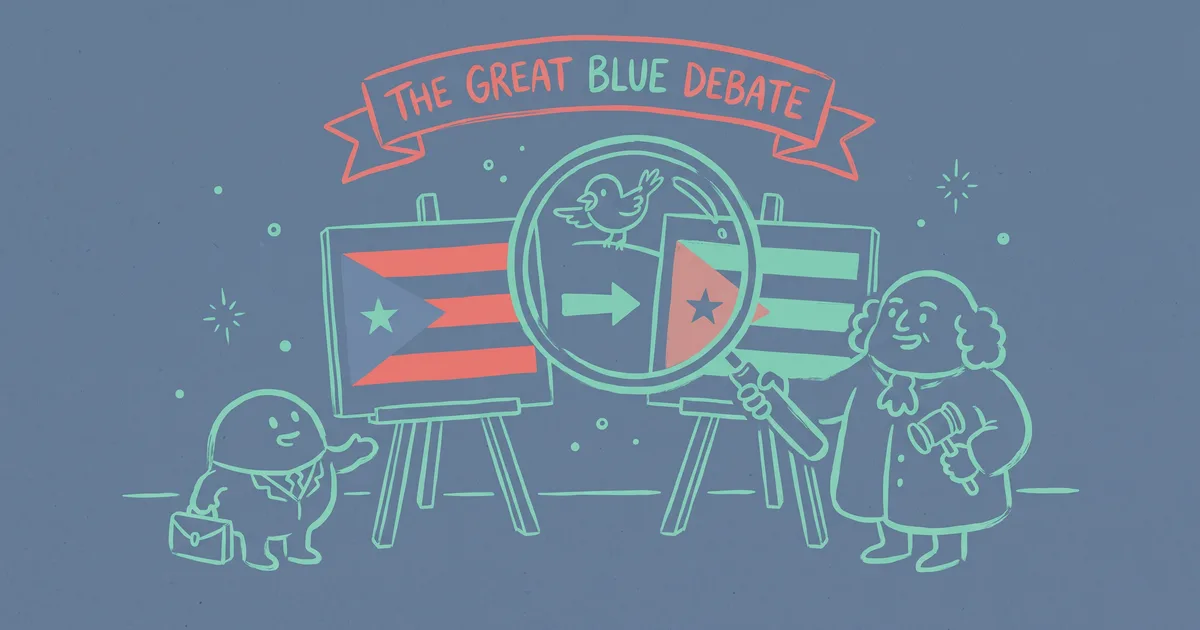
Not everyone liked it. One complaint was that the red disc in the middle looked too Japanese, and the state seal should replace it. Another critic said the flag looked too much like Cuba's.
The complaints went nowhere. The next year three members of the exposition commission, Representatives C. L. Swain and William S. McKinnon and Senator Patterson, brought Eisenmann's design to the General Assembly. McKinnon was Speaker of the House at the time. The bill moved fast, and on May 9, 1902, the exposition banner became the official flag of Ohio.
Plenty of Ohioans still shrugged. In 1906 the first issue of Ohio Magazine complained that people treated the new flag "with scant courtesy" and that some insisted the Stars and Stripes "ought to be good enough." The editors had an answer ready. Nobody had ever proposed swapping Ohio's seal for the national seal. If the state had a seal of its own, why not a flag?
Reading the swallowtail
Every element of the design carries a meaning, and Ohio wrote the meanings into law. Under Ohio Revised Code section 5.01:
- The three red and two white stripes stand for the state's roads and waterways.
- The blue triangle stands for its hills and valleys.
- Thirteen white stars grouped around the circle stand for the original states.
- Four more stars at the point of the triangle bring the total to seventeen, because Ohio was the seventeenth state admitted.
- The white circle with a red centre forms an "O" for Ohio and nods to the Buckeye State nickname.
Purcell adds one more reading. The circle also stands for the Northwest Territory, the land Ohio was carved from.
The geometry is tidy. The flag's proportions are 8 by 13. Flags of the World describes the blue triangle as 8 units long, with 2 units of red stripe beyond its tip and a 3-unit triangle cut out of the fly. The statute itself skips the numbers and points you to "the official design on file in the office of the secretary of state."
You do not need a guide to see the debt to the flag of the United States. Red and white stripes, white stars on blue, and a count of stars tied to a count of states. Eisenmann kept those pieces and changed the outline.
Pennant or burgee?
For a hundred years the law called the flag "pennant-shaped." Then came Senate Bill 240, in force from November 1, 2002, the year before the state's bicentennial. The new wording of section 5.01 calls it "burgee-shaped."
One word, and it caused some confusion. Flags of the World reports that legislative analysts were unsure whether the change meant the flag's shape had to change too.
The same bill gave Ohio a pledge. Section 5.013 sets out the words: "I salute the flag of the state of Ohio and pledge to the buckeye state respect and loyalty." And section 5.012, from the same bill, covers display. Public buildings fly the flag from sunrise to sunset on national and state holidays. It must not be bigger than a US flag flown beside it. A flag worn beyond repair is destroyed privately, by burning or by sealing it in a bag or box before disposal.
What the 2002 law did not cover was folding.
Seventeen folds and a Scout
The notch is the problem. As the AP put it, Ohio's flag lacks the four 90-degree corners every other state flag has, so the usual folds leave you stuck.
Alex Weinstock, a 19-year-old from Somerset, solved it while working toward his Eagle Scout rank. His method, reported by the Associated Press in January 2005, takes two people and seventeen folds and turns the pointed flag into a rectangle. "It was quite a challenge," he told the AP. The same report says his acquaintance with Larry Householder, then the leader of the Ohio House, helped smooth the method's path into law.
It became House Bill 552 and took effect on May 18, 2005. The statute walks you through it:
- Fold the flag in half lengthwise with the points lined up, then fold it lengthwise again so the red disc faces down.
- Fold the pointed end back over itself to form a rectangle. These are the three preliminary folds.
- Make fan-style folds of about two inches for a three-by-five-foot flag, fourteen in all.
- Wrap what is left of the flag snugly around the fan folds to make a compact rectangle.
Three plus fourteen makes seventeen. The statute states the reason outright: the folds represent Ohio as "the seventeenth state admitted to the union." The number already sits on the flag as seventeen stars. Since 2005 it lives in the ritual of taking the flag down, too.
The statute calls the method "recommended," not required. Still, think about what Ohio did here. A shape chosen for an exhibition pavilion in 1901 ended up requiring its own section of state law a century later.
The shape that spread
By the time of its centennial, the odd outline had become a point of pride. Purcell wrote that Ohioans were proud theirs was the only one of the fifty state flags with a swallow-tailed shape. It spread to towns and cities too. Of roughly 160 civic flags in Ohio when he wrote, 29 were swallow-tailed, a far higher share than in any other state. Mentor, in the northeast, follows the state flag closely but puts a red cardinal, the state bird, on a white circle in the blue triangle.
The shape still trips people up. Purcell reproduced a flag from a manufacturer in Taiwan that printed Ohio's design on a plain white rectangle, which rather defeats the purpose.
At the national level, Nepal holds the same distinction as the only national flag in the world that is not rectangular or square.
So look at the fly end the next time you see Ohio's flag. That notch started as a cavalry guidon, turned into an architect's banner over a pavilion in Buffalo, and outlasted the critics who said the disc looked too Japanese. It took a teenager and an act of the legislature before anyone agreed how to put it away.
Julio Song
Writer
Julio is a staff writer at FlagDB. He studied Mathematics at the University of Madrid and has a passion for vexillology.
More from Julio Song →