Four Suns on Four Flags, and Not One of Them Means the Same Thing
Julio Song · · 9 min read
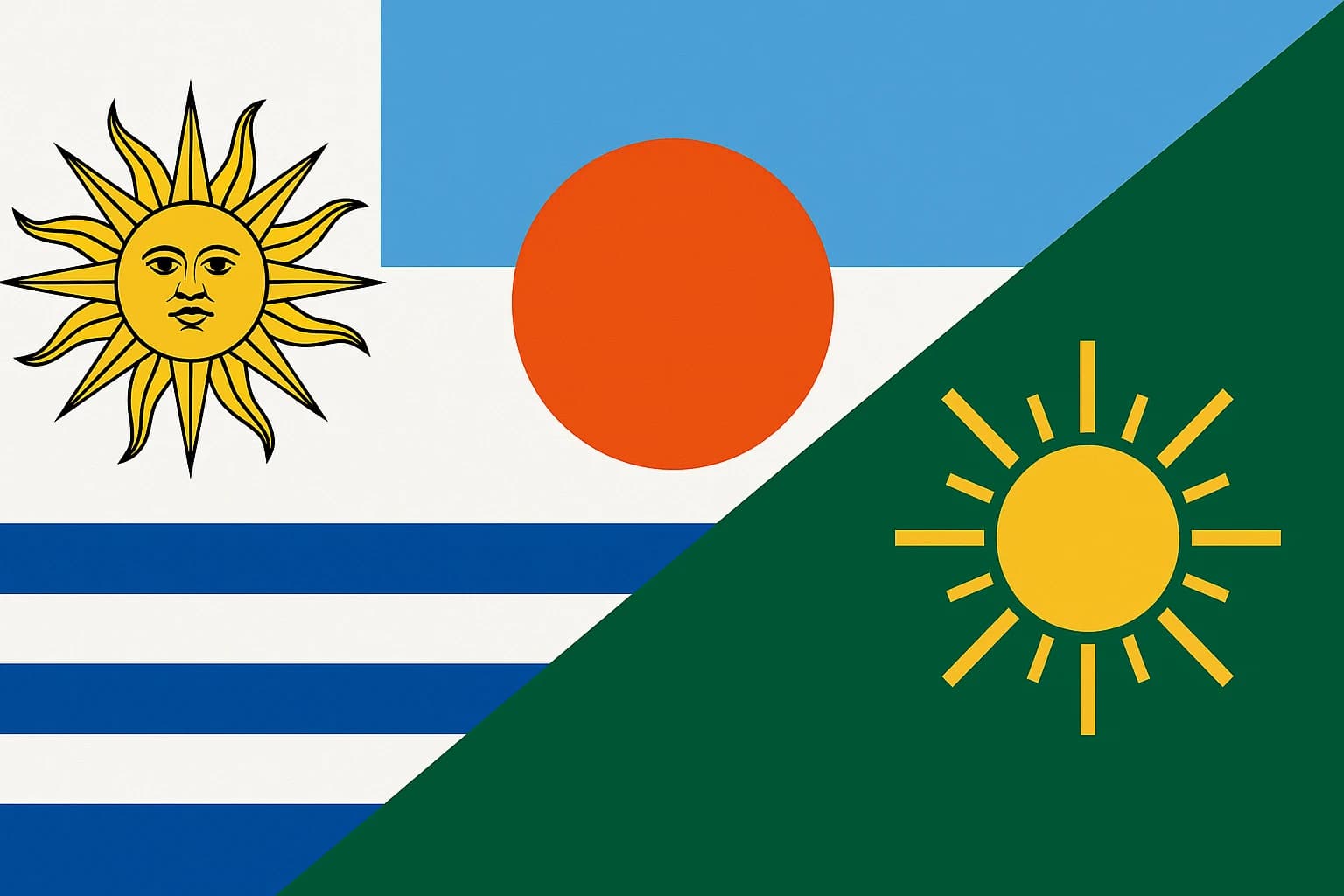
Line up the flags of Argentina, Bangladesh, Taiwan, and Uruguay. You'll see a sun, or something sun-like, on every single one. And not one of them is saying the same thing.
The sun is the most common symbol in vexillology, and probably the most misread. When a symbol shows up everywhere, does it still carry meaning, or does it become visual wallpaper that we glance at and assume we understand?
Argentina's answer is the sharpest one available. Its flag carries a sun so specific it has a name, a face, and a birthday. The Sun of May points to a single afternoon in Buenos Aires in 1810, and all of that specificity hides behind what looks like a generic cheerful circle.
The most overloaded symbol on Earth
As of 2026, at least 50 national and subnational flags feature a sun or solar disc. That makes the sun the single most recurring motif in flag design, beating out stars, crosses, crescents, and stripes. It's everywhere.
And that creates a paradox. A cross on a flag signals something specific, a connection to Christianity. A crescent points toward Islam. But the sun? It belongs to everyone. Nationalists, anti-colonialists, monarchists, revolutionaries, indigenous-rights movements. They all claim it.
Consider the range. Japan's Hinomaru represents dynastic and imperial continuity stretching back centuries.
The Philippines' sun, with its eight rays, represents the first eight provinces to revolt against Spain in 1896, encoding a specific act of federal resistance into its geometry.
Nepal's sun, now a historical emblem tied to the former royal house, carried monarchist weight. Bangladesh's red disc speaks to anti-colonial rebirth in 1971. Same shape. Completely different stories.
That ubiquity is the problem. The sun's universality makes it a blank canvas, so wildly different ideological projects get painted onto the same basic circle and most of us never stop to ask which sun we are looking at. The way to see why the question matters is to find a sun that is not a blank canvas, one so loaded with specific history that it forces you to pay attention.
Argentina's Sun of May
The Sol de Mayo is a golden disc with 16 straight rays and 16 wavy rays alternating around its edge, and a human face at the center. Not a geometric abstraction. A face. That face is the entire argument of the design.
The symbol traces directly to the Incan sun deity Inti, whose face-bearing solar disc appeared throughout Incan iconography. By the late 18th century, that same solar face had been stamped onto colonial-era coins circulating in the Río de la Plata region. People carried this image in their pockets before it ever appeared on a flag.
The specific historical moment that gave the symbol its name came on May 25, 1810. That's the date Argentine patriots deposed the Spanish Viceroy in Buenos Aires during the May Revolution. According to the foundational myth, the sun broke through the clouds during the celebrations. Immediately, that weather event was turned into an omen. The sun itself, the story went, had blessed the revolution.
The formal adoption followed a clear path. The sun first appeared on the Argentine coat of arms in 1813. It was then incorporated into the flag, which Manuel Belgrano had designed in 1812 as a simple arrangement of blue and white stripes. Official decree cemented the link between the solar image and the revolutionary moment.
The face is what separates it from every other solar flag. Most national suns are abstract geometric forms, circles and rays and clean lines. Argentina's is a portrait, and it carries a deity, a revolution, and an identity claim: our sun is not your sun.
The Incan layer beneath the revolution
Inti was the supreme solar deity of the Inca Empire, and the Sapa Inca, the emperor, was considered his earthly representative. The face on the sun was standard in pre-Columbian Andean art, turning up on gold masks, in textiles, and carved into stone.
The complication is that the Argentine patriots of 1810 were overwhelmingly criollo, Spanish-descended colonials born in the Americas, not indigenous Andeans. So why invoke an Incan deity?
It was a deliberate act of symbolic differentiation from Spain. By reaching back to a pre-colonial, American identity, the revolutionaries were making a continental claim. They were saying: we belong to this land, to its history before Europe arrived. The sun of Inti gave them an origin story rooted in the Americas rather than in Madrid.
The historical irony here is sharp. The same criollo elite that invoked Inti as a symbol of liberation had little interest in extending political rights to the indigenous Andean peoples who had worshipped Inti for centuries. The symbol's claimed meaning and its political reality pointed in opposite directions. That gap between rhetoric and practice is something flags tend to hide rather well.
The coin precedent matters too. The revolutionary committee didn't invent this image from nothing. The "sol" coin already carried a solar face. What the patriots did was elevate and politicize an image already in daily circulation, turning pocket change into national mythology.
Incan deity, colonial-era currency, revolutionary weather omen. That layering is what makes the Sun of May irreducibly specific, and it is worth setting against what happens when a country strips the sun back to pure geometry.
The red disc that needed no face
Bangladesh's flag, adopted on January 17, 1972, is a solid red disc on a green field. That's it. Weeks after the country's liberation from Pakistani rule, following the brutal 1971 Liberation War, this flag became the emblem of a brand new nation.
The starkness is deliberate. The red disc has no face, no label, no historical footnotes on its surface. It stands for the blood of those killed in the Liberation War and the dawn of an independent nation, and its force comes from having nothing else to look at.
One detail is worth noting. The disc sits slightly toward the hoist rather than at the geometric center, so that when the flag flies and the fabric ripples the disc reads as centered. A sophisticated choice hiding behind apparent plainness.
Argentina's sun reaches back through pre-Columbian history, colonial economics, and revolutionary mythology. Bangladesh's looks only forward. It is a Year Zero symbol that refuses the weight of the past and declares a new beginning, which is about as far from Inti as a circle can get. Same basic shape, functioning as an archaeological artifact in one country and a clean slate in the other.
Taiwan's white sun and its twelve rays
Taiwan's flag, formally the flag of the Republic of China, follows a design known as "Blue Sky, White Sun, and a Wholly Red Earth." The white sun sits in the upper-left canton: a circle with 12 sharp triangular rays radiating outward.
Those 12 rays are not arbitrary. They represent the 12 months of the year and the 12 traditional Chinese hours, the shí'èr shíchén. The sun is tied to a specifically Chinese cosmological and calendrical framework. This is a different kind of specificity from Argentina's Inti, but specificity nonetheless.
The design's origin goes back to Lu Haodong, a revolutionary and close associate of Sun Yat-sen, who created the party flag for the Revive China Society (Xingzhonghui) in 1895. That means Taiwan's sun is also a revolutionary sun. But it's rooted in Han Chinese nationalist politics, not Andean indigenous iconography.
In 2026 the geopolitical weight of the symbol is hard to overstate. Because the People's Republic of China claims Taiwan as a province, displaying the flag is itself a statement of sovereignty, and its presence or absence on a stage or in a broadcast becomes a diplomatic event.
So the sun on Taiwan's flag, the sun on Argentina's, and the disc on Bangladesh's are not three variations of one symbol. They are three different symbols that happen to share a shape.
When two countries share a sun
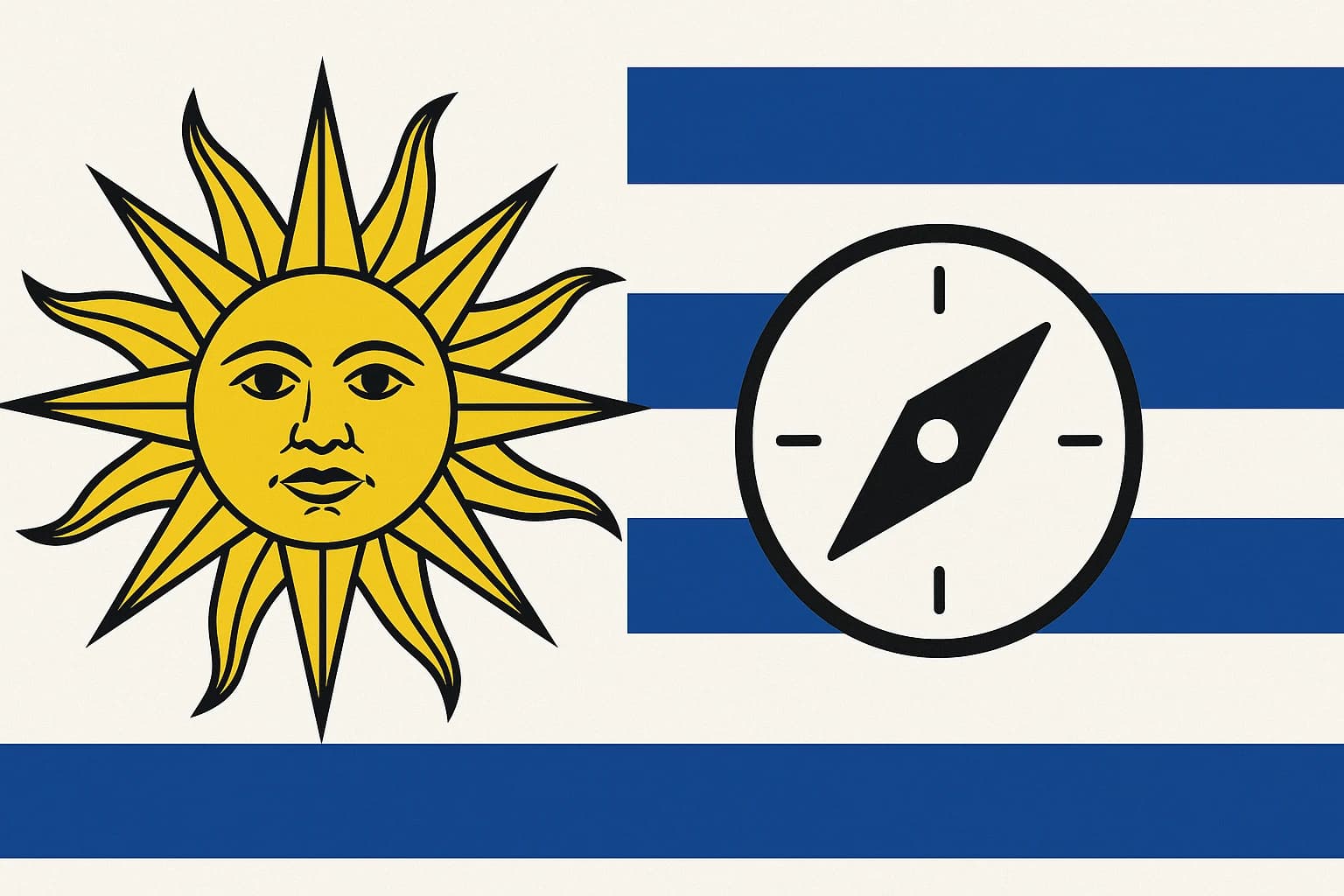
Uruguay's flag also bears a Sun of May, and it looks almost identical to Argentina's. Same face, same alternating rays.
Both countries draw from the same revolutionary tradition of the Río de la Plata, the region that briefly united under the United Provinces of the Río de la Plata after 1810. When Uruguay became independent in 1828, after a period of conflict involving Brazil and Argentina, it retained the Sun of May. But it kept the symbol not as a gesture of regional unity. It kept it as a specifically Uruguayan claim to the same revolutionary heritage.
The same image now carries a subtly different national argument in each country. If two nations using a literally identical sun still mean different things by it, then the symbol's meaning lives entirely in its context, not in the image itself.
Other flags reinforce this principle. India's Ashoka Chakra wheel is sun-adjacent in its circular geometry but points to Buddhist law. Kazakhstan's sun, with 32 rays, represents ethnic unity under a new post-Soviet identity. North Macedonia's stylized sun of eight rays replaced the controversial Star of Vergina in 1995, a change driven entirely by a geopolitical dispute with Greece. In each case, the ray count, color, and framing encode distinct national claims.
Reading the sun
None of this works if you assume a symbol is stable. Meaning is not stored inside a shape. It gets deposited there by the people who chose it, the moment they chose it, and the story they told to justify the choice.
That is what makes vexillology useful for historical and political literacy. Flags are one of the few places where a society compresses its whole self-understanding into one image, which makes the ideological choices unusually visible if you know how to look.
The Sun of May is the densest example here. It carries Incan religious cosmology, a specific calendar date (May 25, 1810), a weather event, a numismatic tradition, and a revolutionary political claim, all compressed into one face.
So the useful question at a sports event or an embassy is not "is that a sun?" but "whose sun is it, who put it there, and what were they trying to say that no other shape could say?" The Sun of May is not a sun. It is Inti, it is May 25, 1810, and it is a face chosen to claim that a revolution belonged to the Americas rather than to Europe. Bangladesh's red disc is 1971 and a nation refusing to look backward. Taiwan's white sun is 12 months, a 19th-century revolutionary party, and a sovereignty claim renewed every time the flag goes up.
The sun turns up everywhere because it is available to everyone. Availability is not interchangeability.
Julio Song
Writer
Julio is a staff writer at FlagDB. He studied Mathematics at the University of Madrid and has a passion for vexillology.
More from Julio Song →