Puerto Rico's Flag Was Once Evidence in Court. Now the Fight Is Over Its Blue.
Julio Song · · 8 min read
In 1950, police in Puerto Rico arrested the poet Francisco Matos Paoli. The evidence against him was four speeches in favor of independence and a Puerto Rican flag kept in his house. He got 20 years, later cut to ten.
Two years after that arrest, the same flag became the official flag of the Commonwealth of Puerto Rico. The law that made it official describes the triangle with a single word: azul. Blue. No shade, no code, no swatch.
That missing detail is why the flag is still a political argument today. To see why, you have to go back to a meeting room in New York.
A flag designed in Manhattan
Puerto Rico's flag was not born in Puerto Rico. On December 22, 1895, exiles in the Puerto Rican section of the Cuban Revolutionary Party met at Chimney Corner Hall in Manhattan and adopted it. Both islands were still Spanish colonies. Both independence movements were working together out of New York.
You don't need a historian to see the family resemblance. The design is the Cuban flag with its colors inverted. Cuba's stripes are blue and its triangle is red. Puerto Rico flipped that: red and white stripes, a blue triangle, one white star.
The Cuban original was older. Narciso López and Miguel Teurbe Tolón designed it in 1849, and rebels first raised it when they took the town of Cárdenas on May 19, 1850.
Who designed the Puerto Rican version is still disputed. Flags of the World lists three claims: Francisco Gonzalo "Pachín" Marín, Antonio Vélez Alvarado, and Manuel Besosa. The safest answer is the committee's. It was a group decision made in a rented hall.
It also had a predecessor. On September 23, 1868, rebels in the town of Lares rose against Spain under a flag designed by Ramón Emeterio Betances and embroidered by Mariana Bracetti. Betances wanted a flag that drew on the Dominican and Cuban designs, part of his push for an Antillean Confederation of the Spanish-speaking Caribbean islands. That revolt failed. Its flag survives at the University of Puerto Rico, and its light blue matters later in this story.
The 1895 flag reached the island within two years. Rebels carried it on March 24, 1897, in the Intentona de Yauco, the last major revolt against Spanish rule. In 1898, US forces landed during the Spanish-American War, and the flag's opponent changed.
The law that never said "flag"
By the 1940s, the flag belonged to the independence movement, and the independence movement worried the island's government. In 1948, the legislature passed Law 53, and in June Governor Jesús T. Piñero, appointed by Washington, signed it into law. Puerto Ricans called it the Ley de la Mordaza: the Gag Law.
Not everyone in politics went along. Dr. Leopoldo Figueroa of the Statehood Party called the law repressive and a direct violation of the First Amendment, since Puerto Ricans were US citizens.
Read the text of Law 53 and you won't find the flag in it. The law targets anyone who promotes or preaches the need to overthrow, destroy or paralyze the island's government. It covers publishing material that argues for that, and organizing groups around it. The maximum penalty was ten years in prison, a $10,000 fine, or both.
So how did a flag become evidence? Through the people enforcing the law. Historian Ivonne Acosta Lespier, in an episode of the La Voz del Centro archive, describes arrests "for simply possessing a Puerto Rican flag or applauding at a rally." Acosta argues the law was passed to stop the independence movement from making a strong showing at the 1948 election.
On paper, the law was about speech. In practice, owning the flag was treated as evidence of that speech.
Jayuya, October 1950
The clearest case of the flag as an act of defiance came on October 30, 1950, in the town of Jayuya.
Nationalists led by Blanca Canales attacked the police station, cut the phone lines and burned the post office. Then Canales led the group into the town square. There, in defiance of the Gag Law, they raised the Puerto Rican flag, and she declared Puerto Rico a free republic.
The governor declared martial law. Ten P-47 Thunderbolt fighters flew from Ramey Air Force Base, and according to the same account they dropped 500-pound bombs and machine-gunned rooftops across the town. Official counts put the dead at 16 Nationalists, 8 police officers and soldiers, and 4 civilians, with about 50 more civilians injured.
Jayuya was one of several coordinated revolts that day. The persecution of nationalists and independence supporters that followed was massive. Acosta's view is blunt. The Gag Law did not stop the 1950 revolt. It helped provoke it.
Matos Paoli was one of those swept up. He shared a cell with the Nationalist leader Pedro Albizu Campos, lost his university post, and was paroled on January 16, 1952. Twenty-five years later, the Mayagüez campus of the same university nominated him for the Nobel Prize in Literature.
Same cloth, new owner
Six months after Matos Paoli walked out of prison, the government adopted his flag.
Law No. 1 of July 24, 1952 made it the flag of the new Estado Libre Asociado, the Commonwealth. The wording is careful. The official flag "will be the one traditionally known until now as the Puerto Rican flag." The legislature did not design anything. It took over a banner the independence movement had carried for 57 years.
The same law describes the geometry: five alternating horizontal stripes, three red and two white, and an equilateral triangle at the hoist with a white five-pointed star. The triangle's vertical side spans the full height of the flag.
The legislature also gave each part a new official meaning, and Flags of the World records it. The red stripes stand for the blood that nourishes the branches of government. The white stripes stand for individual liberty. The triangle stands for republican government, and the star now stood for the Commonwealth itself. A flag made by revolutionaries got an official reading from the government.
Section 2 adds a rule worth noticing. It bans using the flag as the emblem of a political party or a candidate on the ballot. A flag that had been the badge of one political camp was now off limits to all of them.
The law as amended today goes further. Government buildings must fly the Puerto Rican and United States flags together and with equal prominence, with the US flag always on the right. It also sets out an official salute that begins "Juro ante la Bandera del Estado Libre Asociado de Puerto Rico": I swear before the flag of the Commonwealth of Puerto Rico. The pledge is to the flag that the 1948 law had helped turn into evidence.
The Gag Law outlasted that adoption by five years. It was repealed in 1957, after the US Supreme Court's 1956 ruling in Pennsylvania v. Nelson undercut state sedition laws and after pressure from the civil liberties campaigner Roger Baldwin.
One word, three blues
Now look again at that word in the 1952 law: "azul." Nothing more.
Nobody wrote down a shade in 1895 either. The exiles in New York named the colors red, white and blue, and some historians presume they chose light blue to match the Lares flag of 1868.
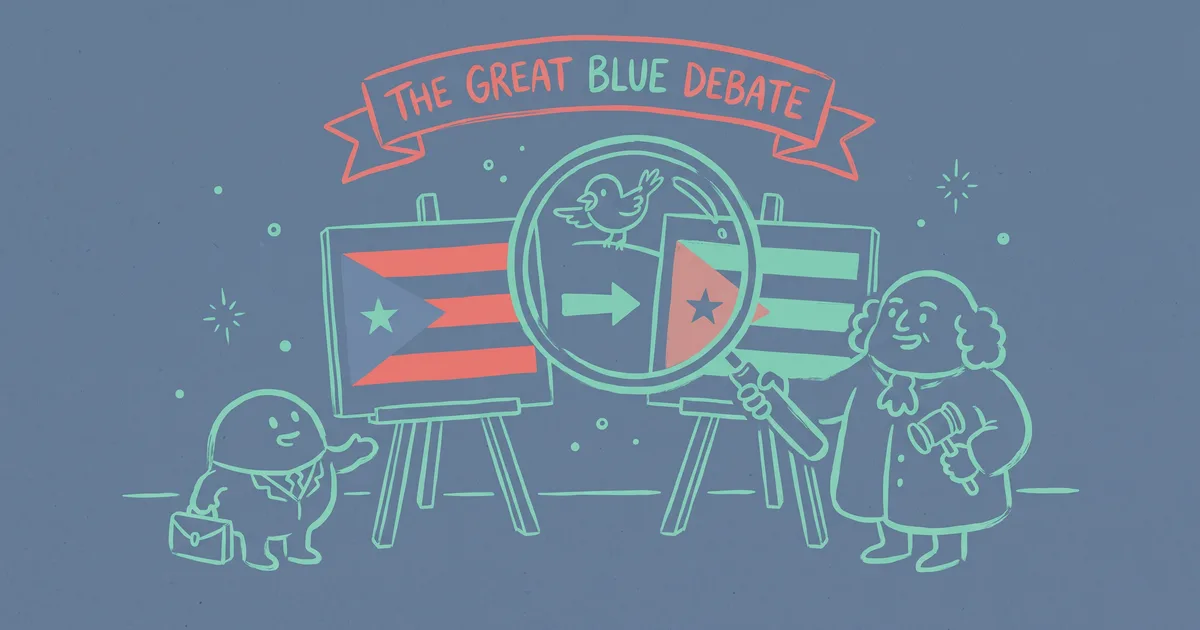
When the Commonwealth started flying the flag in 1952, it used a dark blue close to the one on the US flag. For an independence movement, that change read as a statement about whose flag it now was.
Over time each shade picked up a political meaning. Flags of the World sums it up this way:
- Light blue signals support for independence
- Medium blue signals support for the current Commonwealth status
- Dark blue signals support for statehood
The government has had chances to pick one. A regulation issued on August 3, 1995, the flag's centennial year, restated the rules for its use without fixing a shade.
The most recent attempt to settle it failed. In August 2022, a bill in the Puerto Rican Senate proposed making a medium "azul royal" the official color. It did not pass. The law still says azul.
What to look for next time
Puerto Rico's flag law has never fixed the shade, so the choice stays open to anyone who makes or buys one.
That gives you a way to read a Puerto Rican flag the next time you see one. Check the triangle. A pale sky blue points to the Lares tradition and the independence movement. A navy close to the Stars and Stripes points the other way. A royal blue in between is the color of the status quo.
The design is the same one police found in Matos Paoli's house. The legislature adopted it in 1952 and left the color open, so the argument about who the flag belongs to never closed either.
Julio Song
Writer
Julio is a staff writer at FlagDB. He studied Mathematics at the University of Madrid and has a passion for vexillology.
More from Julio Song →