The Flag of Cuba
Republic of Cuba
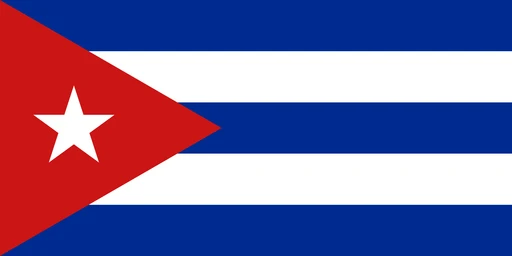
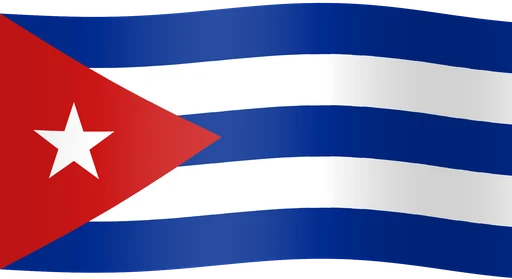
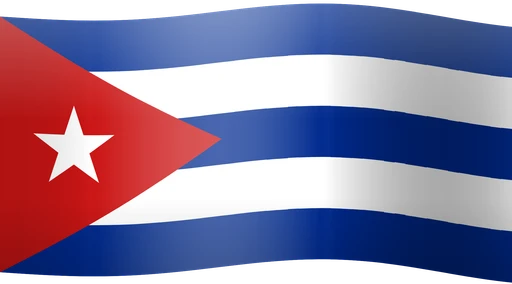
The flag of Cuba consists of five horizontal stripes of blue and white, with a red equilateral triangle based on the hoist side bearing a white five-pointed star in the center. The blue stripes represent the three old divisions of the island, the white symbolizes purity, the red triangle stands for equality, fraternity, and freedom, and the star, known as 'La Estrella Solitaria' (The Lone Star), signifies independence.
La Bandera de la Estrella Solitaria, the Banner of the Lone Star, wasn't born on Cuban soil. It was sketched out in a New York City boarding house in 1849 by exiles plotting revolution against Spanish colonial rule. The flag flew for the first time during a failed annexationist uprising, was later claimed by independence fighters with a completely different political vision, and finally became the national flag of a republic in 1902. Through colonial rebellion, republican government, and socialist revolution, the same design has endured. It's one of the few national banners in the Americas that predates the nation it represents by more than half a century.
Born in exile: the 1849 origins
Narciso López was a Venezuelan-born Spanish military officer who'd switched sides. By the late 1840s, he was living in New York City, organizing Cuban exiles and American sympathizers into a conspiracy against Spanish rule. He's traditionally credited with conceiving the flag's design in 1849. The poet and editor Miguel Teurbe Tolón translated López's concept into an actual visual layout, and Emilia Teurbe Tolón, Miguel's wife, sewed the first physical flag by hand.
The political context matters here, because it complicates the story considerably. López and many of his supporters weren't fighting for Cuban independence in the way we'd understand it today. They were annexationists. Their goal was to pry Cuba away from Spain and attach it to the United States, and some of them specifically wanted Cuba admitted as a slave state. The flag was born under that banner of intent.
López launched two expeditions under the flag. The first, in 1850, briefly seized the city of Cárdenas and marked the first time the flag touched Cuban soil. The second, in 1851, ended in disaster. López was captured by Spanish forces and publicly garroted in Havana. His flag, however, survived him.
That a banner conceived with annexationist and even pro-slavery motivations could later become the supreme symbol of Cuban national sovereignty is one of the stranger turns in vexillological history. But that's exactly what happened.
Three stripes, a triangle, and a lone star: design and symbolism
Five horizontal stripes alternate across the field: three blue, two white. At the hoist sits a red equilateral triangle, and centered within it, a single white five-pointed star. The proportions are fixed at 1:2, height to length, with the triangle's sides equal to the flag's height.
Each element carries meaning layered on by successive generations. The three blue stripes originally represented Cuba's three colonial departments: Occidental, Central, and Oriental. The two white stripes stood for the purity and justice of the independence cause. That red triangle? Blood shed in the struggle for freedom, though its triangular shape has long been read as a Masonic reference. Many of Cuba's leading revolutionaries, José Martí among them, were Freemasons, and the connection wasn't accidental.
The lone star, La Estrella Solitaria, signifies independence. It deliberately echoed the Lone Star of Texas, which had recently broken away from Mexico. That parallel tells you everything about the flag's original annexationist spirit: Texas had separated from one country and joined the United States, and López envisioned the same path for Cuba.
One detail that catches people off guard: the flag of Puerto Rico is essentially the Cuban flag with inverted colors. Red stripes replace blue, a blue triangle replaces red. Puerto Rican exiles designed it in 1895 as a deliberate act of solidarity with Cuban revolutionaries. The two flags remain visual siblings to this day, a reminder of their shared struggle against Spain.
From annexationist banner to national flag: the wars of independence
When Cuba's first major independence war erupted in 1868, the Ten Years' War, there were competing flags. Carlos Manuel de Céspedes raised his own banner, the Demajagua flag, and for a time both designs vied for primacy among the rebels. The question was settled at the Guáimaro Assembly in April 1869, when the Republic in Arms formally adopted the López flag as the national banner. In one vote, the assembly stripped the flag of its annexationist origins and recast it as a symbol of Cuban sovereignty.
José Martí and the Cuban Revolutionary Party carried it forward during the final War of Independence beginning in 1895. By then, the flag's meaning had been thoroughly transformed. It stood for anti-colonial nationalism, full stop.
After the Spanish-American War ended in 1898, the United States occupied Cuba. American military authorities refused to fly the Cuban flag alongside the Stars and Stripes during the occupation, a decision that generated deep resentment and, paradoxically, made Cubans cling to their flag even harder. When the Republic of Cuba was formally proclaimed on May 20, 1902, raising the flag over government buildings was the emotional centerpiece of the day.
Continuity through revolution: the flag after 1959
Fidel Castro's government did not change the flag after the 1959 Revolution, and that was deliberate. Keeping the same banner framed the revolutionary state as the latest chapter in Cuba's long fight for real independence rather than a break with the past. The 26th of July Movement had its own red-and-black flag, still a prominent political symbol on the island, but it was never raised above the national standard.
The 1976 Constitution formally enshrines the flag's design and prohibits its alteration, locking the 1849 pattern into law. That the same flag has flown over a colonial rebellion, a U.S.-aligned republic, and a socialist state is unusual among nations that have undergone comparable ideological transformations. China, Russia, Iran: all changed their flags. Cuba didn't.
And in Miami, Cuban exile communities fly the very same flag at protests against the government that flies it in Havana. Both sides claim it with equal conviction. Few national banners in the world are simultaneously waved by a government and by the diaspora that opposes that government, each insisting the flag belongs to them.
Protocol, display, and cultural presence
Cuban law prescribes strict protocols for the flag's display, covering illumination, positioning relative to other flags, and proper handling and disposal. The banner flies prominently on key national holidays: January 1 (Triumph of the Revolution), July 26 (National Rebellion Day), and October 10 (the anniversary of the start of the Ten Years' War). Each date carries a different political charge, but the flag presides over all of them.
Beyond official ceremony, the flag saturates Cuban culture. It appears in the poetry of Martí, in contemporary visual art, and on the uniforms of Cuba's legendary sports teams. Cuban athletes draping themselves in the flag after Olympic victories is one of the most recognizable images in international sport. Back in Cárdenas, the city museum preserves the history of the flag's first raising on Cuban soil in 1850, and the site carries genuine national significance.
Sister flags and lasting influence
The flag of Puerto Rico, designed in 1895 by the Puerto Rican Section of the Cuban Revolutionary Party, is the most direct offspring of the Cuban design. Its inverted color scheme was a conscious gesture of Caribbean solidarity, and the kinship between the two flags still registers in both island cultures.
Scholars have also traced echoes to the American flag (the stripes) and the Texan Lone Star banner, which fits the mix of annexationism, republicanism, and Freemasonry running through New York exile circles in 1849. More distantly, Catalonia's unofficial independence flag, the Estelada, has drawn comparisons to the Cuban design.
Dreamed up in a New York boarding house by a Venezuelan-born conspirator, sewn by a poet's wife, first raised during a failed invasion, and claimed since by every Cuban political movement in turn: La Estrella Solitaria has had an unusually strange career for a national flag.
References
[1] Constitución de la República de Cuba (1976, amended 2019). Official constitutional provisions on the national flag, Article 2.
[2] Portell Vilá, Herminio. Narciso López y su época. Havana: Cultural S.A., 1930-1958, 3 vols. Primary historical source on López and the flag's creation.
[3] Pérez, Louis A. Jr. Cuba: Between Reform and Revolution. Oxford University Press, 5th edition, 2015. Standard English-language history of Cuba.
[4] Smith, Whitney. Flags Through the Ages and Across the World. McGraw-Hill, 1975. Authoritative vexillological reference covering design specifications and symbolism.
[5] Ferrer, Ada. Cuba: An American History. Scribner, 2021. Comprehensive history covering the flag's political context across eras.
[6] Martí, José. Selected writings and correspondence from the Cuban Revolutionary Party period, 1892-1895.
[7] North American Vexillological Association (NAVA) and the Flag Institute (UK). Organizational resources on flag specifications and display protocols.
Common questions
- Who designed the Cuban flag?
- Narciso López, a Venezuelan-born general of Spanish descent who was fighting to break Cuba away from Spanish rule. He designed it in 1849, and it was first raised on Cuban soil at Cárdenas on 19 May 1850. Cuba did not adopt it as the national flag until 20 May 1902, more than half a century later.
- What does the lone star on the Cuban flag mean?
- The white five-pointed star, known as La Estrella Solitaria, stands for independence. It sits inside the red triangle, which represents equality, fraternity and freedom, the ideals the independence movement took from the French Revolution. The star being alone reflects Cuba standing as a single sovereign state.
- What do the three blue stripes on Cuba's flag represent?
- The three old administrative divisions of the island. The two white stripes between them stand for purity. The arrangement gives five horizontal stripes in total, with the red triangle set against the hoist bearing the star.
- Why do the Cuban and Puerto Rican flags look so similar?
- They share a design lineage. Both emerged from the same 19th-century independence movements against Spain, and Puerto Rico's flag of 1895 deliberately mirrored Cuba's with the red and blue swapped. Cuba has a red triangle with blue stripes; Puerto Rico has a blue triangle with red stripes.
Featured in these articles
- Ohio's Swallowtail Flag Is So Odd the State Wrote a Law on How to Fold It
- Puerto Rico's Flag Was Once Evidence in Court. Now the Fight Is Over Its Blue.
- The Only Flag in the World That Lies to You Depending on Which Side You're Standing On
- The Lone Star Multiplied: How One Simple Symbol Means Freedom, Unity, or Statehood Depending on Who Flies It
Download this flag
Free in 12 styles, from 32px icons up to 2000px, as SVG, PNG, WebP and JPG.