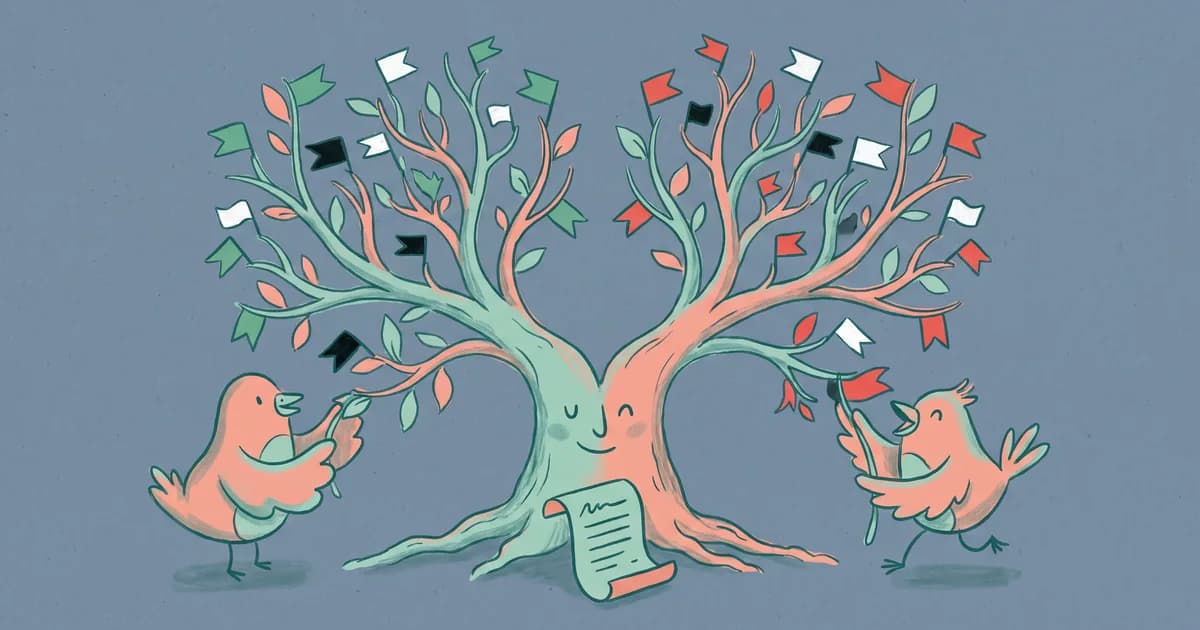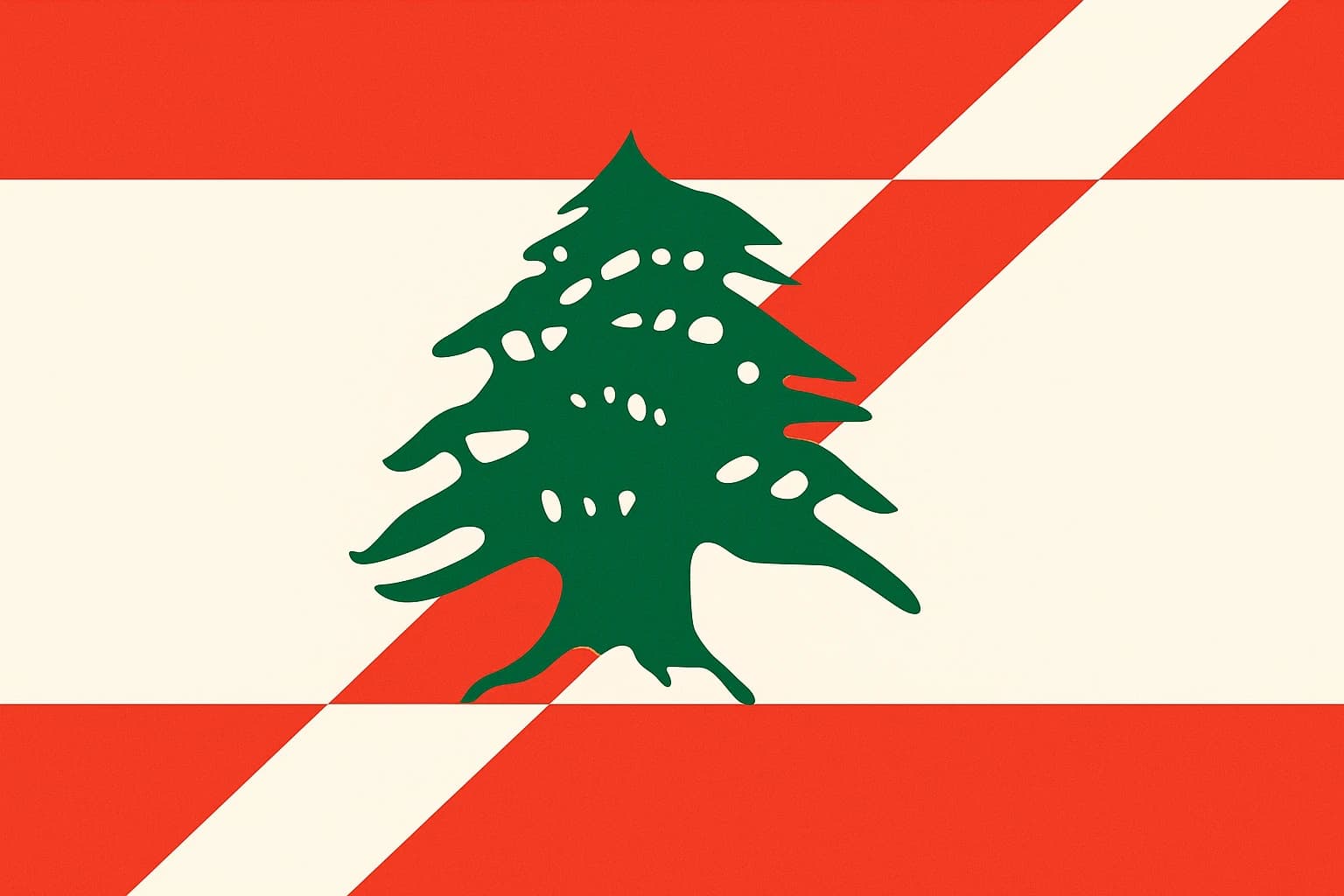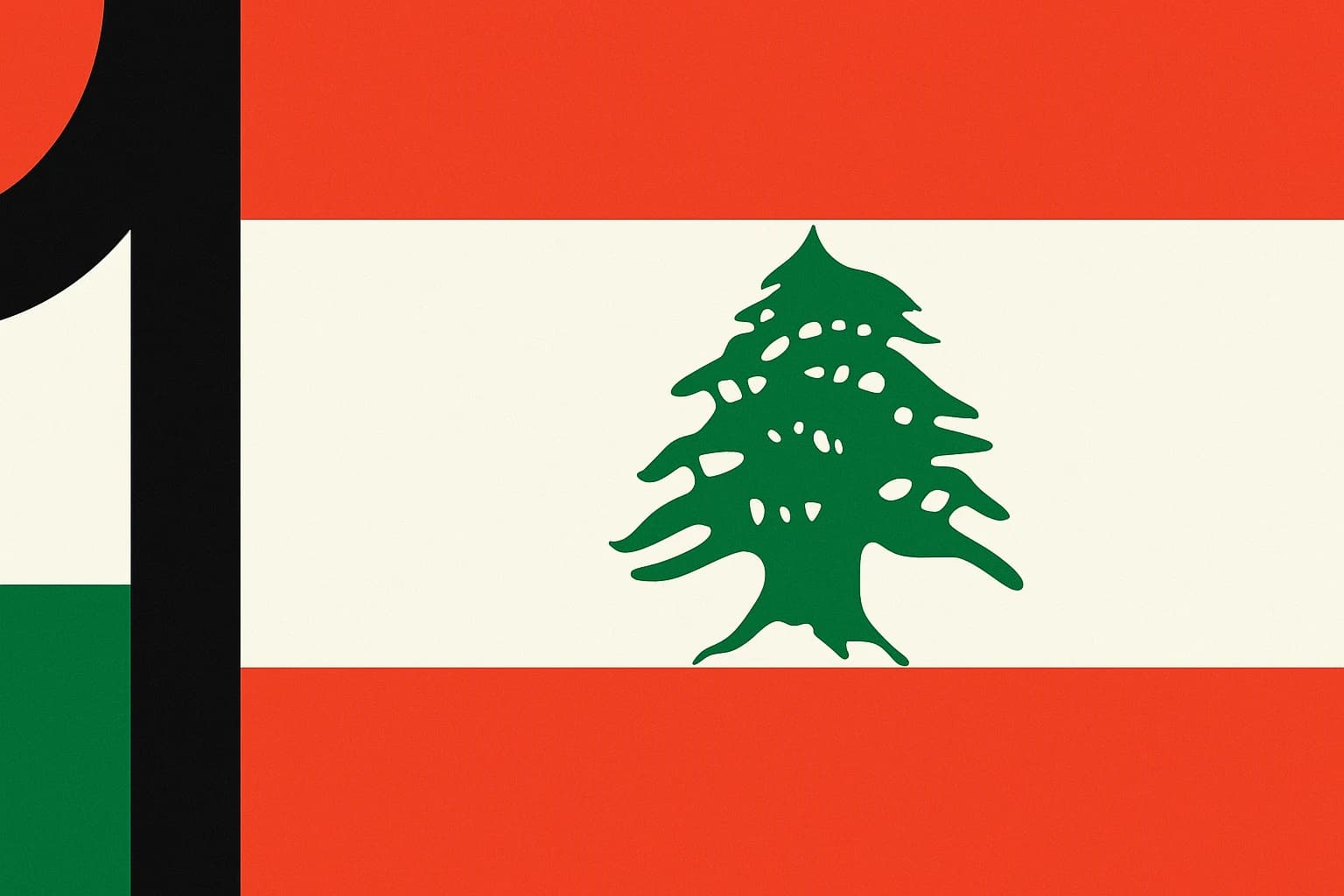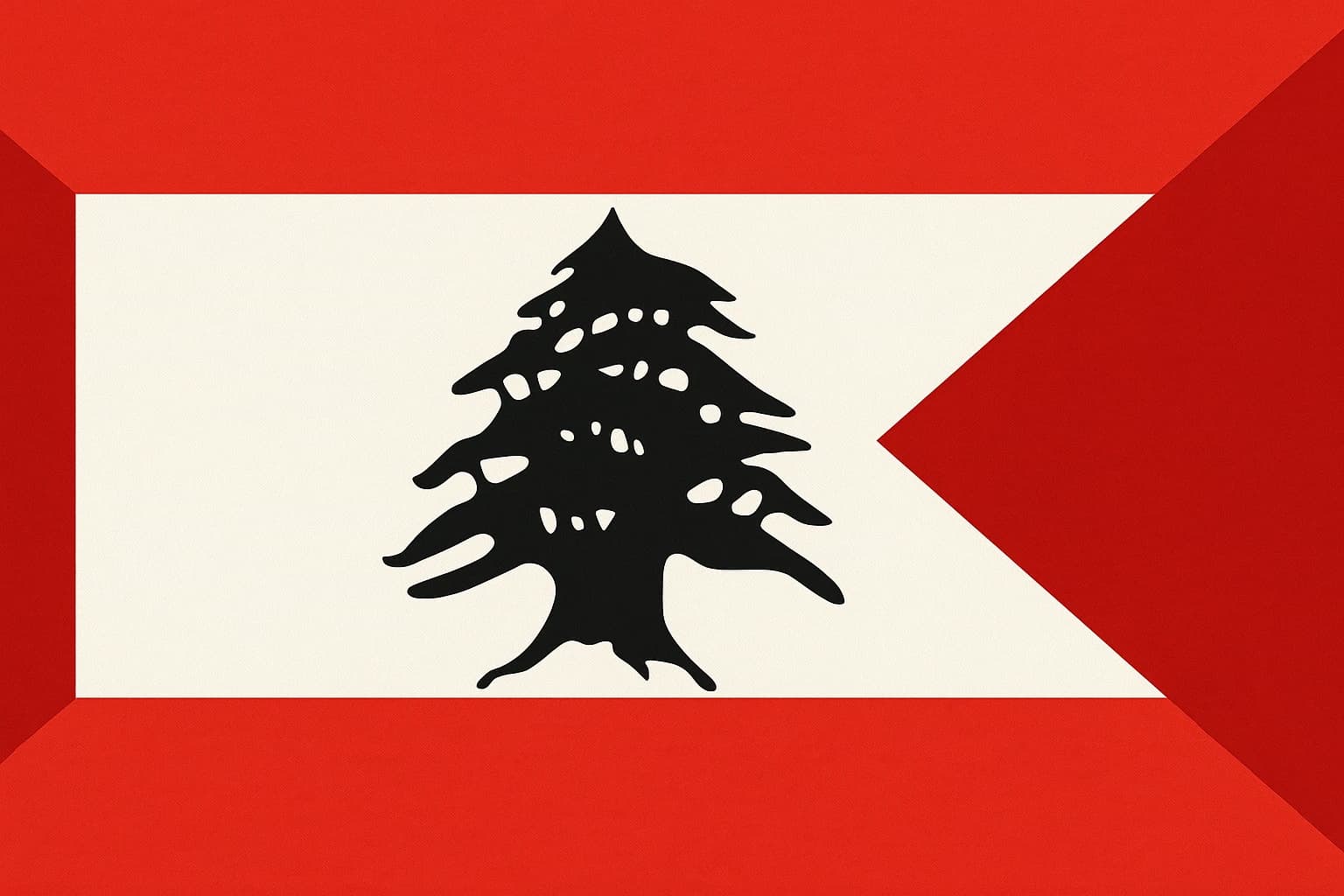
Line up the flags of Syria, Jordan, Saudi Arabia, Egypt, and Iraq. Pan-Arab stripes. Crescents. Eagles. Quranic script. The visual grammar is consistent: bold ideological statements rendered in red, white, black, and green.
Now place Lebanon's flag beside them.
Something shifts. There is no crescent. No star. No shahada. No eagle clutching a scroll. There is a tree. A green cedar, rooted at the center of a white field, flanked by two red stripes. It looks, frankly, like it wandered in from a different region's flag collection.
Lebanon's flag is, as far as anyone has convincingly argued, the only national flag in the Arab world chosen because it belonged to no living group. The cedar was not a Christian symbol. It was not a Muslim symbol. It was not a Druze symbol. It was older than all of them. And in 1943, when Lebanon's fractious founding fathers needed something every faction could sign off on, "older than all of us" turned out to be the only thing they could agree on.
The result is a flag built on negative consensus: unity constructed not around a shared belief but around a shared antiquity that no single sect, party, or creed could claim to own. That strategy is both the flag's cleverest feature and its most honest confession about the country it represents.
A flag designed by disagreement
In November 1943, Lebanon declared independence from the French Mandate. The new republic was tiny, roughly the size of Connecticut, and packed with communities that agreed on almost nothing except their desire to stop being governed by Paris. Maronite Christians, Sunni Muslims, Shia Muslims, Druze, Greek Orthodox, Armenian Catholics, and a dozen other groups needed a state. More urgently, they needed a flag.
The political framework they built was the National Pact (al-Mithaq al-Watani), an unwritten agreement that carved up political power along sectarian lines. A Maronite president. A Sunni prime minister. A Shia speaker of parliament. This arrangement was fragile by design. It required every national symbol, especially the flag, to be scrupulously neutral.
The starting point was the French Mandate flag: a cedar on a white background with a French tricolor in the upper left canton. The 1943 parliamentary committee did two things immediately. They stripped the French element. Then they recentered the cedar on a white field and added two horizontal red stripes, top and bottom, drawn from historic Lebanese mountain banners.
The deliberations were tense. Christian factions, particularly the Maronites, initially favored iconography that leaned toward their religious heritage. Muslim factions pushed back against anything that could be read as sectarian. The cedar resolved the deadlock. Its symbolic roots ran deeper than any religion practiced in Lebanon. It predated the Bible. It predated the Quran. It predated the Druze faith by millennia.
The cedar was selected not for what it affirmed but for what it prevented. Nobody could accuse it of favoring a rival sect. The committee's inability to agree on anything forward-looking produced a symbol that pointed backward, into a past so remote it belonged to everyone and no one.
Older than the Bible or the Quran
The cedar worked as a consensus symbol because its story is very old. Cedrus libani has been documented in the region across at least 3,000 years of recorded history, and the great cedar forests of Mount Lebanon were ancient even when the earliest surviving texts mentioned them.
In the Epic of Gilgamesh, composed around 2100 BCE, Gilgamesh and Enkidu travel to the Cedar Forest, almost certainly the forests of Mount Lebanon, to slay the monster Humbaba and harvest timber. The cedar appears there as divine and forbidden, a resource guarded by gods.
A thousand years later, the Hebrew Bible references cedar over 70 times. Solomon's Temple in Jerusalem (circa 950 BCE) was built with cedar timber supplied by Hiram I of Tyre, a Phoenician city in what is now southern Lebanon. Psalm 92:12 makes the connection explicit: "The righteous shall flourish like the palm tree; he shall grow like a cedar in Lebanon."
The economic history runs deeper still. Egyptian pharaohs, including Sneferu around 2600 BCE, sent ships to Byblos specifically for cedar wood. Cedar built temples, ships and sarcophagi, and it was the commodity that made the Phoenician coast indispensable to the ancient world.
That was the argument in 1943. By the time Islam arose in the 7th century CE, or the Maronite church established its Lebanese identity between the 5th and 7th centuries, the cedar had already accumulated millennia of significance belonging to no single tradition. You cannot own something that was sacred before your faith existed.
Every faction has tried to claim it anyway
Being designed to be unownable has not stopped people from trying to own it.
The Maronite Catholic Church has long associated the cedar with Christian Lebanon, through the Biblical imagery of Solomon's Temple, the cedar forests around the Qadisha Valley (a UNESCO World Heritage Site and historic Maronite heartland), and the visual echoes in church art and architecture. The Kataeb (Phalangist) party, founded by Pierre Gemayel in 1936, used cedar imagery heavily in its explicitly Christian nationalist iconography. During the civil war, the cedar appeared on militia insignia alongside crosses and Maronite saints.
From the other direction, some Lebanese Muslim and pan-Arab political movements have downplayed the cedar's significance entirely. Their argument: Lebanon's true identity lies in its Arab and Islamic heritage, and centering a pre-Islamic, pre-Arab symbol on the flag is itself a political act, one that implicitly contests Lebanon's place in the broader Arab world.
Then there are the Druze communities, concentrated in the Chouf mountains where some of Lebanon's oldest surviving cedar groves still stand. Their geographic connection to the tree is quiet but deep, a counter-claim that further complicates any single group's ownership.
The paradox never resolves. Every attempt to claim the cedar as a sectarian symbol undermines the logic that made it the flag's centerpiece, because its strength as a unifying emblem depends on nobody owning it. It works only as long as its meaning stays unsettled.
What 375 surviving trees say about a nation
In northern Lebanon, near the town of Bsharri, stands the Horsh Arz el-Rab, the "Forest of the Cedars of God," one of the last surviving old-growth cedar groves. Approximately 375 ancient trees remain, some estimated to be over 3,000 years old. They predate every religion, empire, and political faction that has ever claimed Lebanon.
The grove nearly did not survive. During the 19th century, the Ottoman Empire's deforestation campaigns stripped Lebanese cedars for railway fuel and construction. Forests that had once blanketed the mountain slopes were reduced to scattered remnants. The Bsharri grove survived in part because local Maronite communities treated it as sacred ground, a detail that adds another layer of irony to the ownership question.
Lebanon has run national cedar reforestation programs since the mid-20th century. Various governments and NGOs, including the Lebanese Reforestation Initiative, have championed planting efforts. But those programs have been interrupted by the 1975-1990 civil war, the Syrian occupation, the 2006 conflict with Israel, and the economic collapse that accelerated after 2019. The cedar on the flag promises permanence. The actual trees remain fragile.
As of 2026, rising temperatures and shifting precipitation patterns across the Levant are pushing the cedar's viable growing altitude higher up the mountain. Trees that once did well at lower elevations are stressed and new growth is harder. The most ancient living things in Lebanon are also among the most threatened.
The gap between symbol and reality is itself a fair description of Lebanese national identity. The flag's cedar is evergreen, unchanging, stylized into geometric confidence. The real cedars are struggling and retreating uphill.
Negative consensus in global context
Lebanon is not the only country that has reached for a natural symbol to escape political division. Canada's 1965 adoption of the maple leaf flag followed a similar logic.
The old Canadian Red Ensign featured the Union Jack, a reminder of British imperial ties that alienated French Canadians and newer immigrant communities. The maple leaf, like Lebanon's cedar, was chosen partly for what it avoided. But Canada's political context, while contentious, was far less fractured than Lebanon's multi-sectarian landscape.
Contrast this with flags that double down on ideology. Saudi Arabia's flag carries the shahada, the Islamic declaration of faith, written in white Arabic calligraphy. The state's religious identity is non-negotiable, printed in the largest possible font.
Israel's Star of David signals Jewish national identity with equal directness.
These flags make strong, exclusive claims. Lebanon's flag makes the opposite move.
The broader Arab world comparison is telling. Syria, Iraq, Egypt, Sudan, and Yemen all use Pan-Arab colors (red, white, black, green) derived from 20th-century Arab nationalist ideology. Lebanon's flag shares the white field but replaces the ideological palette with a botanical specimen. That substitution quietly signals Lebanon's historical ambivalence about pan-Arab identity, a discomfort that has shaped its politics for over 80 years.
Plant-centered flags are rare in a specific way. Botanical symbols appear on plenty of flags, including the maple leaf and Belize's mahogany tree, but a single plant dominating the center field as the primary symbol is very uncommon. Lebanon put a tree, rather than a human figure, a weapon, a celestial body, or a geometric abstraction, at the literal center of national identity.
When neutrality becomes the problem
Negative consensus worked as a founding compromise. Its structural weakness has become clearer as Lebanon's crises deepened.
The strength is real. The cedar survived the 1975-1990 civil war, the Syrian occupation, the 2006 war with Israel, the October 2019 uprising, and the Beirut port explosion of August 4, 2020, which killed over 200 people and devastated half the capital. Through all of it, no militia fully captured the cedar and no faction turned it into a victory banner. In a country where almost everything else has been divided along sectarian lines, that is remarkable.
But a symbol defined by what it isn't struggles to inspire positive, forward-looking solidarity. During the October 2019 protests, the "thawra," Lebanese demonstrators waved the national flag in huge numbers. It was a cross-sectarian image, and it was moving. People of all backgrounds held the same flag and demanded change. Yet the cedar's neutrality also meant the flag alone could not articulate what kind of Lebanon the protesters were demanding. It could represent "we are all Lebanese." It could not say "this is what Lebanon should be."
As of 2026, Lebanon continues navigating political reconstruction after years of economic collapse, institutional paralysis, and the aftershocks of the 2019 uprising. Debates about electoral reform, the end of confessionalism, and the nature of national identity remain open and unresolved. The flag's studied neutrality reads as either admirable restraint or a failure of national imagination, depending on who you ask.
The country chose a symbol that predates all its divisions, hoping shared antiquity would substitute for shared vision. But a country cannot be governed by a tree. The cedar tells Lebanon where it comes from and offers no map for where it is going.
A tree on a flag
Go back to that lineup of Middle Eastern flags: the Pan-Arab stripes, the crescents, the eagles, and Lebanon's cedar sitting apart from all of them.
The difference isn't a botanical quirk. Lebanon's flag argues, deliberately, that the only thing this nation's communities could agree to revere was something so old that no living group could claim to have invented it. That is either a real insight about how divided societies survive, or an admission that Lebanon never agreed on what it was, only on what it was older than.
The cedar endures on the flag the way the oldest trees in Bsharri endure on the mountain: rooted in a past that belongs to everyone and a present that remains contested.