The Flag of Iraq
Republic of Iraq
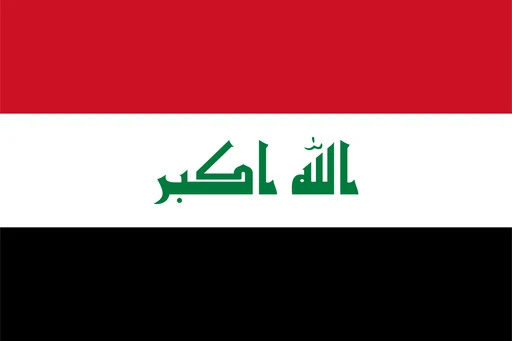
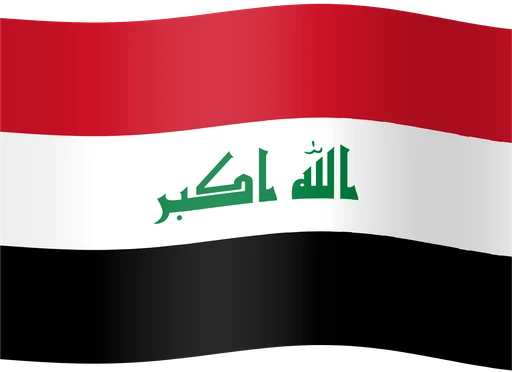
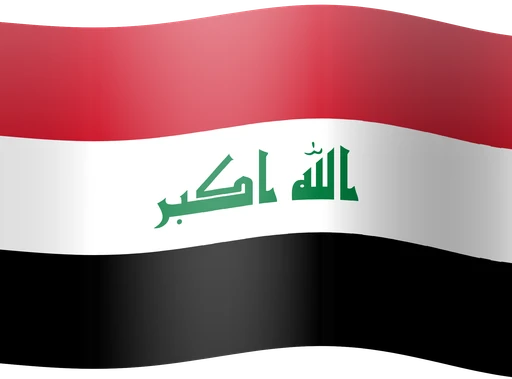
The flag of Iraq has three horizontal stripes of equal width, red, white, and black from top to bottom. Centred in the white stripe is the Takbir ("Allahu Akbar", meaning "God is the greatest" in Arabic) written in Kufic script. The current design was adopted on January 22, 2008. The flag has changed several times since 1921, and each change followed a change of government.
Few national flags have changed as often, or as deliberately, as Iraq's. Within a single generation it went from a symbol of Baathist dictatorship to a contested emblem of post-war national identity, and its most striking revision came in 2008, when the Iraqi parliament voted to remove Saddam Hussein's own handwriting from the flag. Today's flag carries the Pan-Arab colours of black, white, red, and green, and bears the Takbīr, the phrase "Allāhu Akbar" (God is Greatest), in Kufic script at its centre.
Written in the dictator's hand
Iraq's current tricolor traces back to the Baathist coup of February 1963, when the new regime adopted a red-white-black horizontal triband as a declaration of alignment with the Arab nationalist movement then sweeping the region. Three green stars sat on the white stripe, representing a hoped-for union with Egypt and Syria. The union never materialized. The stars stayed anyway.
For nearly three decades, the flag remained unchanged. Then came the Gulf War. In January 1991, as coalition bombs fell on Baghdad, Saddam Hussein ordered the phrase "Allāhu Akbar" added to the white stripe between the stars. The script was reportedly his own handwriting, a populist religious appeal meant to rally support by wrapping the regime in the language of faith. Whether the handwriting was truly Saddam's or merely attributed to him, the effect was the same: the dictator's personal mark was on the national banner.
After the 2003 invasion and Saddam's fall, the interim Iraqi government found itself in an awkward position, flying a flag inscribed with the ousted dictator's script. Something had to change, but what? In 2004, the US-backed Iraqi Governing Council proposed a redesign featuring a crescent on a white-and-blue field. The backlash was immediate. Critics called it a foreign imposition that looked far too much like Israel's flag, and the proposal died within days.
It took four more years to find a solution. In 2008, the Iraqi parliament passed a compromise: the Takbīr would stay, but Saddam's handwriting would go, replaced by standardized Kufic script. The three stars were quietly removed at the same time. The move preserved the religious phrase that many Iraqis had genuinely embraced while severing its link to the man who put it there. The 2008 law also explicitly describes the current design as temporary. A permanent flag remains a subject of national debate, unresolved more than fifteen years later.
The Pan-Arab palette
The four colours on Iraq's flag aren't Iraqi inventions. They belong to a shared visual vocabulary born from the Arab Revolt of 1916, when Sharif Hussein of Mecca raised a banner against Ottoman rule. Red, white, black, and green became the colours of Arab self-determination, and nearly every Arab state that won independence in the 20th century wove them into its flag in some combination.
Each colour carries traditional associations. Red recalls the Hashemite dynasty and the blood of those who fought for liberation. White signals peace and the hope of a better future. Black represents the Abbasid Caliphate, the medieval Islamic golden age centred in Baghdad, and the darkness of oppression overcome. Green evokes Islam and the Fatimid Caliphate.
Line up Iraq's flag alongside Syria's, Egypt's, and Yemen's and you'll see siblings. All share the red-white-black triband in some form. Iraq's distinguishing mark is the green Kufic script on the white stripe. The design looks outward toward a collective Arab identity as much as inward toward Iraq itself, and that family resemblance has always made it harder for the banner to feel unmistakably Iraqi.
The Takbīr and Kufic script
The Takbīr, "Allāhu Akbar," is among the most recognizable phrases in the Islamic world. It's spoken during daily prayers and called out at moments of celebration and crisis alike, and it carries a weight that transcends any single nation or political movement. Placing it on a national flag speaks to Iraq's Muslim-majority population, and it also raises questions about inclusivity in a country home to Christians, Yazidis, and other minorities.
What makes Iraq's approach distinctive is the script. Kufic is one of the oldest calligraphic forms of Arabic, originating in the city of Kufa in present-day southern Iraq. Choosing it was a specifically Iraqi cultural statement as much as an aesthetic decision. The angular, geometric letterforms of Kufic look nothing like the flowing cursive Naskh script of Saddam's handwritten version. Where Naskh is personal and fluid, Kufic is monumental and architectural, closer to carved stone inscriptions and early Quranic manuscripts than to any individual's penmanship.
The switch carried a deliberate irony. By adopting Kufic, parliament rooted the flag in an artistic heritage that predates any living political figure by centuries. Other flags bear the Takbīr or religious text: Saudi Arabia's shahada in Thuluth script, Iran's stylized "Allāhu Akbar" repeated along its stripes, Afghanistan's mosque emblem. Iraq's use of Kufic gives its inscription a cultural specificity that none of those quite match.
The stars that stood for a union that never happened
The three green stars on Iraq's pre-2008 flag represented a planned federation of Iraq, Egypt, and Syria, a dream of unified Arab statehood that collapsed almost as soon as it was announced. Syria's own union with Egypt as the United Arab Republic lasted only from 1958 to 1961. Iraq never joined at all.
Yet the stars survived on the flag for 45 years, long after anyone seriously expected the union to happen. Their quiet removal in 2008 generated little controversy. By then, classical Pan-Arab nationalism as a governing ideology had faded considerably, replaced by more localized identities and sectarian affiliations. The stars' disappearance marks that shift as clearly as any political speech or treaty could.
Usage, variants, and the Kurdish question
Officially, Iraq's flag flies over government buildings, military installations, diplomatic missions, and at the United Nations in New York. Standard protocol governs its display, and the 2008 law specifies its proportions and Pantone colours.
In practice, things get complicated. The Kurdistan Region of Iraq flies its own flag, a horizontal tricolor of red, white, and green with a golden sun at its centre. In Erbil, Sulaymaniyah, and Duhok, the Kurdish flag appears on government offices, schools, and public squares, sometimes alongside the Iraqi national flag and sometimes instead of it. That dual-flag reality reflects Iraq's federal structure and the ongoing negotiation between Kurdish autonomy and national unity.
Iraqi athletes have had their own complicated relationship with the flag. During the Saddam era, the national team's successes were co-opted by the regime. After 2003, the flag became a rare point of shared national pride, particularly during the 2007 AFC Asian Cup victory, when Iraqis of all backgrounds waved it in celebration. Abroad, diaspora communities use different versions as political markers. Some display the pre-1991 version without the Takbīr. Others fly the post-2008 design. Still others prefer the 1991-2004 version with Saddam's handwriting intact. Each choice signals something about the bearer's politics, generation, and relationship to the homeland.
References
[1] Iraqi Constitution (2005), Articles on national symbols. Iraqi Council of Representatives official records.
[2] Law No. 9 of 2008 (Iraqi Flag Law). Iraqi Council of Representatives legislative archive.
[3] Flags of the World (FOTW), Iraq entry. Maintained by the International Federation of Vexillological Associations (FIAV). https://www.fotw.info
[4] Smith, Whitney. Flag Lore of All Nations. Millbrook Press, 2001.
[5] Dawisha, Adeed. Arab Nationalism in the Twentieth Century: From Triumph to Despair. Princeton University Press, 2003.
[6] Tapper, Richard & Jon Thompson (eds). The Diversity of the Muslim Community. Saqi Books.
[7] Al-Jazeera and BBC News archival reporting (2004, 2008) on Iraqi flag controversies and the parliamentary debate over the redesign.
[8] The Flag Institute (UK). https://www.flaginstitute.org
[9] Hiro, Dilip. Iraq: A Report from the Inside. Granta Books, 2003.
Common questions
- Why is "Allahu Akbar" on the Iraq flag?
- The phrase was added during the Gulf War in 1991 as an appeal to Islamic identity and unity. The script was changed to a standardized Kufic style in the years after 2003.
- What do the colors on the Iraq flag mean?
- Iraq's flag uses Pan-Arab colours: red for courage, white for peace, and black for struggle. They tie Iraq to the wider Arab world.
- Why were the three stars removed from the Iraq flag?
- The three stars were removed in 2008. They had stood for a hoped-for union with Egypt and Syria that never happened, and by then the political project behind them had faded.
Featured in these articles
- One Poem, Two Flags: How the Arab World's Colors Split Into Rival Family Trees
- The Cedar That Outlasted Every Regime: How Lebanon Built a Nation Around a Symbol No One Could Own
- The Vatican's Crossed Keys: How the World's Smallest State Flies the Most Theologically Loaded Flag
- Flags on the Move: The Impact of Political Changes on National Flags
Download this flag
Free in 12 styles, from 32px icons up to 2000px, as SVG, PNG, WebP and JPG.