In October 2018, South Korea made a straightforward request: remove the Rising Sun flag from your warships before entering Jeju Island for an international naval review. Japan refused. Its ships never docked.
The empty berth said more than any diplomatic cable could. The disorienting part is that the same flag South Korea treats as a symbol of wartime atrocity flies legally, every single day, on Japan's Maritime Self-Defense Force vessels. It shows up on energy drink cans, surf gear, and streetwear. Japanese officials defend it as a centuries-old cultural motif with no more malice than a chrysanthemum crest.
How does one flag carry two incompatible meanings at the same time?
The Rising Sun flag's contested status is not a misunderstanding waiting to be cleared up. Two countries hold irreconcilable relationships to the same history, and the flag is where that shows. In 2026, with Japan's defense spending at record levels and its military role in the Indo-Pacific steadily expanding, the tension has grown sharper rather than duller.
Before the empire: a surprisingly ancient and innocent origin
The radiating sun motif runs deep in Japanese visual culture, long before anyone attached it to a warship. During the Edo period (1603-1868), the design appeared on military war fans, samurai clan banners, and fishing boat pennants, where it stood for good fortune and divine favor: the land of the rising sun greeting its namesake.
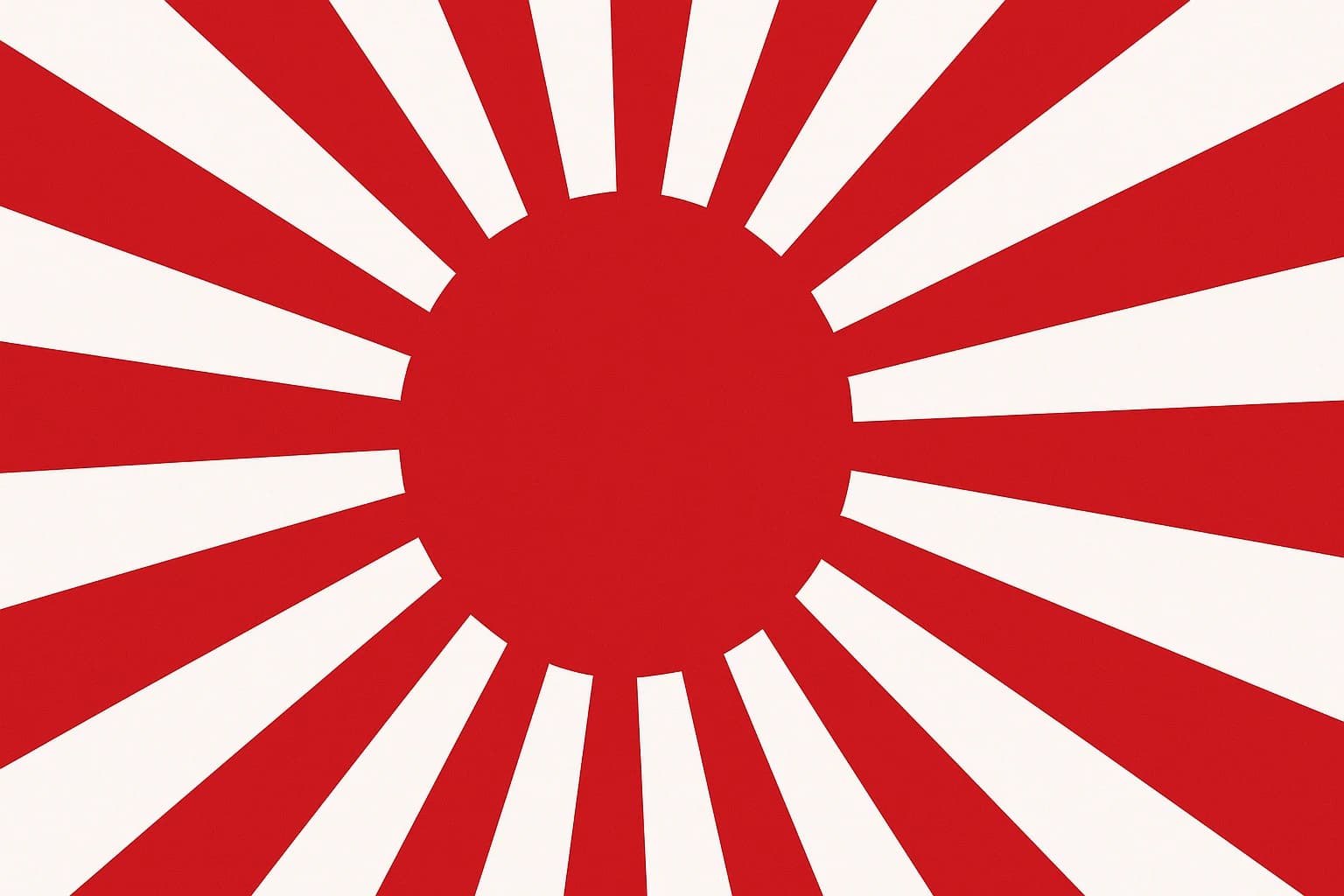
The specific 16-ray design, the Kyokujitsu-ki, was formally adopted by the Imperial Japanese Army in 1870, only two years after the Meiji Restoration. This was a modernizing nation codifying existing cultural imagery into a formal military identity, and there was nothing sinister about the moment itself. In 1889 the Imperial Navy adopted its own version, with the sun disc offset to the left. That offset naval variant is the one the Maritime Self-Defense Force still flies in 2026.
Many symbols later weaponized by nation-states had long, benign histories beforehand. The eagle. The fasces. The swastika was a Sanskrit good-luck charm for millennia before the Third Reich claimed it. An origin story alone does not vindicate or condemn a flag. What happened next is what matters.
For roughly the first 40 years of its official military use, the Rising Sun flag flew in contexts largely invisible to the rest of Asia. That invisibility ended with brutal speed in the 20th century.
The flag goes to war: imperial expansion and the geography of trauma
The Rising Sun flag was there for all of it. The invasion of Manchuria in 1931. The Second Sino-Japanese War from 1937 to 1945. The occupation of Korea, the Philippines, Singapore, Indonesia, and much of Southeast Asia.
Japanese soldiers were photographed and filmed advancing under the Rising Sun flag during the Rape of Nanjing in December 1937, in which an estimated 200,000 to 300,000 Chinese civilians were killed. For Chinese survivors and their descendants, the flag is fused to that image. It is not an abstraction. It is a photograph.
Korea's relationship with the flag carries its own weight. Japan annexed Korea in 1910 and ruled it until 1945. For 35 years, Koreans endured forced labor, systematic cultural erasure, and the "comfort women" system. The Rising Sun flag flew over all of it, which is longer than the Nazi flag ever flew over occupied Europe.
A distinction matters here. The Kyokujitsu-ki was the battle flag, carried into combat, planted in conquered territory, used to mark occupation zones. That sets it apart from the Hinomaru, Japan's plain red-disc national flag, which has its own controversies but a different symbolic weight. The Rising Sun flag was operational. It meant soldiers were coming.
There is also an asymmetry of memory that complicates everything. Japan experienced the war's end through Hiroshima, Nagasaki, and surrender, a narrative of suffering. Critics across Asia have long argued that this narrative of victimhood has crowded out a full national reckoning with the harm Japan inflicted under that flag.
The postwar paradox: why the flag survived when Germany's symbols did not
The comparison to Germany is essential here, and it breaks down in revealing ways.
Germany's de-Nazification process, overseen by the Allies, banned Nazi symbols including the swastika. That prohibition became §86a of the German Criminal Code, still enforced in 2026. The process was painful, incomplete, and took decades to mature into genuine cultural accountability. But it happened.
Japan's postwar trajectory followed a different logic. The American occupation, led by General Douglas MacArthur, had Cold War priorities that shaped everything. The United States needed Japan as a stable anti-communist bulwark in Asia, which meant a rapid pivot from demilitarization to rearmament. The Self-Defense Forces were established in 1954. There was little appetite for the kind of deep symbolic reckoning that Germany underwent.
The result is striking. The Rising Sun flag was never banned, not even during the American occupation from 1945 to 1952. The Imperial Army was dissolved, but its flag survived. When the Maritime Self-Defense Force stood up in 1954, it formally re-adopted the naval variant of the Rising Sun as its official ensign. No redesign. No modification.
Compare that to Germany, where the Iron Cross, Germany's storied military decoration, was not permitted to carry into the Bundeswehr in its original form without significant redesign. Japan faced no equivalent pressure to rethink its military symbols.
The Japanese government's official position has remained consistent through 2026: the Rising Sun flag is a legal, traditional symbol with no legal prohibition, and requests to ban it are characterized as politically motivated interference in Japan's domestic affairs.
The 2018 Jeju naval review and the flashpoints of living memory
The 2018 International Fleet Review was supposed to be a display of multilateral cooperation. South Korea, as host, requested that all visiting warships fly only their national flags and the South Korean flag, a standard diplomatic courtesy. Japan's Maritime Self-Defense Force refused to attend rather than lower the Rising Sun ensign, citing legal obligations under Japanese maritime law.
Why did this cut so deep? Because a naval review is the precise context in which the Rising Sun flag arrived in Korean waters during the Imperial period. The refusal to remove it was experienced in South Korea not as a procedural dispute but as a deliberate echo.
The flashpoints kept coming. The organizing committee banned the Rising Sun flag from the 2020 Tokyo Olympics, held in 2021, after pressure from South Korea and civil society groups. Enforcement was uneven, and it appeared at several venues in spectators' hands.
In 2019, the South Korean parliament passed a resolution formally declaring the flag a "war criminal flag" (전범기). The Chinese government lodged repeated formal diplomatic protests through 2024 and 2025 over its display at joint military exercises. At street level, anti-Rising Sun demonstrations occurred in Seoul as recently as 2025, triggered by the flag's appearance on a Japanese warship participating in a joint U.S.-Japan-South Korea naval drill.
Japan's defense: tradition, law, and talking past each other
Japan's position deserves to be stated in full and fairly. The flag predates militarism by centuries. It has been in continuous use by the Maritime Self-Defense Force since 1954. It carries legal status under Japanese law. And the equation with the Nazi swastika is seen in Japan as a false and offensive comparison, one that erases the difference between a cultural symbol and one designed from scratch for an extermination ideology.
There is also a domestic political dimension. The flag has been re-embraced by nationalist groups, most visibly Nippon Kaigi, a conservative lobby with significant influence within the Liberal Democratic Party, as a symbol of pride in Japan's pre-war culture and military heritage. Any move to retire the flag would face fierce opposition at home.
Some Japanese defenders make a design universalism argument: the radiating sun motif appears in cultures worldwide. Argentina's Sun of May has rays. Incan iconography featured radiating solar designs. The claim that neighbors hold exclusive negative ownership over a common visual motif is portrayed as parochial.
Critics find that argument disingenuous. Nobody is objecting to the abstract concept of sun rays. They are objecting to this specific flag, carried by this specific military, during these specific atrocities.
A generational shift is worth noting. Surveys from 2024 and 2025 show that younger Japanese feel less attachment to the flag than older cohorts, and some Japanese civil society voices have called for its voluntary retirement from military use. It is a minority position, but a growing one.
The impasse looks like this: Japan argues from legal and cultural continuity, South Korea and China from moral and historical rupture. Those are two different conversations happening in the same room, and both parties know it.
What makes a symbol toxic, and who gets to decide?
Symbols mean what communities agree they mean. When communities have irreconcilably different relationships to the same history, they will not agree. The scholar Michael Billig wrote in "Banal Nationalism" about how flags function as daily, unconscious reminders of national identity. They bypass reflection and work on a level beneath argument.
Consider the Confederate battle flag in the United States. It underwent a significant, if incomplete, removal from public institutions after the Charleston church shooting in 2015. No law banned it. Consensus shifted. Enough people decided the harm of its display outweighed the tradition of its presence. Why has no equivalent consensus formed around the Rising Sun flag?
Part of the answer is commodification. The Rising Sun design appears on surfboards, streetwear, and album covers, often with zero awareness of its historical weight. A K-pop fan controversy erupted in 2021 over a jacket featuring the design. That diffusion into commercial and pop-culture spaces makes the symbol harder to reclaim or retire, not easier, because a design that is everywhere starts to feel like it belongs to nobody in particular.
And here is the hardest question. If a symbol's meaning is shaped by its use, does the Maritime Self-Defense Force's use of the flag in 2026, amid growing Japanese military assertiveness, expanded defense budgets, and revised constitutional interpretations, give new weight to its critics' concerns? Does continued official use, in the waters where Japan once waged imperial war, re-charge the symbol with exactly the meaning Japan insists it no longer carries?
There is no clean resolution. The flag has become the arena for a much larger conflict about historical accountability, national identity, and the politics of memory in East Asia.
The empty berth
Go back to Jeju and the empty berth where Japan's ships would have docked. What that flag is best at, in practice, is making cooperation disappear.
Japan's insistence on flying the Rising Sun flag is, from one angle, a nation defending its legal rights and cultural continuity. From another, it is a nation choosing, again and again, to sail into the waters of its former colonies under the same banner that once marked their occupation.
Neither reading is wrong, and the disagreement will not be settled by facts or arguments, because the disagreement is not really about the flag. It is about whether Japan has done enough to reckon with what it did under it. In 2026, with defense spending at historic highs and Japan's military footprint in the Indo-Pacific quietly expanding, that question is louder than it has been in decades.