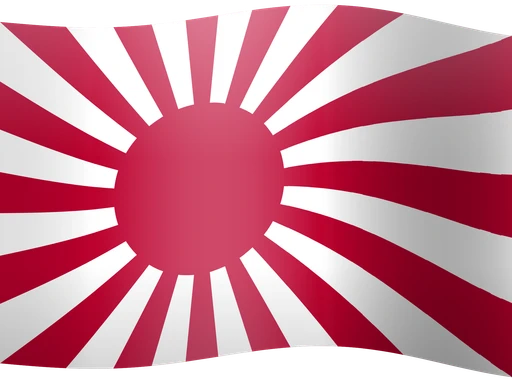
The Flag of The Rising Sun
The Rising Sun
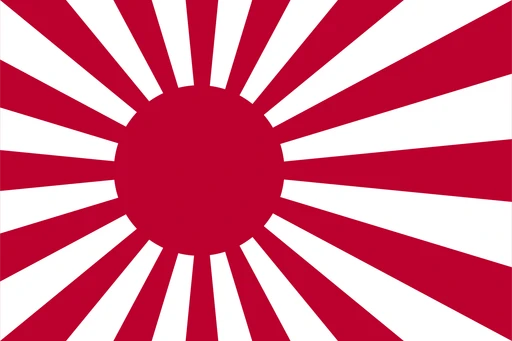
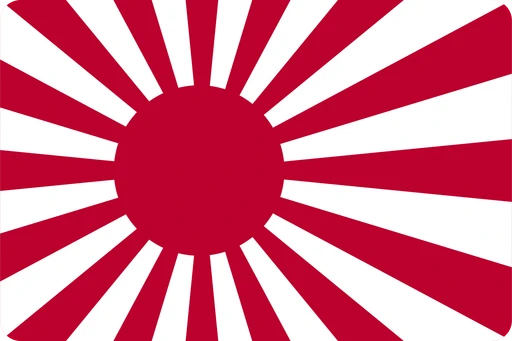
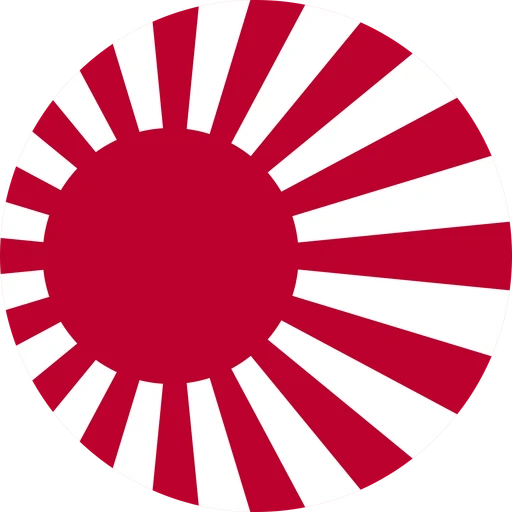
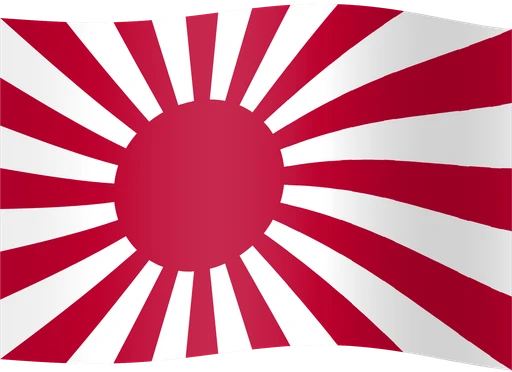
The flag of the Rising Sun, or Kyokujitsu-ki (旭日旗), has a red sun disc at the center with 16 rays running out to the edges of a white field. The design shows the sun at dawn, throwing light across the sky, and the red against white makes the motif read from a distance. Historically it has stood for vitality and expansion, drawing on the sun as a life-giving force.
Few flags provoke as visceral and contradictory a response as Japan's Rising Sun Flag (旭日旗, Kyokujitsuki). With its bold red disc and sixteen rays radiating outward to the edges of a white field, the design draws on centuries of sun worship in Japanese culture, yet it remains one of the most contested national symbols in East Asia. Predating the modern Japanese state, the motif evolved from a feudal emblem of good fortune into the standard of imperial military expansion, and today occupies a fraught space between cultural heritage and painful historical memory. How a symbol of dawn became, for millions across the Pacific, a symbol of devastation, and why it was never retired the way Germany retired the swastika, are two halves of the same question.
Sun worship and the origins of the motif
Japan's identity as "the Land of the Rising Sun" (日本, Nihon or Nippon) is baked into the country's very name. References to Japan as the place where the sun originates date back to 7th-century diplomatic letters sent to China's Sui Dynasty, and the association stuck. Long before anyone codified it on a military flag, the rising sun motif appeared on feudal clan banners called uma-jirushi during the Sengoku period (1467-1615). Warlords flew sun-ray designs as markers of good fortune, energy, and martial vigor on chaotic battlefields where you needed to spot your allies fast.
But the motif wasn't confined to warriors. Fishermen painted radiating sun patterns on their vessel flags, praying for bountiful catches. Merchants used similar designs to invoke prosperous voyages. The sun-ray image lived in folk culture as much as it lived in warfare.
Undergirding all of this was Amaterasu, the Shinto sun goddess and mythological ancestor of the Imperial line. Her presence gave the rising sun both spiritual gravity and political weight centuries before the Meiji government ever thought to standardize it. When reformers eventually went looking for a symbol to project the authority of a modernizing empire, they didn't have to look far. The imagery was already everywhere.
From feudal emblem to imperial war flag (1870-1945)
In 1870, the newly established Meiji government made it official: the sixteen-rayed Rising Sun Flag became the war flag (gunki, 軍旗) of the Imperial Japanese Army. The choice was deliberate. Japan already had the Hinomaru (日の丸), the simple red disc on white, functioning as the national flag. The military needed something with more force, more projection. Sixteen crimson rays fanning outward from a central sun did the job.
The Imperial Japanese Navy followed in 1889 with its own variant. The naval ensign shifted the red disc toward the hoist (left) side, giving the design an asymmetric, forward-driving quality that looked particularly striking when the flag snapped in the wind off a ship's stern. That offset disc became one of the most recognizable military emblems of the 20th century.
The symbolism was no accident. Meiji-era leaders wanted to project imperial authority radiating outward, and the flag's visual language said exactly that. It flew over Japan's rapid succession of military campaigns: the First Sino-Japanese War (1894-95), the Russo-Japanese War (1904-05), the annexation of Korea (1910), the invasion of Manchuria (1931), and the full sweep of the Pacific Theater in World War II.
For the people who lived under those campaigns, the flag became inseparable from what it accompanied. In China, Korea, Southeast Asia, and the Pacific Islands, the sixteen rays meant occupation, forced labor, the Nanjing Massacre, and the comfort women system. The flag didn't cause those atrocities, but it was there for all of them, and memory doesn't make fine distinctions between a symbol and the acts committed beneath it.
Sixteen rays and a disc of red
Technically, the Rising Sun Flag is a white field bearing a red disc at or near center, from which sixteen red rays extend to the edges. Each ray subtends exactly 22.5 degrees, producing perfect radial symmetry. The Army version centers the disc; the Navy version offsets it toward the hoist. Both use the same red, traditionally a crimson derived from beni pigment, now standardized in modern production.
Why sixteen rays? There's no single confirmed answer. The number is commonly linked to completeness, and some scholars note the parallel with the sixteen petals of the Imperial chrysanthemum crest, though the connection is associative rather than derivational.
The contrast with the Hinomaru is worth dwelling on. Both flags share a red disc on white, but the rays change the character of the design completely. The Hinomaru sits still. Add sixteen radiating lines and the whole thing pushes outward, which is what makes the Rising Sun Flag so visually powerful and so politically loaded. Its high contrast, geometric simplicity and radial symmetry also make it one of the most instantly recognizable flag designs ever drawn. You can identify it from a hundred meters away, which is, of course, exactly what a war flag is supposed to do.
The flag that was never banned
The Rising Sun Flag was never prohibited. Not by Allied occupation authorities after 1945, not by any postwar Japanese law. Germany banned the Nazi swastika from public display under its criminal code; Japan did nothing of the kind, and the flag stayed in use.
In 1954, the Japan Maritime Self-Defense Force (JMSDF) officially re-adopted the naval ensign, using a design virtually identical to the one the Imperial Navy had flown. The decision was practical (the JMSDF saw itself as a continuation of Japan's naval tradition) but it's been a flashpoint ever since.
South Korea has been the most vocal critic. Korean officials have repeatedly called for the flag's prohibition at international events, most prominently ahead of the 2020 Tokyo Olympics. Organizers ultimately allowed the flag in venues, a decision that drew sharp protests from Seoul. China and several Southeast Asian nations view the flag in similar terms: as analogous to the swastika, a marker of unrepentant militarism.
Japan's government sees it differently. Tokyo maintains that the Rising Sun Flag predates militarism by centuries and remains a legitimate cultural and official symbol, not an expression of political ideology. The Ministry of Defense has published official explanations along these lines, framing the ensign as part of Japan's maritime heritage.
This is where the debate gets genuinely difficult. Who owns the meaning of a symbol, the nation that created it or the nations that suffered under it? Germany answered that question by retiring the swastika entirely. Japan answered it by keeping the flag and contesting the interpretation. Neither approach has resolved the underlying tensions, but only one forces the argument to continue at every international sporting event, naval port call, and diplomatic meeting.
Pop culture, protest, and the modern flag
Inside Japan, the rising sun motif shows up everywhere: on fishing boats, beer advertisements, baseball supporter banners, soccer scarves, and New Year's decorations. Most of the time, the intent is celebratory or decorative, carrying about as much ideological freight as a smiley face.
Outside Japan, the story changes fast. The design has been borrowed in Western fashion, tattoo culture, skateboard graphics, and album covers, often by people with zero awareness of the wartime history. When that ignorance becomes visible, the backlash can be swift. Nike, Dior, and several other international brands have faced criticism and product recalls after incorporating sun-ray patterns into merchandise.
In South Korea, displaying the flag can provoke immediate public outcry, and legislators have introduced bills to ban it, though no national prohibition had passed as of 2024. FIFA and the International Olympic Committee have both faced pressure to prohibit the flag at events, with mixed responses.
The result is a symbol living a double life: a mundane cultural artifact inside Japan, a reminder of historical trauma outside it. Every new incident, whether a fashion line or a naval exercise or an Olympic ceremony, reopens the same argument.
Similar flags and radiating sun designs
The Rising Sun Flag isn't the only banner built around radiating rays. North Macedonia's flag features a stylized yellow sun with extending beams on a red field. Argentina's flag carries the Sun of May, a human-faced golden sun with alternating straight and wavy rays. The ancient Vergina Sun of Macedonia used a similar radiating pattern centuries ago. Arizona's state flag, with its thirteen red and yellow rays over a copper star, employs the same basic geometry.
None of these carry the same political charge. The visual grammar of rays projecting from a central point has become a staple of graphic design worldwide, sometimes entirely detached from any flag at all.
One confusion worth noting: outside observers frequently mix up the Hinomaru and the Rising Sun Flag, treating them as interchangeable. They aren't. The Hinomaru is Japan's national flag, internationally recognized and largely uncontroversial. The Rising Sun Flag, with its rays, occupies a completely different legal and emotional category. Knowing the difference matters, especially if you're going to have an opinion about either one.
References
[1] Ministry of Defense of Japan, "Regarding the Rising Sun Flag," official explanation of the JMSDF ensign and its history. https://www.mod.go.jp/en/
[2] Smith, Whitney. Flags Through the Ages and Across the World (1975). McGraw-Hill. Comprehensive vexillological reference covering flag design, classification, and history.
[3] Dower, John W. War Without Mercy: Race and Power in the Pacific War (1986). Pantheon Books. Analysis of wartime symbolism and propaganda on both sides of the Pacific conflict.
[4] Duus, Peter. The Abacus and the Sword: The Japanese Penetration of Korea, 1895-1910 (1995). University of California Press. Historical context for the flag's imperial associations.
[5] Korean Ministry of Foreign Affairs, official position papers on the Rising Sun Flag controversy. https://www.mofa.go.kr/eng/
[6] National Diet Library of Japan, digital collections of Meiji-era military regulations and flag specifications. https://www.ndl.go.jp/en/
[7] International Federation of Vexillological Associations (FIAV), standards for flag terminology and classification. https://fiav.org/
Common questions
- Why isn't the Rising Sun Flag banned like the Nazi swastika?
- Short answer: no one ever banned it. After WWII, the Allied occupation didn't outlaw it, and Japan never passed a law restricting it either. In 1954, Japan's Maritime Self-Defense Force actually re-adopted a nearly identical design as its naval ensign. Japan's government argues the flag predates militarism by centuries and is a legitimate cultural and military symbol.
- What's the difference between the Rising Sun Flag and Japan's national flag?
- Japan's national flag, the Hinomaru, is just a red disc on a white background. Pretty simple, and mostly uncontroversial. The Rising Sun Flag takes that same disc and adds sixteen red rays shooting outward. The Hinomaru represents Japan as a country. The Rising Sun Flag was the war flag of the Imperial Japanese military, so it carries very different political and emotional weight.
- Why does the Rising Sun Flag have exactly sixteen rays?
- Nobody knows for sure. Sixteen is often linked to completeness in Japanese culture, and some scholars point out it matches the sixteen petals on the Imperial chrysanthemum crest. Each ray spans exactly 22.5 degrees, giving the flag perfect radial symmetry. The chrysanthemum connection is more of an educated guess than a proven fact, though.
- Why is the Rising Sun Flag considered offensive in South Korea and China?
- The flag flew over Japan's military campaigns across Asia, including the colonization of Korea from 1910 to 1945, the invasion of China, the Nanjing Massacre, and systems of forced labor and comfort women. For millions of people in these countries, the flag is inseparable from those atrocities. Many see it the same way Europeans see the Nazi swastika: a symbol of unrepentant militarism.
- Is the Rising Sun Flag still used in Japan today?
- It is. Japan's Maritime Self-Defense Force flies it as its official naval ensign. Beyond that, the rising sun design shows up all over everyday Japanese life: on fishing boats, sports banners, ads, New Year's decorations. Most of the time it's meant as celebratory or decorative, with no political intent behind it. That casual domestic use is a stark contrast to the strong reactions it triggers abroad.
Featured in these articles
- The Sun That Never Sets: How One Simple Circle Became Asia's Most Loaded Symbol
- The Sun That Rises Differently: How Japan's Rising Sun Flag Became the World's Most Contested Military Symbol
- The Circle That Carries a Nation: How Japan, Bangladesh, and Laos Each Loaded a Simple Disc With Completely Different Meaning
Download this flag
Free in 12 styles, from 32px icons up to 2000px, as SVG, PNG, WebP and JPG.