India's Flag Had to Be Hand-Spun by Law. Then Came Polyester.
Julio Song · · 8 min read
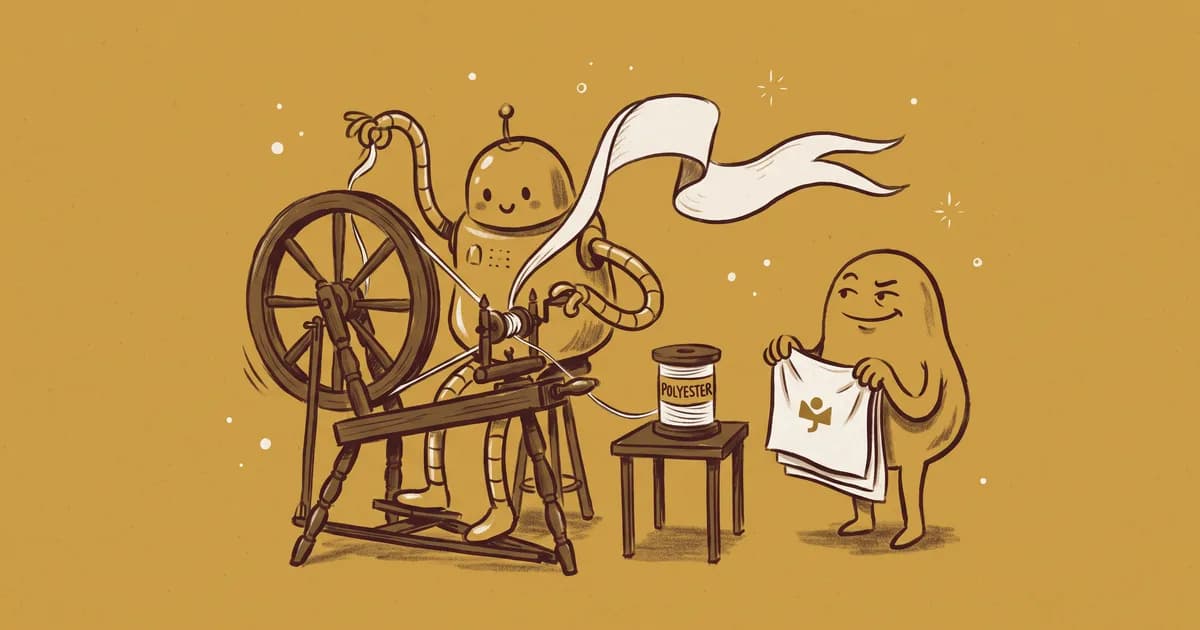
Most countries regulate what goes on their flag. India also regulated what the flag was made of. Until the last days of 2021, a tricolour run up a flagpole under the Flag Code of India had to be hand-spun and hand-woven khadi. A polyester flag was outside the rules.
That sounds like bureaucratic fussiness. It isn't. The cloth rule was the last physical trace of the flag's original idea, which was a spinning wheel. To see why India held onto it for so long, and why it let go, you have to start in 1921.
A flag drawn in three hours
At the end of March 1921 the All India Congress Committee met in Bezwada, now Vijayawada. Gandhi wanted a flag for the movement, and he wanted it to carry the charkha, the hand spinning wheel.
Gandhi told the story himself in Young India on 13 April 1921. He asked Pingali Venkayya, a man who had been lobbying him about a national flag for four years, for a design with a spinning wheel on a red and green background. Red stood for Hindus, green for Muslims. Venkayya delivered it in three hours. It arrived a little late for the committee. Gandhi took the design away, thought it over, and added a white strip for India's other faiths. Gandhi credited the spinning wheel idea to Lala Hansraj of Jullundur.
So the flag began as an argument about cloth. ThePrint's profile of Venkayya describes the charkha as the flag's sign of self-reliance. The tool for making thread at home went in the middle of the national banner.
The design kept shifting. A Congress committee in 1931 swapped red for saffron, set saffron on top, white in the middle and green at the bottom, and put the charkha in the white band. That version, the Swaraj flag, became the banner of the independence movement.
The wheel that lost its spindle
Independence forced a decision. The Swaraj flag belonged to a party. A country needed something else.
On 22 July 1947, Jawaharlal Nehru rose in the Constituent Assembly and moved the resolution on the national flag. It described a horizontal tricolour of deep saffron, white and dark green in equal bands, with a navy blue wheel in the centre "to represent the Charkha." The wheel was to follow the one on the Sarnath Lion Capital of Asoka. The ratio was set at 2:3.
Read that phrase again. The resolution did not drop the spinning wheel. It kept the wheel and called it the Charkha.
Nehru's reason was practical. A flag has two sides, and a symbol should look the same from both. The old charkha had the wheel on one side and the spindle on the other, and the wheel had to sit towards the pole. Flip the flag and the drawing broke. In Nehru's words, "the wheel should be there, not the rest of the Charkha." Borrowing the wheel from Asoka's pillar solved the symmetry problem. Nehru added that it stood for India's ancient culture.
Gandhi was not thrilled. He was initially displeased to lose the charkha and came round to the change later. Venkayya fared worse. He died on 4 July 1963 in poverty, and India only issued a postage stamp in his honour in 2009.
One small detail from that day in the Assembly says a lot. Nehru presented two flags to the House. One was silk. The other was cotton khadi.
Written into the thread count
With the spinning wheel shrunk to a wheel, the cloth carried the khadi idea forward instead.
The Bureau of Indian Standards wrote it down in IS 1:1968, the specification for the national flag. Its number is 1, and it reads like a weaving manual. The yarn "shall be hand-spun from clean-carded cotton." The bunting "shall be woven on handlooms in plain weave." The flag is rectangular at 3:2, and the Asoka Chakra has to be fully visible on both sides. The standard sets out sizes from 6,300 by 4,200 millimetres down to a car flag, and a 1979 amendment added a 450 by 300 millimetre flag for VVIP aircraft and a 150 by 100 millimetre table flag.
The Flag Code of India, 2002, which took effect on 26 January 2002, carried the same rule into the code ordinary citizens were expected to follow. Khadi, hand-spun cloth, was the only permitted material.
Think about what that means in practice. A rule written for the national flag pointed every compliant flag towards spinners and handloom weavers.
The man who wanted a flag on his office
The material rule was strict. The right of ordinary citizens to fly the flag at all was murkier. The 2002 code was the version that let private citizens fly it on any day of the year, as long as they kept its dignity. A court case later put that right on firmer ground.
Naveen Jindal, joint managing director of a factory, flew the tricolour over his company's office and officials stopped him, citing the Flag Code. He went to court. The High Court sided with him, the government appealed, and on 23 January 2004 the Supreme Court dismissed the appeal.
The judges held that flying the flag with respect is part of free expression under Article 19(1)(a) of the Constitution. They also found that the Flag Code was not "law" under Article 13 at all. It was a set of executive instructions.
That finding matters for the khadi story. The hand-spun rule lived in that code and in a standards document, so a government order was enough to change it.
Polyester arrives
The change arrived alongside a campaign. For the 75th year of independence, the government launched Har Ghar Tiranga, a flag on every home, with hoisting planned for 13 to 15 August 2022. A flag on every home is a lot of flags. It's hard to see hand-spun looms keeping up.
So the Ministry of Home Affairs amended the code. An order dated 30 December 2021 allowed machine-made and polyester flags. The new wording permits hand-spun and hand-woven or machine-made flags in cotton, polyester, wool, silk or khadi bunting.
A second order followed on 20 July 2022. Flags displayed in the open or on a private house were now allowed to fly day and night. Before, the rule was sunrise to sunset.
Bengeri, the case study
The people who felt the first order most were in Bengeri, on the edge of Hubballi in Karnataka.
The Karnataka Khadi Gramodyoga Samyukta Sangha runs a flag unit there. It was recognised by the Bureau of Indian Standards in 2004 and is often described as the only BIS-recognised flag maker in the country. Its khadi is spun and woven by hand in Bagalkot district, then dyed, printed and stitched at Bengeri.
According to The News Minute, the Sangha only learned of the December amendment in March 2022. By July, orders had dropped sharply. The unit expected 8 to 10 crore rupees in flag orders for the anniversary year and had received about 1.2 crore. In earlier years it had taken at least 2.5 crore. About 600 people worked at Bengeri, and roughly 1,300 across Bengeri and Bagalkot. Weavers, spinners and tailors earned around 4,000 rupees a month.
On 27 July 2022, the workers began an indefinite protest in Hubballi, demanding the amendment be revoked. A manager at the unit, Annapurna Doddamani, put the economics plainly: "Since polyester is cheaper, no one will buy our flags and we will all lose our livelihoods."
The irony is hard to miss. The flag began as a call to buy hand-spun cloth instead of factory cloth. A century later, the push to put a flag on every home sent buyers towards factory cloth.
Two flag codes, two ideas of respect
It helps to compare India with another country that writes rules for its flag. The United States Flag Code tells Americans that the flag "should never be used as wearing apparel, bedding, or drapery." Its concern is how you treat the flag once it exists.
India's code, for two decades, went one step earlier. It cared about who made the flag and how. A correctly proportioned tricolour in the right saffron and green still fell outside the code if a machine had woven it. The American code treats the flag as something to handle with care. India's treated it as an object with a supply chain.
What the 2021 change left behind
The polyester amendment did not change the design. The 3:2 ratio, the three equal bands and the 24-spoke Asoka Chakra are all where they were. The Ministry's own summary still specifies them.
What changed is the last physical link to 1921. Gandhi asked for a spinning wheel, Nehru kept the wheel and dropped the spindle, and the standards body kept the hand-spun thread. In December 2021 the thread went too.
Next time you see a tricolour, check the cloth. If it's hand-spun khadi, you're looking at the flag as the independence movement meant it. If it's polyester, you're looking at a flag built for a country trying to put one on every roof.
Julio Song
Writer
Julio is a staff writer at FlagDB. He studied Mathematics at the University of Madrid and has a passion for vexillology.
More from Julio Song →