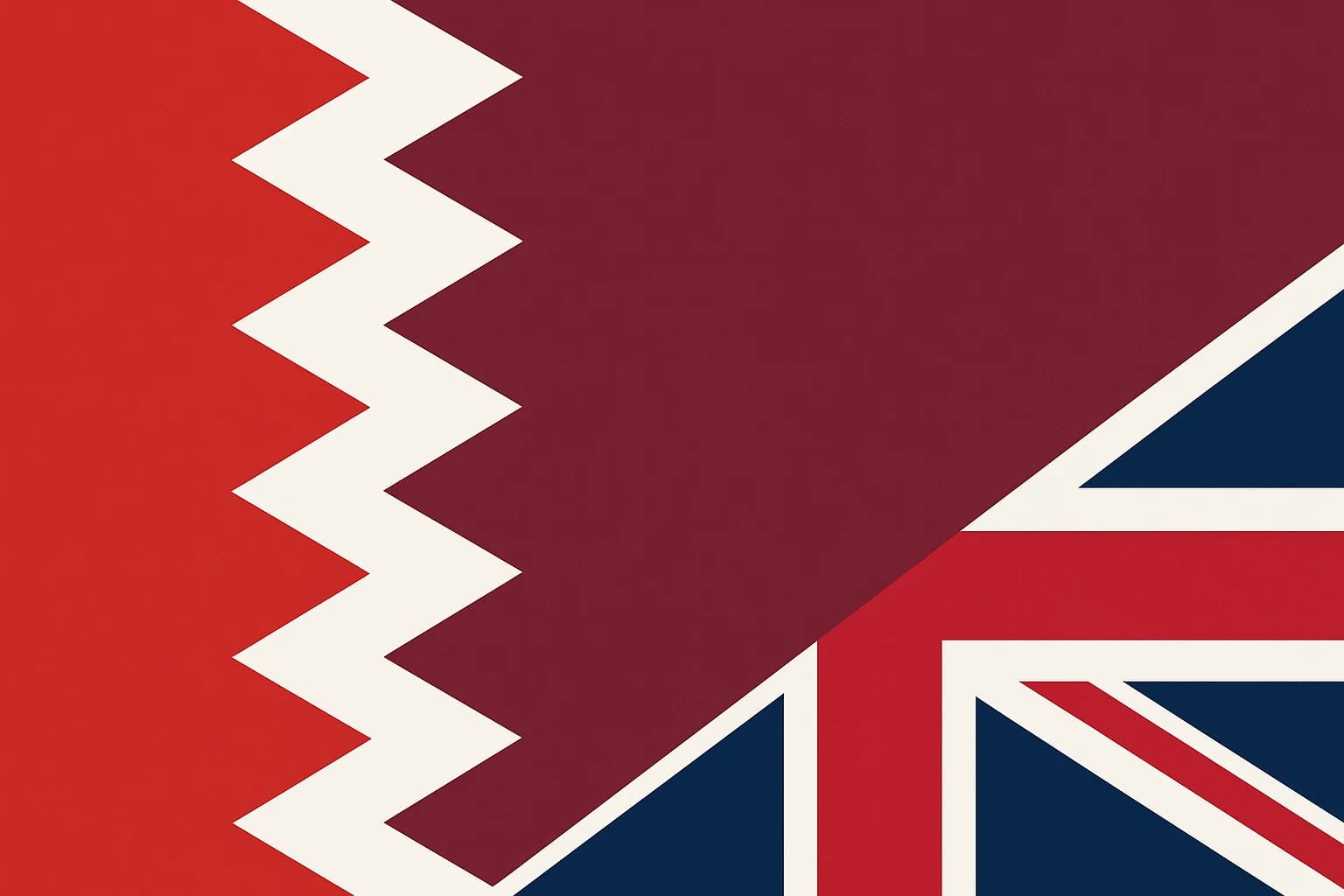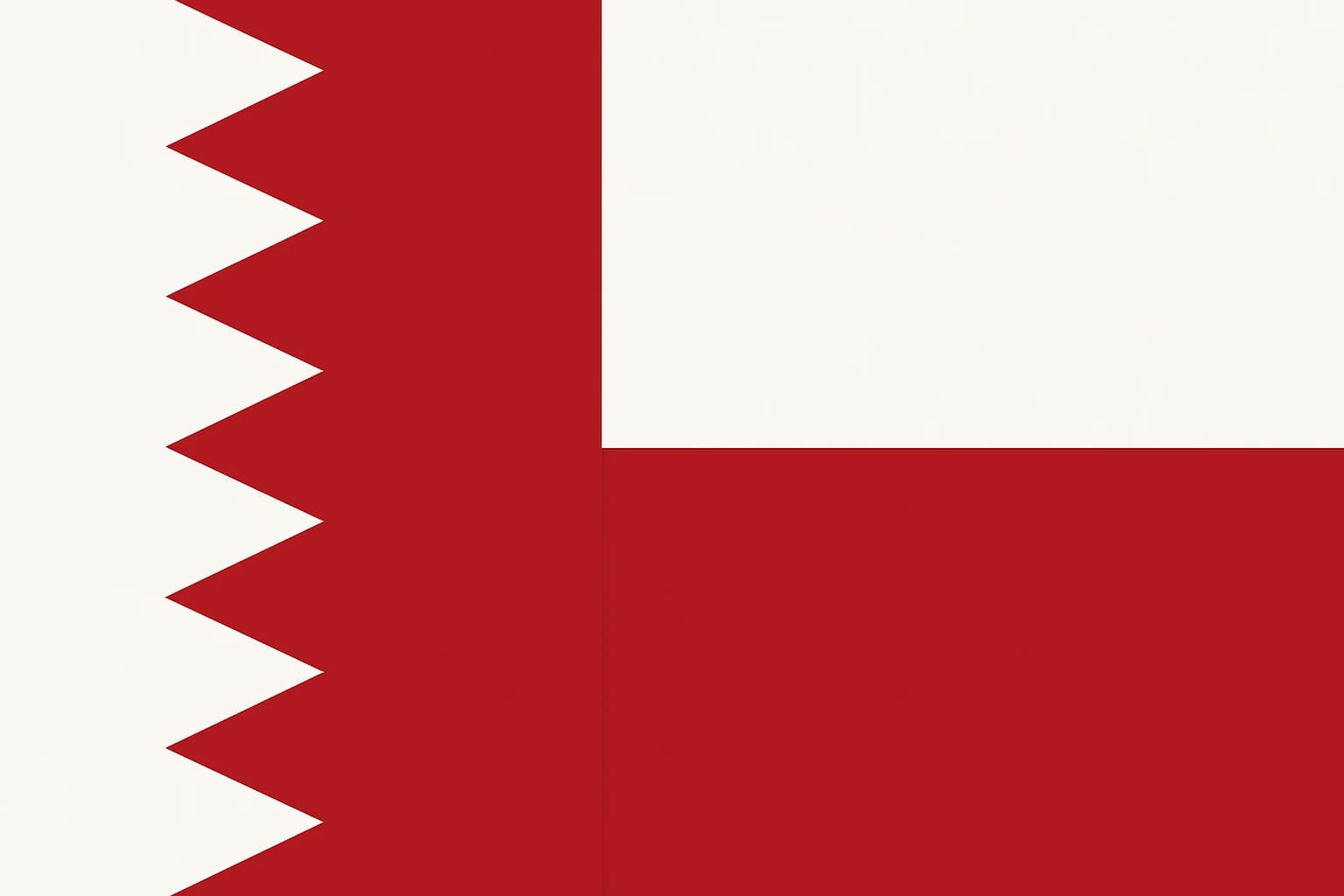
Of the 193 sovereign nations recognized by the United Nations in 2026, exactly two have a serrated zigzag border between their color fields: Bahrain and Qatar. Every other country that divides its flag into colored sections does it with straight lines, curves, or geometric shapes. These two small Gulf states chose jagged teeth.
The explanation most commonly offered sounds almost too charming to be true: that the zigzag disguised the bleeding of fabric dyes in the brutal Persian Gulf heat. Whether or not that origin story holds up, the serrated edge opens onto a stranger history of piracy, treaties, pillar counts, and two nations squeezed between British imperial ambition and deep Islamic tradition.
A sea of red: the shared maritime origin of Gulf flags
Before European intervention, virtually all Arab states along the Persian Gulf flew plain red banners. The color was associated with the Kharijite sect of Islam, historically prevalent in the region, and with Gulf seafaring and trade more broadly. Red meant "we belong here."
Red also created a problem. When every sheikhdom from Kuwait to Oman flew a variation of the same crimson banner, telling friend from foe was nearly impossible. Peaceful trader or pirate? From a ship's deck, squinting against the glare of the Gulf, you could not tell.
The Qawasim confederation, based in what is now Ras al-Khaimah and Sharjah, was among the most powerful naval forces in the Gulf by the late 18th century. The British East India Company branded them pirates. Whether the Qawasim were genuinely plundering trade routes or simply defending their waters against foreign encroachment depends on whose history you read, but the label stuck, and repeated naval confrontations followed between 1809 and 1819. The British needed a way to sort "good" Arabs from "bad" ones on the open sea.
The flags we know today were not born from peaceful self-expression. They came out of a colonial power's need for visual sorting at distance.
The 1820 treaty that made white the color of compliance
In January 1820 Britain imposed the General Treaty of Peace on the sheikhdoms of the so-called Pirate Coast. The core requirement was straightforward: add white to your red flag. Ships flying plain red could be treated as hostile. Ships showing white were under British protection.
The treaty was signed by the rulers of Sharjah, Ajman, Umm al-Quwain, Ras al-Khaimah, Dubai, Abu Dhabi, and Bahrain, though the exact terms and flag modifications varied. Qatar's relationship to the treaty framework developed over later decades, with formal British recognition of the Al Thani dynasty coming later in the 19th century.
The white addition took different forms across the Gulf. Some states adopted a white vertical stripe, others a white border. The Trucial States, now the UAE, adopted white-and-red patterns that evolved into their modern flags. Bahrain and Qatar both took a red-and-white bicolor divided vertically, with one difference from everyone else: the serrated edge.
Worth sitting with for a moment. The "peaceful" white stripe was not a voluntary expression of identity. It was an imposed marker of submission, arranged at the barrel of a cannon.
The dye-bleed theory might be too good
The most widely repeated explanation for the zigzag border is pragmatic. In Gulf summers, where temperatures routinely exceed 45°C (113°F), red and white dyes on flags would bleed into each other along a straight seam and leave a blurred line. A serrated edge, the theory goes, turned that flaw into a feature by making the boundary deliberately irregular.
It is a great story, and it has the hallmarks of a folk etymology: elegant, intuitive, and very hard to verify. No primary-source document from the early 19th century states the rationale. Textile historians point out that dye bleeding would affect all Gulf flags equally, yet only Bahrain and Qatar adopted the zigzag. Why not Abu Dhabi? Why not Sharjah?
Other explanations exist. Some scholars suggest the serration was an aesthetic choice drawn from Islamic geometric traditions. Others propose it made the flags easier to distinguish at sea, where a clean vertical line might blur against horizon glare. Whitney Smith, the American vexillologist who coined the word "vexillology" in 1957, documented the serrated-edge flags in his landmark works but noted that the dye-bleed explanation has uncertain provenance.
The truth is probably a mix of practical, aesthetic, and political factors that no single narrative covers. Either way the zigzag stuck, and its geometry later picked up meanings the original flagmakers almost certainly never intended.
Five points for five pillars
Bahrain's flag went through several modifications across the 19th and 20th centuries. Its modern form was officially standardized in 2002, when the country moved from emirate to kingdom under King Hamad bin Isa Al Khalifa. It has a white band on the hoist side and a red field on the fly side, separated by five white triangular points.
Those five points are universally understood to represent the Five Pillars of Islam: Shahada (faith), Salah (prayer), Zakat (charity), Sawm (fasting), and Hajj (pilgrimage). A colonial-era design compromise turned into a declaration of religious identity.
The easy thing to miss is that before the 2002 standardization Bahrain's flag had eight points, a number carrying no particular symbolic weight. The reduction to five was a deliberate act of meaning-making by the new kingdom, fitting religious significance onto a design that originally had none.
Symbols acquire meaning retroactively all the time in flag history. The zigzag was not designed to represent Islam, but once the five-point version existed it became impossible to see it as anything else.
Nine points for the ninth emirate
Qatar's flag tells a numerical story of a different kind. Its serrated border has nine points, representing Qatar's status as the ninth member of the "reconciled" or "pacified" emirates of the Gulf following the Qatari-British treaty of 1916, though some trace the designation to an earlier agreement in 1868.
The count is occasionally disputed, and some historical specimens show varying numbers of serrations, but nine was formally codified in Qatar's modern flag law. The maroon color, rather than Bahrain's brighter red, is said to reflect the natural darkening of red dyes under the Gulf sun, though that too is debated and may be another retrofitted explanation.
A detail flag enthusiasts enjoy: Qatar's flag is the only national flag whose width-to-length ratio exceeds 1:2, officially 11:28, making it the widest-proportioned flag of any sovereign state. Between that, the serrated edge, and the deep maroon, it is arguably the most visually distinctive flag on Earth, and it still gets surprisingly little attention in vexillology discussions.
The nine-point symbolism anchors Qatar's identity in Gulf regional politics rather than in religion. One flag looks inward to faith, the other outward to diplomacy, using the same zigzag.
Colonial ghosts in modern cloth
Both Bahrain and Qatar kept flags whose fundamental design was dictated by a colonial treaty, and neither treats its flag as a symbol of subjugation. Through the zigzag, the point count, and the color choices, both countries did what postcolonial scholars call appropriation: taking an imposed symbol and filling it with indigenous meaning.
Many formerly colonized nations went the other way and redesigned their flags outright at independence. India replaced the British Raj's Star of India with the Ashoka Chakra. Dozens of African nations adopted pan-African colors in the 1960s.
Bahrain and Qatar chose evolution over revolution, layering new meaning onto old cloth.
Their position in postcolonial history is unusual too. Unlike South Asian or African colonies, the Gulf sheikhdoms kept their ruling dynasties throughout the British protectorate period. The flags represent continuity of local power inside a framework of imperial control, a subtlety you miss entirely if you read them as simply British-imposed.
In 2026 both nations are pushing their global profile, Qatar through its post-2022 World Cup legacy projects and Bahrain through its financial sector and Formula 1 hosting. The serrated flags are a reminder that national identity is negotiated and improvised rather than designed in a vacuum.
Why vexillology needs to look beyond Europe
Mainstream vexillology has historically centered European and American flag traditions: the crosses of Scandinavia, the tricolors of revolutionary France, the stars and stripes. Gulf flags get dismissed as simple or derivative, lacking the heraldic complexity of European standards.
The bias hides good material. The Bahrain-Qatar serrated edge sits at the intersection of materials science, climate, colonial politics, and religious symbolism, and it challenges the assumption that flag design is always a deliberate, top-down act of statecraft. Sometimes it starts as a practical workaround.
The International Federation of Vexillological Associations (FIAV) has worked in recent years to broaden the field's geographic focus, though popular flag content online still skews heavily toward Western examples.
Bahrain and Qatar fly the only national flags on Earth with serrated borders, a quirk born from a collision of Gulf heat, maritime conflict, British imperialism, and Islamic faith. Five points for five pillars, nine points for a ninth emirate. On both flags the edge between the colors is the part carrying the history.