If you laid every national flag in the world side by side, green would appear on more than half of them. But in a specific band of countries stretching from West Africa through the Arabian Peninsula to South and Southeast Asia, green is doing something other than decorating.
For roughly a quarter of the world's nations, the green on their flag carries an Islamic resonance that most casual observers flatten into a single sentence: "Green is the color of Islam." That sentence isn't wrong, but it is badly incomplete. The green on Saudi Arabia's flag is not the same green on Bangladesh's flag, which is not the same green Mauritania chose in 1959, or the green it kept when it redesigned its flag in 2017. This article traces green's journey from the reported wardrobe of the Prophet Muhammad and the gardens of Quranic paradise to the conference rooms where modern nation-states chose their colors. Islam's most famous hue is devotional, nationalist, agricultural, and political at once, and the tension between those meanings is what gives it force.
From paradise to palette: the Quranic and prophetic roots of green
The Quran references green explicitly in descriptions of paradise. Surah Al-Rahman (55:76) describes inhabitants reclining on "green cushions" (rafraf). Surah Al-Insan (76:21) clothes the blessed in "garments of fine green silk." Green is woven into the sensory promise of the afterlife itself, a color you earn by living well.
Hadith traditions report that the Prophet Muhammad favored green garments and a green turban. The authenticity of specific hadiths varies across scholarly traditions, but the cultural consensus that green was "the Prophet's color" solidified early in Islamic history, well before the Umayyad and Abbasid periods had run their course.
The political use came soon after. The Fatimid Caliphate (909 to 1171 CE) was among the first political entities to adopt green as an official dynastic color, flying green banners across North Africa and the Levant. This was partly a claim of descent from the Prophet's family (Ahl al-Bayt) and partly a deliberate contrast with the Abbasids' black and the Umayyads' white. Green was not a neutral choice. It was a challenge.
The Pan-Arab color scheme of green, white, black, and red emerged from the 1916 Arab Revolt and codified green's political role for the modern era. Even here, green's meaning was debated. Was it representing Islam? The Fatimid legacy? Fertile land? All three? Nobody fully agreed, and nobody needed to.
Saudi Arabia's flag: when green becomes a declaration of faith
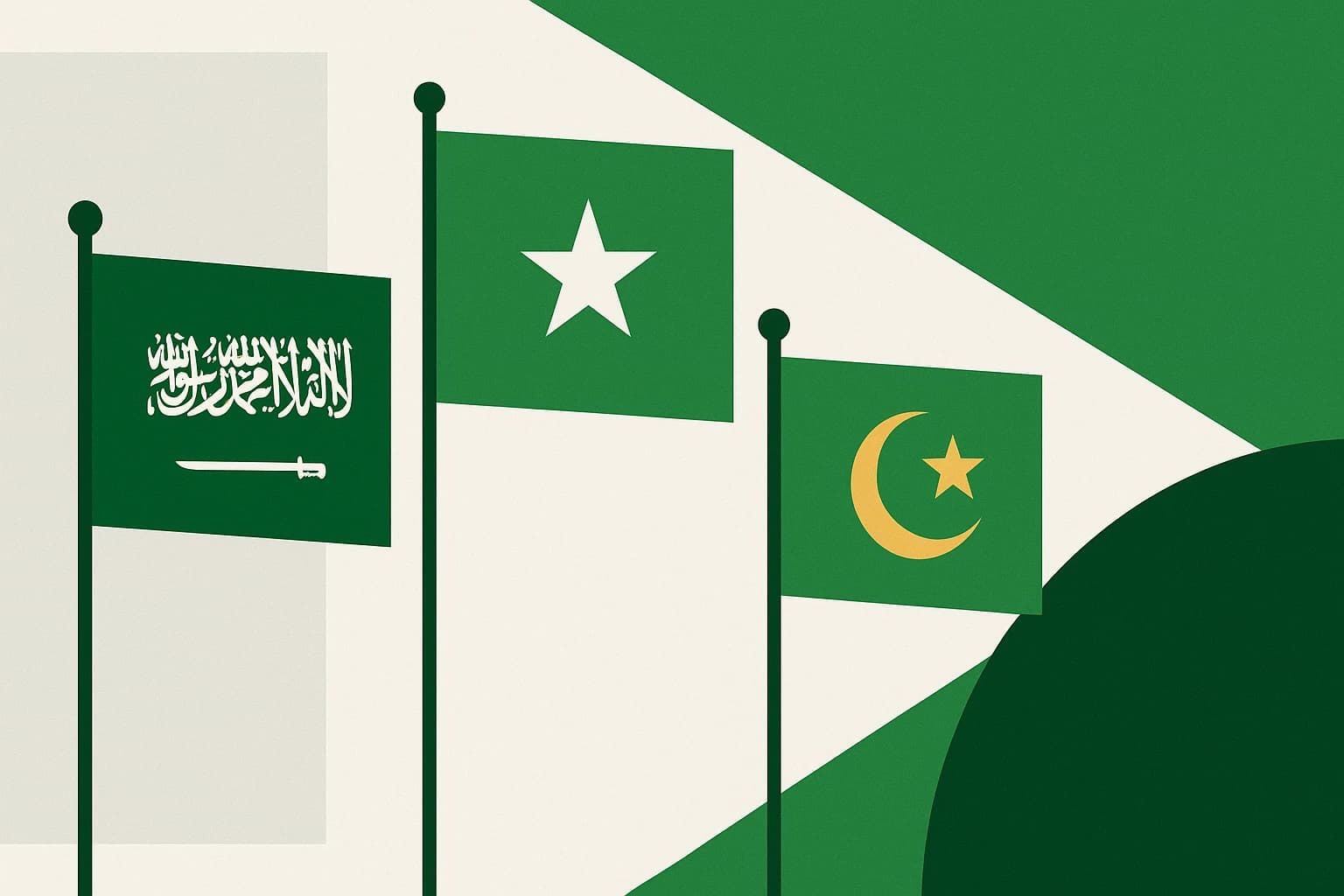
Saudi Arabia's flag is unique among world flags. An entirely green field bears the shahada, the Islamic declaration of faith, in white Thuluth calligraphy above a white sword. It is the only national flag that cannot, by law, be flown at half-mast, because lowering the shahada is considered disrespectful to the divine.
The flag's origins trace to the banners of the First Saudi State (1744 to 1818), founded through an alliance between Muhammad ibn Saud and the religious reformer Muhammad ibn Abd al-Wahhab. Green here was explicitly devotional, a declaration that the state's legitimacy derived from Islamic authority rather than tribal tradition or colonial borders.
The modern design was formalized in 1973 under King Faisal, but its visual DNA is much older. The sword was added in 1902 to represent the House of Saud's military conquest under Abdulaziz ibn Abdul Rahman. The flag layers religious identity, the shahada and the green field, with dynastic power, the sword. It reads as both prayer and claim.
Protocol around the Saudi flag reveals how seriously its religious dimension is taken. It is never printed on commercial merchandise the way other flags are. FIFA had to negotiate special accommodations for it during World Cup branding. And a controversy erupted in 2002 when the shahada appeared on a football the U.S. military distributed in Afghanistan. For many Muslims, the image of children kicking the name of God was viscerally offensive.
For Saudi Arabia, green is less a symbol of Islam than Islam made visible. The flag functions less as a national emblem and more as a portable proclamation of tawhid, divine oneness.
Mauritania's green and gold, and the red that changed everything in 2017
Mauritania adopted its original flag upon independence from France in 1959: a green field with a gold crescent and star. The green represented Islam, since Mauritania's constitution declares it an Islamic republic, while the gold stood for the Sahara Desert. It was one of the most explicitly religious flags in Africa.
Then came the 2017 constitutional referendum. Mauritanians voted to add red stripes to the top and bottom of the flag. President Mohamed Ould Abdel Aziz championed the change, saying the red honored "the blood shed by the defenders of the nation" during resistance to French colonialism. The referendum passed with approximately 85% approval, though opposition parties boycotted.
The redesign shifted the flag's symbolic balance in ways that are subtle but real. The 1959 flag told a story almost entirely about faith and geography. The 2017 flag layers in secular nationalism and anti-colonial memory. Green remains dominant, but it now shares narrative space with sacrifice and historical struggle.
The change was controversial, and not only for aesthetic reasons. Critics argued the redesign was a political vanity project by Abdel Aziz, who simultaneously used the referendum to abolish the Senate. Supporters countered that the original flag had erased the sacrifices of independence fighters. The debate showed something that applies to flags in general: they are never only about colors. They are about who gets to define the national story.
Mauritania also demonstrates that Islamic green on a flag is not static. The green itself didn't change in 2017. What it meant did.
Bangladesh's green field: Islam, agriculture, or independence?
Bangladesh's flag, a red disc on a dark green field, was designed by painter Quamrul Hassan and first raised on March 2, 1971, during the struggle for independence from Pakistan. The original version included a gold map of Bangladesh inside the red disc, which was removed in 1972 for simplicity.
The official symbolism is deliberately layered. The green represents the landscape of Bengal, one of the most fertile river deltas on earth. The red disc stands for the rising sun and the blood of those who died for independence. The government's own descriptions emphasize land and sacrifice, not religion.
Yet Bangladesh is a Muslim-majority nation, roughly 90% of its population, and many citizens and outside observers read Islamic meaning into the green anyway. That ambiguity is productive. The flag works as both secular-nationalist and religiously resonant depending on who is looking.
Compare Bangladesh's green to Saudi Arabia's. In Riyadh, green is theologically explicit, anchored by the shahada. In Dhaka, green is officially agrarian, anchored by geography. Both register as "Islamic green" in popular imagination, but the flags themselves make very different arguments about the relationship between faith and state.
Bangladesh's flag also echoes Japan's Hinomaru, a red disc on white, and Palau's gold disc on blue, which raises the question of whether its visual grammar is Islamic, pan-Asian, or something specific to Bengali nationalism. The answer is probably all three, and that's fine.
The broader green: Libya, Pakistan, and the OIC
Libya under Muammar Gaddafi (1977 to 2011) flew the most extreme version of Islamic green. The flag was a solid green rectangle, the only monochrome national flag in the world at the time. It was adopted after Gaddafi's "Green Book" ideology and was replaced after his overthrow with the pre-Gaddafi tricolor that flies today.
Pakistan's flag, adopted in 1947, uses a white vertical stripe alongside a dark green field with a white crescent and star. The green explicitly represents the Muslim majority and the white stripe represents religious minorities. It is one of the rare flags where green's Islamic meaning is officially paired with an acknowledgment of pluralism, a feature that often gets overlooked.
The Organisation of Islamic Cooperation, representing 57 member states, uses a green background on its emblem and flag. That institutional adoption reinforces green as a pan-Islamic signifier at the supranational level, functioning much like the blue of the United Nations or the gold of the African Union.
Not all Muslim-majority countries use green prominently, though. Turkey's flag is red and white. Indonesia's is red and white. Tunisia's is red and white with a crescent.
Green's Islamic association, powerful as it is, remains a choice rather than a requirement. The countries that choose differently have their own stories about identity, Ottoman heritage, revolutionary symbolism, and the desire to signal modernity over tradition.
Color theory meets theology: why green endures
Green occupies a distinctive position in human color perception. It is the color the human eye distinguishes the most shades of, which partly explains its range as a symbol. In arid landscapes like the Arabian Peninsula and the Sahel, green also represents water, life, and oasis. It carried a pre-Islamic resonance that Islam absorbed and amplified. The color was sacred before the theology made it official.
The association between green and Islam was reinforced during the Crusades, when European Christians began coding Muslims as green in heraldry and literature even as they associated themselves with red, the color of the cross. That external attribution fed back into Islamic self-identification. Sometimes your identity gets defined by the people watching you, and then you claim it for yourself.
In the modern era, green has become a kind of visual shorthand in international media. A green flag at a protest is immediately read as Islamist, sometimes accurately and sometimes reductively. The 2009 Green Movement in Iran complicated this further by reclaiming green for a reformist, democratic cause that was about freedom rather than theocracy.
Green endures in Islamic symbolism because of layering. Each generation adds new meaning without fully erasing the old. The green of the Fatimid banner, the green of the Saudi flag, the green of Mauritania's post-2017 redesign, and the green of a Bangladeshi rice paddy are all connected. None of them are the same.
Reading flags as arguments
Calling green "the color of Islam" is about as useful as calling red the color of revolution: true enough to get you started, too simple to be accurate. Saudi Arabia's green is a confession of faith. Mauritania's green, since 2017, shares the stage with the red of anti-colonial sacrifice. Bangladesh's green is officially about monsoon-fed rice paddies even as it whispers something older. And in countries like Turkey and Indonesia, green's absence from the flag is its own theological and political statement.
Islam did not simply choose a color. A color became a long argument that every Muslim-majority nation enters on its own terms, about what it worships, what it remembers, and what it wants the world to see first.