Seven Flags With an Argument Hidden in the Middle
Julio Song · · 3 min read
Some flags hide their arguments in plain sight. The emblem in the middle turns out to be a labor manifesto, or a party-political scoreboard, or a foundation myth from before the country had a name. These seven are worth looking at closely.
Angola
Angola's flag has two horizontal bands, red over black, with a yellow emblem in the center made up of a half gear, a star, and a machete.
The star stands for international solidarity and progress. The gear stands for Angola's industrial workers, and the machete for agriculture, which has been central to the country's economy and history. Red is the bloodshed of the fight for independence and black is Africa. It is an unusually explicit statement of political program for a national flag.
Aruba
Aruba's flag looks simple: a light blue field, two narrow horizontal yellow stripes, and a red four-pointed star edged in white.
The star represents Aruba's future, and its four points stand for the island's ethnic groups. Blue is the sea, yellow is abundance, and red is the love of the Aruban people. Aruba became a separate nation within the Kingdom of the Netherlands in 1986, and the flag is read as an expression of that freedom and unity.
New Zealand
New Zealand's flag carries the Southern Cross, marking the country's place in the Southern Hemisphere, alongside the Union Jack, which marks its British colonial ties. Blue does double duty for the sky and the sea, both inseparable from an island nation's sense of itself.
Bhutan
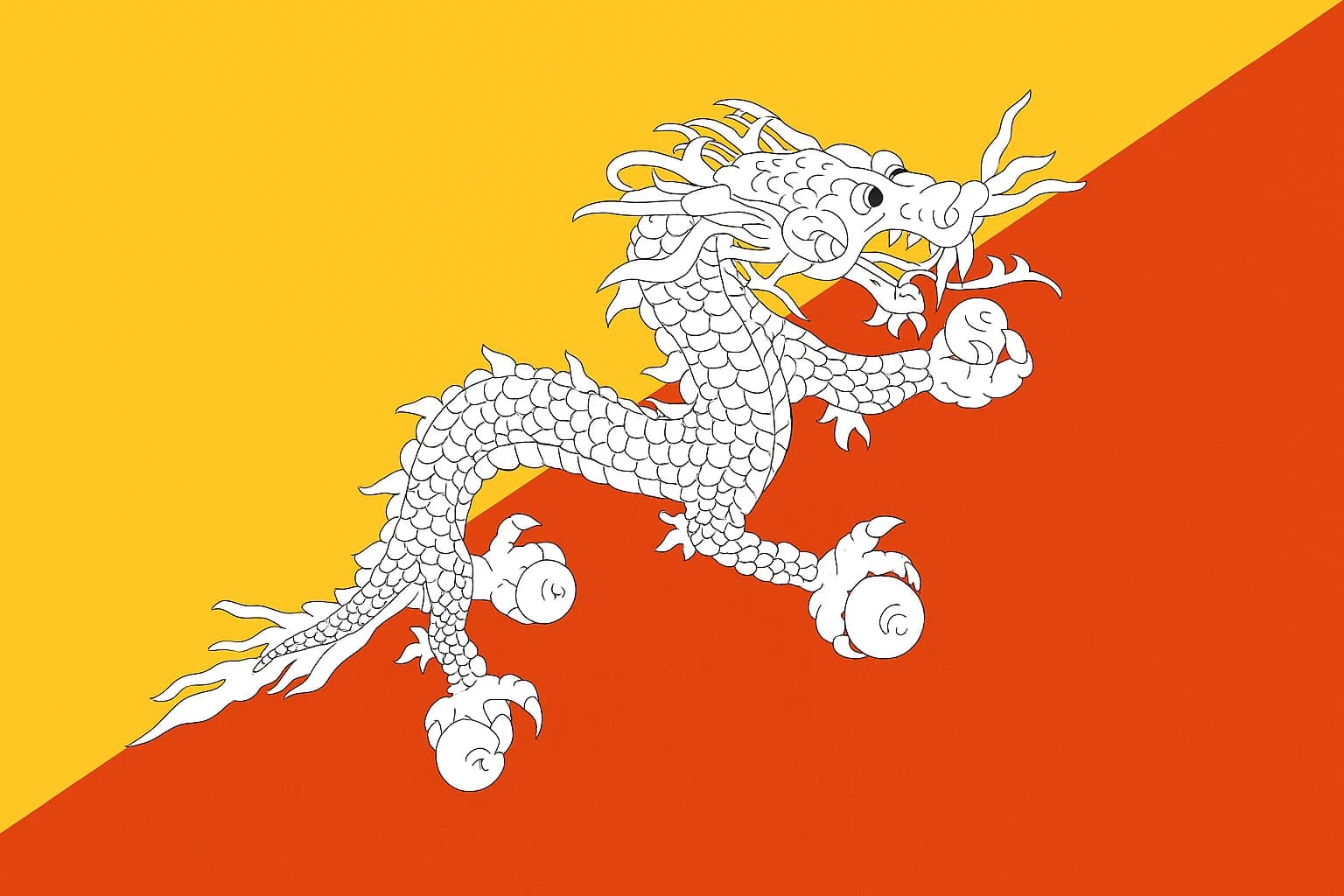
The dragon on Bhutan's flag, the Druk, is the country's own name made visible: Druk Yul, the Land of the Thunder Dragon. It holds gems in its claws, standing for the country's wealth.
The two colors split the state in half. Yellow is the secular authority of the king, orange the spiritual Buddhist tradition, and the dragon lies across the boundary between them.
Mexico
At the center of Mexico's flag an eagle perched on a cactus devours a serpent, a scene from Aztec mythology describing the founding of the capital, Tenochtitlán. The eagle and serpent were carried forward from pre-Columbian civilizations and read now as strength and resilience.
The colors are more recent: green for independence, white for Catholicism, red for unity.
Belize
Belize's coat of arms features tools and two men, a direct reference to the importance of the logging industry, along with a ship that most likely stands for trade.
The colors are more unusual, because they come from party politics rather than from nature or ideals: blue for the People's United Party and red for the United Democratic Party.
France
The French tricolor's simplicity hides its revolutionary origins. Blue, white, and red were chosen during the French Revolution for liberty, equality, and fraternity.
The combination also bridges two histories at once. White carries the royal past, while red and blue carry the struggle of the people, which makes the flag a record of the moment those two things collided.
Julio Song
Writer
Julio is a staff writer at FlagDB. He studied Mathematics at the University of Madrid and has a passion for vexillology.
More from Julio Song →