Hand someone a blank sheet of paper and ask them to draw the flag of Japan. They'll nail it in seconds: a red circle on white.
Now ask them to draw the flag of Belize.
Belize's flag contains two shirtless woodcutters, a mahogany tree, a sailing ship, a shield divided into nine sections, a wreath of leaves, a banner with a Latin motto, and roughly fifty distinct elements that would take a professional illustrator a careful afternoon. That is not a failure of memory. It's a design philosophy taken to its logical extreme.
In the online world of vexillology (the study of flags), these coat-of-arms flags are routinely mocked as the worst in the world. That verdict assumes flags exist only to be simple. Some of them were never meant to be drawn from memory at all. They were meant to be read.
The five rules you've heard a thousand times
The North American Vexillological Association codified five principles of good flag design in Ted Kaye's 2001 publication Good Flag, Bad Flag: keep it simple, use meaningful symbolism, limit your colors to two or three, avoid lettering and seals, and be distinctive. Clean rules, hard to argue with.
Roman Mars then brought them to a mass audience. His 2015 TED talk, "Why City Flags May Be the Worst-Designed Things You've Never Noticed," has racked up over 25 million views and turned "simple equals good" into flag gospel. Every Reddit thread roasting a city flag is downstream of it.
The simplicity crowd loves what they call the bedsheet test, sometimes the child test: if a kid can't draw it from memory, or you wouldn't want it on a bedsheet, the flag fails. By that standard, roughly 30-plus national flags, mostly former colonies, are automatic failures.
The rules do have genuine utility. They drove productive conversations during New Zealand's 2015 and 2016 flag referendum debate, and they inspired Pocatello, Idaho to replace what was widely considered the worst city flag in America in 2017.
But they were formalized in a North American, graphic-design-influenced context, and they assume a flag's job is to function like a logo. That assumption does not obviously transfer to flags created in the heat of nation-building rather than in a design studio.
Belize: a liberation story in fifty square inches
Belize adopted its flag on September 21, 1981, the day it gained independence from Britain.
Two woodcutters, one Mestizo and one Creole, flank a mahogany tree. A shield displays tools of the timber trade. A sailing ship appears in one quadrant. The national motto reads Sub Umbra Floreo, "Under the Shade I Flourish." A wreath of fifty olive leaves encircles the whole composition. Red stripes at the top and bottom were added to the original People's United Party design to represent bipartisan unity, and the blue field comes from the PUP's party color.
The reason for all of it is that Belize's economy was built on mahogany logging under British Honduras, and the coat of arms dates to 1819. The flag asserts that Belizean identity is multiethnic, rooted in labor, and earned through generations of forestry work. Every element is a sentence in an argument for sovereignty.
The practical consequences are real. Belize's flag is widely considered the most detailed national flag in the world and is nearly impossible to reproduce consistently. Different manufacturers produce noticeably different versions, with the woodcutters changing skin tone, posture, and tool placement depending on who's making it. At small scales, on lapel pins, app icons, and emoji, the detail collapses into an indistinct blob.
Even so, a 2019 informal poll by Belizean media showed overwhelming resistance to any simplification. The difficulty is part of the point.
Moldova and Paraguay chose story over symbol
Moldova's flag, adopted in 1990 and formalized with updated proportions on April 27, 2010, starts simple: a vertical tricolor of blue, yellow, and red, clearly influenced by Romania. Then the central coat of arms takes over. A golden eagle holds an Orthodox cross in its beak, a scepter in one talon, an olive branch in the other. On the eagle's chest sits a shield bearing the head of an aurochs, the extinct wild ox of Moldovan heraldic tradition dating back to the medieval Principality of Moldavia under Stephen the Great (r. 1457-1504).
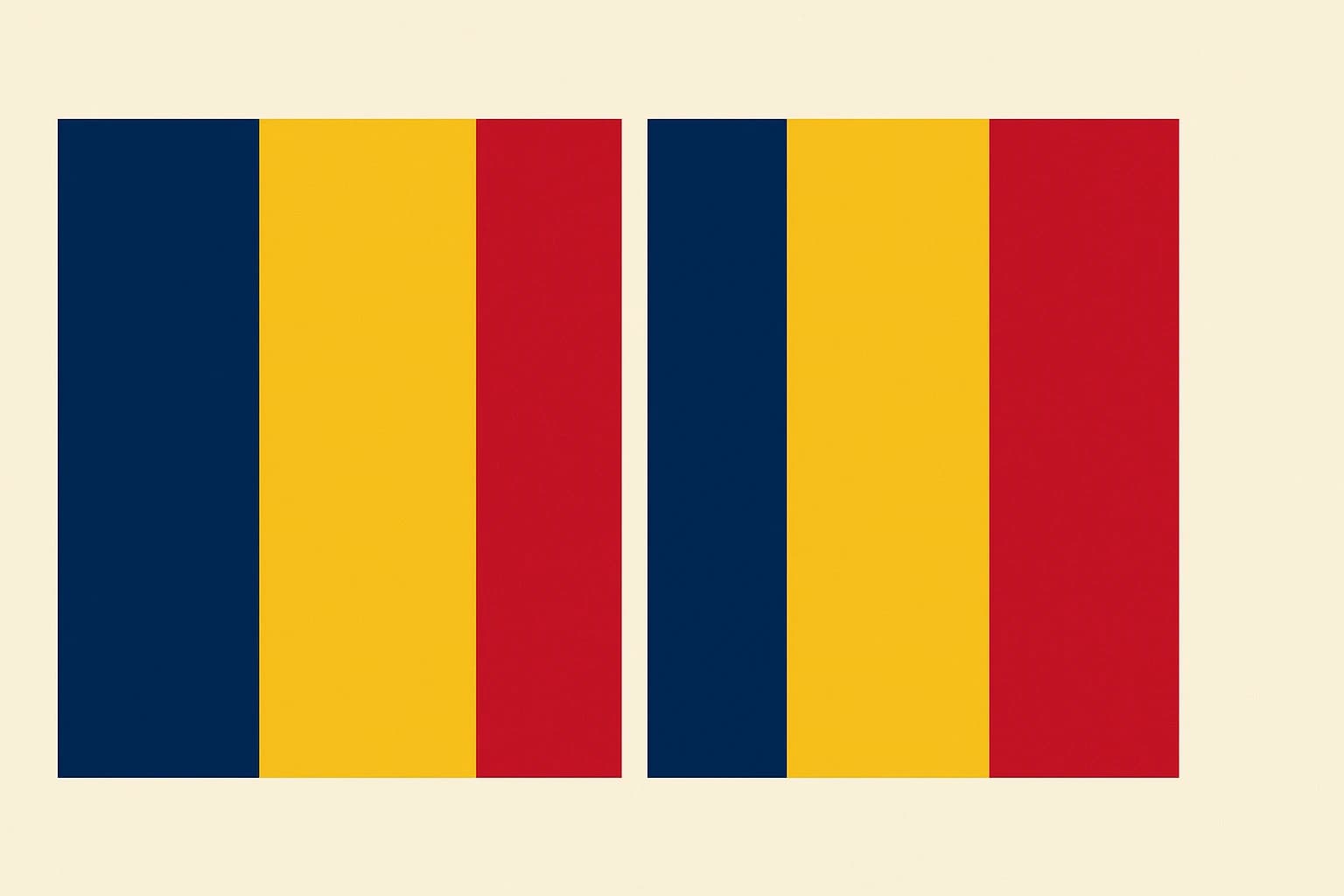
The political logic is airtight. The coat of arms asserts historical continuity with the medieval principality and rejects Soviet identity. It also does something more immediate: remove it and you are left with a flag identical to Romania's, and nearly identical to Chad's.
The coat of arms is the only element that makes Moldova visually sovereign. It stays because it has to.
Paraguay takes complexity in a different direction.
Paraguay holds a distinction no other sovereign nation shares: its flag has different emblems on each side. The obverse bears the national coat of arms, a Star of May surrounded by a palm and olive branch with the text República del Paraguay. Flip it over and you find the Treasury Seal, a lion guarding a Phrygian cap on a pole, with the motto Paz y Justicia. The design dates to November 25, 1842, under President Carlos Antonio López.
The manufacturing problem is obvious. Every Paraguayan flag has to be made as two separate printed faces sewn together, roughly doubling production cost. Paraguay has never seriously considered unifying the two sides, because the duality represents the balance of state power and liberty.
All three flags got their complexity at the same kind of moment: independence for Belize, post-Soviet transition for Moldova, the consolidation of sovereignty for Paraguay. The imperative was political completeness rather than graphic clarity. Say everything at once, because the moment might not come again.
What complexity costs
The trade-offs are significant and worth naming.
Reproduction is the first. The International Federation of Vexillological Associations and flag manufacturers have noted that coat-of-arms flags suffer chronic inconsistency. Belize's woodcutters shift between manufacturers. Moldova's eagle ranges from baroque to cartoonish depending on the source. There is no single correct version in practice.
The digital problem is worse. As of 2026, flag emoji on platforms like Apple, Google, and Samsung must render at sizes as small as 16×16 pixels. At that scale Belize's flag is a blue-and-red smear, where Japan or Ukraine remain perfectly legible.
Then recognition. NAVA's 2004 survey of U.S. and Canadian flags found that flags with seals and coats of arms consistently ranked lowest in public recognition and appeal. That survey covered subnational flags, but the principle scales: from a distance, Belize, Haiti, and El Salvador look nearly identical.
Cost adds up too. Nations with complex flags spend more on official reproductions, protocol items, and embassy displays. Paraguay's double-sided requirement is the extreme case, but even single-sided coat-of-arms flags need multi-color printing rather than simple dye-cut fabric.
On every measurable functional metric, reproducibility, scalability, recognizability, and cost, these flags underperform. The question is whether function is the only thing a flag should be measured by.
What simplicity cannot do
The simplicity gospel assumes a flag's primary job is identification, the way a corporate logo works: quick read, instant recognition, any scale.
Flags also work as narrative objects, though, especially for nations whose stories are contested, complex, or recently won.
Medieval heraldry is the precedent. Coats of arms were meant to be read, not glanced at. A knight's shield told you his lineage, alliances, victories, and claims. Belize's flag sits in that tradition: it's a coat of arms that happens to be on a flag rather than a flag that happens to have a coat of arms.
There's also a pattern in who gets to be simple. The simplest flags in the world belong to the most historically secure nations: Japan, France, the Netherlands, Poland.
Those countries don't need their flags to argue for their existence. Their sovereignty isn't questioned, their borders aren't contested, their identities aren't split between competing civilizational pulls.
Belize, Moldova, and Paraguay are in a different position: a tiny Caribbean nation, a contested post-Soviet state, a landlocked country overshadowed by its neighbors. Their flags say more because more is at stake.
Some contexts reward sparse communication, like road signs, logos, and app icons. Others reward dense communication, like murals and currency. Flags can fall into either camp depending on what they're for.
Complexity is also not inherently unloved. The British Royal Standard is wildly complex and deeply revered. The Great Seal of the United States, on the back of every dollar bill, features an unfinished pyramid, an all-seeing eye, a bald eagle clutching arrows and an olive branch, a constellation of stars, and two Latin mottoes. Americans don't mock it. They carry it in their wallets.
The banner of the Holy Roman Empire, with its double-headed eagle, is one of the most recognizable historical flags in existence.
Should these flags change?
Online redesign communities, r/vexillology and flag enthusiasts on social media, regularly propose simplified versions of coat-of-arms flags. The results are often striking: abstract geometric symbols inspired by the originals, stripped of lettering and fine detail, built to work at emoji scale.
They are also politically naive.
New Zealand's flag referendum is the cautionary tale. The government funded the process. Kyle Lockwood's silver fern design was genuinely beautiful. Voters chose to keep the existing flag, 56.6% to 43.3%, because familiarity and attachment outweighed design logic.
For these three flags the politics cut deeper. In Moldova, any change to the coat of arms would reignite the identity debate between pro-Romanian unionists and those asserting a distinct Moldovan identity. In Belize, simplifying the woodcutters could be read as erasing Afro-Belizean or Mestizo heritage.
There is an emerging middle path. Some designers propose keeping the coat of arms for ceremonial and government use while creating a simplified civil flag for everyday purposes. The dual-flag approach already exists: Austria has a state flag with an eagle and a civil flag without, and Saudi Arabia maintains different versions for different contexts.
That honors both the story and the function, which is probably the most useful answer available. Most people cannot draw the flag of Belize from memory, and the flag was never designed for that. Judging it as a logo measures it against a job it never applied for.