In 1985, Greenland's parliament faced a simple question with enormous political weight: what should the flag of the world's largest island look like? The answer most people expected, a Nordic Cross design in green and white echoing Denmark, Norway, Sweden, Finland, and Iceland, came within a handful of votes of winning. Instead, by a razor-thin margin, lawmakers chose a horizontal bicolor of white and red bisected by an off-center circle whose colors inverted against each field. No cross, no obvious Scandinavian lineage, nothing that would let a casual observer guess this flag belonged to a territory still governed, in part, from Copenhagen.
That narrow vote was not an accident. It was a deliberate act of visual rebellion by a people who had gained Home Rule only six years earlier and were still negotiating what it meant to be Greenlandic within a Danish framework. With Greenland's geopolitical significance now surging amid competition over Arctic resources and sovereignty, the story of Erfalasorput, "our flag," is a useful way to see how identity, autonomy, and design collide when a non-sovereign territory decides to speak for itself.
The Nordic Cross club Greenland refused to join
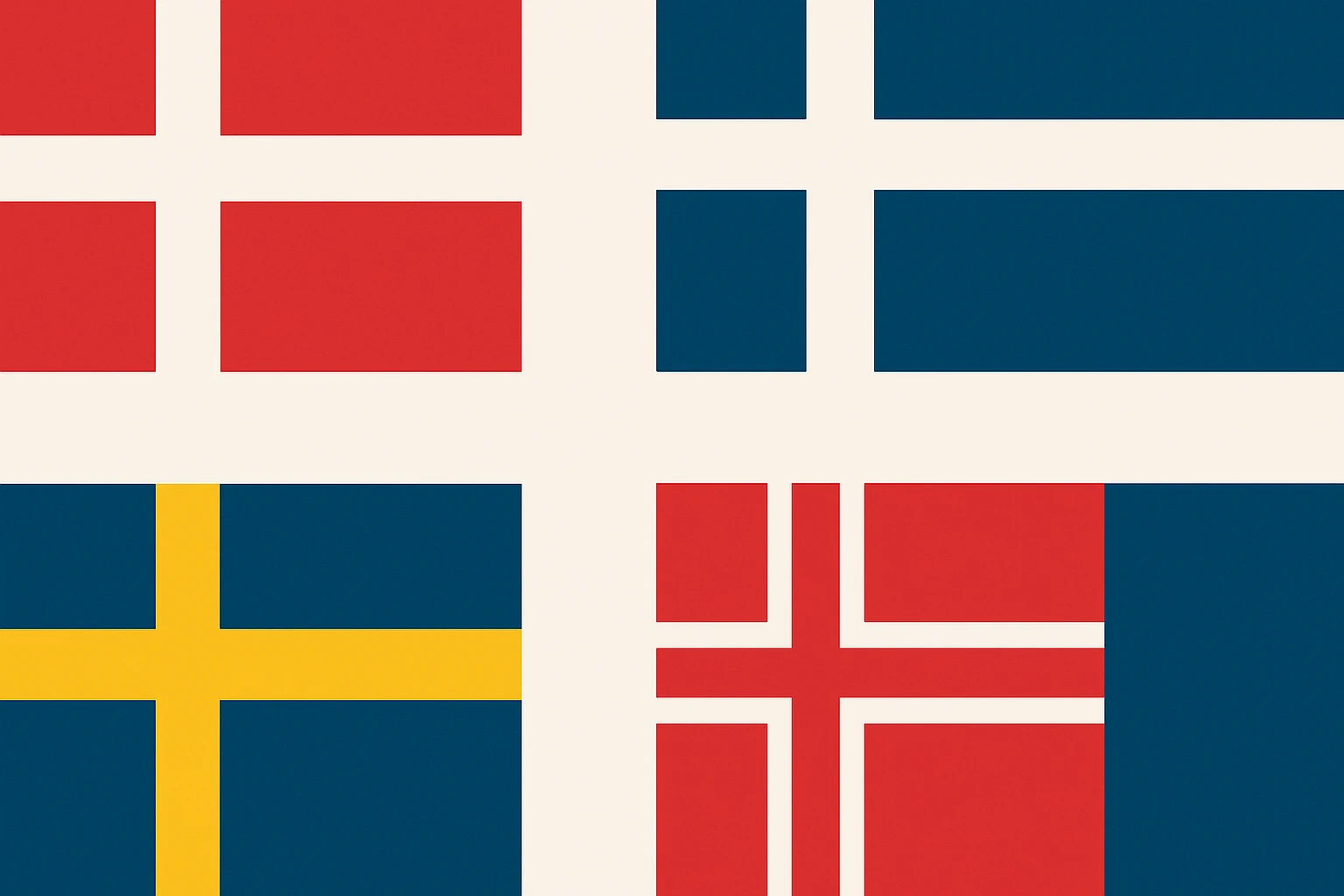
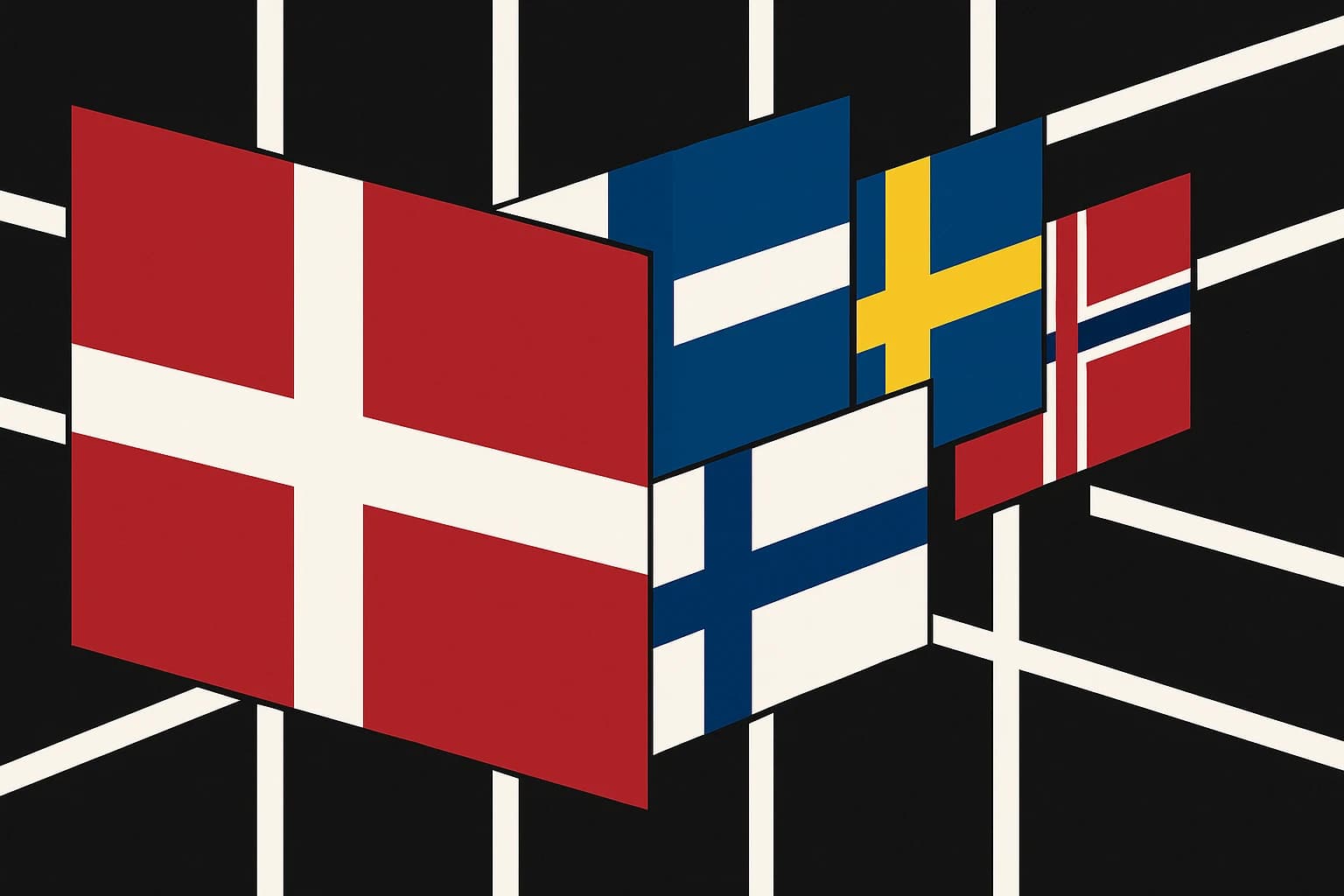
Denmark's Dannebrog, legendarily dating to 1219, established a pattern that became the visual signature of an entire region: an off-center cross on a colored field. Sweden adopted it officially in 1906. Norway designed its own version in 1821. Finland followed in 1918, Iceland in 1915 (with full sovereignty coming in 1944), and the Faroe Islands in 1948.
The Nordic Cross works like a family crest. When you see it, you know you are looking at a nation or territory with roots in Scandinavian Christianity, shared political heritage, and a certain brand of northern European identity. It is one of the most successful visual branding exercises in the history of nations, centuries before anyone used the word branding.
For dependent or autonomous territories like the Faroe Islands and the Åland Islands, adopting a Nordic Cross was a way to assert regional identity while affirming membership in the broader Nordic political family. It said: we are our own place, but we belong here.
Greenland's situation was different. The Inuit majority had no historical connection to Scandinavian Christianity or medieval Norse heraldry. The cross was an imported symbol, not an organic one. Asking Greenland to wear a Nordic Cross was closer to asking someone to display the crest of a family they were adopted into rather than born into. Some people would embrace that. Others would find it dishonest.
Home Rule and the hunger for symbols
Greenland gained Home Rule from Denmark on May 1, 1979, following a 1978 referendum. That created new institutions, the Inatsisartut parliament and the Naalakkersuisut government, and new institutions need new symbols. A flag was inevitable.
The political context mattered as much as the design question. In 1982, Greenland voted to leave the European Economic Community, effective 1985, becoming the first territory ever to withdraw from the EEC. It was a sign of how much appetite there was for defining Greenland separately from Denmark.
The flag question became a proxy for larger identity tensions. How Greenlandic is Greenland? How Danish? A flag commission was established, and a public design competition drew dozens of submissions. Two finalists emerged: a green-and-white Nordic Cross design, proposed by some accounts to honor the island's name, and Thue Christiansen's radically non-traditional bicolor-and-circle design. The choice between them was never about aesthetics alone.
Thue Christiansen's ice, sunsets, and deliberate break
Thue Christiansen (1940-2024) was an artist, politician, and cultural figure from Ilulissat who served in Greenland's parliament and lived deep inside the movement to articulate a distinctly Greenlandic cultural identity. He was not designing a logo. He was making an argument in cloth and color.
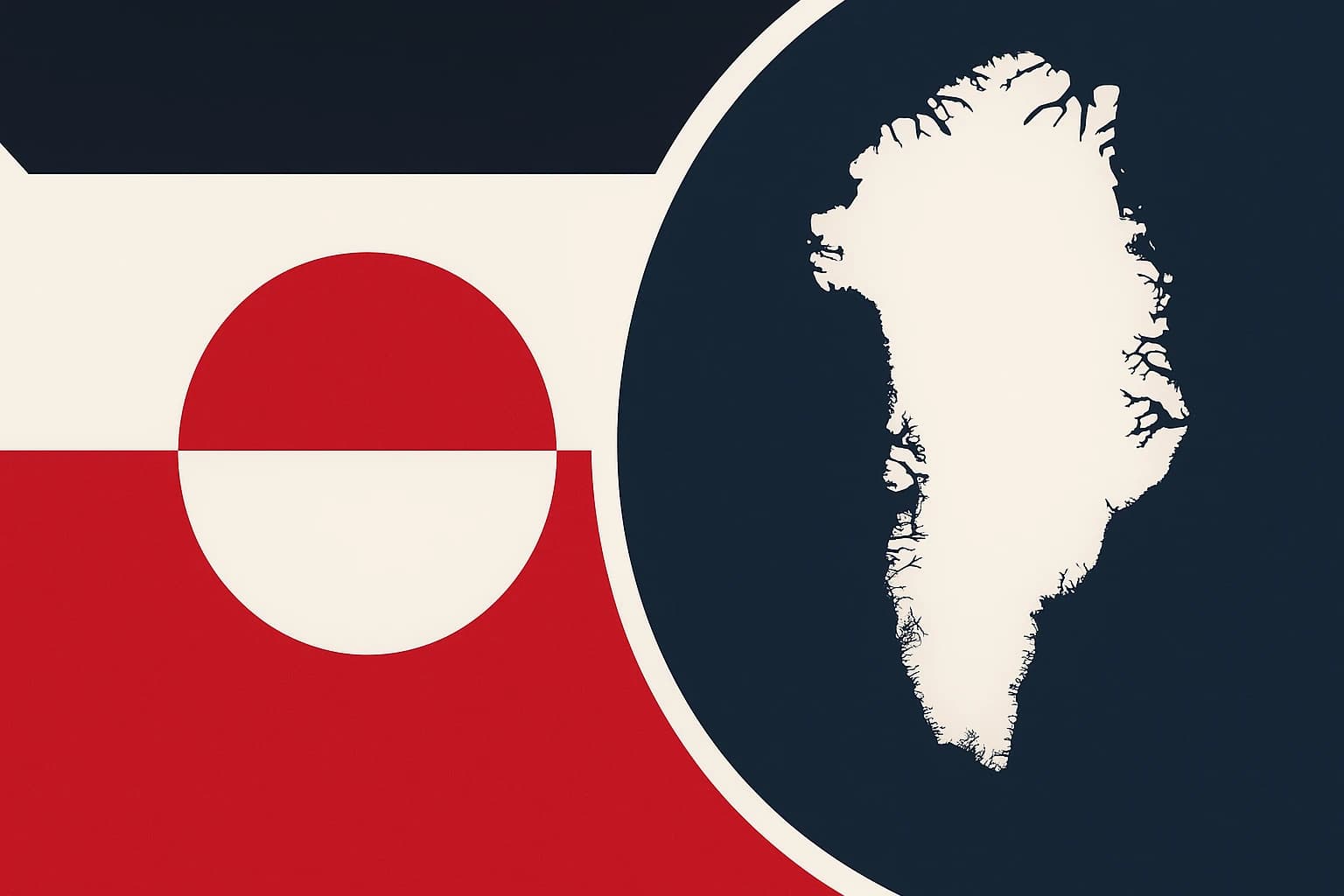
The design is deceptively simple. The white upper half represents the ice cap and icebergs that define Greenland's landscape. The red lower half represents the ocean and the Arctic sunsets. The counter-changed circle, white on red and red on white, evokes both the setting sun over the horizon and icebergs reflected in water.
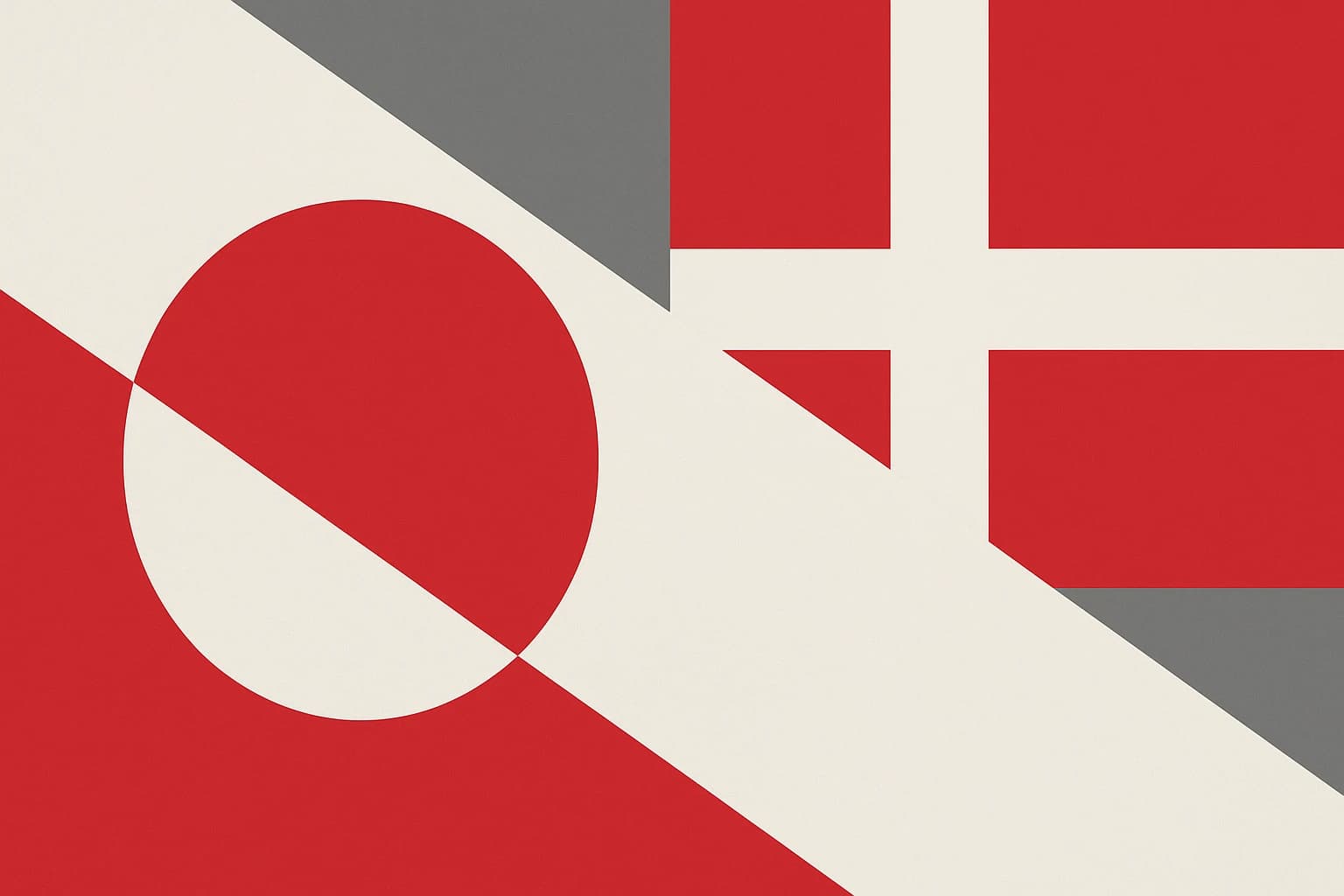
The part that reveals Christiansen's political intelligence is the palette. The red and white deliberately echo the Dannebrog, not as submission but as acknowledgment of a real historical relationship. The complete absence of the cross then asserts that Greenland's identity is Inuit, Arctic, and non-Scandinavian at its core. The colors say we have a relationship with Denmark. The form says we are not Denmark.
The design also borrows its visual logic, circular emblems on plain fields, from Japanese and Bangladeshi flag traditions rather than Nordic ones.
That was a cosmopolitan choice, signalling Greenland looking outward rather than only northward. The flag was adopted on June 21, 1985, the summer solstice, the most symbolically important day in the Arctic calendar.
The vote that almost went the other way
The parliamentary vote was extraordinarily close. Accounts describe a margin of roughly 14 to 11 between Christiansen's design and the green-and-white Nordic Cross alternative. A shift of two votes would have given Greenland a completely different visual identity.
Supporters of the Nordic Cross made a pragmatic case. It would signal international legitimacy, make Greenland visually legible as a Nordic territory, and honor the Green-land etymology through its color scheme. These were not trivial arguments. In international relations, being recognizable matters.
Opponents countered that a Nordic Cross would subordinate Greenlandic identity to a Scandinavian framework the Inuit population never chose, a form of visual colonialism dressed up as tradition. A cross on Greenland's flag would tell the world that Greenland was a branch office of Scandinavia, and the autonomists wanted something that said headquarters.
The debate mirrored a deeper political split between integrationists, who saw Greenland's future within a reformed Danish-Greenlandic partnership, and autonomists, who saw Home Rule as a first step toward eventual sovereignty.
The narrow victory for Christiansen's design gave the flag a productive ambiguity. It was different enough to assert independence of spirit, but its red-and-white palette was conciliatory enough not to provoke Copenhagen. That ambiguity turned out to be its greatest strength.
The Faroe Islands contrast
The Faroe Islands, Denmark's other major autonomous territory, adopted Merkið in 1948, a red-and-blue Nordic Cross on a white field. The flag was designed during the WWII British occupation, first flown in 1919, and recognized by Denmark in 1948.
Unlike Greenland, the Faroe Islands have a predominantly Scandinavian, Norse-descended population with deep historical ties to the Nordic Cross tradition. The cross was culturally organic there, not imposed.
Merkið was itself an act of identity assertion. Its designers, students in Copenhagen, deliberately chose colors distinct from Denmark's red-and-white and Norway's red-white-blue to carve out a specifically Faroese identity within the Nordic framework. They were saying: we are Nordic, but we are not Danish, and we are not Norwegian either.
Comparing the two flags reveals something worth holding onto. The Nordic Cross is not inherently colonial. It becomes colonial only when applied to a population for whom it has no organic cultural meaning. The Faroes claimed it, Greenland rejected it, and both acts were assertions of self-determination.
New Caledonia's dual-flag dilemma
Thousands of miles south, in the Pacific, a French special collectivity has grappled with a strikingly parallel tension. New Caledonia's indigenous Kanak independence movement adopted the flag of Kanaky, horizontal blue-red-green with a yellow flèche faîtière emblem, in 1984, one year before Greenland's flag vote.
Unlike Greenland, New Caledonia never resolved the question with a single flag. Since 2010, both the French Tricolore and the Kanak flag have flown side by side as co-official symbols: two flags for one territory because no single design could carry the weight of both communities' identities.
New Caledonia's three independence referendums, in 2018, 2020, and 2021, all returned no votes, but the dual-flag arrangement persists. Flag identity can run ahead of formal political status, or sit independent of it entirely. A people can fly their own banner long before they run their own country.
Greenland's single-flag solution was cleaner, but it required a design that could carry the weight of ambiguity. Christiansen's flag had to say we are not Denmark without saying we are leaving Denmark. New Caledonia's dual-flag approach admits that no single design can do both jobs at once.
Erfalasorput in 2026
Greenland's geopolitical profile has risen dramatically in 2025 and 2026. Renewed U.S. interest in Arctic strategy, melting ice opening new shipping routes and resource extraction possibilities, and intensifying great-power competition have pushed the world's largest island into headlines it never sought.
As Greenland moves toward a potential independence referendum, discussed but not yet scheduled as of May 2026, the flag has taken on renewed symbolic urgency. It is already the visual anchor of a national identity that may soon seek full sovereignty. The Self-Government Act of 2009 expanded Greenland's autonomy well beyond the 1979 Home Rule framework, and the flag has been a continuity symbol across those changes.
Christiansen's 1985 design has proved durable. Unlike many post-colonial flags that get redesigned as political contexts shift, Erfalasorput has needed no revision. Its ambiguity was a feature. It was built to accommodate a spectrum of political futures, from continued autonomy within Denmark to full independence, so it does not need to change.
The flag now appears with increasing frequency at Arctic Council meetings, in climate change journalism, and in diplomatic coverage. It functions as the de facto national symbol of a territory that is not yet a nation but increasingly acts like one. When that red-and-white circle turns up on a news broadcast, you know the story is about Greenland and not Denmark, which is exactly what Christiansen intended.
A circle on the horizon
When Greenland's parliament chose Thue Christiansen's design on that summer solstice in 1985, it bet that a flag could declare cultural independence without declaring political independence. Forty-one years later, the bet has paid off. Erfalasorput is one of the most recognizable non-sovereign flags in the world, and hard to mistake for any other nation's banner.
The lesson goes beyond vexillology. Sometimes the most powerful statement a people can make is choosing to look like themselves rather than like the power that governs them. As Arctic geopolitics intensifies and Greenland's future remains an open question, that red-and-white circle keeps marking the boundary between what Greenland is and what it has yet to become.