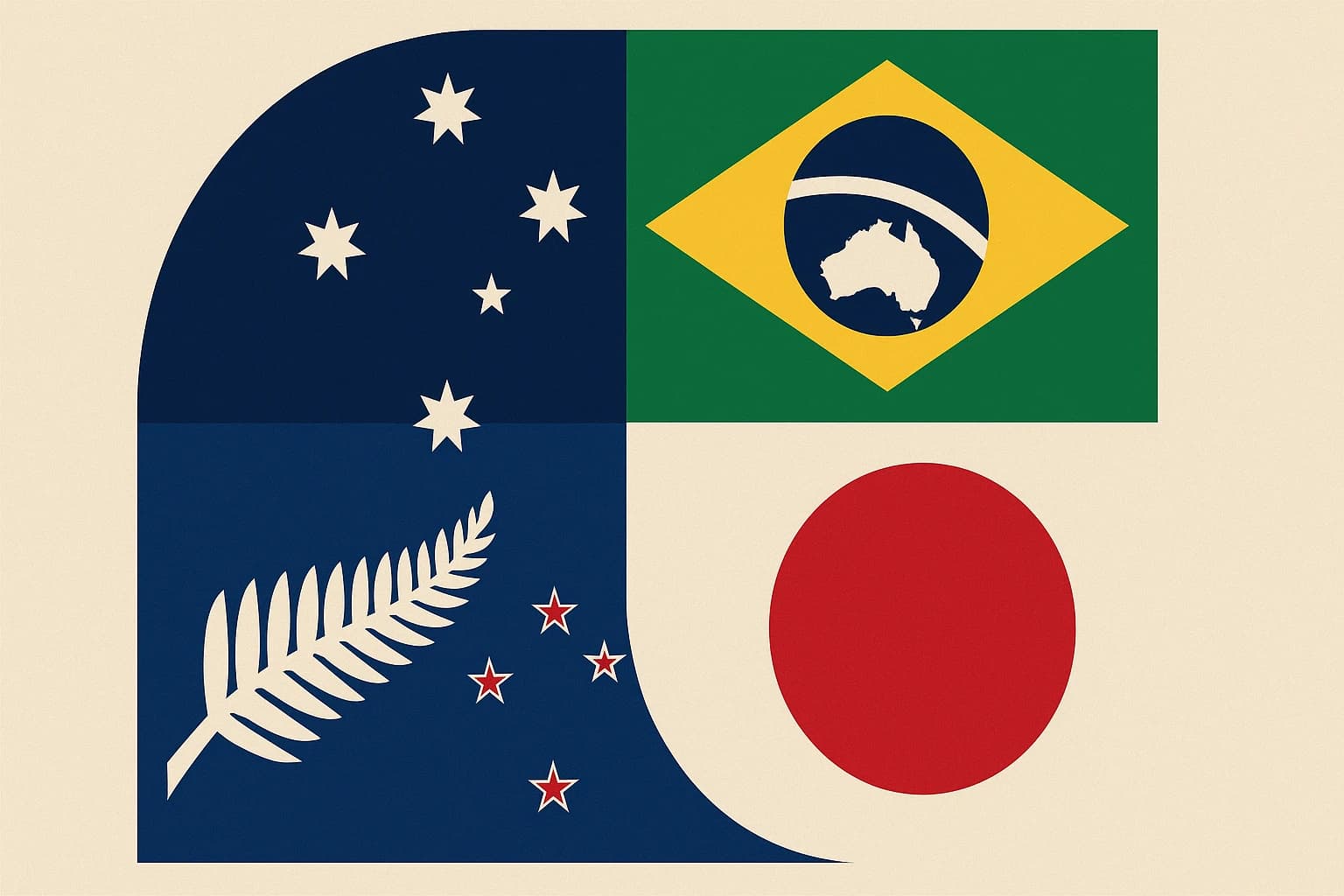
The Flags of the Southern Hemisphere: A Study of Distinct Designs and Symbolism
Julio Song · · 2 min read

No shared house style
Countries in the Southern Hemisphere share a sky and, in places, a coastline, but almost nothing in their flag designs. There is no regional template here, no shared layout that half a dozen neighbors adopted from each other. Each flag was worked out separately, which makes the group unusually varied and worth going through one at a time.
Argentina
Light blue and white bands with the Sun of May in the middle. Blue for the sky, white for the clouds, and the sun for the May Revolution of 1810. The colors describe the weather and the emblem dates the country, which is a lot of information for three elements.
Australia
The Union Jack in the canton and the Southern Cross on a blue field. The constellation ties the flag to the land the country occupies; the canton ties it to the empire that claimed the land. The absence of Indigenous representation keeps the debate over the design alive.
Angola
Red and black, with a yellow half gear, a machete and a star. Red for the struggle, black for Africa. The gear and machete stand for industrial workers and farmers together, and the star for progress and international solidarity. The design says openly what most flags only imply.
South Africa
The Y shape is unlike anything else in use. Black, green and yellow come from the African National Congress; red, white and blue from the colonial powers. After apartheid the country needed a flag that neither erased its history nor endorsed it, and putting both sets of colors into one design was the answer.
Fiji and Samoa
Pacific island flags lean on indigenous motifs and on geography: the sea, palm trees, native animals. The recurring theme is that the nation is part of a place rather than merely governing one.
What holds them together
None of these flags resembles any of the others, and that is the finding. Each was designed to say something a neighbor's flag could not, and taken together they cover independence, colonial inheritance, labor politics, reconciliation and landscape.
Julio Song
Writer
Julio is a staff writer at FlagDB. He studied Mathematics at the University of Madrid and has a passion for vexillology.
More from Julio Song →