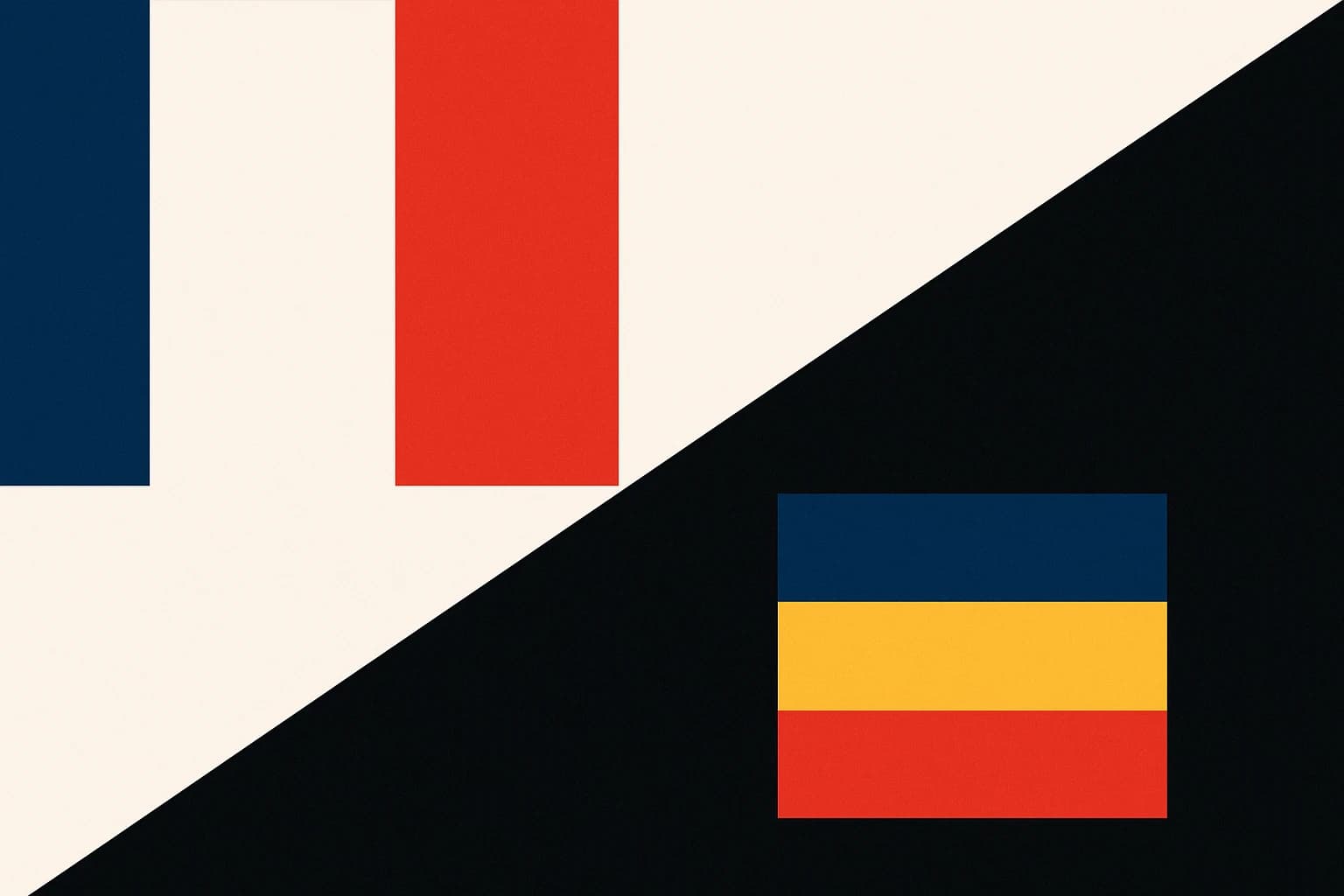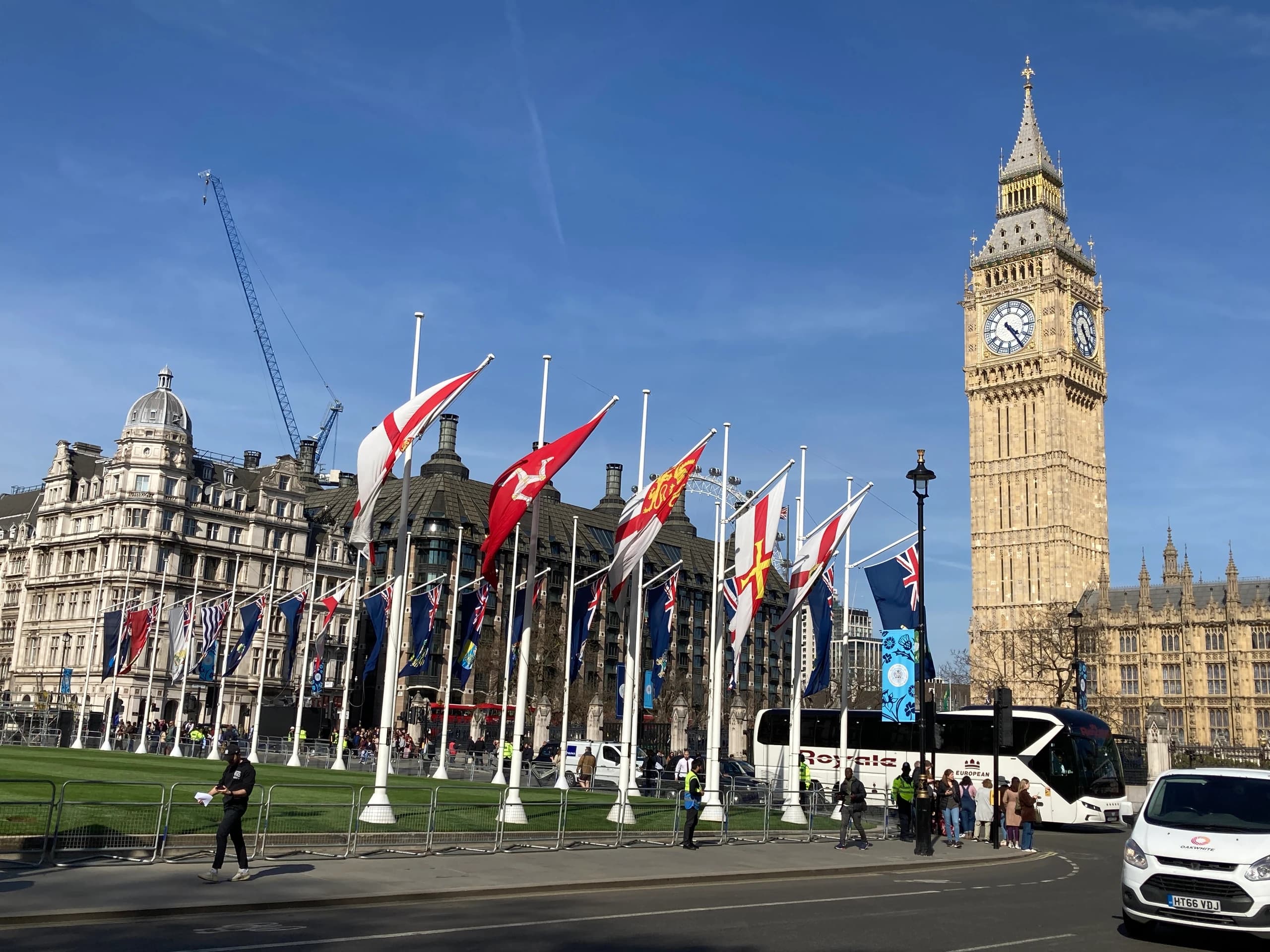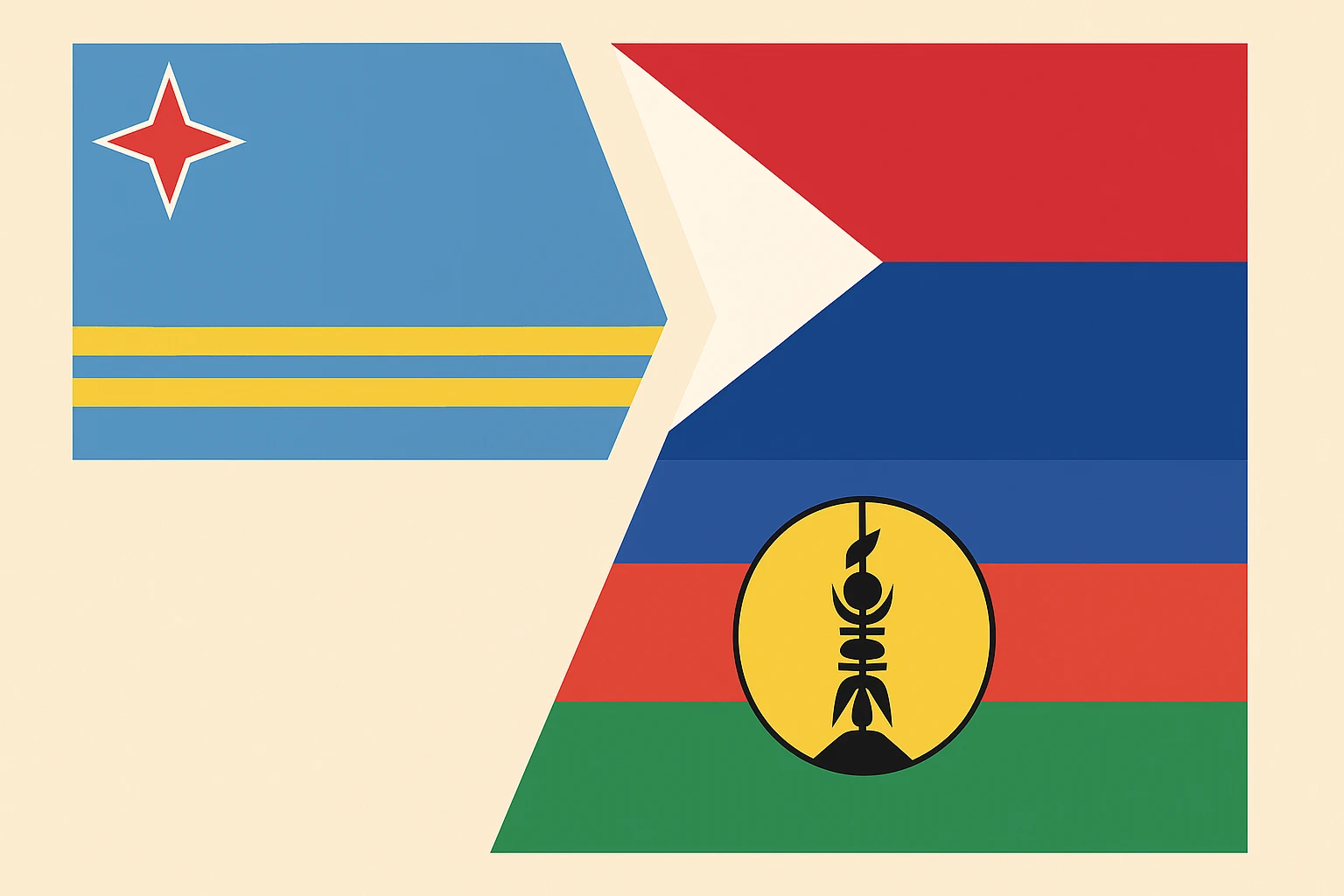
In 2018, voters in New Caledonia, a French-administered archipelago in the South Pacific, went to the polls to decide whether to become an independent nation. They voted no, and then voted no again in 2020 and again in 2021. Throughout all three referendums the Kanak independence flag already flew from government buildings alongside the French tricolor, officially co-equal since 2010. New Caledonia had a national flag before it had a nation.
That is not a one-off. A handful of territories around the world sit in a constitutional twilight zone: no longer classical colonies, not yet sovereign countries, governing themselves in almost every way except the final one. Almost all of them have designed flags that record that in-between status.
Aruba adopted its flag in 1976, a full decade before it formally separated from the Netherlands Antilles. Sint Maarten's flag predates the dissolution of the Antilles by decades. These are political arguments stitched into fabric rather than decorative afterthoughts. They assert distinctness, claim territory, and narrate identity, even when the sovereignty they imply remains permanently deferred.
The political power of a flag without a country
Flags are traditionally understood as markers of sovereignty, the visual shorthand for statehood. But sub-national flags complicate this assumption. When a territory that is not a country designs its own flag, it makes a claim about identity that doesn't necessarily align with its legal status. The flag says one thing. The constitution says another.
Vexillologists, the people who study flags professionally (yes, that's a real field), distinguish between "flags of aspiration" and "flags of accommodation." A flag of aspiration is designed to herald a future state. A flag of accommodation expresses autonomy within an existing arrangement. Aruba, Sint Maarten, and New Caledonia each straddle this line in different ways.
The act of designing a flag matters as much as the flag itself. Choosing colors, commissioning artists, holding public contests and passing legislation all force a community to answer a hard question: who are we, and how are we different from the power that governs us?
Historical precedent backs this up. Many now-sovereign nations used flag design as a mobilization tool before independence. Canada's maple leaf, India's spinning wheel, Ghana's black star, all preceded or accompanied the push for self-rule.
What makes Aruba, Sint Maarten, and New Caledonia unusual is that the flag-making process ran its full course. Independence did not.
Aruba's red star and the independence that became autonomy
Aruba's flag was adopted on March 18, 1976, now celebrated as Flag Day. It features a red four-pointed star on a blue field with two narrow yellow stripes. The star represents the island's four main languages: Papiamento, Spanish, English, and Dutch. Its red color symbolizes the island's earth and the blood shed by Arubans in past conflicts. The yellow stripes represent industry and abundance.
The flag emerged directly from Aruba's independence movement, led by politician Betico Croes, who campaigned throughout the 1970s for full separation from both the Netherlands Antilles and the Netherlands. The flag was intended to be the banner of a sovereign republic. It was designed for a country that didn't exist yet, but was supposed to.
In 1986, Aruba achieved "Status Aparte." It separated from the Netherlands Antilles and became a constituent country within the Kingdom of the Netherlands. Full independence was scheduled for 1996. But in 1994, at Aruba's own request, the independence clause was removed. The economy was booming. Sovereignty seemed like a risk. Why fix what wasn't broken?
So the flag designed for an independent Aruba now flies over a territory that chose to remain Dutch. Its symbolism of distinctness, the four-pointed star unlike anything in Dutch heraldry, the blue recalling Caribbean waters rather than European skies, remains potent. But its original revolutionary purpose has been quietly retired.
Aruba's Flag Day (Dia di Himno y Bandera) is one of the island's most important holidays, celebrated with parades and cultural events. The flag has become less a demand for sovereignty and more a marker of cultural identity within a Dutch constitutional framework. That transformation mirrors the island's own political journey: from revolutionary aspiration to comfortable accommodation.
Sint Maarten: a flag born from dissolution
Sint Maarten's flag, a red, white, and blue tricolor with the territorial coat of arms, was adopted in 1985. That's a full 25 years before Sint Maarten became a constituent country within the Kingdom of the Netherlands following the dissolution of the Netherlands Antilles on October 10, 2010, known locally as "10-10-10."
The flag's design is telling. Its red, white, and blue stripes deliberately echo the Dutch tricolor. But the coat of arms, featuring the courthouse in Philipsburg, a yellow sage bush, a silhouetted pelican, and the motto "Semper Progrediens" (Always Progressing), roots the flag firmly in local identity and geography. It borrows the parent's colors and fills them with Caribbean content.
Unlike Aruba, Sint Maarten's path to autonomy wasn't driven by a charismatic independence movement. It was driven by the slow collapse of the Netherlands Antilles as a political entity. When the Antilles dissolved, Sint Maarten and Curaçao became constituent countries, while Bonaire, Sint Eustatius, and Saba became special municipalities of the Netherlands. The flag, already in use for a quarter century, simply gained new constitutional weight.
Sint Maarten's unique position on an island shared with the French collectivity of Saint-Martin adds a layer you won't find anywhere else. Two flags fly over one island, representing two different European powers and two different models of sub-national autonomy. The physical border, the smallest land mass in the world divided between two nations, makes the flag a daily, visible marker of political difference. You cross a road and you're in a different constitutional universe.
The aftermath of Hurricane Irma in 2017 tested Sint Maarten's autonomous status sharply. The Netherlands sent military aid and imposed conditions that some critics described as neo-colonial. The flag became a rallying symbol for those who argued Sint Maarten should have more control over its own recovery. A symbol of accommodation turned, briefly, back into a symbol of resistance.
New Caledonia's two flags: a colony divided by design
New Caledonia's case is the most dramatic of the three. The Kanak and Socialist National Liberation Front (FLNKS) designed its flag in 1984 during "Les Événements," a period of violent conflict between indigenous Kanak independence supporters and French loyalist settlers (known as Caldoches). The conflict included hostage crises, assassinations, and near-civil-war conditions. No committee produced this flag.
The Kanak flag features three horizontal stripes: blue for the sky and ocean, red for the blood of struggle and the unity of the people, and green for the land. A yellow disc bearing a flèche faîtière, the arrow-shaped ornament atop Kanak houses and a sacred symbol of indigenous identity, sits on the left side. Every element was chosen to counter French symbolism and assert indigenous ownership of the archipelago.
The 1988 Matignon Accords and 1998 Nouméa Accord created a unique decolonization process, culminating in up to three independence referendums. As part of this process, the French government agreed in 2010 to fly the Kanak flag alongside the French tricolor on all official buildings. An independence movement's flag received state-backed legitimacy before independence was achieved, and there is no real parallel for that arrangement anywhere else.
All three referendums (2018, 2020, 2021) returned "no" votes, though the third was boycotted by most Kanak voters and is widely considered illegitimate by pro-independence groups. As of 2024, New Caledonia's political status remains deeply contested. Violent unrest erupted in May 2024 over proposed changes to voting laws that Kanak leaders saw as diluting indigenous political power.
The two-flag arrangement creates a visual paradox on every government building. The French tricolor asserts that New Caledonia is part of the Republic. The Kanak flag asserts that New Caledonia is an indigenous nation under occupation. Both are official. Neither cancels the other. This is what decolonization looks like when it stalls halfway.
Flags as arguments: what colors and symbols claim
Comparing the three flags reveals a shared strategy of symbolic differentiation. All three avoid or reinterpret the heraldic traditions of their colonial parent. Aruba's four-pointed star has no precedent in Dutch symbology. The Kanak flèche faîtière is aggressively pre-colonial, reaching back to traditions that existed centuries before European contact. Even Sint Maarten's use of Dutch colors is subverted by a coat of arms that anchors the flag to Caribbean geography rather than European heritage.
Color choices map onto political claims. Blue in Aruba and New Caledonia represents the Pacific and Caribbean, oceanic identities that separate each territory from a landlocked European metropole. Red in the Kanak flag means struggle and sacrifice. In Sint Maarten's flag, it inherits the ambiguity of the Dutch red while being recontextualized by tropical imagery. The same color says different things depending on who's looking at it.
The process of selection matters as much as the product. Aruba held a public design competition. New Caledonia's flag was created by an independence party and only later co-opted by the state. Sint Maarten's was designed by a committee. Each process reflects the territory's political culture: populist, revolutionary, or administrative.
These flags function as what political scientists call "banal nationalism," the everyday, unremarked reproduction of national identity through symbols. Flags on schools, on license plates, on government letterhead. In territories where nationhood itself is contested, though, there is nothing banal about it. Raising the Kanak flag next to the tricolor makes a political argument, and putting Aruba's red star on a parade float performs an identity. Neither is neutral decoration.
The in-between: what these flags say about decolonization's unfinished business
There are approximately 60 non-self-governing and dependent territories in the world today, home to millions of people. Many have their own flags, anthems, and symbols of identity. The UN maintains a list of 17 non-self-governing territories. New Caledonia was on it until the referendums, and its status remains contested.
The flag-as-identity-tool is not limited to these three cases. Curaçao, the Faroe Islands, Puerto Rico, French Polynesia, and Scotland all use flags to negotiate the space between autonomy and sovereignty.
What Aruba, Sint Maarten, and New Caledonia illustrate with particular clarity is the moment when a flag outpaces the political reality it was designed to represent. The symbol arrives and the nation doesn't follow.
These flags are likely to get more politically charged rather than less. New Caledonia's 2024 unrest, ongoing Caribbean debates about reparations and self-determination, and the wider argument over colonial history are all unresolved, and the flags flying over these territories are live symbols of that.
A flag is supposed to represent what is. These three represent what might have been, what might still be, or what was deliberately left undecided. The ambiguity is not a flaw in the design. It is an accurate account of the territories' political condition, which is more than most flags manage.