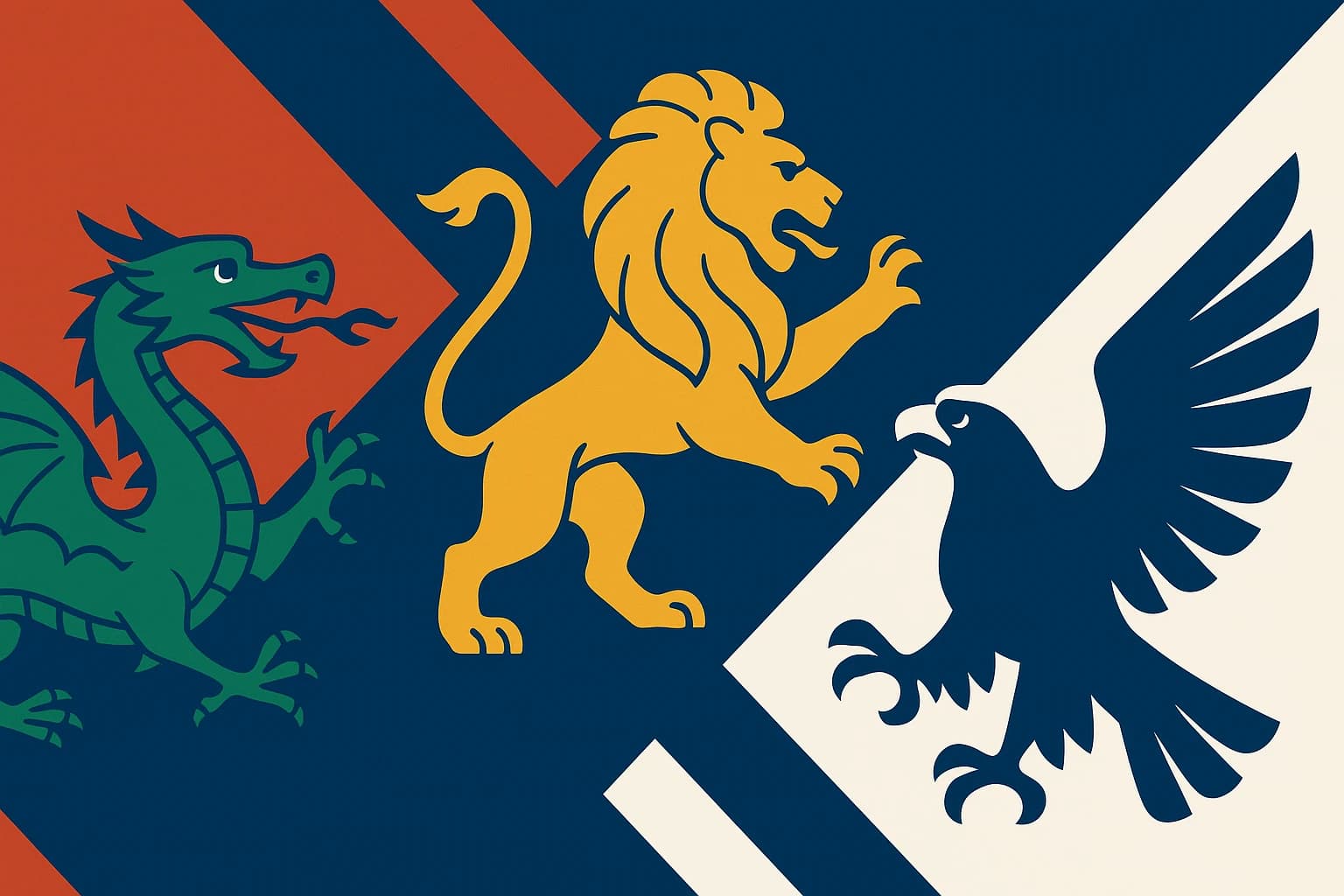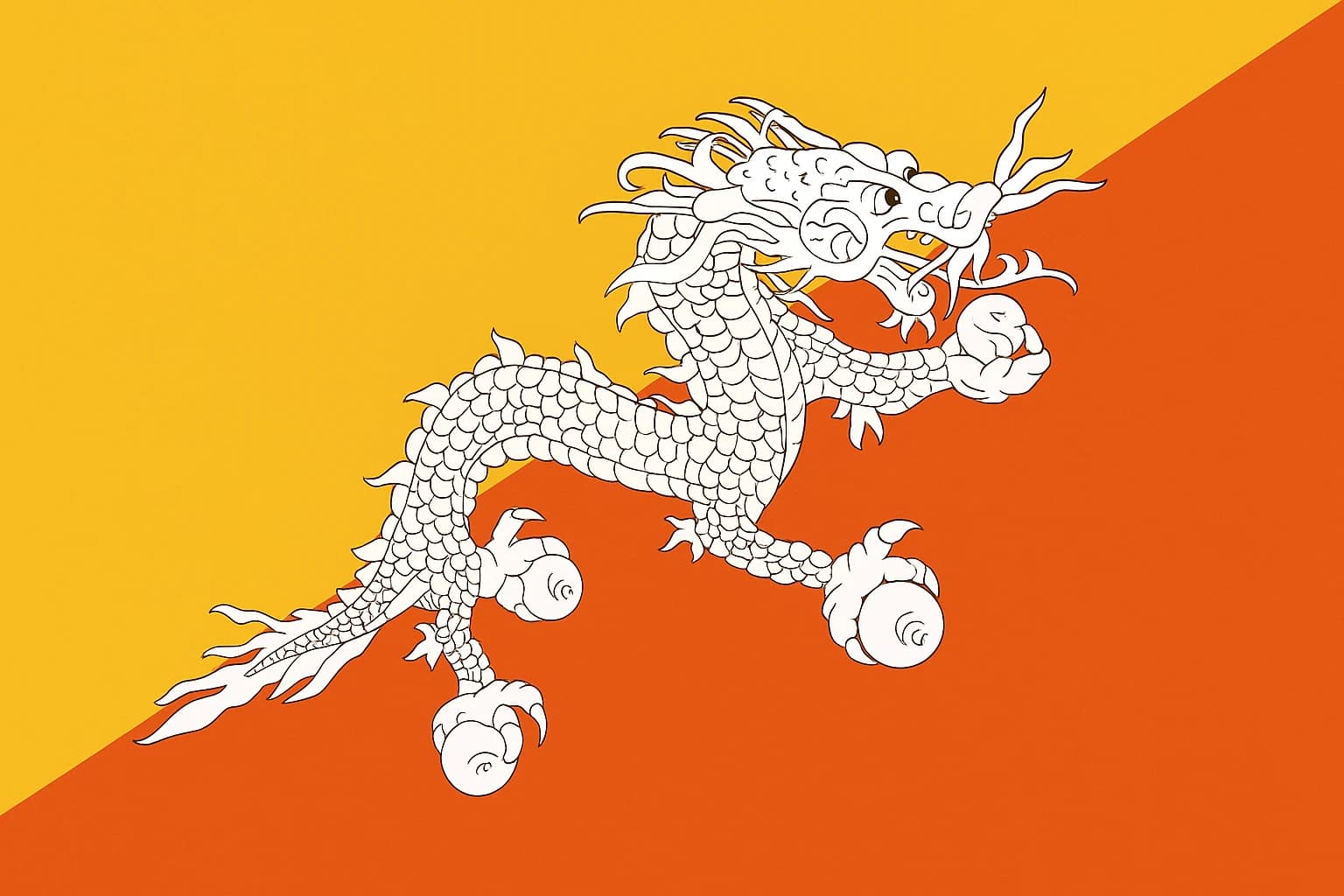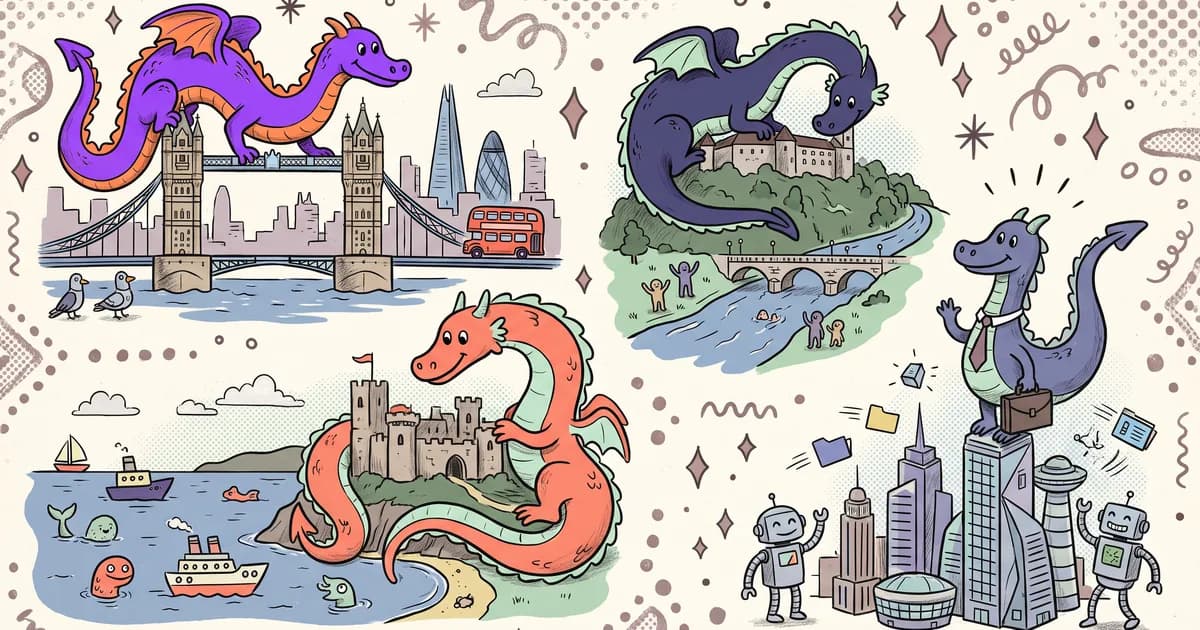
National flags get the famous dragons: Bhutan's thunder dragon, the red dragon of Wales. But the dragon's steadiest employment has always been municipal. Across Europe, dragons stand guard on the flags and coats of arms of cities, propped against shields, perched on towers, and cast in iron at city limits. The city dragon is a different animal from the national one. A national dragon declares who the people are; a city dragon is hired to stand at the gate. Here is where to find them.
London: the dragons at the gates
The flag of the City of London (the ancient square mile, not the metropolis) is the St George's Cross with a red sword in the upper hoist canton. The sword is routinely misread as a dagger commemorating the killing of Wat Tyler; it is actually the sword of St Paul, the City's patron, who was martyred by beheading. The flag itself has no dragon on it.
The dragons arrive one step up, in the City's coat of arms, where the shield is supported by a pair of silver-white dragons bearing a red cross on each wing, an embellishment in place by 1609 on arms that had been in use since at least 1381. The choice is usually traced to the legend of St George: if your flag is St George's cross, dragon supporters complete the story, with the interesting inversion that the monster has switched sides and now defends the shield.
London took its heraldic dragons off the parchment and put them on the streets. Cast-iron dragon statues, painted silver and red, mark the historic boundaries of the City at London Bridge, the Victoria Embankment, and most other major entrances: the "boundary dragons," each holding a shield with the cross and sword. At Temple Bar, a fiercer bronze cousin from 1880 stands the same watch. A Londoner crossing into the Square Mile is, heraldically speaking, passing between the supporters into the coat of arms.
Swansea: a dragon on loan from the nation
Swansea's civic arms, granted in 1922, are a maritime composition: a gold double-towered castle above wavy blue and white bars for the port, an osprey for the crest, and the motto Floreat Swansea, "Let Swansea Flourish." The mythical creature people remember from Swansea's arms is one of its two supporters: a lion on one side and, on the other, a red dragon, the national beast of Wales itself.
That borrowing is the standard Welsh civic move. Cardiff goes further and puts a red dragon on the shield of its arms itself. Where the City of London's dragons are its own invention, the Welsh cities each hold a franchise of a national symbol, the red dragon whose lineage runs back, by tradition, through Cadwaladr to the oldest recorded dragon legend in Britain: the prophecy of the red dragon defeating the white one, written down in the ninth century. (Owain Glyndŵr carried a dragon standard into his revolt too, though his dragon was gold.) A Welsh city adding the dragon to its arms is claiming its place in that very long story.
Ljubljana: the dragon that owns the city
No European city is as thoroughly dragoned as Ljubljana. The Slovenian capital's coat of arms and flag show a green dragon perched on a white tower, and the creature has escaped heraldry entirely: it guards the famous Dragon Bridge in green-patinated copper, appears on manhole covers, and serves as the mascot of nearly everything in the city.
Ljubljana's dragon has two competing origin stories, both excellent. The classical version attaches the city to the Argonauts: Jason and his crew, fleeing with the Golden Fleece, supposedly sailed up the Danube and Sava and wintered at the site of Ljubljana, where Jason slew a marsh monster, the proto-dragon. The Christian version is the familiar St George story imported via the castle chapel, dedicated to the saint. Either way, the dragon began as the city's defeated monster and was gradually promoted to its protector, mirroring London's arc: the vanquished beast ends up with the security contract.
Why cities keep dragons
The pattern across all three cities is the same, and it explains why dragons do better on civic arms than on national flags. A nation's flag needs a symbol of the people. A city's arms need a symbol of protection, because cities were historically walled things with gates, always aware of what is outside. Heraldic supporters exist to hold and guard the shield, and nothing in the medieval imagination out-guards a dragon. The creature's ferocity, a liability in a national self-portrait, is exactly the point at a city boundary.
The national exceptions prove the rule. Bhutan's thunder dragon and the Welsh red dragon are both, at root, guardian figures too: one protects the Land of the Thunder Dragon, the other was prophesied to drive invaders out of Britain. The dragon never really changed jobs; the difference is just the size of the thing it is guarding.
So if you are hunting flag dragons: Wales and Bhutan for nations, and for cities, London's silver boundary guards, Swansea's borrowed red supporter, and Ljubljana's castle-sitting green one, the only dragon in Europe with its own bridge. The species is doing fine. It just prefers municipal work.