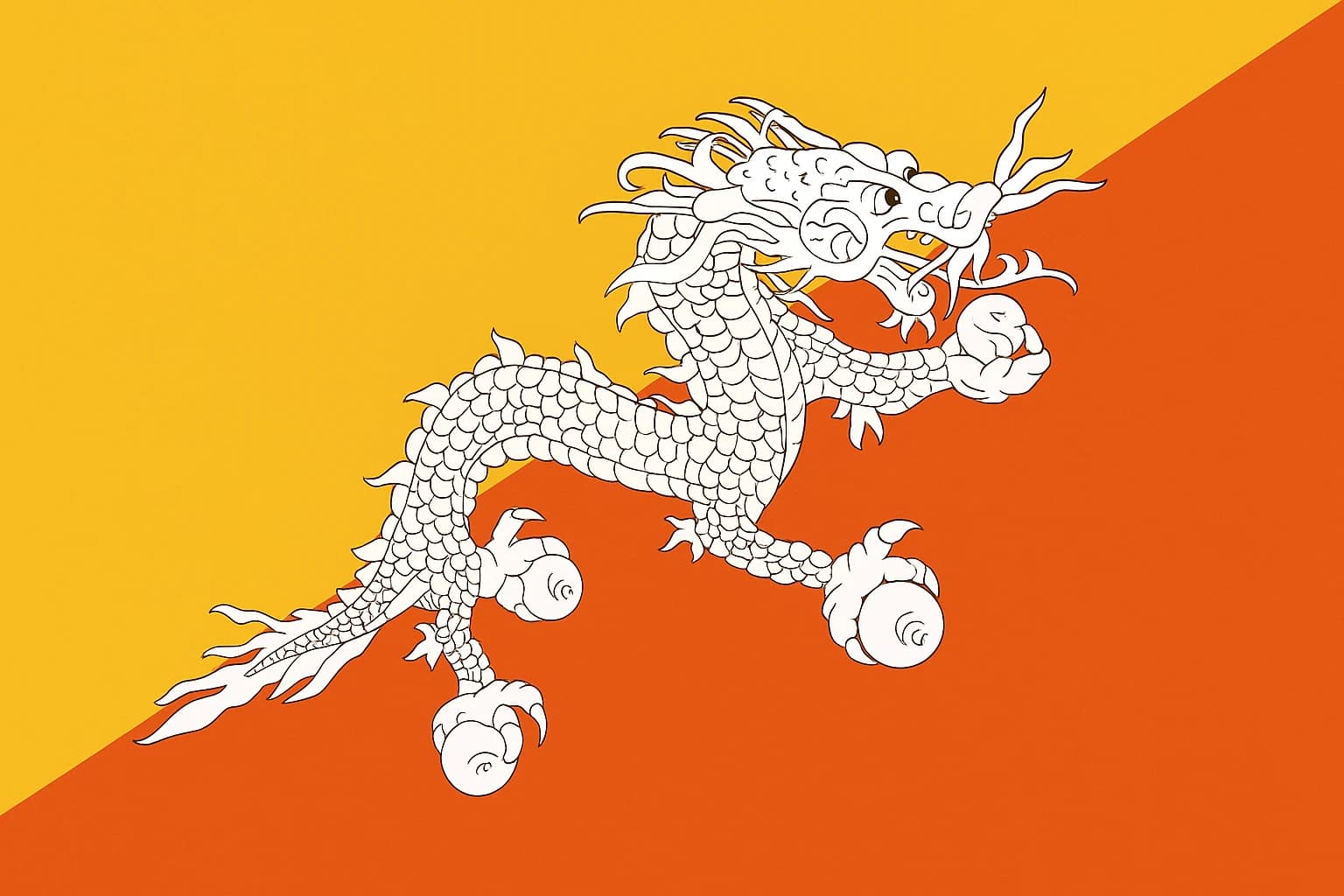
Bhutan's flag is famous for its dragon. Druk, the white thunder dragon, sprawls across the diagonal between the yellow and orange halves, clutching jewels in its claws. It is one of the most recognizable flags in the world, and for most people it is where Bhutan's dragon imagery begins and ends.
But look up Bhutan's national emblem, the circular seal used on government documents, passports, and official buildings, and you will find not one dragon but two. They face each other across a thunderbolt, mouths open, mirrored like parentheses. People who notice the discrepancy reasonably want to know: why does the flag get one dragon and the emblem two, and what is everything else in that circle?
What the emblem shows
Bhutan's national emblem is a densely packed piece of Vajrayana Buddhist iconography inside a circle. Working from the center outward:
At the heart of the design sit two crossed vajras, the ritual thunderbolt-scepters of tantric Buddhism (Dzongkha: dorje). A single vajra represents indestructible spiritual power; crossed, they form the visvavajra, a symbol of stability and of the harmony between secular and religious authority. That pairing is not decorative in Bhutan. The country's founding political idea, established when Zhabdrung Ngawang Namgyal unified Bhutan in the 17th century, is the chhoe-sid-nyi, the dual system of governance in which spiritual and temporal power are held in balance. The crossed vajras are that constitution drawn as a picture.
The vajras rest on a lotus, the standard Buddhist emblem of purity rising from murky water. Above them floats the chintamani, the wish-fulfilling jewel of Buddhist mythology, expressing the supremacy of the sovereign.
And flanking the whole composition are the two thunder dragons, one male and one female, rearing upward on either side. They are the emblem's guardians and its announcers. Bhutan's name for itself is Druk Yul, the Land of the Thunder Dragon, and the paired dragons are traditionally described as proclaiming that name with their voices, thunder being, in Bhutanese tradition, the sound of dragons speaking.
So why two dragons here and one on the flag?
The short answer is that the two designs are doing different jobs.
A flag is seen at distance, in motion, and usually from one side at a time. A single large dragon stretched along the diagonal gives Bhutan's flag a clear silhouette that survives wind, distance, and bad printing. The flag's Druk carries the same national claim as the emblem's pair (its white color stands for purity, and the jewels in its claws for the wealth and security of the country), but it makes the point with one unmistakable figure.
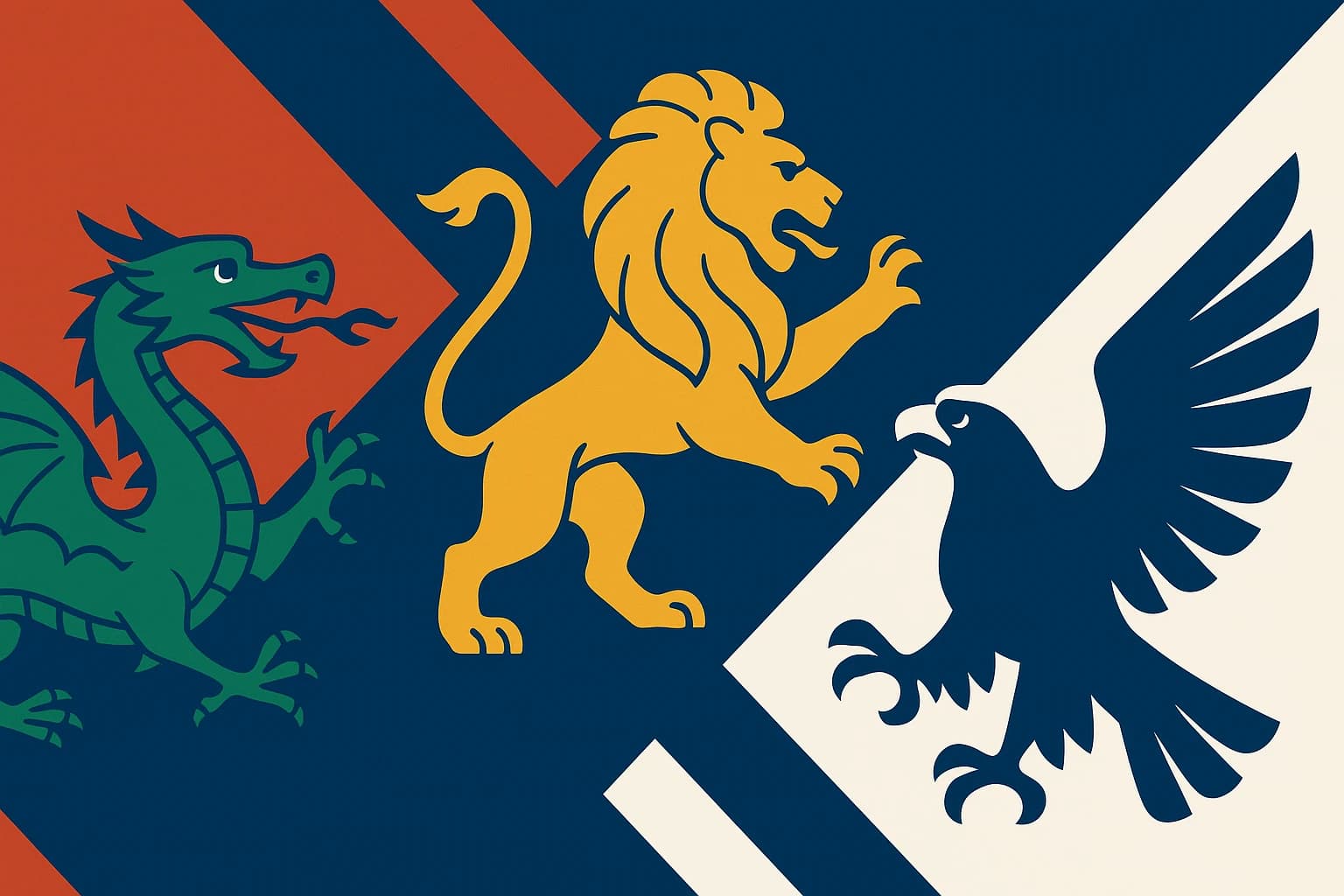
An emblem is studied up close and needs symmetry, because it must sit centered on a letterhead or a coin. Heraldic traditions everywhere reach for mirrored designs: the paired lion supporters of many European arms, the two heads of the Albanian and Serbian eagles, the paired dragons of Bhutan. The male and female pairing adds a layer the flag cannot: completeness and balance, the same dualism expressed by the crossed vajras between them.
There is a practical layer, too. The emblem's two dragons are commonly described as protectors, guarding the religion and the people from hostile forces on either side, a role that only works with one dragon per flank.
The same dragon, either way
It is worth being clear that the flag and emblem are not depicting different creatures. Both show Druk, the thunder dragon that has stood for the country since the 17th-century unification that made it Druk Yul; the Wangchuck dynasty inherited the symbol and put it on the modern flag, first designed in 1947. The dragon lineage goes back further still, to the founding of the Drukpa school of Buddhism in Tibet around 1200. According to tradition, its founder heard thunder, the voice of dragons, over the site of a new monastery (in another telling, he watched nine dragons rise from the ground and take to the sky) and named the school after them. Bhutan inherited the school, the name, and the dragon together.
That is why the dragon count is the least important difference between the two symbols. The flag says this country is the Land of the Thunder Dragon. The emblem says the same, and then adds the full constitutional theory: purity at the base, dual authority at the center, the people's welfare above, and guardians on both sides.
Bhutan next to its neighbors
Among national emblems, Bhutan's is unusual for how much doctrine it compresses into one circle, but the two-dragon arrangement has good company across Asia. Imperial China reserved the five-clawed dragon for the emperor, while paired dragons chasing a flaming pearl decorated temples and palaces across the region; Vietnamese royal iconography set facing dragons around the moon. Bhutan's version is distinctive for being current, a living state symbol rather than a museum piece, and for pairing the dragons with specifically tantric Buddhist objects rather than generic regalia.
The only other flag-dragon regularly mentioned in the same breath is the red dragon of Wales, a heraldic beast with entirely separate mythological roots. Put the two side by side and the difference in role is obvious: the Welsh dragon is a battle standard, all claws and aggression, while Druk is closer to a guardian deity, holding jewels rather than ground.
So if you came here from a search box: yes, Bhutan's national emblem really does have two dragons, male and female, guarding a crossed thunderbolt over a lotus, beneath a wish-fulfilling jewel. The flag's single dragon is the portable version. The emblem is the full sentence, and Bhutan may be the only country whose official seal amounts to a compact theology lecture, delivered by dragons.