In 2008, Bhutan did something no one expected. The kingdom drafted a brand-new constitution, held its first parliamentary elections, and transitioned from absolute monarchy to constitutional monarchy. It was a deliberate, sweeping act of modernization. Then the constitutional architects turned to the national flag, and instead of swapping the dragon for a star or a stripe or a clean geometric abstraction, they sharpened its claws.
While the world's newest democracies were reaching for the safe visual grammar of tricolors and five-pointed stars, Bhutan looked at its Thunder Dragon and made it fiercer. The 2008 constitution did not keep the Druk out of laziness or nostalgia. It codified it, standardized it, and gave it the force of law. In the 21st century, keeping a dragon on your flag is the bold choice.
The vanishing bestiary: why mythological creatures disappeared from world flags
Between 1945 and 1990, dozens of new nations emerged from colonial rule, civil war, and Cold War partition. The flags they chose tell a clear story. Overwhelmingly, these countries reached for geometric abstraction, pan-African color schemes, or socialist symbolism. Stars, crescents, stripes, and solid color blocks dominated the new visual order. Mythological creatures were almost entirely absent.
The reasons were practical and political. Nations seeking UN recognition and international legitimacy needed flags that communicated modernity, inclusivity, and rational governance. Mythological imagery carried baggage. Dragons, griffins, and legendary beasts were read as pre-rational, ethnically exclusive, or theocratically coded. For a country trying to join the postwar international order, a flag covered in mythical creatures signaled the wrong things to the wrong audiences.
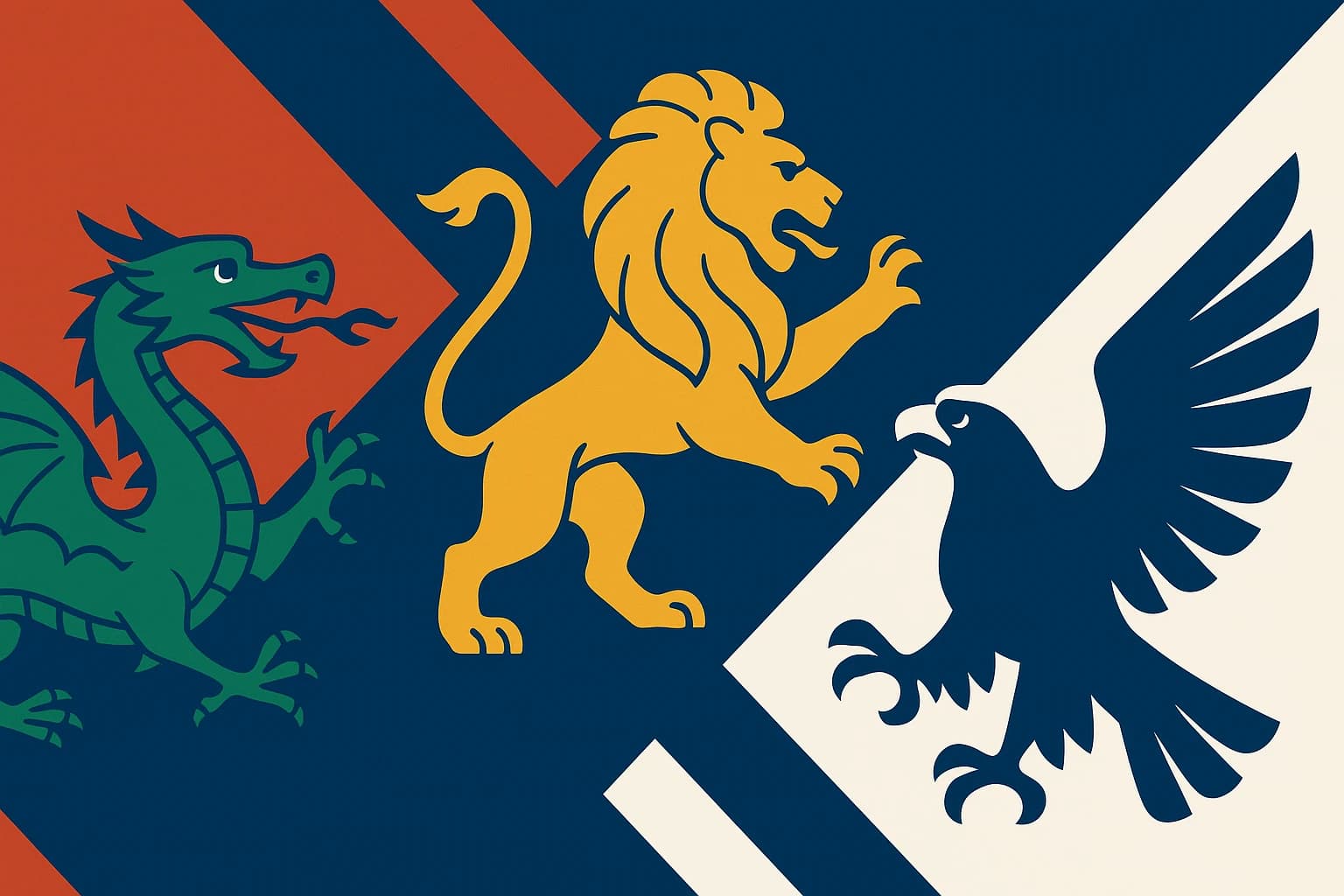
A few exceptions survived. Wales still has its red dragon, though it's worth noting that Y Ddraig Goch never made it onto the Union Jack, illustrating how even the United Kingdom sidelined its most striking mythological element.
Serbia carries a white eagle, but that's heraldic tradition, not mythology in any living sense. It belongs to the visual language of European coats of arms, a different category entirely.
Bhutan's Druk is categorically different from both. It isn't a heraldic relic borrowed from medieval armory. It's a living religious and cultural symbol, rooted in Tibetan Buddhist practice and tied directly to the nation's name, language, and ruling dynasty.
Bhutan also had the luxury of being left alone. The country gained UN membership in 1971 and never faced serious pressure to sanitize its flag. Small, landlocked, sandwiched between India and China, Bhutan occupied a strategic niche where no great power had much incentive to demand symbolic conformity. That positioning gave Bhutan room to resist the homogenization that reshaped flags across Africa, Asia, and the former Soviet bloc.
Druk Yul: when the flag and the nation share the same name
The Dzongkha word "Druk" means Thunder Dragon, and it is also the name Bhutanese people use for their own country. Bhutan's official name in Dzongkha is Druk Yul, "Land of the Thunder Dragon." The ruling Wangchuck dynasty traces its lineage mythology through the Druk, which makes the image on the flag linguistically and politically inseparable from the country. The maple leaf is not detachable from Canada either, but a maple leaf is a plant. The Druk is a claim about how the universe is organized.
The Druk's origins lie in the Drukpa Kagyu school of Tibetan Buddhism, which spread into Bhutan in the 12th century under Tsangpa Gyare. According to tradition, when Tsangpa Gyare was founding a monastery, his laughter was drowned out by a sudden clap of thunder. The event was interpreted as a sign, and the school took its name from it. Centuries later, the dragon became the emblem of the nation itself.
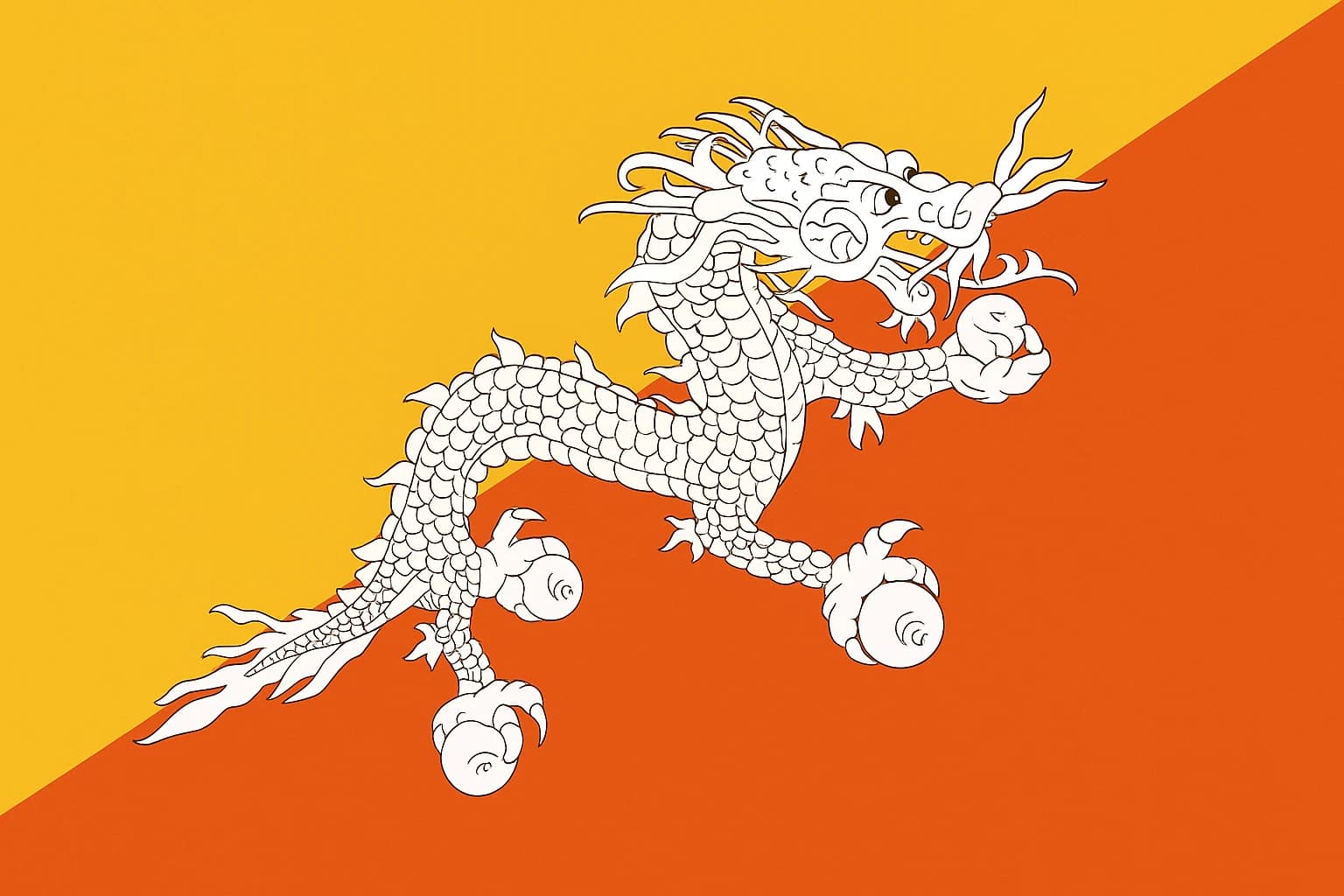
The design carries the same idea. The field is split diagonally, saffron-orange on the upper left for civil and Buddhist authority, crimson-red on the lower right for temporal and military power, with the Druk laid across the boundary so that its body bridges both fields and unites the two realms. Its claws clutch jewels standing for wealth and perfection. Its head faces inward, toward the hoist, an orientation vexillologists read as protective rather than aggressive: the dragon is guarding rather than attacking.
None of that is decorative coincidence. It is a compressed cosmology, a philosophical statement about governance, authority, and spiritual purpose rendered in cloth and color. Calling it "a flag with a dragon on it" misses the point the same way calling a cathedral "a building with windows" misses the architecture.
2008: the year Bhutan modernized everything except the dragon
The scale of Bhutan's 2008 transformation deserves emphasis. King Jigme Khesar Namgyel Wangchuck was crowned. The country held its first parliamentary elections in March. On July 18, 2008, the Constitution of the Kingdom of Bhutan was ratified, establishing a bicameral parliament, an independent judiciary, term limits for prime ministers, and codified civil rights. This was a genuine, structural overhaul of governance.
The constitution also formally standardized the national flag, specifying proportions, the exact rendering of the Druk, and the correct color values. That was a constitutional act rather than a design refresh, placing the dragon's image under the same legal authority as the bill of rights and the separation of powers.
The dragon came through every reform discussion intact. Bhutan's reformers had not forgotten about the flag. They debated it and then decided, in writing and with legal force, to keep a mythological creature at the center of their national identity.
There's a political theology behind this choice. The Wangchuck monarchy derives its legitimacy partly from the title "Druk Gyalpo," the Dragon King. Standardizing the dragon on the flag was also a constitutional reaffirmation of dynastic identity inside the new democratic framework, so the dragon anchored the new democracy rather than contradicting it.
The 2008 standardization also made the dragon more detailed and fiercer than earlier versions. Previous renditions had been softer and more stylized; the constitutional version sharpened the features, added detail to the scales, and made the expression more intense. Modernization amplified the imagery instead of softening it.
The neighbors who chose differently: Myanmar and Cambodia
What makes Bhutan's choice distinctive is clearest next door.
In 2010, Myanmar replaced its socialist-era flag. The old design featured 14 stars surrounding a cogwheel and paddy sheaf, symbols of the country's 14 states and divisions and its agrarian, socialist identity. The new flag, a tricolor of yellow, green, and red with a large white five-pointed star, was implemented under the military junta's so-called "roadmap to democracy."
The redesign stripped away all culturally specific imagery. The 14 stars, which had at least gestured toward Myanmar's ethnic plurality, vanished in favor of a single homogenizing symbol. What the new flag communicates is erasure, symbolic authoritarianism in modernist clothing, a military government imposing visual simplicity on a country defined by ethnic complexity. That is control rather than progress.
Cambodia went another way. Its flag is the only national flag in the world featuring a building: Angkor Wat. And that image has survived across radically different regimes. The monarchy used it. The Khmer Rouge used it. The Vietnamese-backed People's Republic of Kampuchea used it. The current constitutional monarchy uses it. Each regime reappropriated Angkor Wat to legitimize wildly different political projects. The temple persists through passive inertia and nationalist consensus, not through active democratic choice.
Myanmar's star was imposed by fiat and Cambodia's Angkor Wat endures through unexamined inheritance, while Bhutan's Druk was debated, argued for, and legally codified. It is the only case in the 21st century of a mythological symbol being democratically reaffirmed.
Three philosophies, then: erasure in Myanmar, inheritance in Cambodia, active reaffirmation in Bhutan. Only one of them involved a country genuinely choosing its own symbolism.
Gross National Happiness and the dragon as philosophical brand
Bhutan's Fourth King, Jigme Singye Wangchuck, coined the concept of Gross National Happiness (GNH) in the 1970s. It was formalized as a development philosophy, a deliberate rejection of GDP as the sole measure of national progress. GNH prioritizes psychological wellbeing, cultural preservation, ecological balance, and good governance alongside economic growth.
The Druk on the flag and GNH are part of the same coherent national strategy. Both resist the assumption that modernization requires symbolic and economic Westernization. Both say: we'll define progress on our own terms, thank you.
The irony is that Bhutan's mythological flag has become one of its strongest soft-power assets. The dragon is instantly recognizable. In a world of lookalike tricolors, the Druk functions as a global shorthand for Bhutan's distinctive identity. For a country with a population of roughly 780,000, that kind of cultural visibility is wildly disproportionate to its size.
The 2008 constitution explicitly enshrines GNH principles, which puts the dragon and the happiness policy under the same document. The flag is the visual expression of the governance philosophy rather than something separate from it, and it belongs to a country that made philosophical nonconformity a matter of constitutional law.
What vexillologists get wrong about good flag design
The North American Vexillological Association (NAVA) and Roman Mars's 99% Invisible podcast have done more than anyone to popularize the principles of good flag design: simplicity, meaningful symbolism, no lettering, limited colors, distinctiveness. A good flag, by these standards, should be reproducible by a child with crayons.
By those criteria, Bhutan's flag fails. The Druk is complex. It has fine details, curved lines, and elements that would challenge most adults, let alone elementary school students. On paper, it breaks the rules.
It is also one of the most recognized and symbolically coherent flags on the planet. People remember it and talk about it, which the simplicity doctrine struggles to account for.
The NAVA framework, useful as it is, carries an implicit bias toward the visual language of abstraction that came out of post-Enlightenment Western design: clean lines, minimal elements, instant legibility at a distance. Those are fine principles for a corporate logo or a traffic sign, and a national flag does not have to be either.
The complexity standardized in 2008 is the point. The flag is a text to be read rather than a symbol to be scanned. You notice the diagonal split, follow the dragon's body across the boundary, see the jewels in its claws, register the inward-facing posture, and gradually work out the cosmology compressed into the design. The time that takes is a feature.
A more honest test would not ask whether a flag is simple. It would ask whether it represents what the nation believes about itself, and by that standard Bhutan's is exemplary. The complexity of the flag matches the complexity of the culture behind it.
The dragon, renewed
Picture the 2008 delegates finalizing a democratic founding document, working through term limits, judicial independence, and civil liberties, and then writing the dragon into law with the full weight of the constitution behind it.
Flag design in this era gravitates toward the safely abstract and the politically neutral, which makes Bhutan's codified mythological continuity an act of cultural sovereignty. The Druk did not survive by inertia. It is a position, renewed and sharpened: we know who we are and where that identity comes from, and we are not embarrassed by it.
Most national flags are converging on the same vocabulary of stars and stripes. It is worth asking which countries will keep their dragons, and what goes missing when none of them do.