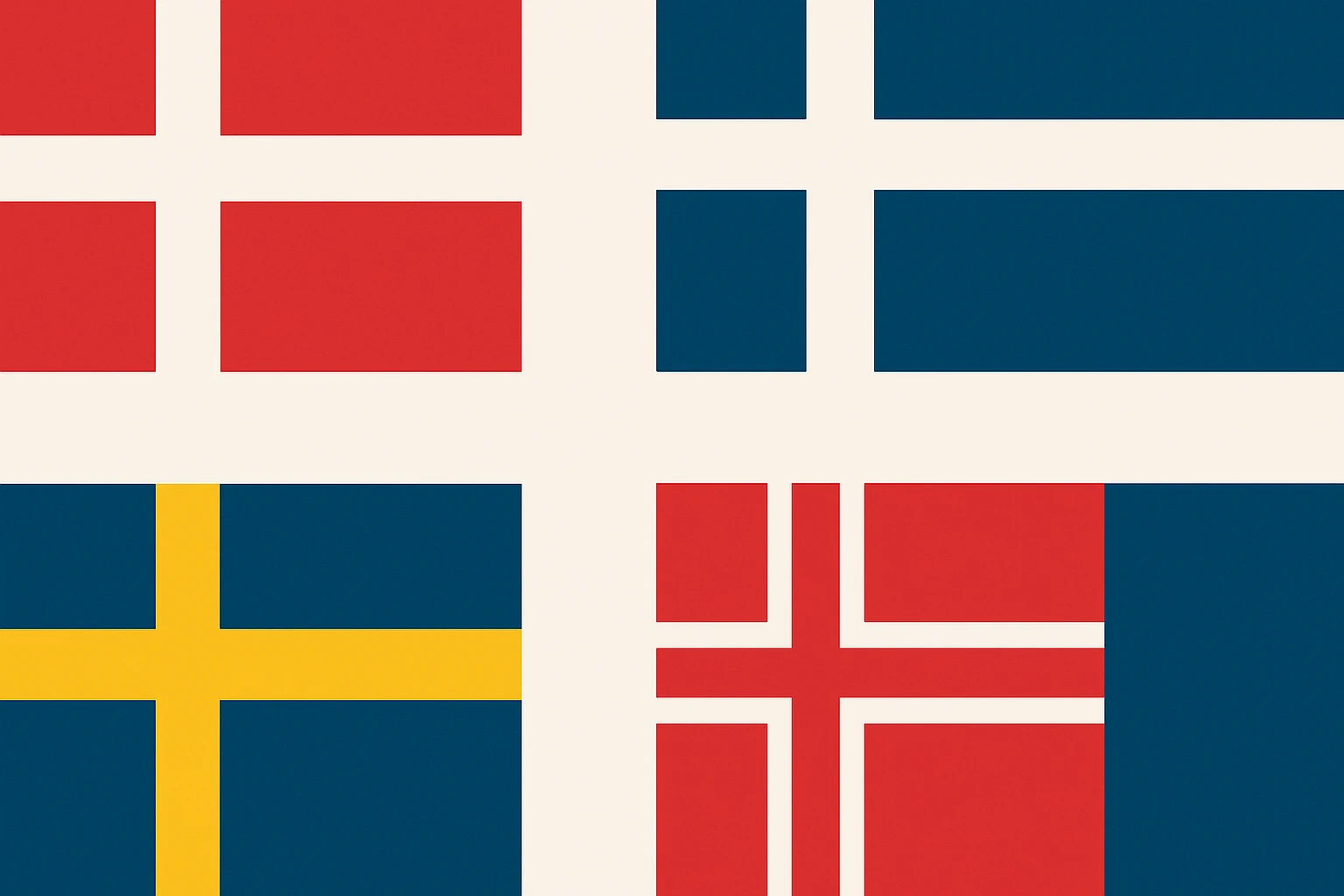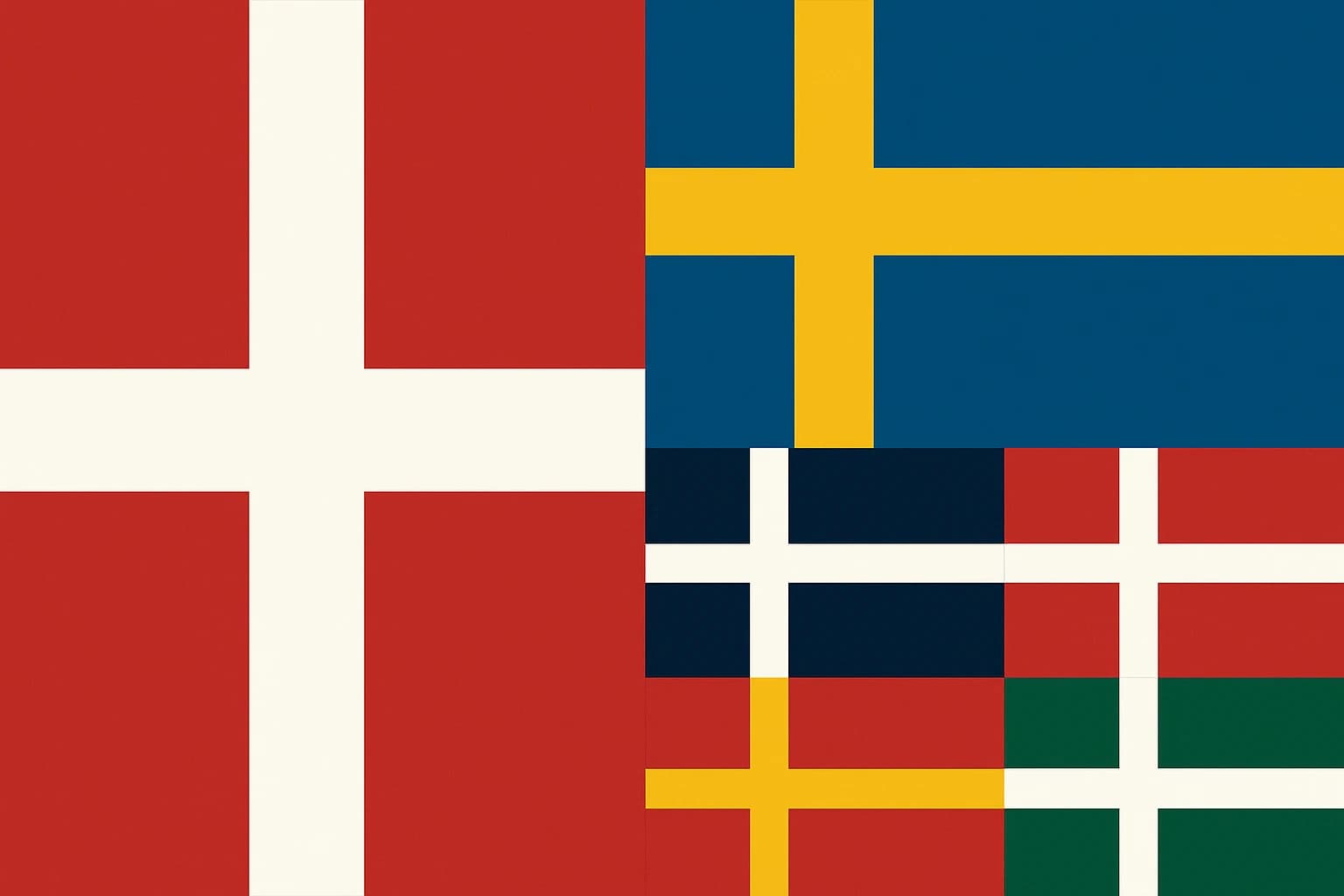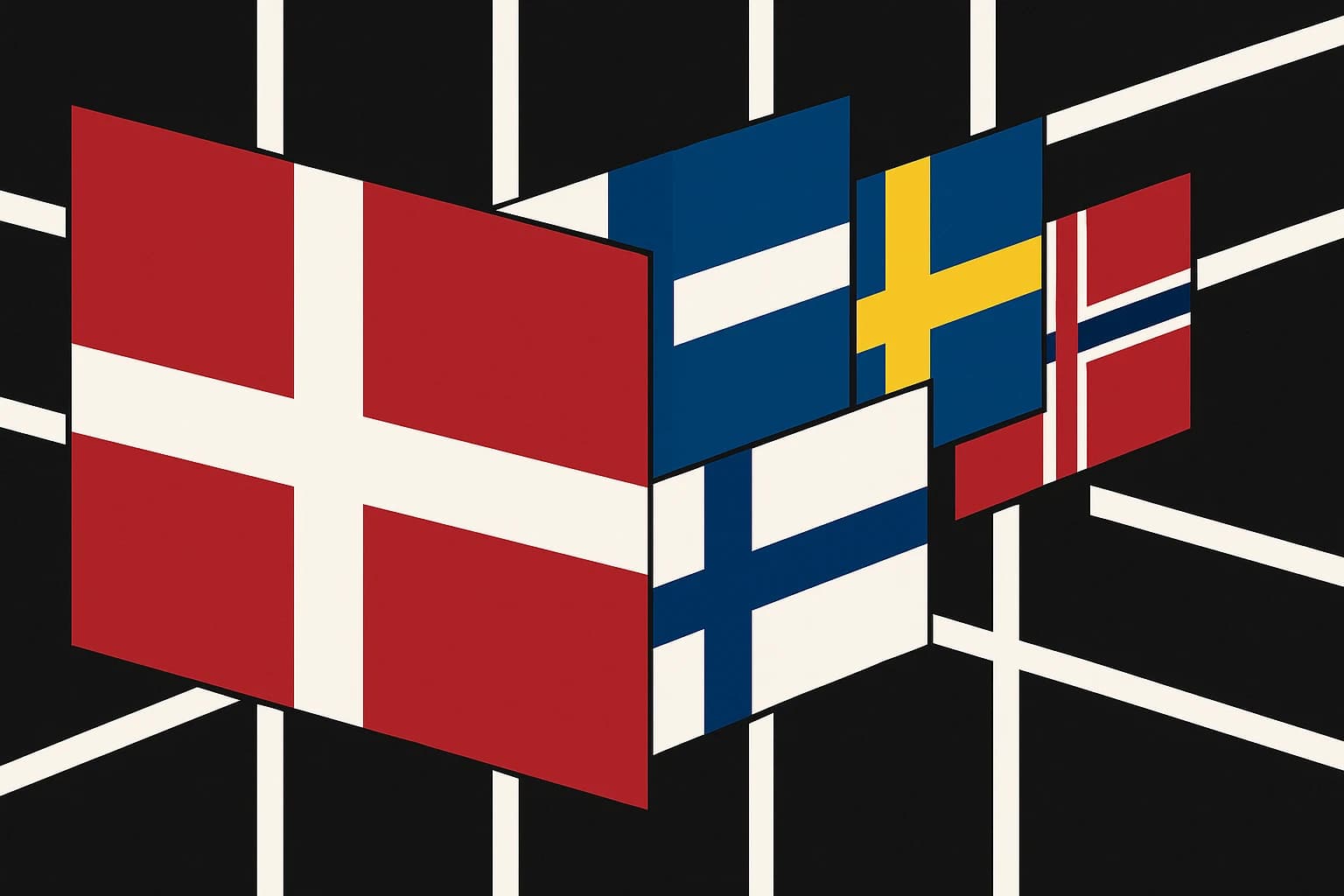
On June 15, 1219, according to Danish legend, a red banner bearing a white cross fell from the sky during the Battle of Lyndanisse in modern-day Estonia and rallied King Valdemar II's crusading forces to an improbable victory. Whether or not you believe in divine textile delivery, the consequence is not in dispute. That banner, the Dannebrog, is the oldest continuously used national flag in the world, and its off-center cross became the most copied layout in the history of flags. Every sovereign Nordic nation and nearly every autonomous Nordic territory flies a version of it. No other regional design convention comes close, and eight centuries later the motif still starts arguments about who counts as Nordic.
The origin myth and the documentary record
The legend runs like this. Danish crusaders under Valdemar II, fighting Estonian pagans near Lyndanisse (modern Tallinn), were losing badly. A red cloth with a white cross came down out of the sky, the tide turned, and the Danes never forgot it.
Nobody wrote the story down for roughly 300 years. The earliest recorded version appears in the chronicle of Christiern Pedersen in the 16th century, which is a long time for a miracle to wait for a pen. The documentary record is more modest: the earliest confirmed references to the Dannebrog date to the 14th century, and the oldest surviving depiction is in the Gelre Armorial, compiled between roughly 1370 and 1395. Even on that conservative dating it is the oldest state flag in continuous use, predating England's St George's Cross as a recognized national symbol.
The design is simple and specific. A white cross on a red field, the vertical bar shifted toward the hoist (the side attached to the pole), the arms running to all four edges. That off-center placement probably descends from the broader European tradition of crusader crosses, but Denmark's particular arrangement is the innovation that defined a whole family of flags.
Danes also refuse to treat the thing as a relic. They fly it at birthdays, put miniature versions in Christmas trees, and wave it at graduations. Dannebrog Day, June 15, is Valdemarsdag, marking the legendary fall from the sky. It may be the most domestically omnipresent national flag anywhere, present constantly and remarked on by nobody.
What separates a Nordic cross from every other cross
Plenty of countries put crosses on their flags. Switzerland centers a white cross on a red square. England centers a red cross on white. Georgia scatters five crosses across its field. Scotland and Jamaica use diagonal saltires. None of them look anything like the Nordic family.
The Nordic cross, also called the Scandinavian cross, follows a precise formula. The cross runs to the edges, and the vertical arm sits toward the hoist, which produces a short horizontal arm near the pole and a long one on the fly. Proportions vary between countries. The asymmetry does not.
The reason for the shift is practical rather than decorative. When a flag hangs from a vertical pole, biasing the cross toward the hoist keeps it prominent whether the cloth is snapping in a gale or hanging dead on a windless afternoon. The design works in motion and at rest, which is sensible engineering for something that spends its life outdoors.
The unusual part is what happened next. The Nordic cross turned into a protocol, a shared structure that signals regional belonging. There are loose parallels in the pan-African color tradition (red, green, black, sometimes yellow) and the pan-Arab palette (red, white, black, green), but those are color schemes. This is geometry, which is both more rigid and more instantly readable.
The cross's origins are explicitly Christian. It stood for Christendom during the crusading era, and that is the context the Dannebrog came out of. Meaning drifts, though. The Nordic cross now reads as a marker of Nordic identity rather than religious affiliation, and since Denmark and Sweden are among the most secular societies on Earth, nobody takes their flags as statements of faith.
Copy, adapt, belong
Each Nordic nation adopted the cross at a moment of self-definition, which makes every one of these flags a political act in colored cloth.
Sweden's blue field with a gold cross is attested from the 16th century, though legend pushes it back to King Eric IX's 12th-century crusade, where he supposedly saw a golden cross in the sky. The parallel with Denmark's myth is hard to miss. The current design was standardized in 1906, on a blue and gold palette with centuries of precedent behind it.
Norway's flag arrived in 1821, designed by Fredrik Meltzer during the union with Sweden. Meltzer chose the Nordic cross format to signal Scandinavian kinship, then picked red, white, and blue to assert Norwegian distinctiveness and nod toward the tricolor tradition of the French and American revolutions. Belonging and independence in the same rectangle.
Finland's case is the most telling. When Finland declared independence from Russia in 1917, the flag adopted the following year, by Eero Snellman and Bruno Tuukkanen, was a white and blue Nordic cross. It beat several competing proposals, including a red and yellow lion design. The choice anchored Finland inside the Scandinavian cultural sphere despite Finnish being a Finno-Ugric language with no relationship at all to the Scandinavian tongues. The flag claimed something the language could not.
Iceland's flag, designed by Matthías Þórðarson, was first flown in 1915 and officially adopted on full independence from Denmark in 1944. Its blue, white, and red reference the Icelandic landscape, blue for the sea, white for ice, red for volcanic fire, while keeping a visual link to the Danish flag it was leaving behind.
Every one of those adoptions happened at a hinge point: independence, constitutional reform, separation from a larger power. None of it was passive inheritance.
When sub-national territories claim the cross
The motif does not stop at sovereign borders, and the territorial versions are often the most revealing, because each one records a negotiation.
The Åland Islands, an autonomous Swedish-speaking region of Finland since 1921, adopted their flag in 1954: a blue field with a red-on-yellow Nordic cross. Blue and yellow reference Sweden, red references Finland, and the whole arrangement is legally protected under the Autonomy Act.
The Faroe Islands, a self-governing territory of Denmark, fly the Merkið, adopted in 1948 after informal use since 1919. The white field with a red-bordered blue Nordic cross was designed by Jens Oliver Lisberg and fellow Faroese students studying in Copenhagen. During the Second World War Danish authorities banned it, which made it more popular rather than less, as bans on flags reliably do.
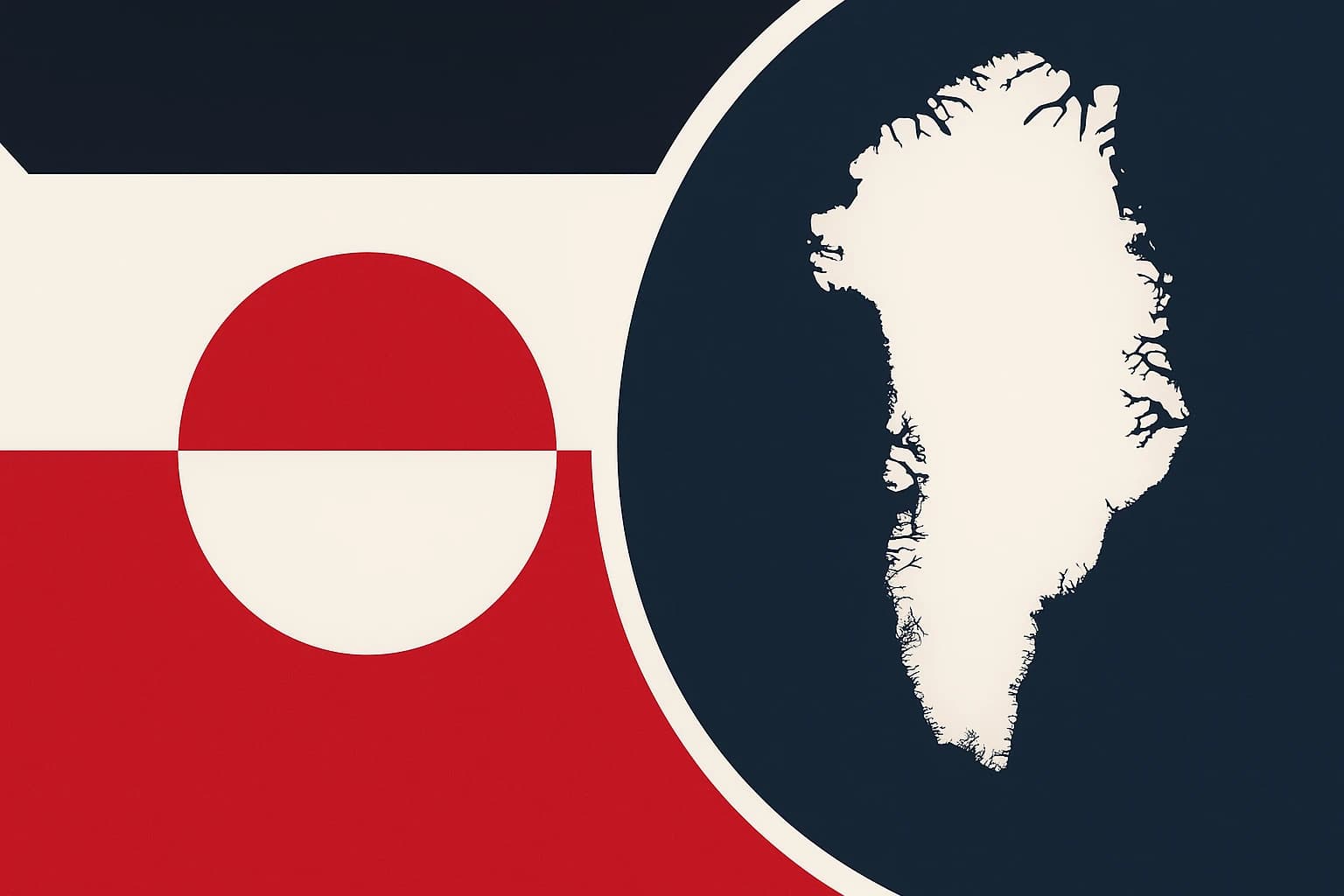
Then the counter-examples. Greenland broke from the cross entirely in 1985, adopting Thue Christiansen's semicircle design inspired by the polar landscape, a deliberate assertion of an identity distinct from Danish colonial history.
The Sámi, indigenous to northern Scandinavia and Finland, fly a flag with no cross at all. Their design, adopted in 1986, uses a circle motif and bright primary colors from Sámi tradition. The absence is as pointed as any presence: the Sámi were there before the crosses and the kingdoms.
The club that almost grew: Estonia's Nordic cross debate
After Estonia regained independence in 1991, a serious debate broke out over whether to adopt a Nordic cross flag. The blue, black, and white tricolor had deep roots in Estonian independence identity, dating to the 19th-century national awakening, but proposals surfaced for a blue-black-white Nordic cross variant, and they had real support.
Advocates argued that a Nordic cross would signal Estonia's cultural affinity with Finland and Scandinavia and pull the country out of its post-Soviet Baltic framing. Estonia is Lutheran, like the Nordic countries, and shares long historical ties with Finland and Sweden. The Nordic label also carries weight of its own: prosperous, stable, well-governed. Adopting the cross amounted to an application to join a club of successful democracies.
Opponents pushed back hard. The tricolor was sacred to Estonian independence, they argued, and switching would erase a century of national symbolism. The debate peaked in the mid-1990s and has resurfaced periodically, including in Estonian press discussions in the 2020s. The tricolor endures. The conversation has not stopped.
Estonia is not the only case. The Shetland and Orkney Islands, historically Norse territories now part of Scotland, use Nordic crosses. Various American communities with Nordic heritage have designed their own. The motif travels, and it carries the same implicit claim wherever it lands.
Inclusion, exclusion, and a design that will not budge
Conversations about identity across the Nordic region are more charged now than they have been in decades. Immigration policy, EU politics, Nordic Council membership criteria, the meaning of the word Nordic itself: all of it comes back to who belongs.
The cross sits in the middle of that. It marks a shared cultural and historical space, and by doing so it draws a line. The Sámi rejected the motif, Greenland left it, Estonia debated adopting it, and each of those is a different answer to the same question about who issues the membership.
The design's longevity is the strange part. In over 800 years no Nordic nation has seriously challenged or replaced the template. It has outlasted the Kalmar Union, the Napoleonic Wars, two world wars, the Cold War, and the Soviet Union, at a time when countries elsewhere are reconsidering colonial-era symbols, renaming cities, and redesigning flags outright.
The reason has less to do with the Dannebrog surviving than with what it started. A 13th-century battlefield banner produced a structure compelling enough that every Nordic nation picked it up voluntarily, each at a moment of maximum national self-awareness. Nobody forced Sweden to use the cross or mandated it for Finland. They chose it, and then kept choosing it, which is why a single decision about where to put a vertical bar has outlasted every empire that had an opinion about it.