The Flag of Estonia
Republic of Estonia
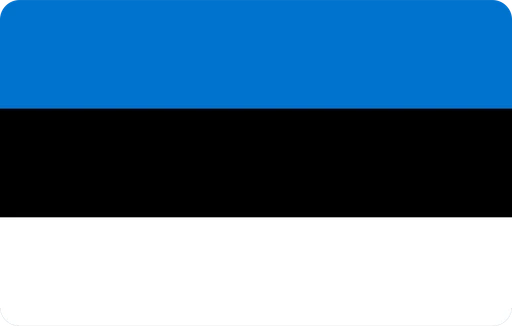
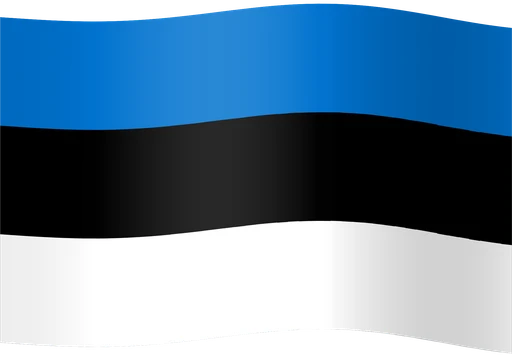
The flag of Estonia consists of three horizontal stripes of equal size. From top to bottom, the colors are blue, black, and white. The blue represents Estonia's sky, sea, and lakes; the black symbolizes the dark past and suffering of the Estonian people; and the white stands for purity, hope, and freedom.
The Estonian tricolor, three horizontal bands of blue, black, and white, did not come from a royal decree or an imperial chancery. A student fraternity adopted it in 1881, Soviet occupation drove it out of public life for nearly five decades, and it was restored in 1990. Most of the meaning attached to it was acquired in the years when flying it could get you deported.
Born in a fraternity house
Most national flags trace their origins to governments, revolutions, or monarchs. Estonia's came from a university fraternity. In 1881, during a period of intense cultural ferment known as the National Awakening (or ärkamisaeg), members of the Estonian Students' Society (Eesti Üliõpilaste Selts) in the university town of Tartu proposed a blue, black, and white tricolor as their symbol. At the time, Estonia was a province of the Russian Empire, and political independence was barely even a dream. What the students wanted was something more modest and, in its own way, more radical: a visual anchor for Estonian cultural and linguistic identity.
The flag was formally consecrated on June 4, 1884, in the town of Otepää, in a ceremony that drew figures from Johann Voldemar Jannsen's circle of cultural nationalists. That date, June 4, is still celebrated as Estonian Flag Day. The original consecrated flag survives and can be seen at the Estonian National Museum in Tartu, where it's treated with a reverence usually reserved for founding documents or sacred relics. For many Estonians, it's the single most emotionally significant artifact in the country.
For more than three decades, the tricolor served as a cultural emblem rather than an official state flag. That changed when Estonia declared independence on February 24, 1918. The new republic formally adopted the blue-black-white tricolor as its national flag on November 21, 1918, giving official status to a design that had already been carried through decades of national aspiration. Few flags anywhere in the world can claim such genuinely grassroots origins.
Blue, black, and white
Ask an Estonian what the three colors mean and the answer will usually run through landscape and longing. Blue represents the sky, the Baltic Sea, and a quality of spirit sometimes described as igatsemine, a word that sits somewhere between yearning and homesickness. Black stands for the dark boreal forests, the fertile soil, and centuries of suffering under foreign rule. White evokes snow, birch bark, and the hope for enlightenment and freedom.
None of this is officially codified. The interpretations came from poets and cultural figures over generations rather than from any government, and they are gently contested. Some emphasize the land, others the emotion, and the ambiguity feels right for a symbol that belongs to an entire people rather than a single authority.
The flag's proportions are 7:11, with three horizontal bands of equal height. Its blue is a specific, rich cornflower shade, officially defined in Estonian law and sometimes simply called "Estonian blue." Look at the design as a whole and you'll notice something unusual for a 19th-century flag: there's no coat of arms, no stars, no eagles, no emblems of any kind. The flag's entire identity comes from color and proportion alone. That's a modernist restraint you rarely see in flags from that era.
Standing alongside its Baltic neighbors, the Estonian palette is visually distinct. Latvia's dark red and white carries echoes of a 13th-century legend; Lithuania's yellow, green, and red is warm and assertive. Estonia's combination, particularly that central black band, is unique among European national flags and reads clearly even at a distance.
Banned in 1940, raised again in 1989
Soviet forces occupied Estonia in 1940, and the tricolor was banned almost immediately. Flying it became a criminal act. Possessing one could lead to deportation or a prison sentence. In its place, the Soviet Estonian SSR flag appeared: a red field bearing blue and white wavy stripes with a hammer and sickle. For nearly five decades, the blue-black-white tricolor vanished from public life inside Estonia.
But it didn't vanish entirely. Estonian exile communities in Sweden, the United States, and Canada kept it alive, flying the tricolor at émigré gatherings, song festivals, and cultural events. Inside occupied Estonia, some families hid flags in attics and root cellars, risking severe punishment simply to preserve a piece of cloth and what it meant.
Everything changed during the Singing Revolution of 1987 to 1991. In what may be the most remarkable non-violent independence movement in modern history, Estonians began openly displaying the forbidden tricolor at mass gatherings and song festivals. The courage this required shouldn't be understated. Soviet troops were still stationed across the country, and the outcome was far from certain.
On August 23, 1989, the 50th anniversary of the Molotov-Ribbentrop Pact that had sealed the Baltic states' fate, approximately two million people formed the "Baltic Way," a human chain stretching across Estonia, Latvia, and Lithuania. Estonian flags were everywhere. UNESCO later added documentation of the Baltic Way to its Memory of the World Register.
The tricolor returned to its most important perch on February 24, 1989, Estonian Independence Day, when it was raised over Pikk Hermann tower in Tallinn for the first time since the Soviet takeover. Witnesses describe the moment as overwhelming. Full legal restoration followed with re-independence on August 20, 1991, closing one of the most painful chapters in Estonian history.
Pikk Hermann and the daily ritual
Pikk Hermann, or Tall Hermann, is the medieval tower of Toompea Castle in the heart of Tallinn's old town. It's Estonia's most symbolically charged flagpole. Every morning at sunrise, the national flag is raised in a formal ceremony; every evening at sunset, it's lowered. On national holidays, the flag stays up for a full 24 hours, and the distinction is literally visible on the city skyline.
Flag Day falls on June 4, the anniversary of the 1884 consecration in Otepää, which keeps the flag's student origins in view rather than leaving them as a footnote. Estonian flag law (Riigilipp) lays out precise rules: correct proportions, the exact shade of blue, positioning relative to other flags, and mourning protocols (half-mast or adorned with a black ribbon).
Private citizens are actively encouraged to fly the flag on national holidays, and many do. Estonia's civic flag culture is notably strong compared to most European nations. Walk through any Estonian town on Independence Day or Victory Day and you'll see tricolors hanging from apartment balconies, farmhouses, and shop windows.
Variants, the presidential standard, and the Baltic neighbors
The tricolor forms the visual foundation of Estonia's entire system of state flags. The naval ensign features the national tricolor with the coat of arms superimposed: three blue passant lions on a gold shield, a heraldic design dating back to the Danish era. The Presidential Standard carries the same coat of arms centered on the tricolor and flies wherever the President is in residence or traveling officially. Civil air ensigns and various government department flags all derive from the same blue-black-white base.
Among the three Baltic states, each nation developed a completely distinct visual identity despite sharing centuries of overlapping history and Soviet occupation. Latvia's flag, dark red separated by a narrow white stripe, traces its legend to the 13th century. Lithuania's warm yellow-green-red tricolor was adopted in 1918. Set side by side, the three flags share almost nothing visually, which is itself a statement about each nation's insistence on individuality.
The horizontal tricolor format is common worldwide, but Estonia's specific color combination, especially that black central band, is unique among European national flags. Some vexillologists have also noted the Estonian flag's influence on broader Finnic cultural symbolism, which makes sense given Estonia's close linguistic kinship with Finland. The two nations share deep roots, and their symbols occasionally echo one another in subtle ways.
References
[1] Estonian Institute, "Estonian Flag" (estonia.ee), official cultural overview including flag history and symbolism.
[2] Riigilipp (Estonian Flag Law), Riigi Teataja (State Gazette of Estonia), RT I 2005, 18, 107, legal definition of the flag's proportions, colors, and display rules.
[3] Estonian National Museum (Eesti Rahva Muuseum), Tartu, repository of the original 1884 consecrated flag of the Estonian Students' Society.
[4] Anatol Lieven, The Baltic Revolution: Estonia, Latvia, Lithuania and the Path to Independence (Yale University Press, 1993), detailed account of the Singing Revolution and the flag's role in independence.
[5] Rein Taagepera, Estonia: Return to Independence (Westview Press, 1993), scholarly account of Estonian history including flag origins and symbolism.
[6] UNESCO Memory of the World Register (2009), Baltic Way documentation including records of the August 23, 1989 human chain.
[7] Flags of the World (crwflags.com) and the Flag Institute (UK), vexillological specifications, variant flags, and comparative analysis.
Common questions
- What do the colors of the Estonian flag mean?
- Blue stands for the sky, lakes, and Baltic Sea, symbolizing loyalty. Black represents the soil and the struggles endured by Estonians. White signifies purity, enlightenment, and hope for the future.
- Has the Estonian flag ever been banned?
- Yes, during the Soviet occupation, it was banned and displaying it was punished. It remained a symbol of resistance until it was officially re-adopted in 1990.
- What do the colors on the Estonian flag mean?
- Blue stands for the sky, the sea, and longing. Black represents the dark forests, soil, and centuries of hardship under foreign rule. White symbolizes snow, birch bark, hope, and freedom. None of it was ever defined by the government. The meanings came from poets and cultural leaders instead, which is why they vary depending on who you ask.
- Where did the Estonian flag come from?
- It didn't come from the government, which is pretty unusual. Instead, a university fraternity in Tartu called the Estonian Students' Society created it in 1881 during Estonia's National Awakening. They officially blessed it in 1884, and when Estonia declared independence in 1918, it became the national flag.
- Is the Estonian flag similar to the other Baltic flags?
- Not at all, visually speaking. Even though Estonia, Latvia, and Lithuania share history and both suffered Soviet occupation, each nation wanted its own look. Latvia's is dark red and white, Lithuania's is yellow, green, and red, and Estonia's is blue, black, and white. The three flags have almost nothing in common, which actually says something important about each country's desire to stand apart.
Featured in these articles
Download this flag
Free in 12 styles, from 32px icons up to 2000px, as SVG, PNG, WebP and JPG.